

There is a problem with bad science that doesn’t end when the science is corrected. Sometimes that is when the real problem begins.
A paper can be methodologically weak. It can be rejected. A preprint can be removed. A journal can withdraw it. Independent researchers can tear its methods apart. The authors can fail to adequately answer those criticisms.
And none of that necessarily puts the claim back in the bottle. Because by then the headline has escaped.
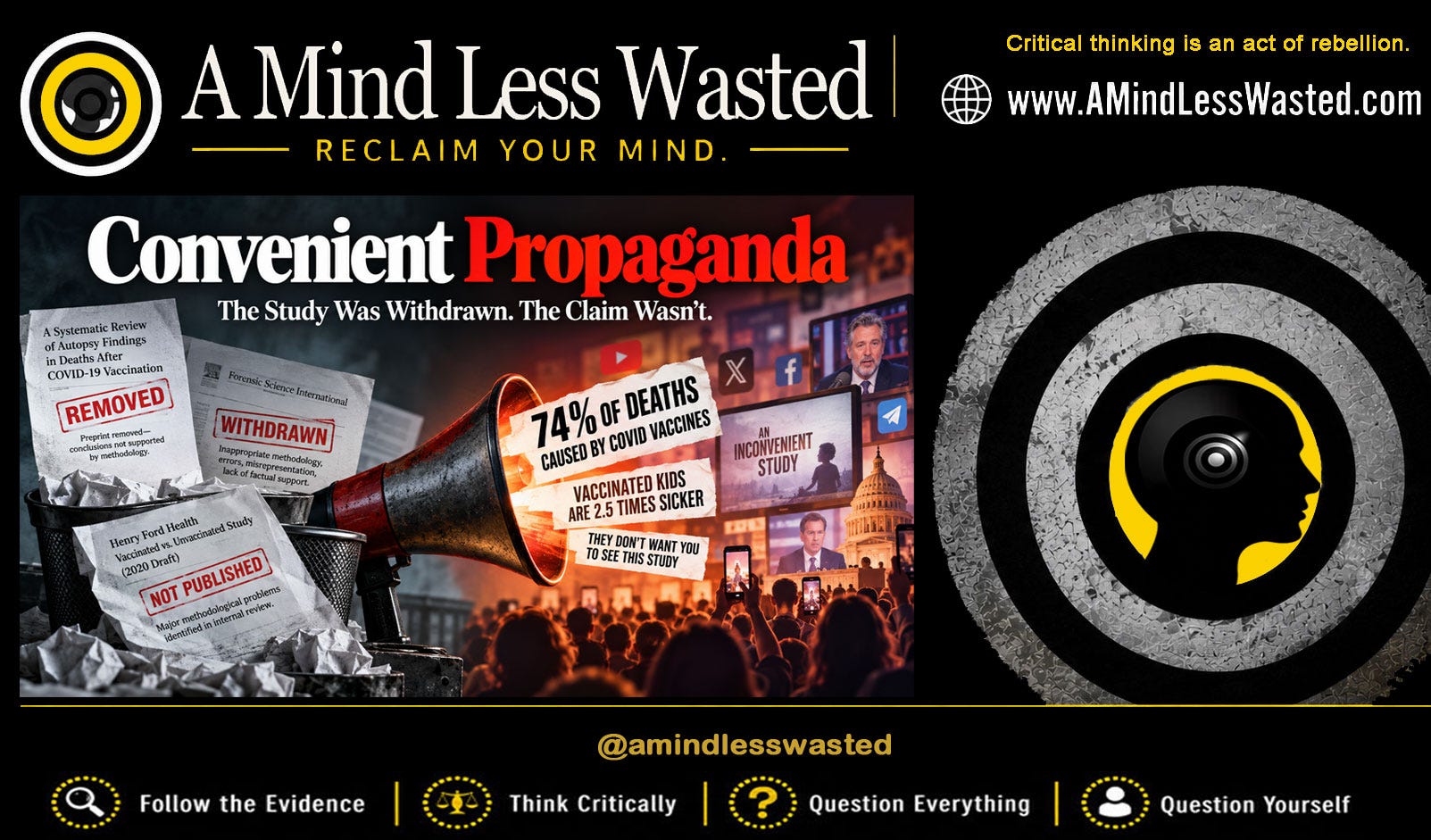
“74% of deaths caused by COVID vaccines.”
“Vaccinated children have far more chronic disease.”
Those are memorable.
“Inappropriate study methodology, uncontrolled confounding, differential healthcare utilization and unequal follow-up” doesn’t exactly fit on a meme.
And therein lies the advantage.
A bad study does not necessarily have to survive scientific scrutiny to accomplish its purpose in the information ecosystem. It only has to survive long enough to generate the headline.
The autopsy paper that wouldn’t die
Consider the COVID-19 vaccine autopsy paper by Nicolas Hulscher, Peter McCullough and colleagues.
In July 2023, the authors uploaded a preprint titled A Systematic Review of Autopsy Findings in Deaths after COVID-19 Vaccination to SSRN’s Preprints with The Lancet.
Its explosive conclusion was that 73.9% of 325 deaths reviewed by the authors were directly caused by, or significantly contributed to by, COVID-19 vaccination.
That is one hell of a headline. There was also a serious problem. The preprint was removed. And let’s be precise about why.
Preprints with The Lancet currently state directly on the paper’s SSRN page:
“This preprint has been removed … because the study’s conclusions are not supported by the study methodology.”
It was not a Lancet paper that had passed peer review and was suddenly censored. It was a preprint, and the platform removed it because the conclusions weren’t adequately supported by the methods.
The paper didn’t disappear.
It was uploaded elsewhere and continued circulating.
Then, in June 2024, a version appeared as an Article-in-Press in Forensic Science International.
Once again, the “74%” claim exploded across social media. And once again, serious methodological concerns followed. This time the journal itself ultimately withdrew the paper.
The withdrawal notice is unusually explicit. Editors cited concerns involving inappropriate citations, inappropriate methodology, errors, misrepresentation, lack of factual support for the conclusions, and failure to recognize or cite disconfirming evidence.
The authors were allowed to respond and submitted a revised manuscript. The journal then sent that revision to two independent peer reviewers.
According to the withdrawal notice, both concluded that the revision did not adequately resolve the concerns and that the manuscript was unsuitable for publication.
The authors disagreed with the withdrawal. That should be noted.
But the scientific history is nevertheless clear: the preprint was removed once because its conclusions weren’t supported by its methodology, and the later journal version was withdrawn after additional scrutiny and independent peer review.
So did the “74%” claim die?
Of course not.
Just find another home
In November 2024, essentially the same central analysis appeared in Science, Public Health Policy and the Law, where it is labeled “Peer Reviewed.”
Its conclusion remained that 73.9% of the deaths reviewed were attributable to COVID-19 vaccination.
And today, the McCullough Foundation still lists the paper in its publication library.
McCullough was still invoking the same 74% figure in May 2025, writing that if autopsies were performed on all VAERS deaths, “~74%” would be due to vaccination—an extrapolation that goes considerably beyond what the autopsy paper itself could establish.
Think about what happened here.
The original claim survived:
Preprint removed → claim survives.
Published version withdrawn → claim survives.
Independent reviewers say the concerns weren’t adequately resolved → claim survives.
Paper appears somewhere else → headline lives again.
Scientifically, the paper encountered repeated problems. Communicatively, it succeeded spectacularly.
Then came An Inconvenient Study
The Henry Ford vaccinated-versus-unvaccinated study provides an even cleaner example.
This wasn’t a retracted study. It wasn’t even a published study. It was a 2020 draft that never made it through Henry Ford Health’s internal review process.
The analysis compared roughly 16,500 children who had received at least one vaccine with about 2,000 classified as completely unvaccinated and reported substantially more diagnosed chronic conditions among the vaccinated group.
That finding sounds devastating. Until you look at how the groups were constructed.
Henry Ford Health says its first internal review identified serious problems, including major demographic differences between the groups, a much smaller unvaccinated cohort and dramatically different periods of observation.
One-quarter of the unvaccinated children were observed only through six months of age, according to Henry Ford, and 75% only through age three—before many chronic childhood conditions are routinely diagnosed.
Independent researchers subsequently identified even more problems.
A peer-reviewed critique published in Clinical Infectious Diseases on August 5, 2026, highlighted uncontrolled confounding, exposure misclassification, unequal follow-up, surveillance bias and multiple-comparison problems.
One number captures the problem nicely:
Vaccinated children averaged about seven healthcare encounters per year. Unvaccinated children averaged about two.
Children who see healthcare providers more frequently have more opportunities to have asthma, eczema, ADHD, speech problems and other conditions discovered and entered into their medical records.
That doesn’t prove the vaccinated children weren’t actually sicker.
It means the study design cannot reliably tell us that vaccination was the reason.
The same critique found median follow-up of approximately 970 days for vaccinated children versus 461 days for unvaccinated children. The vaccinated group was therefore not only seeing doctors more frequently; it was being observed for roughly twice as long.
These aren’t cosmetic criticisms. They go directly to whether the headline result can support a causal interpretation.
But the draft had already escaped
None of that stopped the document from becoming An Inconvenient Study, a documentary produced by Del Bigtree’s Informed Consent Action Network.
The film’s central premise is dramatically more compelling than a discussion of ascertainment bias:
A researcher supposedly conducted the definitive vaccinated-versus-unvaccinated study, discovered an inconvenient truth and then the establishment wouldn’t publish it.
The official film site says:
“That study never saw the light of day... until now.”
It encourages viewers to distribute promotional cards, download and share the trailer, organize screenings and spread the film through social media and group chats. Its website currently claims more than 100 million views worldwide. That number comes from the filmmakers themselves and shouldn’t be treated as independently verified, but it illustrates the claimed scale of the campaign.
To its credit, ICAN doesn’t now claim the study definitively proves vaccines cause chronic disease.
Its response to critics says exactly that. ICAN calls the findings a “signal” warranting additional investigation and argues that sensitivity analyses lessen concerns about unequal follow-up.
That’s a fair position to include.
But it doesn’t resolve the methodological problems identified by other researchers.
And more importantly for this discussion, it doesn’t change what happened next.
The draft became a movie.
The movie became social-media content.
The social-media content became political testimony.
And the draft is still being amplified.
A year later, it was before lawmakers
On September 17, 2026—long after the methodological criticisms were public—the Michigan House Subcommittee on the Child Welfare System held a hearing specifically concerning the Henry Ford material. The official Michigan House website lists testimony from that hearing under “Henry Ford Health Studies.”
A week later, The HighWire featured Hulscher discussing his testimony and again promoted the Henry Ford vaccinated-versus-unvaccinated findings featured in An Inconvenient Study.
Think about that timeline.
The original document failed internal review in 2020. It resurfaced publicly in 2025. A documentary was built around it. Independent statisticians and epidemiologists detailed serious flaws. Henry Ford publicly rejected the conclusions attributed to it.
A peer-reviewed critique appeared in a major infectious-disease journal in August 2026.
And in September 2026, the same draft was being discussed before state lawmakers and amplified again to a large media audience.
Scientifically unfinished. Politically and culturally very much alive.
This is the part we underestimate
There is a widespread assumption that science eventually corrects itself, and therefore misinformation based on bad research will eventually disappear.
The first part is often true.
The second isn’t.
Researchers have actually studied what happens to papers after retraction.
One analysis examined 7,813 retracted biomedical papers and more than 13,000 post-retraction citation contexts.
Only 5.4% of those post-retraction citations acknowledged that the cited paper had been retracted.
In other words, the overwhelming majority continued citing the work without even mentioning its retracted status.
Another study compared more than 3,000 retracted papers with matched controls. Retraction reduced citation rates substantially, but didn’t kill them. The authors concluded simply:
“Retracted papers often live on.”
And that’s inside the scientific literature.
Now imagine the problem on Facebook, X, podcasts, documentaries, Substack and YouTube, where nobody is required to update an old meme because the methodology collapsed six months later.
The asymmetry is enormous
The original claim gets: “Vaccinated kids are 2.5 times sicker!”
The correction gets:
“The hazard ratio may be severely biased because of nonexchangeable cohorts, differential follow-up, ascertainment bias and time-dependent exposure misclassification.”
Guess which one travels farther. The original claim gets a trailer. The rebuttal gets a methods table. The original claim gets a documentary. The correction gets a journal article. The original claim takes ten seconds to understand.
Explaining why it is unreliable can take ten minutes. And once people have emotionally invested in the original story, the correction can actually be folded back into it.
Study rejected? Suppression.
Preprint removed? Censorship.
Paper withdrawn? They were afraid of it.
Institution says the methods were flawed? The institution is covering itself.
Independent reviewers reject the revision? Gatekeeping.
At that point, the normal mechanisms of scientific quality control become evidence for the conspiracy they’re supposed to refute.
It is almost perfectly self-sealing.
Was that the plan?
I don’t know. And importantly, I don’t have to know.
I can’t prove Hulscher, McCullough, Bigtree or anyone else involved sat down and consciously devised a strategy in which scientific rejection would be converted into publicity.
Claiming that as fact would require evidence of intent I don’t have. The more defensible point is also the more troubling one:
The information ecosystem rewards the behavior whether it was planned that way or not.
Make a sensational claim and millions may see it. When the methodological critique arrives, a fraction of them will read it. If the paper is withdrawn, an even smaller fraction will read the withdrawal notice.
And some of the original audience will interpret the withdrawal itself as confirmation that powerful people wanted the information suppressed.
The original claim therefore receives the benefit of both stages:
Publication becomes evidence that the claim is true.
Rejection becomes evidence that the claim is dangerous to powerful interests.
Heads they win. Tails science loses.
That’s convenient propaganda
“Propaganda” doesn’t require every underlying statement to be fabricated.
Effective propaganda frequently contains real numbers, genuine documents and actual events.
What makes it powerful is selection and framing.
Take the most frightening result.
Strip away the methodological uncertainty.
Turn it into a headline.
Repeat it.
Build a narrative around its suppression.
And when the criticism arrives, don’t let that end the story.
Make the criticism part of the story.
That is why arguing about whether a bad study was technically “debunked” sometimes misses the larger issue.
The scientific argument may already be over.
The communications battle isn’t.
The Hulscher autopsy paper could be removed from one platform, withdrawn by a journal, and heavily criticized, yet its central number still circulates.
The Henry Ford analysis can remain an unpublished draft with serious unresolved biases, yet become a documentary, testimony before lawmakers and recurring media content.
They don’t have to win the scientific argument. They just have to keep the claim alive.
And in an ecosystem where the allegation travels faster than the correction, and censorship is the ready-made explanation for every rejection, even losing the scientific argument can be turned into a propaganda victory.
That may be the most inconvenient study of all.
Resources
Preprints with The Lancet / SSRN — Hulscher et al. autopsy preprint. The page states that the preprint was removed because its conclusions were not supported by its methodology. SSRN preprint and removal notice
Forensic Science International — withdrawal notice. Lists the journal’s concerns and says two independent reviewers found the revised manuscript still unsuitable for publication. Forensic Science International withdrawal notice
Science Feedback — analysis of the autopsy paper. Discusses selection bias, causality problems, and why the methodology does not establish that vaccination caused 74% of the deaths reviewed. Science Feedback review
Science, Public Health Policy and the Law — later publication of the autopsy analysis. Useful for reading the authors’ own methods, conclusions and limitations rather than relying solely on critics. Later publication of Hulscher et al.
McCullough Foundation — Publications. Currently lists the autopsy paper among its publications. McCullough Foundation publication library
Henry Ford Health — statement on the unpublished vaccinated-versus-unvaccinated analysis. Describes the institution’s reasons for abandoning the draft after internal review. Henry Ford Health statement
Clinical Infectious Diseases — “Vaccines, Bias, and the Perils of Non-peer-reviewed Studies.” Peer-reviewed August 2026 methodological critique addressing confounding, healthcare utilization, exposure classification, follow-up and multiple outcomes. Clinical Infectious Diseases critique
ICAN / An Inconvenient Study — Responses to criticism. The filmmakers’ response to Henry Ford, Jake Scott and other critics, including their argument that the draft represents a safety signal rather than definitive proof. ICAN’s responses to criticisms
An Inconvenient Study — official site. Shows how the unpublished research has been packaged and promoted, including campaigns for sharing, screenings and promotional materials. Official An Inconvenient Study website
Michigan House Subcommittee on the Child Welfare System — September 17, 2026. Official committee page documenting the hearing and Henry Ford Health Studies testimony. Michigan House committee record
The HighWire — Episode 495, September 24, 2026. Shows the continued amplification of the Henry Ford analysis after the major methodological criticisms were already public. The HighWire episode
Hsiao & Schneider — Continued use of retracted papers. Analysis of 7,813 retracted biomedical papers showing that only 5.4% of examined post-retraction citation contexts acknowledged the retraction. Quantitative Science Studies paper
Kühberger et al. — Self-correction in science. Study of more than 3,000 retracted papers finding that retraction reduced citations but did not eliminate them: “retracted papers often live on.” PLOS ONE study on post-retraction citations