

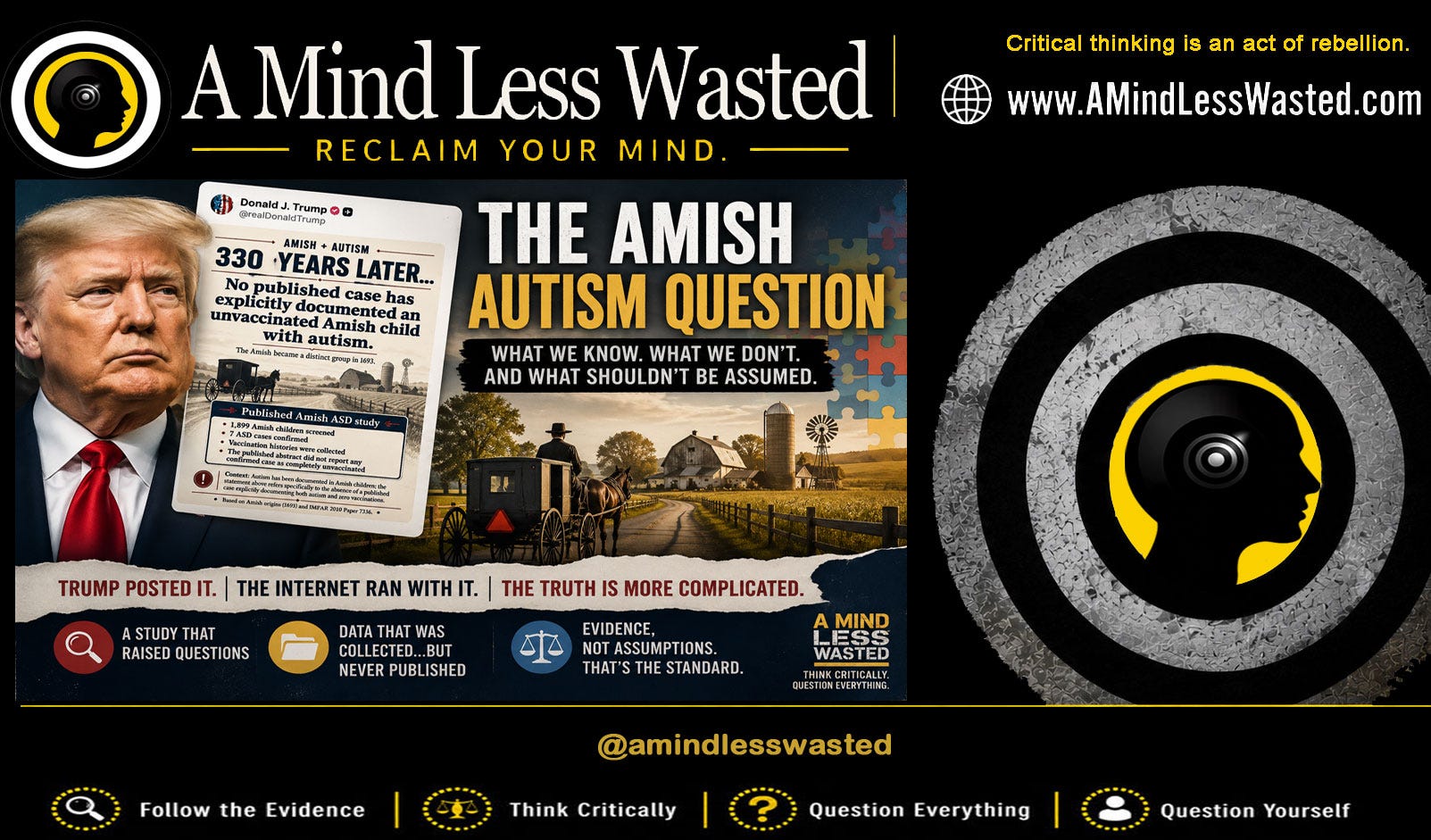
On August 31, President Donald Trump posted an image on Truth Social making a striking claim:
“330 years later… No published case has explicitly documented an unvaccinated Amish child with autism.”
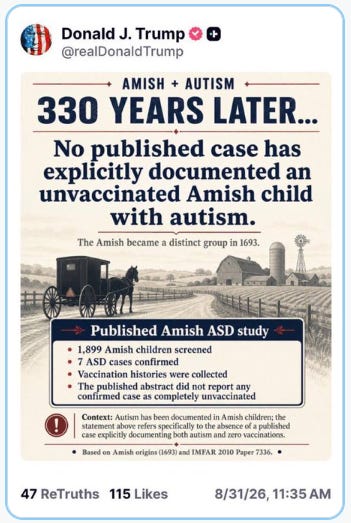
The graphic cited a 2010 autism study of Amish children. Researchers screened 1,899 children, confirmed seven cases of autism spectrum disorder, and reported that they had collected vaccination histories. What they did not report was the vaccination status of those seven children.
That omission has become the centerpiece of a much larger argument.
Within hours, the post was being treated in some corners of social media as something close to a natural experiment: the Amish vaccinate less, autism appears less common among them, and nobody can point to a published case explicitly documenting autism in a completely unvaccinated Amish child. Therefore, the reasoning goes, vaccination must be the missing variable.
Steve Kirsch, a technology entrepreneur and prominent vaccine-safety activist, pushed the argument even further, calling the Amish a “perfect control group” and asserting that the only significant difference between autistic and non-autistic Amish children is vaccination.
That conclusion is far ahead of the evidence.
But there is an uncomfortable detail underneath the rhetoric that deserves more than a dismissive fact-check.
The researchers really did collect vaccination histories.
And as far as I can determine, those histories were never published.
That does not establish that completely unvaccinated Amish children never develop autism. It does not establish that vaccination caused the autism cases that were identified. And it certainly does not turn the Amish into a randomized control group.
But sixteen years later, it leaves a fair question sitting in plain sight:
What did those vaccination histories show?
That is where this story becomes interesting.
The 2010 Study Behind Trump’s Post
The study cited in Trump’s graphic was presented at the 2010 International Meeting for Autism Research under the title Prevalence Rates of Autism Spectrum Disorders Among the Old Order Amish.
One qualification matters immediately: this was a conference abstract, not a full peer-reviewed journal article.
Researchers conducted door-to-door screening in Amish communities in Holmes County, Ohio, and Elkhart-Lagrange County, Indiana. They screened 1,899 children using two autism screening instruments.
Twenty-five children screened positive on at least one measure. Fourteen subsequently received more extensive evaluations. Seven were ultimately classified as having autism spectrum disorder.
Then comes the sentence that has received renewed attention:
“A Vaccination History and a brief family history including questions specific to the ASD phenotype were also taken.”
So Trump’s graphic is correct about something important: vaccination histories were collected during the study.
What the abstract does not tell us is whether the seven children diagnosed with ASD were fully vaccinated, partially vaccinated, or never vaccinated.
Nor does it provide vaccination information for the broader screened population in a form that would allow us to calculate autism prevalence by vaccination status.
I have also been unable to locate a later peer-reviewed publication from this project reporting those data.
That missing information is worth discussing.
What it does not do is tell us what the missing information would have shown.
“1 in 271” Is Preliminary, Not Definitive
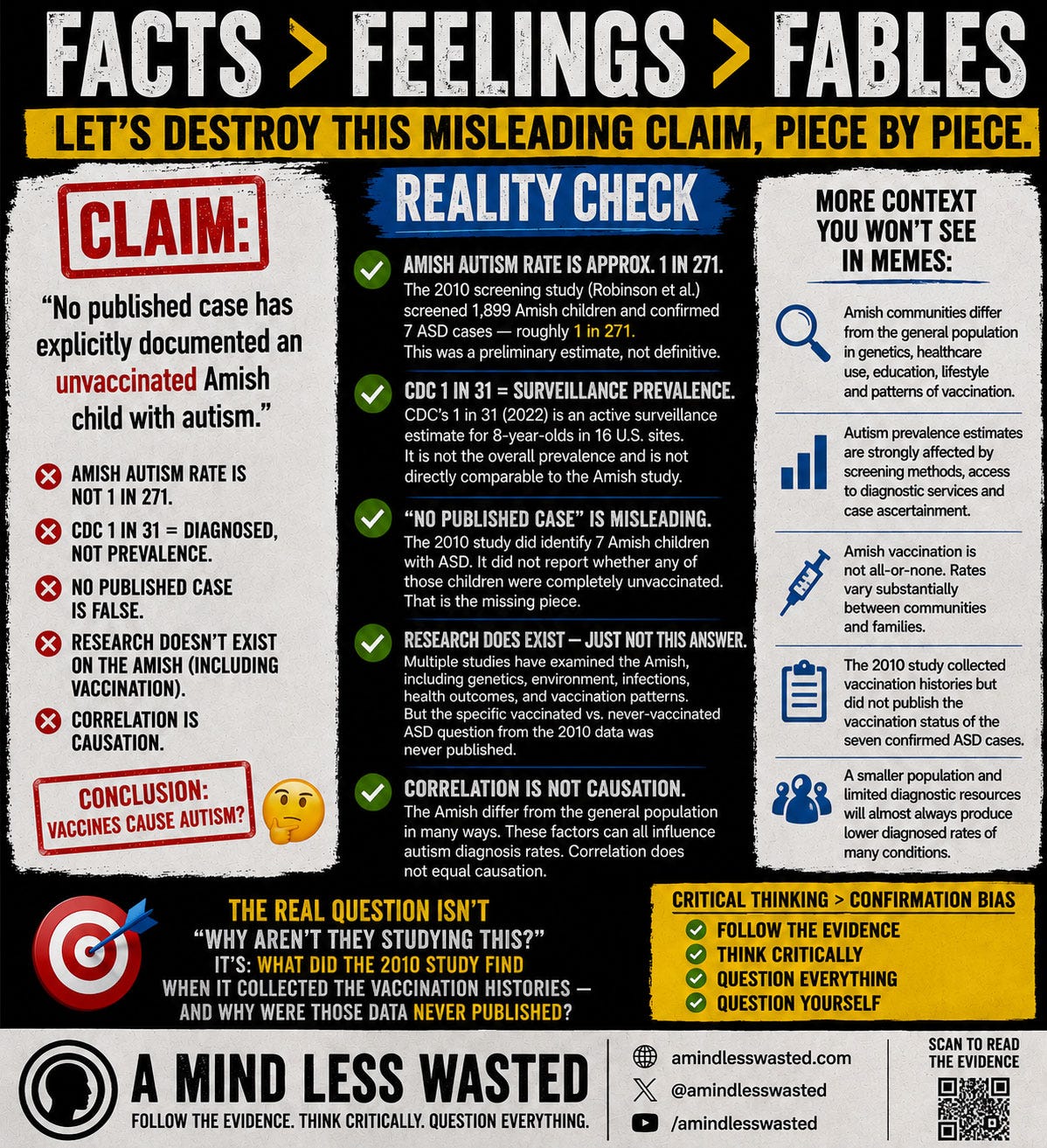
The seven identified ASD cases among 1,899 screened children produce the frequently quoted figure of approximately 1 in 271.
But that number needs context.
Twenty-five children screened positive. Only 14 of those 25 received the more extensive evaluation, and seven of those fourteen were classified as having ASD.
We therefore do not know how many of the eleven remaining screen-positive children might have met diagnostic criteria had they also completed the evaluation.
Screening itself is another issue. A screening instrument is designed to identify children who may need further evaluation. It is not a perfect census of every autistic child in a population.
A large real-world study published in Pediatrics involving nearly 26,000 children found that a commonly used toddler autism screening process identified substantially fewer eventual ASD cases than might be assumed from controlled validation studies. That does not tell us how well the specific tools used in the Amish study performed, but it illustrates an important point: measured prevalence depends partly on how cases are sought and confirmed.
The Amish investigators themselves noted another complication. Results differed somewhat depending on the diagnostic instrument used, and they raised the possibility that Amish caregiver reporting styles and cultural factors could influence the assessment.
The authors therefore described their findings appropriately:
preliminary data.
The approximately 1-in-271 estimate is real.
It simply should not be treated as a definitive measurement of the true prevalence of autism throughout the Amish population.
There is also an interesting numerical comparison worth noting. U.S. surveillance data later estimated the prevalence of profound autism at about 4.6 per 1,000 8-year-olds in 2016.
The Amish study’s seven identified ASD cases among 1,899 children work out to about 3.7 per 1,000. Those figures are in the same general range.
But they are not directly comparable: the Amish study did not classify its seven cases as “profound autism,” and a screening study in a culturally distinct population could have missed less obvious cases.
The similarity is therefore suggestive of a possible ascertainment issue, not proof of one.
That distinction becomes even more important when people compare it directly with the current CDC estimate of roughly 1 in 31 among 8-year-old children.
The CDC figure comes from active surveillance across 16 U.S. sites using medical, educational, diagnostic and administrative records. It is a prevalence estimate for a very different population, period and surveillance system.
Putting 1 in 271 beside 1 in 31 makes for a striking meme.
It does not create an apples-to-apples epidemiological comparison.
But They Collected Vaccination Histories
This is the part that should not be brushed aside.
According to the study’s own methods, vaccination histories were collected.
Yet the abstract does not report them.
Sayer Ji, founder of the natural-health website GreenMedInfo and a longtime critic of vaccination policy, recently highlighted the same omission in an article arguing that the forgotten vaccination data are central to the renewed Amish-autism controversy. Ji reports searching for a subsequent publication and being unable to find one that disclosed the vaccination status of the identified ASD cases.
He reports searching for a subsequent publication and being unable to find one that disclosed the vaccination status of the identified ASD cases.
On that narrow point, he has identified something worth asking about.
The abstract also indicated that additional work was underway.
Sixteen years later, a vaccination-stratified autism analysis from the project does not appear to have been published.
Why?
I don’t know.
Neither does Ji.
That difference matters.
“Unpublished” Does Not Mean “Suppressed”
Research projects routinely collect variables that never become published analyses.
Funding disappears. Researchers move. Follow-up recruitment fails. Data turn out to be incomplete. Consent agreements restrict later use. Samples become too small to answer the intended question. Projects simply end.
And yes, sometimes potentially useful data sit unpublished when they probably should have been made available.
Without hearing from the investigators, we do not know which explanation applies here.
That means the claim that the study was deliberately “buried” goes beyond the evidence currently available.
We can demonstrate nonpublication.
We cannot demonstrate suppression simply from nonpublication.
Still, I would like to know what happened.
If usable vaccination-history data remain and ethical and privacy requirements permit further analysis, publishing them could help resolve at least part of a controversy that has lingered for years.
What Does “No Published Case” Actually Mean?
This is where the argument frequently changes shape.
There is an enormous difference between these statements:
No published paper I can find explicitly identifies an Amish autistic child as completely unvaccinated.
and:
No completely unvaccinated Amish child has autism.
The first is a statement about the published literature. The second is a statement about reality. One does not prove the other.
Medical researchers also generally do not publish the identities of individual children alongside sensitive medical histories. The scientifically useful evidence would therefore not be somebody producing the name of a particular child.
What we would need is a study that systematically identifies autism and reliably determines vaccination history in the same population.
That specific Amish vaccinated-versus-never-vaccinated comparison apparently has not been published.
So the proper conclusion is not:
Vaccines therefore cause autism.
Nor should it be:
There is nothing here worth investigating.
It is:
We do not currently have the data necessary to answer that specific Amish vaccinated-versus-never-vaccinated question.
But That Does Not Mean Vaccine-Autism Research Is Absent
This narrow uncertainty should not be confused with an absence of vaccine-autism research generally.
Large population studies have examined specific vaccine-autism hypotheses.
A 2019 nationwide Danish cohort followed 657,461 children and found no increased autism risk associated with MMR vaccination, including in the susceptible subgroups and post-vaccination periods examined.
A U.S. study of 95,727 children likewise found no increased ASD risk following MMR vaccination, including among children with an older sibling with autism.
And a 2014 meta-analysis pooling cohort and case-control evidence involving more than a million children found no association between vaccination and autism.
Those studies do not answer every conceivable question about every vaccine, every combination of vaccines, the entire childhood schedule, or Amish children specifically.
They should not be represented as though they do.
But the reverse is equally important.
An unpublished Amish vaccination analysis cannot reasonably be treated as though it outweighs the much larger body of evidence that actually has been published.
The uncertainty should remain exactly where the uncertainty exists.
The Amish Aren’t a “Perfect Control Group”
The Amish are potentially an interesting population for research.
They are not a naturally randomized vaccine experiment.
For one thing, the Amish do vaccinate.
Rates vary enormously between settlements, affiliations, families, and time periods.
A 2011 survey of Amish parents in Holmes County found that 68% said all of their children had received at least one immunization, another 17% said some of their children had, and 14% reported that none had.
A survey roughly a decade later found much lower vaccination uptake: 59% of respondents reported not vaccinating their children.
That alone tells us there is no single “Amish vaccination rate.”
The later study also reported something particularly important for causal inference: children with special needs were more likely to have been vaccinated than healthy children.
That does not tell us why.
But it is an immediate warning about confounding.
Families who use healthcare differently may also vaccinate differently. Families with children who have developmental or medical problems may interact with physicians more frequently. Conversely, some parents may stop vaccinating younger children after attributing a problem in an older child to vaccination.
Health status can therefore become correlated with vaccination status even when vaccination did not cause the health difference being measured.
This is exactly why merely dividing children into “vaccinated” and “unvaccinated” groups does not automatically produce a valid causal comparison.
The Amish are interesting precisely because their vaccination patterns vary.
But they are not a ready-made randomized control group.
Finding Autism Depends Partly on How Hard You Look
Another complication is almost completely absent from viral memes about Amish autism.
Autism prevalence is not measured identically everywhere.
A major systematic review of autism prevalence around the world found striking variation between populations and concluded that measured prevalence is influenced by diagnostic definitions, awareness, service availability, help-seeking behavior and methods of identifying cases.
More recent research on diagnostic inequities has likewise found that autism identification can be delayed or missed because of differences in healthcare access, cultural interpretation, provider practices, and availability of appropriate diagnostic services.
That does not prove autism is underdiagnosed among the Amish.
It means underascertainment is a plausible competing explanation that must be investigated rather than assumed away.
Consider how autism is identified in much of mainstream America: pediatric developmental screening, specialist referrals, school evaluations, speech therapy, occupational therapy, insurance claims, special-education records and repeated interactions with medical systems.
Now compare that with a culturally distinct population whose relationships with formal education, medicine and disability services may differ.
A lower rate of recorded autism could therefore reflect some combination of true biological difference, case ascertainment, healthcare use, cultural recognition, genetics, environment, family structure, pregnancy factors, lifestyle, and many other variables.
Vaccination is a legitimate variable to include.
It is not the only difference between Amish and non-Amish children.
Sayer Ji Gets Something Important Right
Ji’s argument is more interesting than the simplistic statement that “the Amish prove vaccines cause autism.”
He acknowledges that the lack of an explicitly documented, completely unvaccinated Amish autism case is an argument from absence, not direct proof.
He also correctly calls attention to something that deserves attention: the 2010 researchers say they collected vaccination histories, yet those histories never appeared in the published abstract.
That is worth asking about.
Where Ji becomes less convincing is when an unanswered question begins turning into evidence for a much larger conclusion.
What the Institute of Medicine Actually Said
Ji points to a 2013 Institute of Medicine report on the childhood vaccination schedule.
Some of his description is correct.
The IOM recommended against conducting a randomized trial in which children would deliberately be assigned to receive the full vaccination schedule versus no vaccines or an alternative schedule. The committee did not believe such a trial was ethically justified.
It also considered prospectively studying naturally unvaccinated groups such as Amish communities.
And it did not recommend that approach as its preferred design, citing two major problems: potentially inadequate numbers of completely unvaccinated children and serious confounding because culturally distinct populations differ from more highly vaccinated populations in many ways besides vaccination.
That deserves to be stated plainly.
But the IOM did not conclude that comparisons between vaccinated and unvaccinated children should simply never be studied.
It discussed observational alternatives, including research using large healthcare databases such as the Vaccine Safety Datalink, and specifically considered comparing health outcomes among children with different vaccination patterns.
So the IOM position was not:
Don’t ask the question.
It was closer to:
Don’t answer it with a randomized trial or assume a small culturally distinct population automatically provides a clean causal experiment.
Whether researchers have since done enough with the observational alternatives is a separate question.
And that question is fair.
Are the Amish Being “Erased” as a Control Group?
Ji goes further, arguing that efforts to increase vaccination among Amish communities are effectively eliminating a valuable natural control group.
There is a narrow statistical point here worth conceding.
If the number of completely unvaccinated children declines, some vaccinated-versus-unvaccinated comparisons become harder to conduct with adequate statistical power.
That is true.
But that does not demonstrate the much larger claim that public-health efforts are intentionally trying to eliminate an unvaccinated population to prevent vaccine-safety research.
Showing that a policy has an effect is not the same as showing that producing that effect was the purpose of the policy.
Amish communities have experienced outbreaks of vaccine-preventable diseases. Public-health agencies therefore encourage vaccination for the same stated reason they encourage it elsewhere: disease prevention.
Researchers also do not get to preserve a community in a particular exposure state merely because it would create a convenient comparison group.
And increasing vaccination does not make observational research impossible. Amish vaccination patterns remain heterogeneous enough that meaningful comparisons may still be possible if researchers obtain reliable individual exposure data and account carefully for confounding.
The study would be difficult.
That does not mean it cannot be done.
So Why Hasn’t Someone Done the Obvious Study?
This is the part of the controversy that interests me most.
Why, after years of argument, don’t we have a large, carefully designed study of Amish and other Plain communities that includes standardized autism assessment and verified vaccination history?
There are legitimate obstacles.
The proportion of completely unvaccinated children varies sharply by community and affiliation.
Families accepting vaccines may differ systematically from families declining them.
Medical records may be incomplete.
Researchers would need diagnostic methods that work reliably in the cultural setting.
They would need enough participants to produce meaningful estimates and enough community trust to obtain accurate information.
Amish populations also have distinctive founder genetics. That makes them scientifically interesting, but it creates another variable that must be considered rather than ignored.
None of those problems means the study should not be attempted.
A strong study would define its population and hypotheses before looking at outcomes. Vaccination histories would be verified where possible. Autism diagnoses would be established independently of vaccination status. Researchers would account for age, sex, genetics, healthcare use, pregnancy and birth factors, socioeconomic differences, and other plausible confounders.
And the results would be published whether they showed an association, no association, or something nobody expected.
That would move the discussion forward.
The Question Steve Kirsch Should Be Asking
There is a revealing difference between these two questions:
Can anyone name an unvaccinated Amish child with autism?
and:
What is autism prevalence among Amish children stratified by verified vaccination history?
The first makes for an effective social-media challenge.
The second is a scientific question.
And it is the second one we actually need answered.
If you begin with the conclusion that vaccination causes autism, every missing dataset starts looking suspicious. Every unexplained case becomes supporting evidence. And every failure to find contrary evidence becomes confirmation.
Science cannot work that way. Absence can generate a hypothesis. It cannot become the evidence that proves it.

The 2010 Amish autism study was real, although it was presented as a conference abstract rather than a full journal paper.
Researchers screened 1,899 children and reported seven confirmed ASD cases among the 14 screen-positive children who underwent the more extensive evaluation.
The resulting approximately 1-in-271 figure was explicitly preliminary and should not be treated as a definitive estimate of autism prevalence throughout Amish communities.
The researchers also reported collecting vaccination histories.
Those histories were not presented in the abstract, and I have not located a subsequent peer-reviewed publication reporting the vaccination status of the seven identified ASD cases.
That is a legitimate unanswered question.
But there is currently no evidence demonstrating that those data were intentionally suppressed because they showed vaccination caused autism.
Amish communities are also not uniformly unvaccinated. Vaccination practices vary substantially between communities, families, and time periods.
And even if no published case currently explicitly documents both complete nonvaccination and autism in an Amish child, that does not establish that such children do not exist.
There is something here worth investigating. Just not the conclusion being advertised.
One Question I Would Like Answered
I would genuinely like to hear from the investigators responsible for the 2010 project.
Do the vaccination histories collected during that 1,899-child screening project still exist?
If they do, were they complete? Were they based on medical records or parent reports? What was the vaccination status of the seven children ultimately classified as having ASD? Why was that information not reported? Were the eleven additional screen-positive children ever evaluated? And did the “further studies” mentioned in the abstract ever take place?
Those are not anti-vaccine questions.
They are not pro-vaccine questions either.
They are simply questions the available record leaves unanswered.
Maybe the answers would strengthen the vaccine-autism hypothesis.
Maybe they would weaken it.
Maybe the data are incomplete or unusable.
Maybe they no longer exist.
Bottom line: The most interesting fact here is not that nobody can produce the name of an unvaccinated Amish autistic child. It is that researchers once collected vaccination-history information that might have helped answer the question — and sixteen years later, we still do not know what those data showed or whether they were sufficient to answer it.
If you found this useful, subscribe to A Mind Less Wasted for more evidence-first investigations that separate what the data actually show from what people want them to show.

Resources and Further Reading
Robinson JL, Nations L, Suslowitz N, Cuccaro ML, Haines J, Pericak-Vance M. Prevalence Rates of Autism Spectrum Disorders Among the Old Order Amish. International Meeting for Autism Research, 2010. Preliminary 1,899-child screening project reporting seven confirmed ASD cases and collection of vaccination histories. View the conference abstract record
Wenger OK, McManus MD, Bower JR, Langkamp DL. Underimmunization in Ohio’s Amish: Parental Fears Are a Greater Obstacle Than Access to Care. Pediatrics. 2011;128(1):79–85. DOI: 10.1542/peds.2009-2599. PubMed Full article
Scott EM, Stein R, Brown MF, et al. Vaccination Patterns of the Northeast Ohio Amish Revisited. Vaccine. 2021;39(7):1058–1063. DOI: 10.1016/j.vaccine.2021.01.022. PubMed
Guthrie W, Wallis KE, Bennett AE, et al. Accuracy of Autism Screening in a Large Pediatric Network. Pediatrics. 2019;144(4):e20183963. DOI: 10.1542/peds.2018-3963. PubMed
Zeidan J, Fombonne E, Scorah J, et al. Global Prevalence of Autism: A Systematic Review Update. Autism Research. 2022;15(5):778–790. DOI: 10.1002/aur.2696. Full article
Srivarathan A, Bradford A, Shearkhani S, et al. Bridging Diagnostic Safety and Mental Health: A Systematic Review Highlighting Inequities in Autism Spectrum Disorder Diagnosis. BMJ Quality & Safety. 2026;35(7):487–497. DOI: 10.1136/bmjqs-2025-018723. Full article
Hviid A, Hansen JV, Frisch M, Melbye M. Measles, Mumps, Rubella Vaccination and Autism: A Nationwide Cohort Study. Annals of Internal Medicine. 2019;170(8):513–520. DOI: 10.7326/M18-2101. PubMed
Taylor LE, Swerdfeger AL, Eslick GD. Vaccines Are Not Associated With Autism: An Evidence-Based Meta-analysis of Case-Control and Cohort Studies. Vaccine. 2014;32(29):3623–3629. DOI: 10.1016/j.vaccine.2014.04.085. Journal article
Institute of Medicine. The Childhood Immunization Schedule and Safety: Stakeholder Concerns, Scientific Evidence, and Future Studies. National Academies Press, 2013. DOI: 10.17226/13563. Read the full National Academies report
Sayer Ji. Trump Just Pointed at the Low Autism Rates in Unvaccinated Amish. Here’s the Study They Buried and the Cohort They’re Erasing. August 31, 2026. Read Ji’s article