

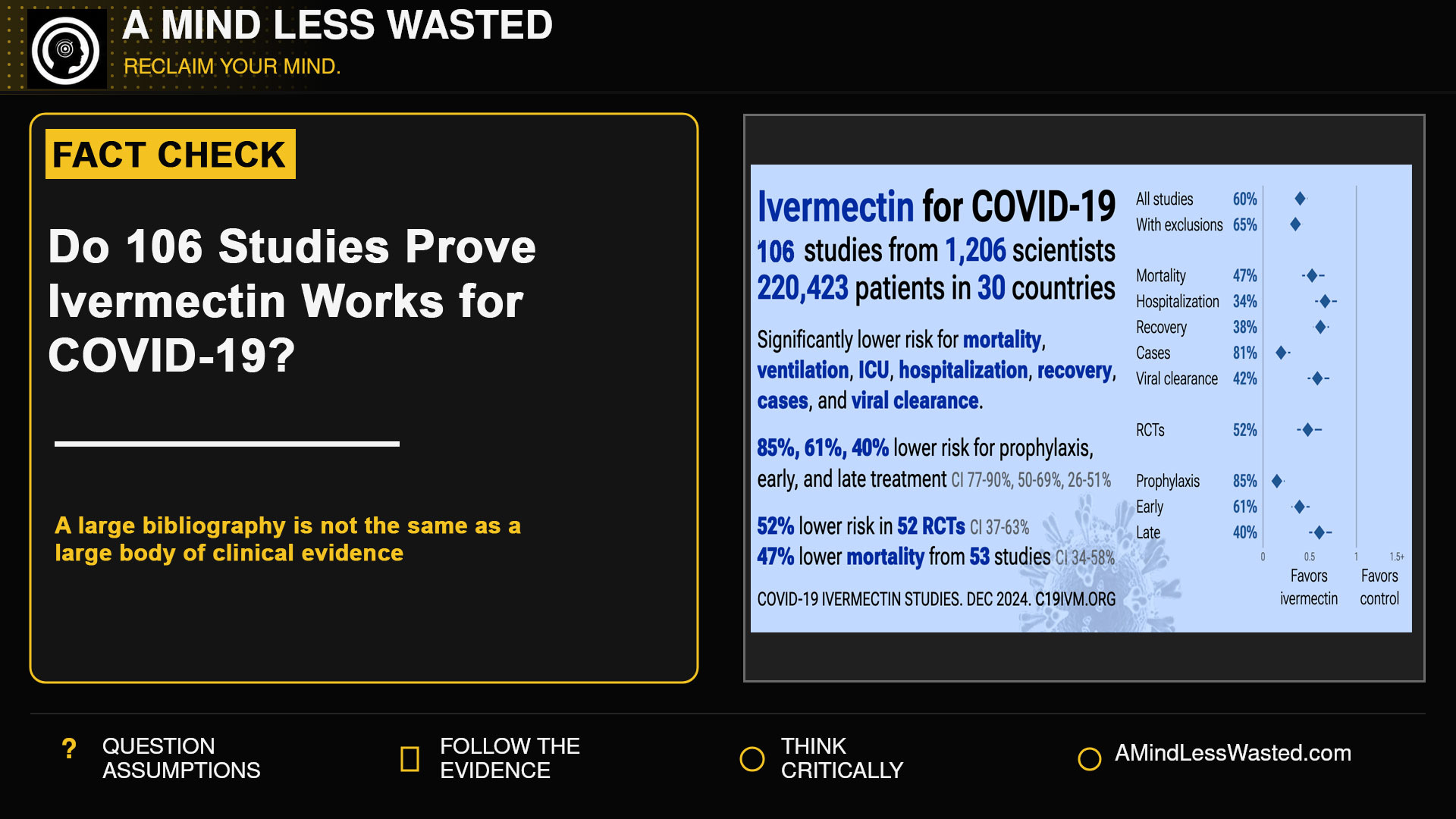
The number keeps growing. First it was 60 studies. Then 99. Then 105. As of July 2026, c19ivm.org claims to have a real-time meta-analysis of 106 studies showing that ivermectin is effective against COVID-19.
That sounds impressive, especially in a social media post where nobody is expected to open 106 links and examine them one by one.
But the number of items on a website is not the number of studies proving a claim. A bibliography can include studies that found no benefit, laboratory experiments, computer models, animal research, opinion pieces, letters, news articles, duplicate analyses, withdrawn papers, and retracted studies. Counting all of them under one large headline creates the appearance of overwhelming evidence without establishing what that evidence actually shows.
This is the link dump fallacy dressed up as a meta-analysis.
What is c19ivm.org?
The website presents itself as a continuously updated analysis of ivermectin research. Its downloadable report is attributed to “@CovidAnalysis,” not to clearly identified researchers with affiliations and responsibility for the work.
That does not automatically make its calculations wrong. It does make scrutiny more difficult. Readers cannot readily examine the authors’ relevant expertise, conflicts of interest, previous work or accountability for the decisions behind the analysis.
The site also includes several papers and articles by Pierre Kory, co-founder and president emeritus of the Front Line COVID-19 Critical Care Alliance, now known as the Independent Medical Alliance. The organization has spent years promoting ivermectin for COVID-19.
That connection does not invalidate a study by itself. It does mean Kory’s writings should be evaluated as advocacy from someone who has publicly championed the treatment, not treated as independent confirmation that the treatment works.
The privacy-protected domain registration is not especially revealing. Many legitimate and illegitimate websites use domain-privacy services. The more important question is whether the analysis itself is transparent, reproducible, and based on appropriate evidence.
What counts as a “study”?
The central problem becomes obvious when the list is examined.
Some of the listed studies found no meaningful benefit
Ravikirti and colleagues conducted a randomized trial among hospitalized patients. The authors reported no effect on inpatient mortality and no reduction in the length of hospital stay among survivors.
López-Medina and colleagues compared ivermectin with placebo in adults with mild COVID-19. The trial found no significant improvement in the time to resolution of symptoms. The authors concluded that the findings did not support ivermectin for treating mild COVID-19.
Babalola and colleagues compared ivermectin alone with ivermectin combined with hydroxychloroquine and azithromycin. Because every group received ivermectin, the study could not determine whether ivermectin worked better than no ivermectin. It tested the addition of other drugs, not ivermectin itself.
A list does not become evidence for ivermectin merely by including every paper that contains the word “ivermectin.”
Some entries were not human evidence of effectiveness
Several items are in silico studies, meaning the work was performed using computer models. These studies can help researchers identify hypotheses worth testing, but they cannot establish that a drug improves outcomes in people.
Jitobaom and colleagues reported antiviral activity in cell culture, while also noting that the effects of the individual drugs required high concentrations. An in vitro result can justify further research. It cannot tell us whether an achievable and safe dose benefits a patient.
The Mansour paper studied the safety of inhaled ivermectin formulations in rats. It did not test whether ivermectin treats COVID-19 in humans.
The Huerta León paper examined the quality and concentration of compounded ivermectin formulations in Peru. It found substantial variability in the products tested. That may be relevant to drug quality, but it is not evidence that ivermectin treats COVID-19.
The Merck material on Mectizan concerns ivermectin’s established use against river blindness and other parasitic diseases. The Stromectol prescribing information likewise describes approved antiparasitic uses. Neither provides evidence that ivermectin is effective against COVID-19.
Ivermectin is an important antiparasitic drug. Its success against parasites does not establish that it works against an unrelated viral illness.
Some entries were commentary, promotion or repetition
The list has included a social media post, a letter to a researcher, blog articles, advocacy summaries and links returning to the website’s own analysis.
Pierre Kory’s article about Uttar Pradesh, for example, did not establish how many residents took ivermectin or provide the individual-level data needed to compare users with nonusers. A decline in cases after a government recommends a drug does not prove that the drug caused the decline. Prior infections, vaccination, changing behavior, public-health restrictions, testing practices and reporting problems are all possible explanations.
Thomas Borody’s early promotion of an ivermectin-based combination was reported through TrialSite News rather than presented there as a complete peer-reviewed clinical trial report. A news or advocacy article cannot substitute for methods, patient-level accounting, prespecified outcomes, and a reproducible statistical analysis.
Letters and commentary can raise useful questions. They do not become additional clinical trials simply because they receive separate numbers in a long list.
Some of the research was retracted or withdrawn
The Efimenko analysis claiming lower mortality was retracted. The authors said their findings had been widely misinterpreted and expressed concern that the work might be contributing to patient harm.
The Elshafie clinical trial was retracted after concerns were raised about the validity and integrity of its data.
The Hill meta-analysis was retracted after one of its largest included studies was withdrawn over fraudulent data and additional problems emerged in other included studies. This matters because small meta-analyses can change dramatically when one apparently large positive trial is removed.
Kory’s proposed Frontiers review requires a more precise description. It was not retracted because Frontiers never published it. The journal rejected the manuscript during review, stating that it contained unsupported claims and did not meet its standards for scientific rigor.
Retraction does not prove that every conclusion associated with a paper is false. It means the paper can no longer be treated as reliable support for the claim.
Why the total is misleading
The 106 items are not 106 independent, equally reliable experiments asking the same question.
They differ in almost every important respect:
prevention versus treatment;
early disease versus hospitalization;
adults with different levels of risk;
different doses and treatment durations;
ivermectin alone versus multi-drug combinations;
laboratory outcomes versus clinical outcomes;
randomized trials versus observational reports;
reliable studies versus papers with serious integrity concerns.
Adding those items together does not create 106 votes for ivermectin.
A meta-analysis can be useful when its inclusion rules are defensible, its studies are sufficiently comparable, its risk-of-bias judgments are sound and its results are not driven by unreliable data. It can also produce a precise-looking answer from a distorted evidence base.
The question is not, “How many citations can be collected?”
The question is, “What happens when the most reliable trials are examined?”
What did the larger randomized trials find?
The results are remarkably consistent.
The TOGETHER trial found that ivermectin did not reduce hospitalization or prolonged emergency-department observation among high-risk outpatients with early COVID-19.
The I-TECH randomized trial found that ivermectin did not prevent progression to severe disease among high-risk patients with mild to moderate COVID-19.
The ACTIV-6 platform trial found that ivermectin did not meaningfully shorten recovery in outpatients. A later ACTIV-6 trial tested a higher dose for a longer period and reached the same conclusion.
A 2022 Cochrane review found no evidence supporting ivermectin for treating COVID-19 or preventing SARS-CoV-2 infection. A 2024 systematic review of 12 randomized trials involving 7,035 non-hospitalized patients likewise found no benefit in clinical or nonclinical outcomes.
That is why counting citations is such a poor substitute for evaluating evidence. Several large, well-controlled trials can tell us more than dozens of small, indirect, duplicated, or unreliable reports.
For a broader look at how the evidence changed as larger randomized trials were completed and problems emerged in the early research, read epidemiologist Gideon Meyerowitz-Katz’s analysis, “Ivermectin Doesn’t Work for COVID-19.”
The answer
No, 106 studies do not prove that ivermectin is effective for COVID-19.
C19ivm.org has assembled 106 items and applied its own inclusion rules and statistical methods to them. That is not the same claim. The collection includes studies that found no benefit, evidence that never involved human COVID-19 outcomes, commentary presented alongside research and papers that were withdrawn or retracted.
Ivermectin was reasonable to investigate. Early laboratory findings and small clinical reports gave researchers a hypothesis worth testing.
They tested it.
The better randomized evidence did not confirm a meaningful clinical benefit.
The study count keeps growing. The evidence for the claim does not.