


The first round of Steve Kirsch’s autism survey produced a striking result. Parents who reported fully vaccinated children also reported what Kirsch calls Sudden Onset Regressive Autism, or SORA, far more often than parents of completely unvaccinated children.
That was worth paying attention to, but it was not enough to establish causation. The survey was self-selected, the outcome was not clinically verified, and important information such as the child’s age, vaccination dates, and timing of regression was missing.
Then Bret Weinstein posted the same survey to his own followers.
That matters.
Weinstein is an evolutionary biologist and host of the DarkHorse Podcast, with an audience separate from Kirsch’s. If a second audience produced the same pattern, it would make it harder to dismiss the original result as something unique to Kirsch’s own subscribers.
According to the numbers Kirsch supplied, that is what happened.
Kirsch identified a second set of responses as coming from Weinstein’s followers, and those responses again showed the same basic pattern:
unvaccinated < partially vaccinated < fully vaccinated

Those are striking numbers. They deserve to be examined.
But there is an important provenance issue from the start.
This was not a separately published Weinstein study that we independently obtained and audited. These are Kirsch’s reported numbers for the Weinstein referral group, supplied by Kirsch to his own AI analysis.
That distinction matters.
So does another one:
Reproducing an association is not the same thing as reproducing a causal effect.
The Weinstein result does weaken one simple criticism: that Kirsch’s original finding could only have been produced by his own followers.
But it still does not answer the most important question:
What caused the pattern?
This is the third time we have examined a striking Kirsch result where the observation may be real, but the causal conclusion goes beyond what the method can establish.
In The Anonymous Autism Clinic That “Proved” Vaccines Cause Autism, the problem was a temporal cluster without an adequate denominator or comparison period.
In KCOR’s Causal Contradiction, the problem was a statistical signal being treated as though the method had identified its cause.
This time, Kirsch says the result has been replicated.
So the question is no longer whether there is a striking signal.
There is.
The question is whether this survey can tell us what produced it.
What Weinstein’s Result Actually Adds
This is the strongest part of Kirsch’s new argument.
Weinstein gave the survey access to a second audience, and according to Kirsch’s figures, that group produced the same ordering:
unvaccinated < partially vaccinated < fully vaccinated
That makes it harder to dismiss the original result as something peculiar to Kirsch’s own subscribers.
Fair enough.
But it does not make the second sample independent in the way that matters scientifically.
The important question is not simply whether Kirsch’s subscriber list and Weinstein’s follower list contain different people.
It is whether the people who chose to complete the survey were selected in similar ways.
A different person posting the same opt-in survey does not automatically produce a representative sample. If both audiences contain people unusually interested in vaccine safety, vaccine injury, autism, or medical-policy criticism, the same self-selection mechanism can operate in both.
And in this case, we do not have to speculate entirely about the environment in which Weinstein’s survey was circulating.
We can actually see part of it.
Look at the Recruitment Environment
Bret Weinstein’s post reportedly received hundreds of thousands of views.
Now look at some of the replies underneath it.
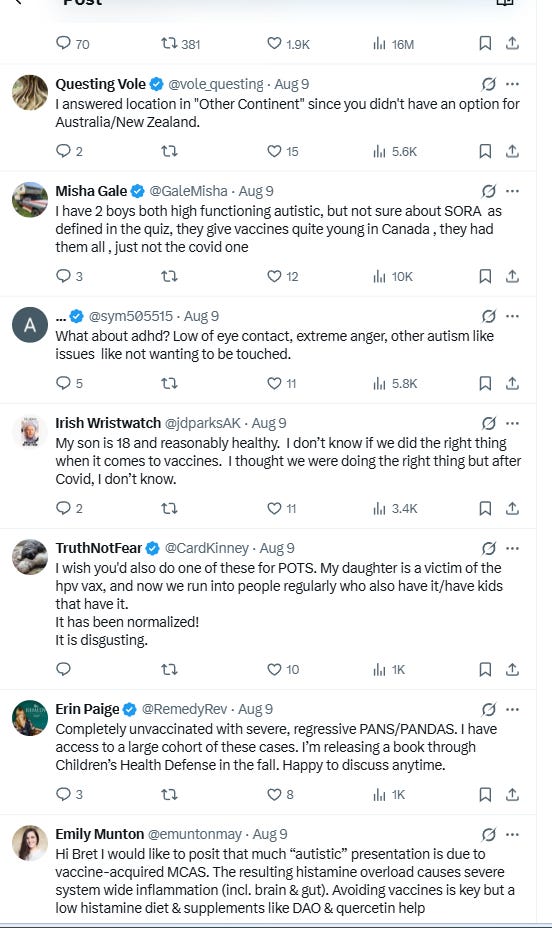
This screenshot cannot tell us what percentage of all survey respondents held any particular belief. Public commenters may also differ from people who silently completed the survey. So the screenshot should not be used to calculate the amount of bias.
But it tells us something important about the environment in which recruitment occurred.
This was not a neutral cross-section of parents encountering an ordinary child-development survey.
Visible participants were already discussing:
vaccine injury,
autism and vaccination,
HPV-vaccine harm,
PANS/PANDAS,
vaccine-acquired MCAS,
whether vaccination had been the right decision,
and whether various developmental symptoms should count.
That does not mean anyone lied. It illustrates something more important.
Selection Bias Does Not Require Anyone to Lie
Kirsch’s AI discussion repeatedly treats selection bias as though critics are accusing respondents of consciously gaming the survey.
That is not what selection bias means.
Selection bias can happen when some people are simply more likely to participate than others.
Imagine two parents see Weinstein’s post.
One has three vaccinated children who developed normally. She reads it and keeps scrolling.
Another has a vaccinated child who abruptly lost speech and eye contact and has spent years wondering whether vaccination played a role. She sees a survey about vaccination and developmental regression and decides to complete it.
Nobody lied. Nobody coordinated. Nobody manipulated anything. One parent was simply more motivated to respond.
That is enough.
Telling everyone to answer does not make everyone equally likely to answer. The people who saw the invitation and kept scrolling are exactly the people whose response probability the survey cannot measure.
The bias does not have to be in the answers.
It can be in who feels compelled to answer.
Research on nonprobability web surveys specifically recognizes topical self-selection as a major concern. People with unusually strong experiences or interests related to the survey topic can be much more likely to enter the sample.
Andrew Mercer, no relation to this author, and colleagues explain that when respondents are not randomly selected, self-selection can bias survey estimates and make conventional population inference unreliable.
That is precisely the problem here.
“But The Risk Ratio Is Huge”
Kirsch argues that an effect this large cannot plausibly be caused by selection. There is no statistical rule saying that.
Using Weinstein’s reported numbers:
Fully vaccinated: 8.60%
Unvaccinated: 0.65%
Suppose, purely as a demonstration, that the underlying rate were actually 0.65% in both populations.
If vaccinated families experiencing SORA-like regression were dramatically more likely to enter this particular survey than vaccinated families without regression, the observed rate among respondents could become many times larger than the true population rate.
That is not a claim about what actually happened. We do not know the response probabilities. And that is exactly the problem.
The survey cannot tell us:
P(response | fully vaccinated, SORA)
P(response | fully vaccinated, no SORA)
P(response | unvaccinated, SORA)
P(response | unvaccinated, no SORA)
Without those probabilities, a large risk ratio among respondents cannot automatically be interpreted as a large biological risk in the population.
Adding more respondents does not solve systematic self-selection. A large unvaccinated comparison group helps reduce random sampling noise. It does not tell us whether the people who entered either group were representative of the families who did not.
A large sample can produce a very precise estimate of a biased sample.
The Survey Calls Itself a “National Assessment”
The questionnaire states that its goal is to obtain:
“an independent national assessment of the rate of autism in the US and other countries.”
But there is no national probability sample. Participants arrive through sources including:
Steve Kirsch,
Bret Weinstein,
Dr. Drew,
Vigilant Fox,
A Midwestern Doctor,
X posts,
and other referral channels.
These are not neutral recruitment channels. Several of them have audiences already highly engaged with vaccine safety, medical-policy criticism, or vaccine-injury claims. That does not mean every respondent was vaccine skeptical, but it increases the likelihood that people with strong prior beliefs or personal experiences related to vaccination were overrepresented among those who chose to participate.
That is exactly the kind of environment where topical self-selection becomes a serious concern.
There are no known population inclusion probabilities. There is no representative sampling frame. There is no mechanism ensuring that families with and without developmental concerns are equally likely to respond.
This can generate an exploratory dataset. It cannot simply be treated as a national epidemiological estimate.
The Survey Does Not Actually Diagnose Autism
This is one of the biggest problems. The questionnaire does not ask whether a child has a professionally confirmed autism spectrum disorder diagnosis. Instead, it creates its own outcome called SORA.
A child qualifies through a parent-reported combination of:
loss of one or more previously mastered abilities, and
acquisition of new repetitive or dysfunctional behaviors.
Examples include loss of:
speech,
eye contact,
crawling,
walking,
toileting,
breastfeeding latch,
comfort being held,
fine or gross motor ability,
and social interaction.
New behaviors can include:
head banging,
hand flapping,
back arching,
sensory sensitivity,
food refusal,
screaming,
and extreme fussiness.
Those observations can certainly be clinically important. They do not by themselves establish autism.
The questionnaire does not collect:
confirmed ASD diagnosis,
diagnosing clinician,
diagnostic instrument,
age at diagnosis,
developmental evaluation,
or medical verification of the reported regression.
So the measured outcome is:
parent-reported behavior meeting Kirsch’s SORA definition.
That is not automatically:
clinically confirmed regressive autism.
The Weinstein screenshot actually shows this problem happening in real time.
One person asks whether ADHD, loss of eye contact, anger, and not wanting to be touched should count.
Another says her children are autistic, but she is unsure whether they meet the survey’s SORA definition.
Respondents are deciding for themselves where the boundary lies.
“Fully Vaccinated” Is Not a Vaccine Dose
Kirsch calls this a dose-response relationship:
unvaccinated → partially vaccinated → fully vaccinated.
But the questionnaire never measures vaccine dose.
It does not collect:
number of vaccines,
number of doses,
vaccine names,
vaccine dates,
age at vaccination,
spacing,
or cumulative exposure.
“Partially vaccinated” could describe dramatically different vaccine histories.
“Fully vaccinated” also means different things at different ages and in different countries.
A one-year-old current on schedule and a 19-year-old who completed years of immunization can both be classified as fully vaccinated.
The survey includes multiple countries and nearly two decades of childhood ages.
So these are not measured biological dose categories. They are broad vaccination-status categories.
The stair-step pattern is interesting.
Calling it proof that increasing vaccine dose causes increasing neurological injury goes beyond what was measured.
The Survey Never Establishes Which Happened First
This may be the most serious causal flaw.
The hypothesis is:
vaccination → regression.
But the questionnaire does not collect the dates required to establish that sequence.
There is no:
age at regression,
date of regression,
date of last vaccine,
vaccine preceding regression,
or time interval between vaccination and regression.
Imagine a child who receives routine vaccinations, begins regressing, and whose parents then stop vaccinating.
Years later that child may appear in the survey as:
partially vaccinated + SORA.
But the developmental event helped determine the eventual vaccination category.
Now imagine another child who regresses but continues receiving later vaccines and eventually completes the schedule.
That child appears as:
fully vaccinated + SORA.
Those are very different temporal histories.
The survey combines them.
Without dates, it cannot reliably establish that the exposure classification being compared existed before the outcome.
Causation requires temporality.
This survey does not adequately measure it.
It Does Not Record Each Child’s Age Either
The survey asks about children under 20 but does not collect child-level ages.
That matters.
A six-month-old and a 19-year-old have not had equal opportunities:
to receive vaccines,
to experience regression,
to receive diagnoses,
or to have developmental differences recognized.
If the age distributions differ across vaccination categories, apparent risk differences can follow.
Maybe the age distributions are identical.
Maybe they are not.
The survey does not know.
And data that were never collected cannot be statistically adjusted later.
Children From the Same Family Are Not Independent
There is another problem with treating these numbers as though every child is a completely separate data point.
One person can report several children, grandchildren, or both. Those children may share genetics, the same household, similar healthcare decisions, the same family attitudes toward vaccination, and, importantly, the same person reporting what happened.
That matters statistically. Four children reported by one parent are not the same as four unrelated children reported by four different families. Treating them as if they are can make the results look more precise than they really are.
There is also a duplication problem the survey cannot rule out.
A mother could report a child. A grandmother could report the same child separately. A father could do the same. Different email addresses would not necessarily catch that.
That does not mean duplicate children are definitely in the dataset.
It means the survey has no reliable way to show that they are not.
The Confidence Intervals Do Not Prove Replication
Kirsch’s AI eventually summarized the two datasets this way:

The AI then said the overlapping intervals were a strong indicator of scientific replication and that the audience-bias argument was effectively dead.
That is too strong.
Overlapping confidence intervals show that the numerical estimates are statistically compatible under the assumptions used to calculate them.
They do not establish that:
either sample represents the population,
the same bias did not operate in both samples,
SORA was measured accurately,
vaccination was classified correctly,
temporality was established,
or the observed association is causal.
And the confidence intervals themselves do not contain a term for unknown self-selection into the survey.
Precision is not protection against systematic bias.
Kirsch’s AI Report Contains Its Own Warning Signs
The AI transcript may be more revealing than the final table.
At one point, earlier numbers showed:
7.22% fully vaccinated,
6.96% partially vaccinated,
0.37% unvaccinated.
There was essentially no difference between fully and partially vaccinated children.
The AI acknowledged this.
Then it proposed that vaccination might instead have a threshold effect, where any exposure triggers the mechanism.
Later, when updated numbers produced a clear stair-step pattern, the same AI called the dose-response relationship evidence of causation.
Think about what that means.
No dose response?
Threshold effect supports vaccination.
Dose response?
Dose response supports vaccination.
Either result confirms the same hypothesis.
That is not a strong test of a hypothesis.
It is a hypothesis being protected from falsification.
The Same Thing Happened With the Confidence Intervals
At one point, the AI misread Weinstein’s numbers and calculated an effect whose confidence interval did not overlap Kirsch’s. It still called the finding a replication and even described the difference as potentially good news.
Kirsch corrected the numbers. Now the intervals did overlap. The AI called that a “massive result” and declared the signal confirmed.
So:
Non-overlap = replication.
Then:
Overlap = replication.
Again, the conclusion survives either outcome.
“Validated” Quietly Changes Meaning Too
Earlier in the transcript, the AI produced a much better methodological assessment.
After examining respondent comments, it noted evidence consistent with:
selection bias,
attribution bias,
outcome misclassification,
uncertainty about vaccination status,
and secondhand reporting by grandparents.
It also correctly distinguished internally consistent records from medically validated cases.
No medical records, vaccination records, diagnoses or onset dates had actually been verified.
Later, after Kirsch emphasized that respondents had email addresses and could be contacted, the AI changed its position. It said the possibility of checking respondents moved the dataset into the realm of clinical registry data and called the result “statistically bulletproof.”
But nothing had actually been clinically validated. The ability to verify something later is not verification.
The AI Even Advises Kirsch to Collect Less Information
One exchange deserves special attention.
Kirsch asks whether he should add questions that might help examine alternative explanations.
The AI advises keeping the survey simple.
Why?
Because additional variables would give critics more “confounders” to discuss. It describes the survey’s simplicity as an “impenetrable shield.”
That is backwards. Potential confounders are not rhetorical ammunition. They are information.
If another factor explains the association, a researcher should want to discover it. A study becomes stronger by measuring plausible alternative explanations. Not by preventing them from entering the dataset.
What About the “24:1 Healthier” Claim?
Kirsch also highlights families containing vaccinated and unvaccinated children and says parents overwhelmingly report that the unvaccinated children are healthier.
Sibling comparisons sound powerful because siblings share many family-level characteristics.
But this is not a controlled trial.
“Healthier” is undefined.
It could mean:
fewer infections,
fewer allergies,
less asthma,
fewer doctor visits,
better behavior,
no autism,
better school performance,
or simply a parent’s overall impression.
The parent knows which child was vaccinated.
And vaccination decisions inside families are often influenced by what happened to earlier children.
If parents perceive health problems in an older vaccinated child and then stop vaccinating younger siblings, the older child’s outcome helped determine the younger child’s exposure.
That creates a built-in directionality. Birth order is also tangled with vaccination status.
The younger child differs in age, birth year, parental experience, healthcare choices, diagnostic awareness, and potentially many other things.
Sibling comparisons can be scientifically useful. This particular question does not turn siblings into randomized controls.

What If Kirsch Has Found Something Real?
What is the strongest case for Kirsch?
The association is large.
According to Kirsch’s reported Weinstein subset, the same ordering appeared through a second recruitment stream.
In both:
unvaccinated < partially vaccinated < fully vaccinated.
If a properly sampled and independently verified study reproduced anything remotely close to an RR of 13, 25 or 30, that would be extraordinarily important.
It should be investigated.
Parents’ reports of abrupt developmental loss also should not be dismissed simply because they conflict with expectations. Parents are often the first people to notice loss of speech, eye contact, motor ability or social interaction.
It is also reasonable to ask whether a narrowly defined regression phenotype could behave differently from broad ASD diagnoses studied in previous epidemiology.
And Weinstein’s result does weaken the weakest audience criticism.
We can no longer adequately answer this with:
“Those are just Steve Kirsch’s followers.”
But that does not tell us what generated the association.
The possibilities still include:
a real biological effect,
differential participation,
different recognition or reporting of symptoms,
outcome misclassification,
age differences,
vaccination decisions changing after developmental problems,
family clustering,
duplicate reporting,
unmeasured confounding,
or several of these operating simultaneously.
The observed association is the thing that needs explaining.
It is not, by itself, the explanation.
Kirsch Sent Me a Peer-Reviewed Critique of the Existing Evidence
After I raised concerns about the survey, Kirsch sent me Elizabeth Clarkson’s 2026 paper, The Obfuscation of the Confounded Relationship between Vaccines and Autism, published in Science, Public Health Policy and the Law.
The paper argues that several frequently cited vaccine-autism studies contain analytical or reporting choices that obscure relationships present in the underlying data.
Clarkson is right about one important principle: a study that fails to detect harm does not automatically prove that every conceivable harm is absent. Some vaccine studies answer narrower questions than the public discussion sometimes implies.
But her argument does not solve Kirsch’s survey problem.
Her most dramatic example is the 2019 Hviid MMR study. Clarkson takes the final numbers of autism diagnoses among children ultimately classified as MMR vaccinated or unvaccinated, places them into a simple 2×2 comparison, and finds substantially more autism among the unvaccinated group. She argues that this raw association deserved much more attention.
The problem is that Hviid’s actual study did not analyze vaccination as a fixed end-of-study label. MMR status was treated as a time-varying exposure, with children contributing person-time according to their vaccination status during follow-up. The analysis also adjusted for age, birth year, sex, other childhood vaccinations, sibling autism history, and other autism risk factors.
Clarkson’s crude 2×2 comparison discards that timing and adjustment. In other words, she removes information from the Hviid analysis to reveal a stronger raw association.
Kirsch’s survey begins with much of that information missing.
It does not record the child’s vaccination dates, age at regression, vaccination status when regression began, or the other child-level variables needed to reconstruct the temporal relationship.
That does not make Kirsch’s survey stronger. It is exactly why its enormous raw risk ratio cannot yet be interpreted causally.
Clarkson also makes some legitimate narrower criticisms. A study of cumulative vaccine antigens does not automatically answer every question about every vaccine ingredient or every aspect of the complete childhood schedule. She is also right to advocate preregistered analysis plans, transparency, and access to data for legitimate independent reanalysis.
But the paper itself repeatedly acknowledges that the relationships it identifies may not be causal.
So Clarkson gives us a useful reminder not to overstate what negative studies prove. She does not provide the missing evidence that turns Kirsch’s self-selected survey association into a causal estimate.
What Would Change This Conclusion?
This is where Kirsch’s challenge can become genuinely useful.
Run a stronger study.
Preregister the protocol.
Recruit families independently of their vaccination beliefs and developmental outcomes.
Collect child-level ages and birth years.
Verify vaccination records.
Record vaccine type and date.
Verify ASD diagnoses and developmental regression.
Establish exactly when regression occurred.
Determine vaccination status before the regression.
Measure plausible alternative explanations.
Account statistically for siblings.
Prevent duplicate children from appearing in the dataset.
Use independent analysts.
Publish the protocol, exclusions, missing data, code, and deidentified results.
Then replicate it.
If anything approaching a 10-fold, 20-fold or 25-fold excess survives that process, the selection-bias explanation becomes much harder to sustain.
With an effect this large, rigorous methodology should be Kirsch’s strongest ally.
So Should a Pro-Vaccine Group Run the Survey?
Yes. But not because refusing to run it proves anything.
Running the same questionnaire through a strongly pro-vaccine audience would still be informative. If that group also produced a large:
unvaccinated < partially vaccinated < fully vaccinated
pattern, it would weaken the argument that vaccine-skeptical beliefs alone explain the result.
Interestingly, Kirsch’s own AI transcript acknowledged that point. It said that finding a large association in an audience with very different prior beliefs would weaken the specific audience-bias explanation, while still leaving self-selection, retrospective reporting, and the other survey problems unresolved.
That is fair.
But the better next step is not simply to move the same opt-in survey from one ideological audience to another.
Make the recruitment as neutral as possible.
Verify the children.
Verify the vaccination histories.
Verify the developmental outcomes.
Record the dates.
Then see what is left.
Conclusion
Bret Weinstein’s recruitment stream is new information. It matters.
According to the numbers Kirsch supplied to his AI analysis, respondents attributed to Weinstein again reported substantially more SORA among vaccinated children than among completely unvaccinated children.
That deserves investigation.
It also makes one simplistic criticism less convincing:
“Only Kirsch’s subscribers could produce this result.”
But Kirsch wants that concession to do far more work than it can.
The survey still does not:
diagnose autism,
measure actual vaccine dose,
establish vaccine timing,
establish regression timing,
establish that vaccination preceded regression,
record child-level age,
control self-selection,
provide a probability sample,
adequately account for sibling clustering,
prevent duplicate children,
or distinguish a biological effect from the processes that produced the respondent sample.
And his AI analysis repeatedly changes explanations in ways that preserve the preferred conclusion.
No dose response becomes a threshold effect.
A later dose response becomes causal evidence.
Non-overlapping confidence intervals become replication.
Overlapping confidence intervals become replication.
Potential future verification becomes “clinical registry data.”
That should make anyone interested in the truth uncomfortable, regardless of what they believe about vaccines.
The defensible conclusion is narrower:
Kirsch reports a striking association that appeared in two social-media recruitment streams. That makes the signal worth testing. It does not establish that vaccination caused regressive autism.
That is not dismissing the data. It is refusing to confuse an observation with its cause.
The question is not whether the graph is dramatic. It clearly is. The question is whether the study can tell us what caused the pattern.
A large signal does not repair a weak design. It makes a strong design more urgent.
If you’d rather examine the evidence than simply accept the conclusion, subscribe to A Mind Less Wasted. And if you value the work, consider becoming a paid subscriber. Your support helps keep the research, fact-checking, and writing going.

Sources and Further Reading
Earlier in This Series
The Anonymous Autism Clinic That “Proved” Vaccines Cause Autism
Our examination of Kirsch’s earlier autism-clinic claim and why a temporal cluster without an adequate comparison period cannot establish causation.
KCOR’s Causal Contradiction
Our examination of the difference between detecting a statistical signal and identifying its cause.
Primary Material
Steve Kirsch, “The autism survey that ‘they’ will never do,” August 16, 2026.
Kirsch’s article presenting Weinstein’s circulation of the survey as replication.
Kirsch AI Analysis Transcript: “RORA Risk Calculation”
The AI conversation underlying Kirsch’s analysis. It contains the Weinstein figures, risk-ratio and confidence-interval calculations, changing interpretations of dose response, discussion of selection bias, and statements about whether the responses were “validated.”
Survey Methodology
Mercer AW, Kreuter F, Keeter S, Stuart EA. “Theory and Practice in Nonprobability Surveys: Parallels between Causal Inference and Survey Inference.” Public Opinion Quarterly. 2017;81(S1):250–271.
Explains why self-selection in nonprobability samples can bias population estimates and why valid inference depends on assumptions about how respondents enter the sample. DOI: 10.1093/poq/nfw060.
Lehdonvirta V, Oksanen A, Räsänen P, Blank G. “Social Media, Web, and Panel Surveys: Using Non-Probability Samples in Social and Policy Research.” Policy & Internet. 2021;13(1):134–155.
Examines nonprobability web and social-media recruitment and identifies topical self-selection as an important source of distortion. The article was first published online in 2020. DOI: 10.1002/poi3.238.
American Association for Public Opinion Research. Best Practices for Survey Research.
AAPOR guidance on probability and nonprobability sampling, questionnaire design, recruitment, representativeness, transparency, and analysis. It specifically identifies opt-in panels and participants recruited through social media or personal networks as nonprobability samples requiring special analytical care.
American Association for Public Opinion Research. Disclosure Standards.
AAPOR standards for reporting recruitment methods, sampling frames, sample sizes, precision, weighting, and the assumptions used when reporting results from nonprobability samples.
Critique Supplied by Kirsch
Clarkson E. “The Obfuscation of the Confounded Relationship between Vaccines and Autism.” Science, Public Health Policy and the Law. January 28, 2026.
A peer-reviewed methodological critique of four studies frequently discussed in the vaccine-autism debate. Clarkson argues that analytical choices, confounding adjustments, and selective reporting may obscure relationships in the underlying data. We discuss the paper because Kirsch provided it in response to concerns about his survey, while distinguishing its legitimate criticisms from its inability to establish that Kirsch’s observed survey association is causal.
Autism Diagnosis
Centers for Disease Control and Prevention. Clinical Testing and Diagnosis for Autism Spectrum Disorder.
Summarizes DSM-5 diagnostic criteria for ASD and explains that diagnosis generally relies on developmental history together with professional observation rather than a single checklist or parent-reported symptom combination.