


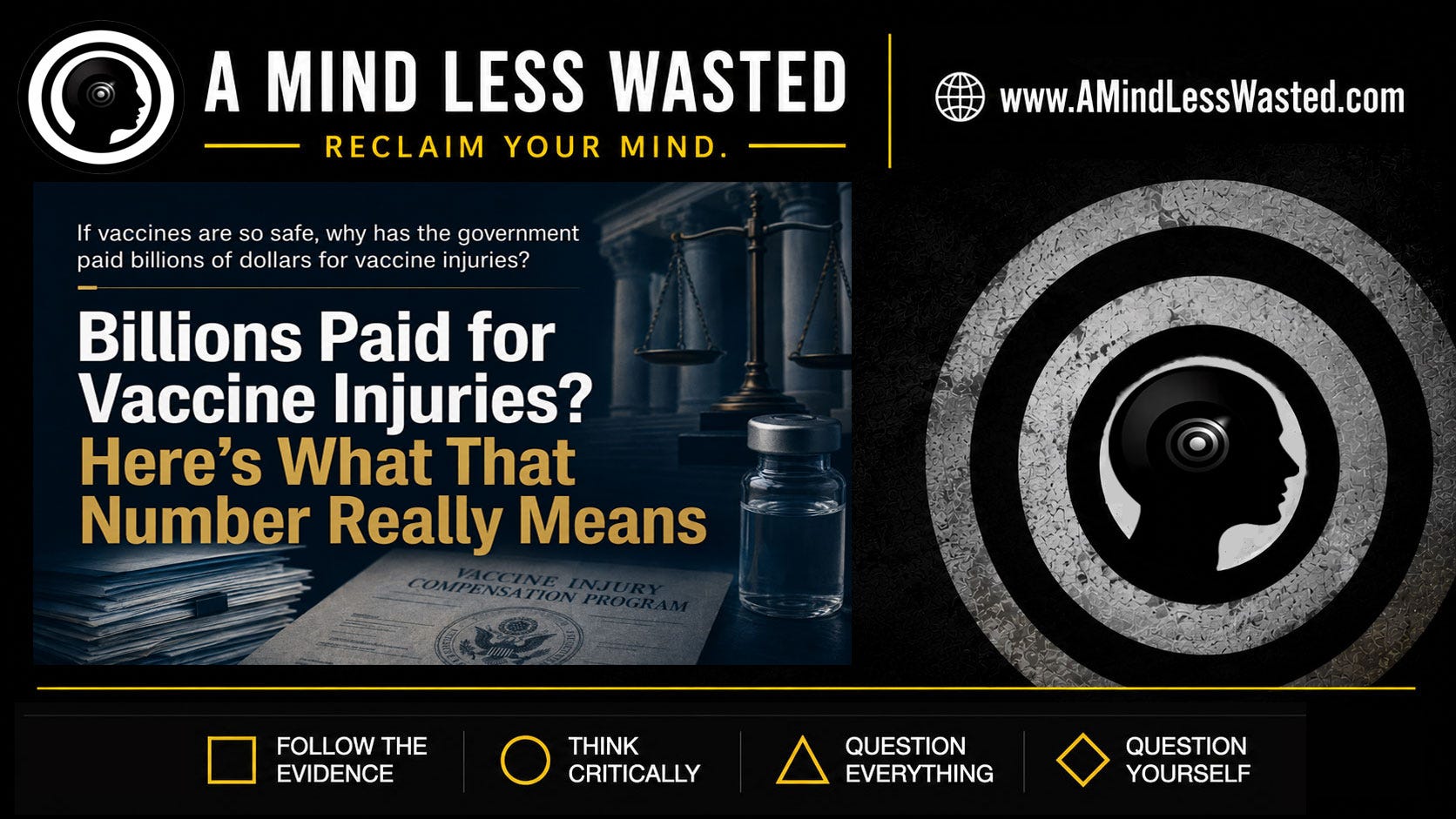
A familiar social media talking point is often presented as a challenge to vaccine safety:
Q. If vaccines are so safe, why has the government paid billions of dollars for vaccine injuries?
A. Because safe does not mean risk-free. Vaccines can cause serious injuries in rare cases, and those people deserve compensation.
It’s a simple question, but it is designed to get a reaction rather than an actual evidence-based discussion
The billions cited online are real, but they accumulated over nearly four decades. The program’s total outlays also include settlements in which neither HHS nor the court determined that a vaccine caused the alleged injury, attorneys’ fees and costs, and administration injuries such as SIRVA.
Those payments show that injuries and compensation exist. By themselves, they do not tell us how frequently vaccines cause serious harm or establish that vaccines are broadly unsafe.
What the VICP actually does
The National Vaccine Injury Compensation Program, or VICP, was created as a no-fault alternative to traditional lawsuits for certain routinely administered vaccines.
Some claims involve injuries listed on the Vaccine Injury Table. When the injury and its timing meet all the table’s requirements, causation is legally presumed unless the government shows that an unrelated factor more likely caused it.
For injuries that do not qualify for that presumption, petitioners generally must show that the vaccine more likely than not caused or significantly aggravated the injury.
Then there are settlements.
HRSA reports that approximately 60% of VICP compensation results from negotiated settlements. In those cases, HHS has not concluded that the vaccine caused the alleged injury, and the court does not make a finding of causation.
Why settle without deciding causation? HRSA lists several reasons: reducing the risk of continuing to trial, limiting the time and expense of litigation, and resolving the case more quickly.
A compensated case may therefore represent a government concession, a court decision, a legal presumption under the Vaccine Injury Table, or a settlement. Those are not the same thing.
What is included in the billions?
As of July 1, 2026, HRSA reported approximately $5.66 billion in total VICP outlays since the program began.
About $5.01 billion of that went to petitioners. The rest consisted of attorneys’ fees and costs, including some legal fees paid in cases that were ultimately dismissed.
So yes, billions have been paid to petitioners. That part of the claim is true. But the larger total sometimes presented online also includes the cost of administering and litigating claims, and many compensated cases were settled without a finding that the vaccine caused the injury.
A large share involved shoulder injuries
Another part of the total deserves attention. Many recent VICP petitions have involved shoulder injury related to vaccine administration, or SIRVA.
SIRVA is generally caused by how or where the injection is given, not by the vaccine’s ingredients. It can occur when the needle is placed too high or enters tissue around the shoulder joint, causing pain, inflammation, and reduced movement.
HHS reported 3,057 SIRVA petitions filed from fiscal year 2010 through part of fiscal year 2020. During fiscal years 2017 through 2019, SIRVA accounted for 1,987 petitions, or 52.6% of all VICP petitions filed. Approximately $119.2 million was paid to SIRVA petitioners from fiscal year 2016 through fiscal year 2019.
SIRVA remained a major part of the program after that. HRSA reported that more than 63% of petitions filed during fiscal years 2021 and 2022 alleged SIRVA.
HRSA’s current public report does not break all compensated awards down by injury, so an exact cumulative SIRVA total is unavailable. Still, the available figures show that a substantial share of recent VICP claims involved injuries caused by vaccine administration rather than reactions to the vaccine itself.
Now add the missing denominator
The same HRSA report lists 5.65 billion doses of VICP-covered vaccines distributed in the United States from 2006 through 2024.
During that period, 14,835 petitions were adjudicated, and 10,933 were compensated.
HRSA summarizes this as approximately one compensated individual for every one million doses distributed. Dividing the figures in its own table produces about 1.9 compensated petitions per million doses, which is closer to two.
Either way, this is a compensation rate, not an injury rate.
The denominator consists of doses distributed, not confirmed doses administered. The numerator includes settlements in which causation was not established. It also reflects the rules, deadlines, and evidentiary requirements of the program.
The figures provide useful context. They do not measure the actual incidence of vaccine injury.
COVID vaccine claims use a different program
COVID vaccine claims are not handled by the VICP. They go through the Countermeasures Injury Compensation Program, or CICP.
As of July 1, 2026, HRSA listed 92 compensated CICP claims covering fiscal years 2010 through 2026. Of those, 62 involved COVID-19 vaccines. Total compensation across all 92 claims was $13,618,257.12.
The covered injuries for COVID vaccine claims included myocarditis, myopericarditis, Guillain-Barré syndrome, anaphylaxis, and thrombosis with thrombocytopenia syndrome.
Those awards show that serious vaccine reactions are recognized and compensated when claims meet the program’s requirements. They do not tell us how often those reactions occur, and they do not establish that every reported health problem following vaccination was caused by the vaccine.
The low number of awards should not be treated as a complete safety statistic either. At the time of HRSA’s July 2026 update, thousands of COVID-related CICP claims remained pending or under review.
Who funds these payments?
The VICP is financed through the Vaccine Injury Compensation Trust Fund rather than ordinary general appropriations.
The fund receives revenue from a federal excise tax on covered vaccines. The tax is 75 cents for each taxable vaccine component in a dose. For example, MMR is taxed at $2.25 because it contains three taxable vaccine components.
The CICP works differently. It is funded through congressional appropriations.
This does not make the compensation unimportant or mean the money somehow does not count. It explains how the two programs are funded and why their payment systems are different.

Are we leaning too far in the other direction by emphasizing settlements and billions of doses?
That is worth asking.
A settlement does not prove that a vaccine caused an injury, but it does not prove that it did not. Some people who believe they were injured may never file a claim. Others may miss a deadline, fail to meet the program’s severity requirements, lack the records needed to prove their case, or remain stuck in a backlog.
“Doses distributed” is not the same as doses administered. One person may receive many doses. And compensation data were created to resolve legal claims, not to track every medical outcome after vaccination.
The same caution applies to the CICP. A small number of completed payments cannot define the true injury rate while thousands of claims remain unresolved.
We should not use the $5.66 billion total to claim that vaccine injuries are widespread. But we should not use the compensation rate to claim that the actual injury rate is one or two per million either.
The program’s numbers tell us how claims were handled. They do not replace vaccine-safety surveillance or epidemiological research.
Ask the question the dollar amount cannot answer
Has anyone ever suffered a serious vaccine injury?
Yes.
But that is only the beginning of a safety discussion. For any particular vaccine and injury, we need to know how often the condition occurs without vaccination, how much vaccination changes that risk, and how the risk compares with the disease being prevented.
A cumulative payout total cannot answer those questions.
Vaccine injuries should not be dismissed. Neither should compensation figures be stripped of their legal and statistical context and presented as proof of widespread harm.
The number is real.
The conclusion attached to it may not be.

Support Independent, Evidence-Based Analysis
If you value careful fact-checking that questions the claim, the counterclaim, and its own conclusions, consider subscribing to A Mind Less Wasted.
Free subscribers receive new articles as they are published. Paid subscriptions help support the research, source review, and time required to produce this work.
Subscribe for free, or become a paid supporter to help keep this work going.

Resources
HRSA: About the National Vaccine Injury Compensation Program
Explains the VICP’s purpose, no-fault structure, settlements, and funding through the vaccine excise tax.HRSA: Vaccine Injury Compensation Data
Provides VICP claim and compensation statistics and explains that approximately 60% of compensation results from negotiated settlements in which HHS did not conclude that the vaccine caused the alleged injury.HRSA: VICP Data and Statistics, January 2026
Reports more than 5 billion covered vaccine doses distributed from 2006 through 2023 and approximately one compensated individual per million doses distributed.HRSA: Vaccine Injury Table
Lists covered vaccines, qualifying injuries, and the time periods required for a legal presumption of causation.HRSA: CICP and VICP Comparison
Compares the two programs, including eligibility, filing deadlines, available benefits, and funding.HRSA: Countermeasures Injury Compensation Program Data
Provides current CICP claim totals, decisions, denials, and compensation data.HRSA: CICP Claims Compensated, Fiscal Years 2010–2026
Lists each compensated CICP claim, the covered countermeasure, the recognized injury, and the amount paid. As of July 1, 2026, the table listed 92 payments totaling $13,618,257.12.IRS Publication 510: Excise Taxes
Explains the 75-cent tax per dose of each taxable vaccine and how the tax applies to combination vaccines.