

By Vincent Mercer
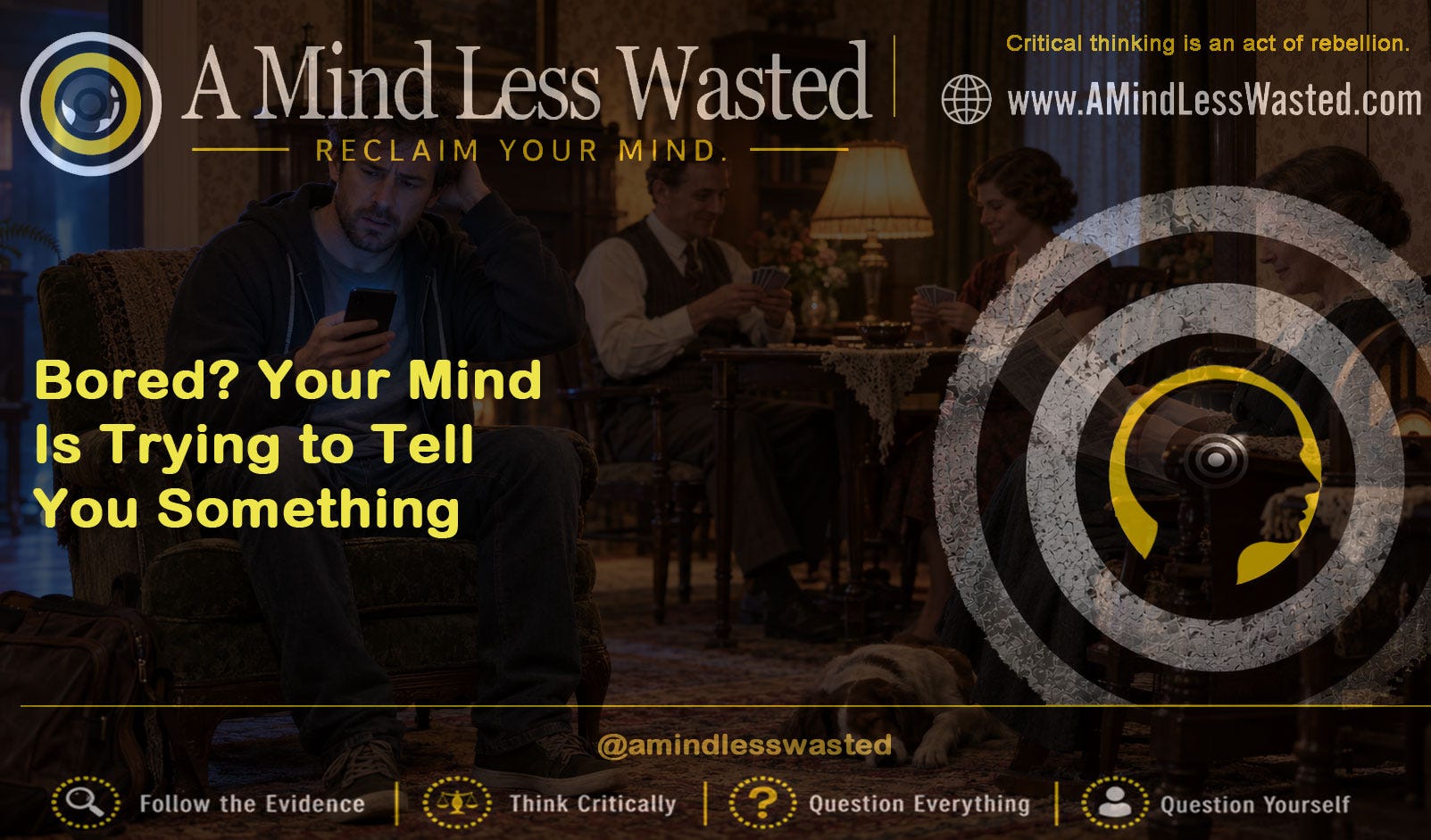
You are sitting somewhere with nothing urgent to do. The television is off. Your phone is out of reach. No one is talking. Within minutes, perhaps seconds, a familiar restlessness begins.
There must be something to look at.
That uncomfortable space is boredom. We usually treat it as a minor irritation, a blank interval that should be filled as quickly as possible. Reach for the phone. Turn on the television. Open the refrigerator, even though we are not hungry. Anything to make the feeling go away.
But boredom is not simply the absence of entertainment. It is a message from the mind. The trouble is that we often silence it before finding out what it is trying to say.
What is boredom?
Psychologists John Eastwood and his colleagues offered a wonderfully plain definition: boredom is the unpleasant experience of wanting to engage in a satisfying activity but being unable to do so.
That last part matters. A person can have plenty to do and still be bored. There may be a hundred television channels, several unfinished chores and the entire internet waiting inside a phone. None of it feels worth entering.
Researcher Erin Westgate describes boredom as a problem involving two basic ingredients: attention and meaning. We tend to become bored when we cannot hold our attention on what we are doing, when the activity feels meaningless, or when both problems occur at once.
A task can be too easy and leave the mind underused. It can also be so difficult that the mind cannot get a grip on it. Both can produce boredom. Then there are activities that hold our attention perfectly well but feel pointless. We can do them. We simply do not care about them.
So boredom is not the mind shutting down. It is the mind refusing to settle.
What does the mind need?
The obvious answer is stimulation, but that is only partly true. If stimulation alone cured boredom, no one holding a smartphone would ever be bored again.
The mind needs a workable match between challenge and ability. Too little challenge and attention slips away. Too much and it gives up trying to enter. The mind also needs some reason to care, even if that reason is small: curiosity, usefulness, connection, progress, pleasure or the satisfaction of finishing something.
It also needs a degree of choice. Boredom becomes especially uncomfortable when we feel trapped in an activity and cannot change it. Think of waiting rooms, long meetings or repetitive work. The experience is not empty. It is crowded with the desire to be doing something else.
What the mind does not need is nonstop novelty. Novelty can capture attention, but capturing attention is not the same as satisfying it.
In a series of experiments published in 2024, people tried to avoid boredom by skipping through videos or switching from one video to another. The strategy often backfired. Digital switching left participants more bored, less satisfied and less engaged than simply watching one video. They kept searching for the thing that would hold them, but the searching itself prevented immersion.
That may be one of the strangest features of modern life. We have more entertainment than any people in history, yet we have built habits that can make sustained engagement harder. We are offered everything, so we commit to nothing.

Did cavemen get bored?
We cannot ask a Paleolithic human what he felt while sitting beside a fire 30,000 years ago. Boredom leaves no fossil. Any confident answer should therefore begin with some humility.
Still, there is no good reason to believe boredom arrived with civilization, television or the smartphone. Early humans had attention, goals, frustration, waiting and repetitive tasks. They experienced periods when nothing immediately useful could be done. It is reasonable to infer that they sometimes felt something recognizable as boredom, even if they had no word for it.
That does not mean prehistoric life was one long empty afternoon. Survival demanded long stretches of work: finding food, making tools, caring for children, preparing shelter and watching for danger. Yet human beings also played, decorated objects, made music and told stories. Those activities were not frivolous additions to human life. They helped people learn, bond, remember and imagine.
Modern hunter-gatherer societies are not living museum pieces, and we should not pretend they are exact replicas of prehistoric people. But they can suggest possibilities. Anthropologist Polly Wiessner compared daytime and nighttime conversation among the Ju/’hoansi of southern Africa. Daytime talk centered more on practical matters and social problems. Around the fire at night, conversation shifted heavily toward stories, along with singing, dancing, and ceremony. Once the day’s work ended, people did not merely wait for sleep. They entered one another’s memories and imaginations.
The first screen may have been the fire. The difference was that the audience also had to supply the stories.
What did people do before screens?
They did many of the things we still do when we put the screens down.
They visited neighbors. They told stories, played music, sang, danced, walked, read, wrote letters, played cards and board games, carved wood, sewed, knitted, cooked, tended gardens and repaired things. Children invented games from whatever happened to be nearby. Adults joined clubs, attended religious services, gathered in pubs and sat on porches talking.
Games are certainly not a modern invention. Archaeologists have found board games in ancient Egypt and the Near East, and possible game boards reach back to the Neolithic period. Human beings have been turning spare time into play for thousands of years.
We should not romanticize the past, however. Many people had far less leisure than we do. Household work took longer. Travel was slower. Jobs could be brutally repetitive. Sailors stood watch, soldiers waited, farm workers repeated the same motions, and the wealthy complained of ennui. People did not conquer boredom. Sometimes they endured it.
And that may be the part we have lost.
Before every quiet second could be eliminated, a person had time to move through boredom instead of escaping it instantly. The mind wandered. A conversation began. A game was invented. A small task became absorbing. An idea had enough silence around it to become visible.
Not every bored moment produced a poem or an invention. Most probably produced nothing remarkable. But boredom created an opening. What came next had to be supplied by the person, not delivered by an algorithm.
Is boredom the same as depression?
No. Ordinary boredom is a temporary state. It usually changes when the situation, task or level of engagement changes. Depression is a mental health condition involving persistent low mood or loss of interest and pleasure, generally lasting most of the day, nearly every day, for at least two weeks, along with other symptoms and difficulty functioning.
The two can overlap. A depressed person may describe life as boring because activities that once mattered no longer feel rewarding. Chronic boredom can also accompany loneliness, low motivation and a loss of meaning.
Can boredom lead to depression? The careful answer is that persistent boredom is associated with depressive symptoms and may contribute to declining mental health, but association is not a simple proof of cause. A 2024 study following 513 young Finnish workers found that greater job boredom predicted later increases in depression and anxiety symptoms, along with lower life satisfaction and positive functioning. The study followed change over time, which makes the finding more informative than a one-time survey, but it was still observational and specific to job boredom in a particular group.
Occasionally having nothing interesting to do is not depression. Feeling unable to enjoy anything, including things you normally value, is different. If that loss of interest persists for two weeks or more, affects daily life or comes with hopelessness, major changes in sleep or appetite, feelings of worthlessness or thoughts of self-harm, it should not be dismissed as boredom.
Would we adapt to life 100 years ago?
Imagine being transported back to 1926. At first, many of us would probably be miserable. Our hands would keep reaching for phones that did not exist. There would be no streaming, social media, video games or instant answers. Entertainment would require planning, participation and often other people.
But the mind adjusts its expectations. After a while, a newspaper might hold our attention longer. A card game might last all evening. We might listen to an entire record without skipping a song or sit through a conversation without checking anything.
We would still get bored. People were bored long before smartphones. But we would probably become less frightened of boredom because there would be no instant escape from it. Eventually, the slower world might stop feeling empty and begin feeling normal.
The real question is not whether we could adapt to 1926. We could. The more interesting question is whether returning to 2026 would then feel unbearably noisy.
Listen before you escape
The next time boredom arrives, it may help to delay the automatic cure for a few minutes and ask a better question.
Is this activity too easy? Too difficult? Does it feel pointless? Am I tired? Do I need company? Am I avoiding something? Or have I become so used to rapid stimulation that ordinary life now feels unbearably slow?
Different forms of boredom need different answers. Make an easy task harder. Break a difficult one into a smaller step. Rest if attention is exhausted. Find a reason the task matters, or admit honestly that it does not. Call someone. Make something. Take a walk without turning it into another delivery system for content.
Most of all, choose one thing and stay with it long enough to enter it.
Boredom is uncomfortable because it sits between what we are doing and what we want to be doing. A screen can cover that distance for a moment. It cannot always tell us where we actually want to go.
If you made it this far, perhaps boredom has already done its job.
Think Critically. Follow the Evidence. Question Everything. Question Yourself.
Sources
John D. Eastwood et al., “The Unengaged Mind: Defining Boredom in Terms of Attention”, Perspectives on Psychological Science (2012).
Erin C. Westgate, “Why Boredom Is Interesting”, Current Directions in Psychological Science (2020).
Katy Y. Y. Tam and Michael Inzlicht, “Fast-Forward to Boredom: How Switching Behavior on Digital Media Makes People More Bored”, Journal of Experimental Psychology: General (2024).
Polly W. Wiessner, “Embers of Society: Firelight Talk Among the Ju/’hoansi Bushmen”, Proceedings of the National Academy of Sciences (2014).
The Metropolitan Museum of Art, “Board Games from Ancient Egypt and the Near East” (2018).
Jie Li, Jari Hakanen and Johanna Huhtala, “Job Boredom as an Antecedent of Four States of Mental Health”, BMC Public Health (2024).
World Health Organization, “Depressive Disorder (Depression)”.