

There is something almost comical about cognitive bias. Once people learn what it is, they immediately begin finding examples of it in everyone else.
We see confirmation bias in the person who rejects our evidence. We see motivated reasoning in the person defending the other political party. We see cognitive dissonance when somebody refuses to admit we were right.
Somehow, we remain the objective one in the room.
Psychologists actually have a name for this tendency. In 2002, Emily Pronin, Daniel Lin and Lee Ross published a series of studies on what they called the bias blind spot. Participants tended to see cognitive and motivational biases more readily in other people than in themselves.
In one follow-up study, participants who showed a better-than-average bias continued to describe their own assessments as accurate and objective even after reading an explanation of how that bias could have affected them.
So the title of this article is not merely a joke.
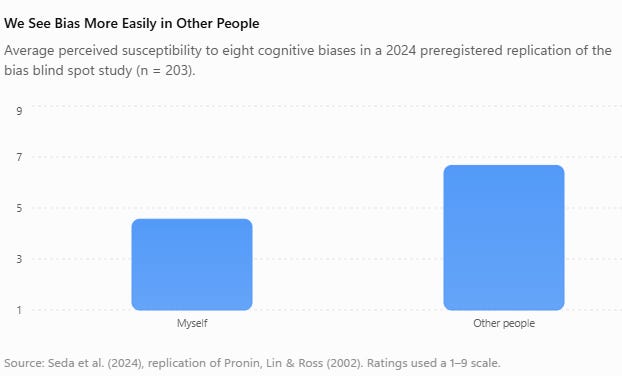
We really are better at seeing bias in other people.
That is precisely why the subject matters.
The useful question is not, “Which cognitive bias explains why that person disagrees with me?”
It is:
How do I know it isn’t affecting me?
Bias is not a character flaw
Before going any further, we should clear up something important. Cognitive bias does not mean stupidity, dishonesty, or corruption.
The modern study of judgment under uncertainty owes a great deal to psychologists Amos Tversky and Daniel Kahneman. In their landmark 1974 paper in Science, they described several mental shortcuts, or heuristics, that people use when making judgments.
They did not portray these shortcuts as evidence that the human mind is hopelessly defective. In fact, they described heuristics as “highly economical and usually effective.”
The problem is what comes next. Those same shortcuts can also produce systematic errors. That distinction gets lost when cognitive bias becomes an insult.
Human beings have to make countless judgments without stopping to perform a statistical analysis. We estimate risk, recognize patterns, decide whom to trust, remember previous experiences, and make quick comparisons. Mental shortcuts are unavoidable and often useful.
The trouble begins when the shortcut gives us the wrong answer, and we do not realize we have taken one.
Consider something as simple as a frightening story.
Suppose three people tell you that they developed the same medical problem shortly after taking a particular treatment. Those stories matter. They may deserve investigation. They may even reveal a real safety signal.
But the stories alone cannot tell us whether the treatment caused the problem.
We still need to know how many people received the treatment, how often the condition normally occurs, whether it also occurred among people who did not receive the treatment, whether there are plausible alternative causes, and whether the difference between the groups is larger than we would expect by chance.
The three stories are easy to remember.
The denominator is not.
Tversky and Kahneman studied this general tendency under the availability heuristic. Events that come to mind easily can influence our estimates of how common or likely they are. A vivid event can therefore carry more psychological weight than its actual frequency warrants.
This does not make the event unimportant.
It means memorable and common are not the same thing.
That distinction alone would improve a surprising number of arguments on social media.
Confirmation bias can begin before we find the evidence
Confirmation bias is probably the best-known cognitive bias, but the usual definition is too simple.
People often describe it as believing information that agrees with us and rejecting information that does not.
It can happen that way, but confirmation bias may enter the process much earlier.
It can begin with the question we type into Google.
Suppose I become convinced that a particular supplement works. I search for:
“Studies showing supplement X works.”
I find a paper supporting it. Then another. I find a doctor explaining the biological mechanism. Someone has posted a personal story describing an extraordinary recovery. An X thread contains twelve papers and announces that the “science is settled.”
After an hour, I may have collected an impressive amount of evidence.
But I have not necessarily conducted an impressive investigation.
What did I search for?
Did I deliberately look for good studies finding no benefit? Did I examine the methodology of the studies I liked as aggressively as I would examine a study I disliked? Did I look for failed replications? Did I check whether the outcomes were clinically meaningful? Did I ask how many people took the supplement and experienced absolutely nothing?
Raymond Nickerson devoted a major 1998 review to confirmation bias and described it as seeking or interpreting evidence in ways that favor existing beliefs, expectations, or a hypothesis already under consideration.
Notice that the evidence itself does not have to be fake.
That is an important point.
A person can collect real studies, real anecdotes, and real statistics and still construct a badly distorted picture if the selection process consistently favors one conclusion.
This is why dropping twenty links into an argument does not settle anything.
The relevant questions are still: What do the studies actually show? How good are they? What evidence was left out?
A famous experiment, and what it really showed
In a classic 1979 study, Charles Lord, Lee Ross and Mark Lepper recruited people who already held strong views about capital punishment. Participants were shown research that appeared to support deterrence and research that appeared to undermine it.
People tended to judge the research supporting their existing position more favorably and scrutinize the opposing research more critically. After considering the mixed evidence, the opposing groups did not simply converge toward the middle. Their attitudes moved further apart.
One experiment from 1979 should not carry an entire theory on its back. Fortunately, it does not have to. Nickerson’s later review examined confirmation bias across a much broader literature.
Still, the Lord, Ross and Lepper experiment captures something recognizable.
We can be extremely demanding critics when evidence threatens our beliefs.
The question is whether we remain equally demanding when the evidence tells us exactly what we hoped to hear.
A simple test is worth trying:
Would I find this evidence just as convincing if it supported the opposite conclusion?
If the answer changes when the conclusion changes, something besides evidence may be influencing the judgment.
Being biased does not automatically make you wrong
This is another distinction worth protecting. Bad reasoning can produce a correct answer.
If I predict rain tomorrow because my knee hurts and it rains, I was right about the weather. My forecasting method is still terrible.
The reverse is also possible. Someone can reason carefully from incomplete evidence and reach a conclusion that later turns out to be wrong.
Being correct does not prove that the reasoning was good. Being incorrect does not prove that the reasoning was irrational.
This matters because accusations of bias are often used as shortcuts themselves.
A scientist receives industry funding, therefore the study is false.
A researcher works for the government, therefore the result cannot be trusted.
An activist funded the research, therefore it is propaganda.
A pharmaceutical company paid for the trial, therefore the drug does not work.
None of those conclusions follows automatically.
Conflicts of interest matter because they can create incentives and opportunities for bias. They are reasons to examine methods, disclosure, study design, analysis, and replication more closely.
They are not evidence erasers.
The same principle applies in the opposite direction. Institutional prestige does not turn weak evidence into strong evidence either.
Who produced the evidence matters.
But eventually we still have to examine the evidence.
Cognitive bias and cognitive dissonance are not the same thing
These two terms get mixed together constantly.
They are related, but they describe different things.
Cognitive bias concerns tendencies in how we process information and make judgments.
Cognitive dissonance concerns conflict among cognitions, such as beliefs, attitudes, knowledge, or behavior, and the pressure that conflict may create to reduce the inconsistency.
Leon Festinger developed cognitive dissonance theory in the 1950s. His basic proposal was that inconsistency among important cognitions can be psychologically uncomfortable and can motivate attempts to reduce that inconsistency.
Imagine that you have defended a position for ten years. You have argued about it publicly. Perhaps you have written articles about it. You have told other people they were wrong.
Then compelling evidence appears suggesting that you were mistaken.
Now there are at least two issues.
There is the evidence itself.
And there is everything attached to your old position.
Your previous arguments. Your reputation. The people you dismissed. Maybe an audience. Maybe money. Maybe simply pride.
Changing your mind is no longer free.
That is where cognitive dissonance becomes relevant.
But here is where popular discussions frequently go too far.
Dissonance does not mean that a person must reject contrary evidence or double down. Reducing inconsistency can happen in different ways. Someone may rationalize the old belief. Someone may discount the new information. Someone may change a behavior.
Someone may also change the belief.
In other words, the existence of dissonance does not tell us in advance which path a person will choose.
Festinger himself warned against turning his theory into an explanation for everything:
“It would be unfortunate indeed if the concept of dissonance were used so loosely as to have it encompass everything.”
That warning was written in 1957.
We should probably listen to it.
And the research deserves some humility too
If we are going to write an article about cognitive bias, it would be rather embarrassing to mention only the famous studies and ignore research that complicates the story.
Cognitive dissonance theory has produced a large and influential research literature, but some classic experimental approaches have been challenged.
In 2024, David Vaidis and a large international group of researchers published a multilab replication of the induced-compliance paradigm, one of the traditional ways psychologists have studied cognitive dissonance. Across 39 laboratories, 19 countries, and 4,898 participants, the primary analysis failed to reproduce the key high-choice versus low-choice attitude-change effect predicted by that paradigm.
That does not demonstrate that cognitive dissonance does not exist.
It does mean we should be careful about presenting every classic demonstration as settled fact.
Other lines of dissonance research have produced stronger results. For example, a 2021 meta-analysis examining improved versions of the “free-choice” paradigm found evidence that making choices can alter later preferences even after researchers addressed an important methodological artifact identified in earlier studies.
So the responsible conclusion is neither “cognitive dissonance has been debunked” nor “seventy years of textbook examples are beyond question.”
The evidence is more interesting than either slogan.
Motivated reasoning is another piece of the puzzle
There is a third concept that belongs in this discussion: motivated reasoning.
Psychologist Ziva Kunda’s influential 1990 review proposed that motivation can influence the cognitive strategies people use to access, construct, and evaluate beliefs.
Her wording is worth reading carefully:
“People are more likely to arrive at conclusions that they want to arrive at.”
But Kunda did not argue that people can simply believe anything they wish. She emphasized an important constraint. We still tend to need explanations that seem reasonable to us.
That is what makes motivated reasoning so difficult to recognize from the inside.
It does not necessarily feel like:
“I know the evidence says X, but I am going to pretend it says Y.”
It can feel like careful analysis.
We find the methodological flaw.
We remember the exception.
We question the sample.
We find another expert.
We reinterpret the statistic.
Any one of those objections may be perfectly legitimate.
Again, the pattern matters.
If every weakness in evidence against my position is fatal while every weakness in evidence supporting my position is merely a limitation, I should probably become curious about that.
A useful distinction is:
Bias can influence how I process the evidence. Dissonance describes a conflict among important cognitions. Motivated reasoning can influence how I reason toward a preferred conclusion.
They overlap.
They are not synonyms.
Intelligence does not grant immunity
One of the more uncomfortable findings in this area concerns intelligence.
It would be reassuring to think that sufficiently intelligent people eventually reason their way out of these problems.
Research on what Keith Stanovich and colleagues call myside bias makes that difficult to assume.
Myside bias describes the tendency to evaluate evidence, generate arguments or test hypotheses in ways favorable to one’s existing views.
In a 2013 review, Stanovich, Richard West and Maggie Toplak reported that the magnitude of myside bias showed “very little relation to intelligence.”
That does not mean intelligent people are more biased.
It means intelligence, at least as measured in the research they reviewed, offered surprisingly little protection against this particular kind of biased reasoning.
That makes intuitive sense.
Intelligence gives us better tools.
Those tools can be used to challenge our beliefs.
They can also be used to defend them.
A highly intelligent person may spot methodological weaknesses that everyone else misses. That is valuable. But if those remarkable powers of methodological criticism appear only when the study reaches an unwelcome conclusion, intelligence has not solved the problem.
It may simply have made the defense more sophisticated.
This is one reason I do not think skepticism alone qualifies as critical thinking.
Being skeptical of things you already distrust is easy.
The harder skill is knowing when to become skeptical of something you desperately want to believe.
Social media complicates the problem, but be careful with the story
It is tempting to say that social media creates echo chambers, algorithms trap us inside them, and those bubbles make everyone more polarized.
There is some truth buried in that story.
There is also a lot more uncertainty than the usual version admits.
Social platforms unquestionably allow selective exposure on a scale that was difficult before. We can follow people who think like us, block people who annoy us, join communities organized around particular beliefs and interact repeatedly with information selected partly from our previous behavior.
Algorithms can influence what we see too.
But how much that changes our underlying beliefs is a separate question.
A large 2023 Facebook study found that content from politically like-minded sources made up a majority of what users encountered. Researchers then reduced exposure to like-minded content by about one-third for more than 23,000 users during the 2020 U.S. election.
The intervention changed what people saw.
It did not produce measurable changes in the eight preregistered attitude measures the researchers examined, including ideological extremity and affective polarization.
Other research has found effects under different conditions. In a 2021 field experiment, researchers increased Facebook users’ exposure to news from outlets with opposing political viewpoints. That exposure reduced some negative attitudes toward the opposing political party. Interestingly, simply subscribing to opposing-viewpoint outlets was not enough to guarantee exposure, because Facebook’s algorithm was less likely to show users posts from those sources.
What should we conclude?
Probably something less exciting than “THE ALGORITHM IS BRAINWASHING EVERYONE.”
Social media can shape our information environment. Selective exposure is real. Algorithms matter.
But exposure, belief change, and political polarization are not the same outcome, and the causal relationships among them remain complicated.
That distinction matters because an article about cognitive bias should not commit the very error it is warning about.
The belief that cannot lose
There is one pattern that should make us especially cautious.
A belief gradually becomes structured so that every possible outcome supports it.
The prediction comes true? Proof.
The prediction fails? Someone interfered.
Evidence appears? Confirmation.
Evidence does not appear? Cover-up.
Experts agree? They are protecting the establishment.
Experts disagree? The science is obviously unsettled.
A whistleblower speaks? Evidence of the conspiracy.
No whistleblower speaks? Everyone is afraid.
The problem is not that any individual explanation is impossible. Sometimes people really do interfere. Evidence really can be hidden. Experts can have conflicts. Institutions can behave badly.
The problem appears when no conceivable observation is allowed to count against the belief.
At that point we should ask:
What would prove this wrong?
If there is no answer, the belief is no longer being meaningfully tested.
It is being protected.
This question applies equally well to conventional beliefs and unconventional ones. Institutional consensus can become dogmatic. Anti-establishment thinking can become dogmatic. Skepticism itself can become dogmatic.
Nobody gets an exemption simply because he calls himself a skeptic.
Can we do anything about our biases?
Knowing the names of cognitive biases does not make them disappear.
In fact, the bias-blind-spot research suggests there is an obvious danger here. Learning about bias may simply give us a more sophisticated vocabulary for explaining why everyone else is irrational.
There are, however, ways to improve the process.
One particularly simple method has experimental support. In a 1984 study, Charles Lord, Mark Lepper and Elizabeth Preston asked people to consider the opposite, deliberately thinking about how the alternative conclusion might be true. This reduced bias in the social judgments they studied.
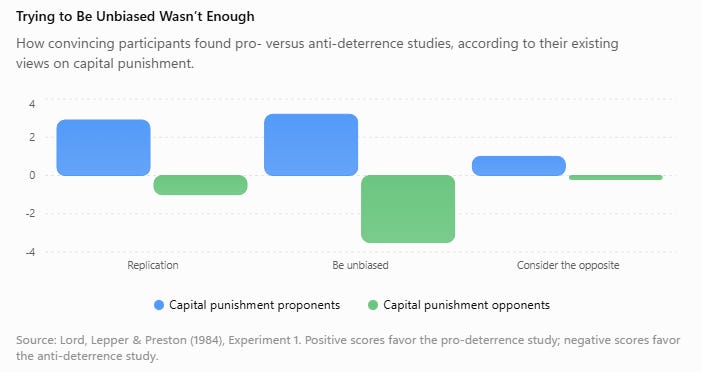
I like that approach because it is more demanding than saying “keep an open mind.”
Actually try to make the opposing case.
If I think a treatment works, what would the evidence look like if it did not?
If I think a study is fraudulent, what evidence would convince me that it was legitimate?
If I believe an institution is lying, what evidence would count as evidence that it is telling the truth?
If I trust an institution, what would make me withdraw that trust?
If my answer to the question is always “nothing,” then the problem is no longer lack of information.

There is an irony in reading about cognitive bias. Most of us immediately start thinking about the people who need to read the article.
That person on X. That relative. That friend who refuses to look at the evidence.
For a moment, leave them out of it.
Ask yourself a harder set of questions.
Would I find this evidence just as convincing if it supported the opposite conclusion?
Do I scrutinize evidence I dislike more aggressively than evidence that supports what I already believe?
Did I read the actual study, or am I relying on somebody else’s description of it?
Do I know the denominator, or do I only know the stories?
Have I ever deliberately searched for the strongest evidence against my position?
And most important:
What evidence would actually change my mind?
There is one more question worth asking because it may explain why that one can be so difficult:
What would it cost me to be wrong?
Sometimes the answer is almost nothing. You change your mind and move on.
Other times there is more attached to the belief than we realize. Reputation. Friends. An audience. Political identity. Money. Years spent arguing the point. Maybe just the embarrassment of admitting that someone you dismissed had a better argument than you did.
None of that tells you that your belief is false.
But it does tell you something important: you may have reasons to want it to remain true.
And once we have something invested in a belief, we should probably examine it a little more carefully.
Question everything includes yourself
The goal is not to become perfectly unbiased.
That is fantasy.
The goal is to make it harder for our biases to operate unnoticed.
This is one reason serious research uses tools such as control groups, randomization, blinding, preregistration, replication, and transparent methods. Different methods address different problems, and none removes every source of bias. They exist because simply telling researchers to “be objective” is not enough.
The same principle applies to the rest of us.
Do not merely promise yourself that you will be fair.
Build habits that make unfair reasoning easier to catch.
Look for the missing comparison.
Check the denominator.
Read the strongest opposing argument.
Consider the opposite.
Decide what evidence would change your mind before you see the result.
Do not move the evidentiary goalposts when the result becomes uncomfortable.
And when you discover that you were wrong, say so.
There may be no better evidence that critical thinking is actually taking place.
Because cognitive bias is not something that happens only to conspiracy theorists, politicians, journalists, scientists, activists, experts, anti-vaxxers, pro-vaxxers, liberals, conservatives, religious people, atheists or that annoying person arguing with you on X.
It is part of human reasoning.
Which means the four words Question Everything are incomplete by themselves.
The harder part is the fourth principle.
Question Yourself.
If you find this kind of evidence-first thinking useful, consider subscribing to A Mind Less Wasted.
The goal here is not to tell you what to think. It is to get better at examining claims, questioning assumptions, and noticing when our own reasoning may be getting in the way.
#ThinkCritically #FollowTheEvidence
#QuestionEverything #QuestionYourself
Sources and further reading
Tversky, A., & Kahneman, D. (1974). “Judgment under Uncertainty: Heuristics and Biases.” Science, 185(4157), 1124–1131. DOI: 10.1126/science.185.4157.1124.
Nickerson, R. S. (1998). “Confirmation Bias: A Ubiquitous Phenomenon in Many Guises.” Review of General Psychology, 2(2), 175–220. DOI: 10.1037/1089-2680.2.2.175.
Pronin, E., Lin, D. Y., & Ross, L. (2002). “The Bias Blind Spot: Perceptions of Bias in Self Versus Others.” Personality and Social Psychology Bulletin, 28(3), 369–381. DOI: 10.1177/0146167202286008.
Seda, L., Martins, I. T. C., Lisbôa, T. L. R. de C., Batistuzzo, M. C., & Fatori, D. (2024). “Theoretical Maturation of the ‘Bias Blind Spot’: A Preregistered Replication Study of Pronin, Lin, and Ross (2002) in a Brazilian Sample.” Collabra: Psychology, 10(1), 122158. DOI: 10.1525/collabra.122158.
Lord, C. G., Ross, L., & Lepper, M. R. (1979). “Biased Assimilation and Attitude Polarization: The Effects of Prior Theories on Subsequently Considered Evidence.” Journal of Personality and Social Psychology, 37(11), 2098–2109. DOI: 10.1037/0022-3514.37.11.2098.
Lord, C. G., Lepper, M. R., & Preston, E. (1984). “Considering the Opposite: A Corrective Strategy for Social Judgment.” Journal of Personality and Social Psychology, 47(6), 1231–1243. DOI: 10.1037/0022-3514.47.6.1231.
Kunda, Z. (1990). “The Case for Motivated Reasoning.” Psychological Bulletin, 108(3), 480–498. DOI: 10.1037/0033-2909.108.3.480.
Stanovich, K. E., West, R. F., & Toplak, M. E. (2013). “Myside Bias, Rational Thinking, and Intelligence.” Current Directions in Psychological Science, 22(4), 259–264. DOI: 10.1177/0963721413480174.
Festinger, L. (1957). A Theory of Cognitive Dissonance. Stanford University Press.
Enisman, M., Shpitzer, H., & Kleiman, T. (2021). “Choice Changes Preferences, Not Merely Reflects Them: A Meta-Analysis of the Artifact-Free Free-Choice Paradigm.” Journal of Personality and Social Psychology, 120(1), 16–29. DOI: 10.1037/pspa0000263.
Vaidis, D. C., Sleegers, W. W. A., van Leeuwen, F., et al. (2024). “A Multilab Replication of the Induced-Compliance Paradigm of Cognitive Dissonance.” Advances in Methods and Practices in Psychological Science, 7(1). DOI: 10.1177/25152459231213375.
Levy, R. (2021). “Social Media, News Consumption, and Polarization: Evidence from a Field Experiment.” American Economic Review, 111(3), 831–870. DOI: 10.1257/aer.20191777.
Nyhan, B., et al. (2023). “Like-Minded Sources on Facebook Are Prevalent but Not Polarizing.” Nature, 620, 137–144. DOI: 10.1038/s41586-023-06297-w.