

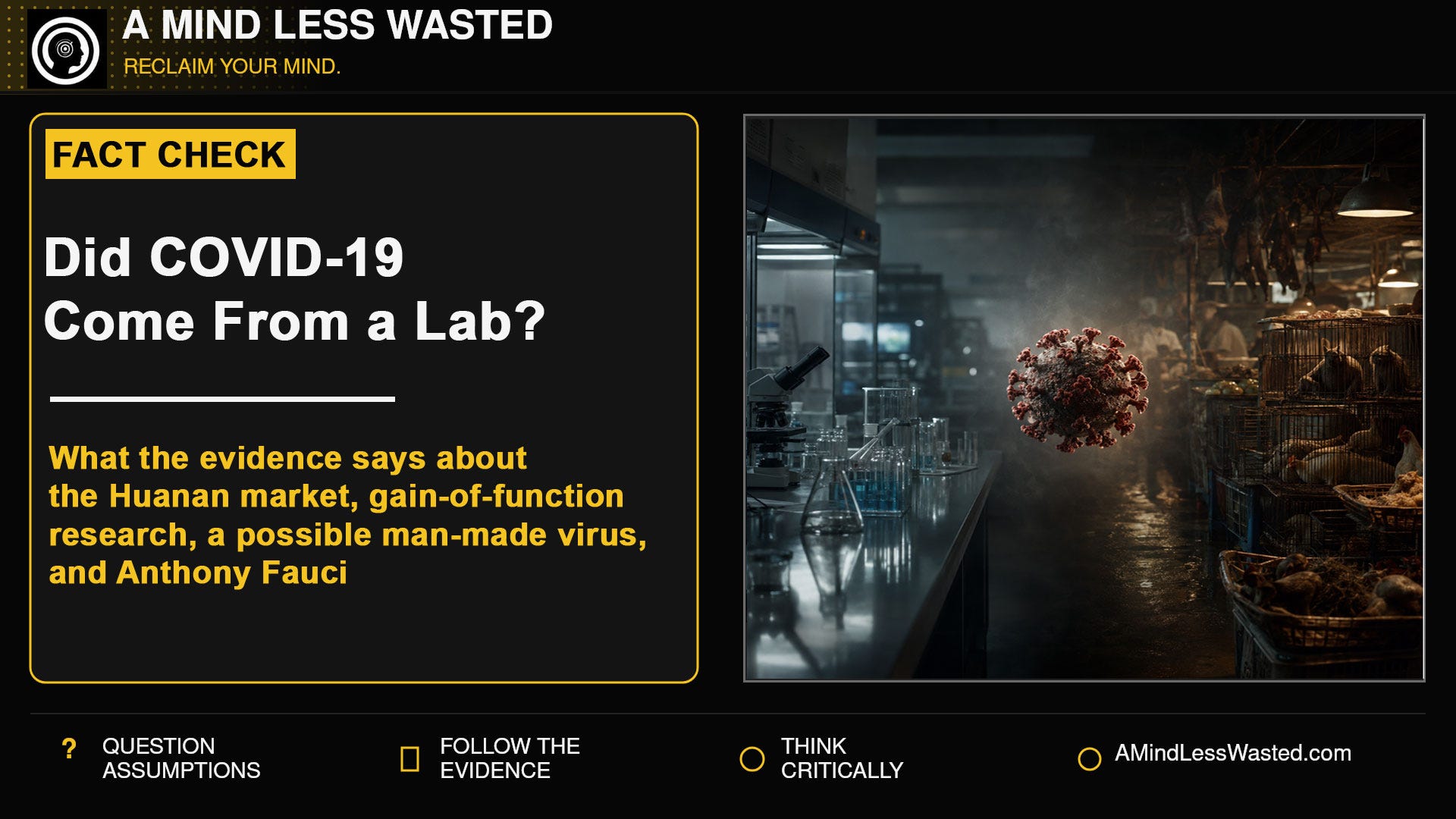
Six years after the earliest known COVID-19 cases emerged in Wuhan, the origin of SARS-CoV-2 remains uncertain.
That has not stopped people from speaking with certainty.
Some point to the Huanan market as if an infected animal was found there and the mystery was solved. Others point to coronavirus research in Wuhan, gain-of-function experiments, and Anthony Fauci’s statements as if those facts prove a laboratory origin.
Neither conclusion goes as far as the evidence.
After reviewing the published research, the major criticisms of that research, government records, and the latest World Health Organization assessment, I believe the publicly available evidence currently favors a zoonotic emergence associated with the wildlife trade and Wuhan’s Huanan market.
That is not the same as saying a zoonotic origin has been proved. It has not.
No infected source animal has been identified. The immediate progenitor of SARS-CoV-2 has not been found. Important early patient data, animal supply-chain records, and Wuhan laboratory records remain unavailable. Because of those gaps, a laboratory-associated origin cannot be ruled out.
But two explanations do not become equally supported simply because neither has been proved. The laboratory hypothesis still lacks the decisive evidence we would most want: a documented pre-outbreak precursor, infected researcher, laboratory construct, or incident record.
That does not mean the laboratory case consists only of speculation. There is a meaningful circumstantial case. Wuhan housed one of the world’s leading SARS-related coronavirus research programs. WIV researchers collected novel bat coronaviruses from distant regions and brought samples to Wuhan. Recombinant and gain-of-function experiments were performed. DEFUSE proposed additional experiments strikingly relevant to later origin questions. Some coronavirus research was conducted under biosafety conditions that raised concerns among U.S. intelligence analysts. And China has refused access to records that could help confirm or falsify a research-related accident.
None of those facts proves a laboratory origin.
Taken together, however, they deserve more evidentiary weight than “technical capability” alone.
Anthony Fauci’s role also deserves scrutiny. At times, he spoke with more confidence than the evidence warranted. His denial that NIH funded gain-of-function research in Wuhan relied on the narrower federal regulatory definition, rather than the broader scientific meaning most people would have understood.
Those criticisms are valid. They do not tell us where the virus came from.
We need to separate the claims
Much of the confusion begins with the phrase “lab leak.” It is often used as another way of saying “man-made virus,” although the two are not the same.
There are at least four possible scenarios:
A naturally occurring virus reached humans through the wildlife trade.
A naturally occurring virus was collected in the field or brought into a laboratory, then infected someone through a research-related accident.
A virus was altered through laboratory experimentation or adaptation and later escaped accidentally.
A virus was deliberately created and released.
The evidence is not the same for all four.
A laboratory accident could involve a virus that was never genetically engineered. A researcher could become infected while collecting samples, culturing a natural virus, or handling an infected animal. Evidence against deliberate construction does not eliminate those possibilities.
The fourth scenario is the most serious allegation and the least supported. There is no credible public evidence that SARS-CoV-2 was created as a biological weapon or deliberately released.
When we combine all laboratory scenarios into one claim, evidence against obvious engineering gets used to dismiss every possible accident. When we combine every question about Wuhan research into the opposite claim, proof that risky research occurred gets presented as proof that it caused the pandemic.
Both shortcuts fail.
Why the evidence keeps leading back to Huanan
The zoonotic case is stronger than the claim that a few early patients happened to visit a seafood market.
Huanan also sold live mammals susceptible to SARS-CoV-2. Researchers found that the earliest known December 2019 cases were geographically centered near the market, including cases with no documented market connection. A 2022 Science analysis identified Huanan as the pandemic’s early epicenter.
The strongest counterargument is ascertainment bias. Once Huanan was linked to the outbreak, nearby patients and those connected to the market may have been more likely to be identified. Researchers argue that the earliest cases were found before the market was recognized as their shared exposure and that cases with no known market connection still clustered nearby. The geography remains important evidence, but it is not immune from bias.
Inside the market, virus-positive environmental swabs were concentrated near the wildlife stalls. A later Cell study found genetic material from susceptible species, including raccoon dogs, civets, and bamboo rats, in some of those samples.
This does not prove that any animal was infected. The swabs contained mixed environmental material. Finding viral RNA and animal DNA together shows that both were present in the same area, not that the animal carried the virus.
Still, the cumulative pattern is difficult to dismiss. The earliest recognized outbreak centered on a market selling susceptible animals, and viral contamination was concentrated where those animals had been sold. That is not a photograph of the first infection, but it is more than a coincidence created by the market’s address.
Some researchers argue that the earliest viral lineages, A and B, represent two separate animal-to-human introductions. If so, repeated spillover through the same wildlife network would better explain the evidence than one infected person starting an outbreak at the market. A 2022 Science paper reached that conclusion.
I would not make this the foundation of the case. The argument relies on reconstructing the earliest viral family tree from a small and biased collection of sequences. In 2025, evolutionary biologist Jesse Bloom concluded that the available data are insufficient to root that tree confidently. The early sequences are disproportionately linked to the market, and different rooting methods produce different results.
The two-spillover theory may be correct, but it remains less certain than the geographic and market evidence.
What the market evidence cannot tell us
No animal at Huanan was confirmed to be infected before the market closed.
Chinese investigators found SARS-CoV-2 in dozens of environmental samples but none of 457 animal samples. However, sampling began after the market had closed and the live mammals from the implicated stalls were gone. Investigators tested what remained, not the animals most relevant to the outbreak.
The positive swabs could also reflect human contamination. An infected vendor or customer may have deposited viral material where animal material was already present.
Bloom and Débarre disagree over how the swabs should be interpreted, but neither analysis proves that a particular animal was infected. Their published exchange shows where the dispute lies.
Huanan could also have amplified an outbreak that began somewhere else. A crowded market can become an early center of transmission without being the location of the first human infection.
This leaves us with a narrower conclusion than “COVID began in a raccoon dog at Huanan.” The evidence favors an emergence associated with the wildlife trade and the market. It does not show where the first animal-to-human transmission occurred. That may have happened inside Huanan, on a farm, elsewhere in the supply chain, or before an infected person or animal reached the market.
The WHO’s 2025 expert assessment reached essentially the same conclusion. It said the weight of the available evidence suggests zoonotic spillover, either directly from bats or through an intermediate host. It could not determine whether Huanan was the first spillover site or a later site of spillover and amplification. The WHO report is clear about both the evidence and its limits.
What about the October 2019 Military Games?
Another argument for earlier circulation points to the World Military Games held in Wuhan from October 18–27, 2019. Some participants later reported illnesses, and a 2021 paper found a correlation between the number of athletes countries sent to Wuhan and their subsequent COVID-19 case totals. But the study was an ecological model. It did not test the athletes for SARS-CoV-2, and its author acknowledged that whether the Games actually contributed to pandemic spread could not be determined from the data. The paper is worth reading, but it does not establish infection at the Games.
The WHO’s 2021 origins investigation found no appreciable cluster of fever or severe respiratory disease requiring hospitalization associated with the Games. Importantly, however, it also said that data from the on-site clinics had not been fully evaluated and recommended further review. That uncertainty should not be erased in either direction.
The Military Games remain a reasonable lead to investigate. They are not evidence that SARS-CoV-2 was circulating there in October 2019, much less evidence of a laboratory origin. Even a confirmed October infection would move the timeline earlier; it would not tell us where the virus came from.
The laboratory hypothesis is not unreasonable
There are serious reasons to investigate a research-related origin.
Wuhan was home to laboratories conducting extensive work on bat coronaviruses. Scientists at the Wuhan Institute of Virology collected SARS-related viruses, sequenced them, cultured some, and tested whether they could use human receptors.
They also participated in recombinant-virus experiments. A 2015 Nature Medicine study created a chimeric virus using the spike from bat coronavirus SHC014 in a mouse-adapted SARS coronavirus backbone. It replicated in primary human airway cells and in mouse lungs. The study was led at the University of North Carolina, included WIV researcher Shi Zhengli, and received U.S. funding.
In 2017, WIV researchers described a method for substituting spike genes from newly discovered bat viruses into a WIV1 coronavirus backbone. The resulting chimeric viruses were used to test receptor use. The published study acknowledged support from an NIAID grant awarded to EcoHealth Alliance.
These studies establish that researchers connected to WIV had the expertise and tools to create and test recombinant coronaviruses. They also establish that U.S. funding supported some of that work.
They do not establish that those researchers created SARS-CoV-2.
The published viruses are far too genetically distant to be the immediate ancestor of the pandemic virus. No publicly available paper, sequence, inventory, or laboratory record shows that SARS-CoV-2 or its direct progenitor was present at WIV before the outbreak. No laboratory worker has been shown through a verified pre-outbreak sample to have carried the virus before community transmission began.
Without that connection, the evidence proves relevant activity and technical capability. It does not prove origin.
The 2018 DEFUSE proposal adds to the concern. EcoHealth Alliance and its research partners proposed experiments involving SARS-related coronaviruses, including work involving cleavage sites and chimeric viruses. DARPA rejected the proposal. The document shows that researchers were considering experiments relevant to this debate. It does not show that the proposed work was performed elsewhere, performed secretly, or used to create SARS-CoV-2. The DEFUSE proposal can be read here.
The missing laboratory records matter just as much. The WHO says it has not received the staff health records, biosafety information, research documentation, and fieldwork records needed to evaluate the Wuhan laboratories properly. China’s failure to provide them prevents a complete investigation.
That secrecy justifies suspicion, but it cannot prove what the missing records contain. Otherwise, the claim becomes impossible to test or disprove.
U.S. intelligence agencies remain divided. In January 2025, the CIA favored a research-related origin with low confidence. The FBI and Department of Energy have also favored a laboratory incident, while other agencies favor natural exposure or remain undecided. None of the public assessments provides the pre-outbreak sample, sequence, experiment, or infected worker needed to establish a laboratory connection independently.
A declassified May 2020 Lawrence Livermore assessment concluded that all the conditions it considered necessary for the accidental release of a laboratory-modified coronavirus were present at WIV. It gave equal weight to three scenarios: natural emergence, accidental release of a natural virus, and accidental release of a modified virus. However, a 2023 intelligence-community email included in the same release challenged a critical premise of the assessment, noting that it had not substantiated WIV’s access to a potential SARS-CoV-2 precursor.
Newly released Energy Department records show that another laboratory-origin analysis was being developed by November 2020. A heavily redacted Technical Intelligence Note from the Department of Energy’s Office of Intelligence and Counterintelligence, involving Los Alamos National Laboratory, argued that the low genetic diversity among 13 of the earliest available SARS-CoV-2 sequences was consistent with a single human introduction. It also described the furin cleavage site as rare among known SARS-like coronaviruses and called laboratory recombination a simpler explanation than recombination in the wild. The document is marked “DRAFT Working Papers,” and its key judgments, sources, and much of its analysis remain redacted. The newly released records can be read here.
The document is historically significant. It shows that a technical laboratory-origin case existed inside the Energy Department system by late 2020, years before DOE’s position became public. But the disclosed analysis does not establish that a laboratory accident occurred. A single infected founder could result from either one animal-to-human spillover or one laboratory-associated infection. The statistical result cited in the document did not prove a single-founder model, and its apparent fit improved after one of only 13 sequences was excluded as a possible error. Likewise, calling laboratory recombination “simpler” is an analytical judgment, not evidence of a particular virus, experiment, or accident.
These assessments show why a laboratory scenario warranted serious investigation. Neither identifies the missing precursor virus, laboratory incident, or infected researcher.
Ashish Jha Now Favors a Lab Leak. Does That Change the Evidence?
Since this article was published, another prominent voice has entered the origin debate.
Ashish Jha, who served as President Biden’s White House COVID-19 Response Coordinator, now says he believes a laboratory accident is the more likely origin of the pandemic.
That deserves attention.
Jha told CNN that when he entered the White House in April 2022, he considered a natural outbreak “almost surely” the explanation. He says information he subsequently learned and saw changed his assessment, and he now considers a laboratory leak more likely. He has since clarified that he means an accidental leak, not deliberate release and not necessarily an engineered virus. He also describes the evidence as circumstantial and acknowledges that reasonable people can examine it and disagree.
Vinay Prasad highlighted Jha’s reversal, and Steve Kirsch subsequently circulated it as another reason to favor the laboratory hypothesis.
The important question, however, is not simply who has changed his mind.
It is:
What evidence changed his mind?
That distinction matters.
Jha’s judgment is relevant. He was inside the White House, had access to government briefings unavailable to most of us, and is an experienced public-health physician. It would be unreasonable to pretend that his assessment carries no informational value.
But an informed assessment is still not the same thing as publicly verifiable evidence.
Jha has not produced a pre-outbreak SARS-CoV-2 precursor from a Wuhan laboratory. He has not identified a laboratory experiment that produced the pandemic virus. He has not produced a verified infected researcher connected to the beginning of transmission. And he has not claimed to possess proof of any of those things.
In fact, his own wording is considerably more cautious than some of the headlines generated from it. He says this is his “best assessment,” not something he knows for certain. He describes the evidence as “strong circumstantial evidence,” and explicitly says reasonable people can disagree.
That makes Jha’s reversal important, but it does not settle the origin question.
There is also a useful critical-thinking lesson here.
An expert changing his mind is evidence of a changed assessment, not necessarily changed evidence
Scientists and policymakers should change their minds when the evidence warrants it. Refusing to update a belief because you once stated it publicly would be the opposite of good reasoning.
So Jha should not be criticized simply because his position changed.
But neither should his change of opinion be converted into:
“The former COVID czar now admits COVID came from a lab, therefore the lab leak has been proved.”
That would go beyond what Jha himself says.
There are really two questions:
1. Has Jha’s estimate of the probabilities changed?
Clearly yes.
2. Has new publicly available evidence emerged that establishes a laboratory origin?
Not from this interview.
Those are different propositions.
His statement may reasonably cause someone to update their probability of a lab accident upward, particularly because he says his change followed information encountered while serving in government. What we cannot do is independently evaluate information that has not been made public.
This is precisely why the distinction between evidence and authority matters.
An appeal to expertise is not automatically fallacious. We rely on specialists constantly because no individual can personally investigate every scientific question. But expertise cannot manufacture evidence that the public has not seen. At some point, if a claim is to become independently established, the underlying evidence has to be available for examination.
That standard should apply regardless of which direction the expert moves.
If a former White House official announced tomorrow that previously unseen evidence had convinced him that zoonotic spillover was virtually certain, that statement alone would not prove zoonosis either.
We should ask him the same question:
What did you see?
Until that evidence becomes available, Jha’s reversal belongs in the laboratory column as a significant informed judgment. It strengthens the case that a laboratory origin deserves serious consideration and continued investigation.
It does not fill the evidentiary gap identified earlier in this article: there is still no publicly demonstrated pre-outbreak connection between SARS-CoV-2, or its immediate progenitor, and a Wuhan laboratory.
That remains the crucial missing link.
Was SARS-CoV-2 man-made?
This question deserves a more careful answer than either “obviously” or “impossible.”
The furin cleavage site in the SARS-CoV-2 spike protein has drawn particular attention. It helps activate the spike and was absent from the closest known related bat viruses at the start of the pandemic. The DEFUSE proposal also discussed work involving cleavage sites. These facts reasonably raised questions about laboratory manipulation, but they do not provide a genetic signature of it.
Furin cleavage sites occur naturally in other coronaviruses, and insertions and recombination are normal parts of coronavirus evolution. Knowing how to add such a feature establishes technical capability, not that scientists added this one.
The paired CGG codons have also been cited as evidence of engineering because CGG is uncommon in SARS-CoV-2. But uncommon does not mean unnatural. CGG pairs occur in naturally evolving viruses, and codon choice alone cannot establish engineering. A peer-reviewed response addresses this argument.
A 2022 preprint similarly argued that the spacing of restriction sites used to assemble viral genomes suggested a synthetic origin. Critics found that its statistical criteria were selective and that similar patterns occur naturally. A published reanalysis concluded that the restriction map does not establish engineering.
Modern reverse-genetics methods do not always leave an obvious scar, and laboratory passage may leave no recognizable engineering signature. Genomic analysis therefore cannot rule out every possible manipulation. But technical possibility is not evidence that SARS-CoV-2 was altered. It does not supply the missing precursor, construct, experiment, or laboratory record.
The influential Proximal Origin paper argued that SARS-CoV-2 was not purposefully constructed. That conclusion remains defensible, but the paper went too far in dismissing every laboratory-based scenario as implausible. Genomic evidence would not resolve an accident involving a naturally collected virus, and passage or seamless alteration might not reveal the virus’s full history.
A 2026 Cell study adds evidence against prolonged laboratory adaptation. SARS-CoV-2 showed patterns of natural selection resembling viruses emerging from animal reservoirs, not the shift preceding the laboratory-linked reemergence of H1N1 influenza in 1977. This weakens claims of substantial laboratory adaptation, but does not exclude shorter passage, every engineering method, or an accident involving a natural virus.
The strongest conclusion is narrower: no credible public evidence demonstrates that SARS-CoV-2 was deliberately constructed, and its genomic features are compatible with natural evolution. Genomic evidence alone, however, cannot eliminate every technically possible form of laboratory manipulation.
Gain of function, Fauci, and the argument over words
Gain of function broadly describes research that gives an organism a new ability or enhances an existing one. In virus research, that might mean improving its ability to enter cells, replicate, or use a new receptor. Most gain-of-function research is not especially dangerous.
The controversy concerns the narrower subset that could make a potential pandemic virus more transmissible or harmful to humans. That distinction became central to the argument over what research the United States funded in Wuhan.
Experiments that met the broad scientific definition of gain of function did occur. That fact has been obscured by a dispute over definitions.
In the broad scientific sense, gain of function is not new. Scientists have used mutations, selection, and genetic modification for decades to give bacteria, viruses, and other organisms new or enhanced traits. Much of that work is routine. The serious concern is a narrower group of experiments that may make a potential pathogen more transmissible, more harmful, or better able to infect a new host. The National Academies explains the difference between the broad category and the narrower risk concern.
Under that broad meaning, coronavirus gain-of-function experiments were conducted. Chimeric viruses were created and tested for changes in replication, receptor use, and disease effects. NIH funding passed through EcoHealth Alliance to coronavirus research at WIV.
Fauci’s denial relied on the narrower federal regulatory category used for certain enhanced potential pandemic pathogens. In 2024, NIH Principal Deputy Director Lawrence Tabak acknowledged that, under the generic definition, NIH had funded gain-of-function research in Wuhan. Fauci maintained that the work did not meet the government definition relevant to the regulation under discussion. The hearing transcript records that exchange.
The distinction may matter for regulatory purposes. It did not justify the categorical public statement that NIH had never funded gain-of-function research at WIV.
A general audience would reasonably have heard that denial in the ordinary scientific sense, not as a reference to a specialized federal review category. A complete answer would have acknowledged that NIH supported experiments qualifying as gain-of-function under the broad meaning, then explained why officials believed the work did not fall under the narrower federal policy.
That would not have settled whether the research was adequately supervised. It would have stated the issue honestly.
Fauci made a similar mistake when discussing the origin of the virus. In May 2020, he told National Geographic that the evidence strongly indicated natural evolution and animal-to-human transmission. The article also reported that he did not entertain the possibility that a virus found in nature had been brought into a laboratory and accidentally released. The genome could not justify dismissing that entire category of laboratory accident.
Scientists had privately discussed laboratory possibilities early in 2020 before several concluded that natural emergence was more likely. There is nothing inherently suspicious about scientists changing an initial view after further analysis. The public record also does not establish that Fauci dictated the conclusion of the Proximal Origin paper.
The newly released diary and private messages do, however, make the problem with that paper more serious.
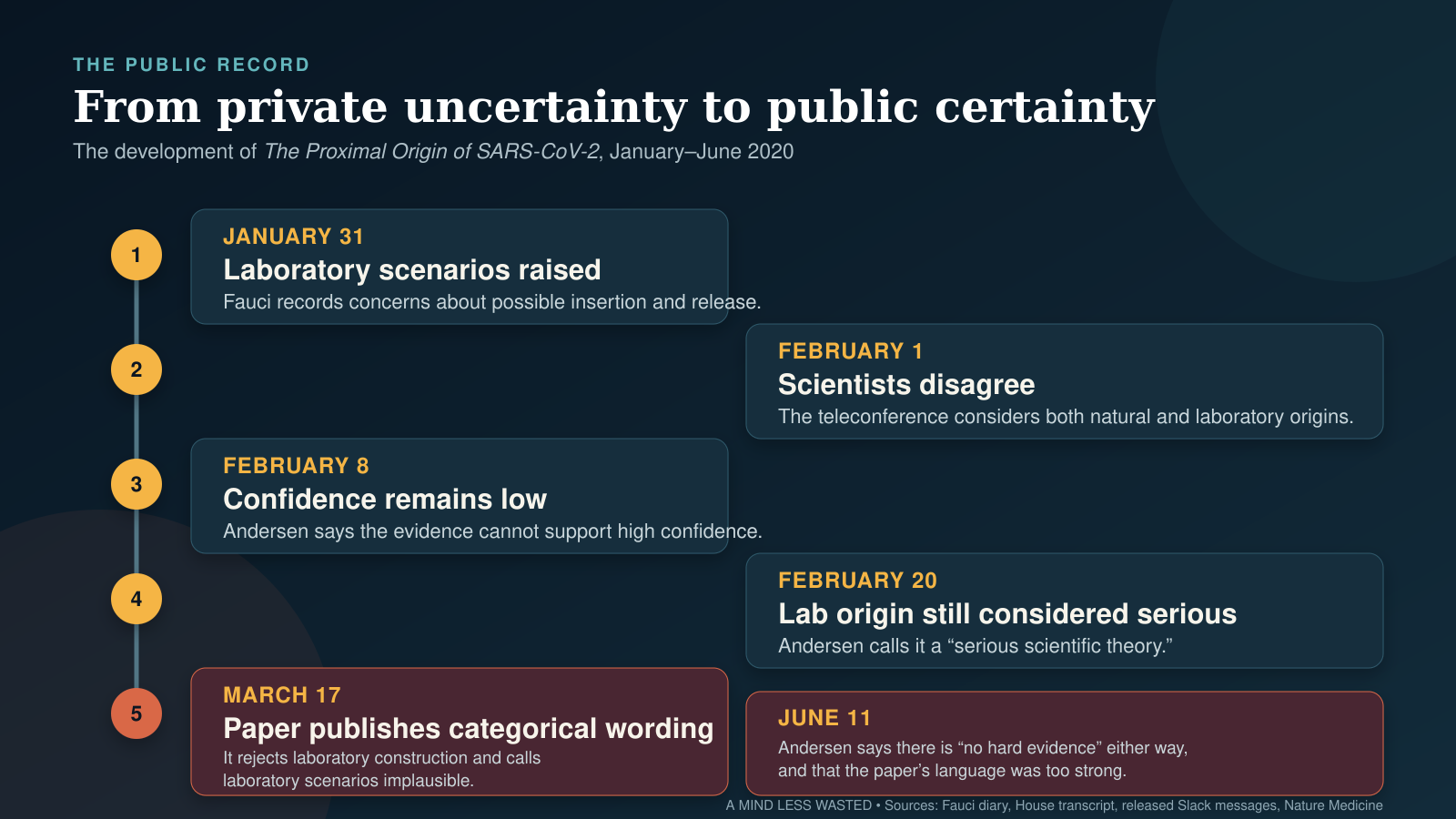
Peter McCullough has claimed that Kristian Andersen attended a meeting where the participants knew the virus came from a laboratory, then helped craft a fraudulent natural-origin story. Two facts are documented: Andersen participated in the February 1, 2020, teleconference with Fauci, Francis Collins, Jeremy Farrar, and other scientists, and he later became the lead author of Proximal Origin. The claim that the participants knew the virus came from a laboratory is not documented.
The diary does not support that claim. On January 26, Fauci wrote that the market appeared to have amplified the outbreak rather than started it. In the next sentence, however, he maintained that the virus had jumped from animals to humans. His belief that the market was an amplifier was not a statement that the virus came from a laboratory.
In a January 31 diary entry, Fauci recorded that scientists on an earlier call were concerned that mutations around the furin cleavage site might have been inserted. They discussed accidental and deliberate release, with “the former being the most likely.” The diary entry deserves to be read in context. “The former” compares accidental release with deliberate release. It does not say that laboratory release was considered more likely than natural emergence.
Fauci’s February 1 notes are just as important. He recorded disagreement within the group. Some scientists believed the feature could arise naturally. Others believed deliberate insertion was possible and that the question required further investigation. The diary shows that a laboratory scenario was being taken seriously in private. It does not record a shared conclusion that the virus came from a laboratory.
Andersen’s own communications create a separate issue. On February 8, he wrote that the group had been trying to disprove laboratory theories but that the evidence was not conclusive enough to justify high confidence in any of the three main hypotheses. On February 20, he told a Nature editor that a laboratory origin remained a “serious scientific theory” that the available data could not dismiss. Those communications and Andersen’s later explanation appear in his House interview transcript.
The published paper included an important caveat, stating that the alternative origin theories could not then be proved or disproved. But it also said the analysis clearly showed that SARS-CoV-2 was not a laboratory construct or purposefully manipulated virus, then concluded that no laboratory-based scenario was plausible. The caveat prevents us from claiming that the authors expressed absolute certainty, but it does not eliminate the conflict between their acknowledged uncertainty and their categorical conclusion.
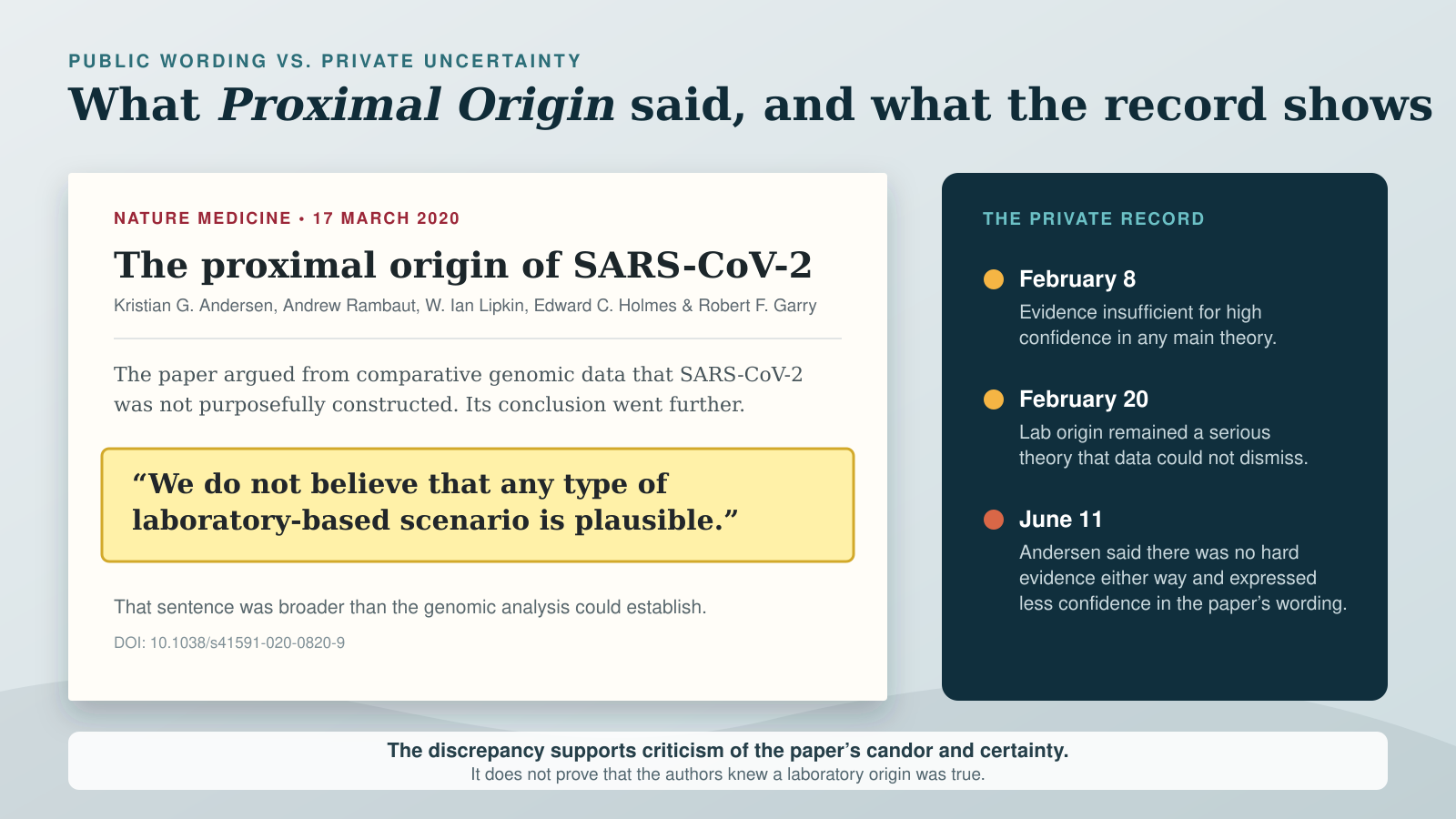
The discrepancy did not disappear after publication. In June 2020, Andersen wrote that there was no hard evidence either way, that deliberate insertion could not be ruled out, and that the paper had been too strong in saying there was “no way.” He continued to believe the virus was natural, but also wrote that, “given no data,” he considered the natural and laboratory scenarios equally probable and was moving back toward the middle.
Andersen has explained that “trying to disprove” a laboratory origin meant trying to falsify his initial hypothesis, which is a normal part of the scientific method. He also testified that Fauci and Collins prompted the group to examine the origin and consider writing a paper, but did not control the drafting. No released document shows Fauci or the authors possessing proof of a laboratory origin or knowingly writing a conclusion they believed was false.
That does not excuse the paper’s language. A paper may reach a defensible conclusion and still state it with more certainty than its evidence permits. The private record supports calling Proximal Origin overconfident and misleading in the way it dismissed laboratory scenarios. It also raises fair questions about whether institutional or political concerns influenced how the conclusion was presented.
The released material demonstrates a serious mismatch between the authors’ private uncertainty and their public confidence. But it does not show that they knowingly presented a conclusion they believed was false or that they fabricated or falsified evidence. It therefore does not establish scientific fraud.
This distinction is not a defense of the paper. It is the evidentiary line. Private uncertainty can expose public overstatement. It cannot prove that the uncertain alternative was correct.
There is still a legitimate question about candor and institutional interest. NIAID had funded coronavirus research through EcoHealth Alliance. Fauci had a particular responsibility to distinguish what the evidence supported, what it could not exclude, and what his agency had funded. His categorical language failed that standard.
His July 29, 2026, Senate appearance did not resolve the matter. Fauci repeatedly invoked the Fifth Amendment and declined to answer questions about the pandemic response and the origin debate. That decision can reasonably affect how people judge his openness. It did not add new virological evidence to the origin question. The hearing occurred, but the scientific evidence did not change with it.
This distinction is essential. Evidence that Fauci was evasive, imprecise, or protecting an institution would be evidence about Fauci’s conduct. It would not establish the physical history of SARS-CoV-2.
The same applies to gain-of-function research. Proving that relevant experiments occurred establishes capability, risk, and the need for honest oversight. It does not prove that one of those experiments produced the pandemic virus.

Before reaching a verdict, we should ask what evidence would make us change it.
What would materially strengthen a laboratory origin?
A securely documented pre-outbreak laboratory sample or sequence close enough to be the immediate progenitor of SARS-CoV-2
Contemporaneous records showing that such a virus was collected, cultured, altered, or passaged
A verified pre-outbreak infection in a researcher, supported by sequence data and a credible chain of transmission
Laboratory incident, inventory, or staff-health records connecting a specific event to the earliest outbreak
What would materially strengthen the zoonotic case?
A pre-outbreak animal or farm sample containing SARS-CoV-2 or its immediate progenitor
Supply-chain records connecting infected wildlife to Huanan or another Wuhan market
More complete early patient and sequence data showing that the outbreak consistently radiated from the wildlife trade
Independent evidence confirming that the early lineages represent separate animal-to-human introductions
What would weaken my present conclusion?
Reliable evidence of an earlier outbreak centered somewhere other than Huanan
Proof that biased case-finding and sampling largely created the apparent market clustering
Laboratory records showing possession of a pre-outbreak virus much closer to SARS-CoV-2 than anything yet found in nature
There is also a more personal test.
Am I treating the failure to find an infected market animal as proof that no infected animal existed? No.
Am I treating China’s failure to release laboratory records as proof that a leak occurred? No.
Am I allowing my judgment of Fauci to substitute for evidence about the virus? No.
Am I treating the Proximal Origin authors’ private doubts as proof that the laboratory hypothesis was true? No.
Would I accept the same quality of inference if it supported the conclusion I was inclined to reject?
That last question is the one we should continue asking.
Where the evidence leaves us
The publicly available scientific evidence currently favors a zoonotic emergence associated with the wildlife trade and the Huanan market. The early-case geography, the sale of susceptible mammals, and the concentration of viral material around the wildlife stalls form a cumulative case that the laboratory hypothesis has not matched with comparable publicly available origin-specific evidence.
My confidence in that conclusion is moderate, not absolute.
We still do not know the immediate animal host. We do not know where the first transmission occurred. And we cannot fully evaluate a research-related incident because China has not provided records needed to investigate it.
The laboratory hypothesis remains possible and deserves continued investigation. Former White House COVID response coordinator Ashish Jha has recently said that he now considers an accidental laboratory leak more likely, explaining that information he encountered while serving in government shifted his assessment toward that possibility. That is a significant informed judgment from someone who had access to government information. But because the underlying evidence has not been made public, his assessment does not provide the missing independently verifiable link connecting SARS-CoV-2 to a Wuhan laboratory before the outbreak.
Experiments that met the broad scientific definition of gain-of-function research did occur. Fauci’s categorical denial relied on a narrower regulatory definition and was misleading to the public. He also spoke too broadly when dismissing the possibility of an accidental laboratory release. China has not provided information that should have been made available for an independent origins investigation years ago.
The newly released diary and messages make the candor problem worse. They show that laboratory scenarios received serious private consideration and that the authors of Proximal Origin expressed more uncertainty than their published language conveyed. They do not show that anyone knew SARS-CoV-2 came from a laboratory.
Each of those facts matters. None completes the missing chain from a Wuhan laboratory to the first human infection.
The evidence does not justify saying that both origins are equally supported. It also does not justify declaring the laboratory hypothesis impossible.
The honest conclusion is narrower:
The published scientific evidence presently provides a stronger affirmative case for a connection to the Huanan market than the publicly available evidence provides for a specific laboratory accident. But that comparison has an important limitation: substantially more relevant market and outbreak data are publicly available than the laboratory records needed to investigate the competing hypothesis.
The circumstantial laboratory case is meaningful and substantial enough to warrant continued investigation, while the publicly available evidence connecting a specific Wuhan laboratory virus, experiment, worker, or incident to the beginning of the outbreak remains missing.
Zoonotic spillover is therefore supported by more publicly available origin-specific evidence. How much greater confidence that should produce is legitimately disputed, particularly while critical laboratory records remain inaccessible.
That conclusion should change if better evidence appears. Until then, we should not confuse suspicion with proof, or uncertainty with equal evidence.
If you value analysis that follows the evidence rather than defending a predetermined conclusion, subscribe to A Mind Less Wasted. You will receive future investigations and critical-thinking articles directly in your inbox.
Follow the Evidence. Think Critically.
Question Everything. Question Yourself
Resources
Huanan market and zoonotic evidence
Worobey et al., “The Huanan Seafood Wholesale Market in Wuhan was the early epicenter of the COVID-19 pandemic,” Science, 2022.
Crits-Christoph et al., “Genetic tracing of market wildlife and viruses at the epicenter of the COVID-19 pandemic,” Cell, 2024.
Pekar et al., “The molecular epidemiology of multiple zoonotic origins of SARS-CoV-2,” Science, 2022.
Bloom, “The Data are Insufficient to Confidently Root the SARS-CoV-2 Phylogenetic Tree,” Molecular Biology and Evolution, 2025.
Liu et al., “Surveillance of SARS-CoV-2 at the Huanan Seafood Market,” Nature, 2023, updated 2024.
Bloom, “Association between SARS-CoV-2 and metagenomic content of samples from the Huanan Seafood Market,” Virus Evolution, 2023.
Débarre, “What we can and cannot learn from SARS-CoV-2 and animals in metagenomic samples from the Huanan market,” Virus Evolution, 2024.
World Health Organization, “Independent assessment of the origins of SARS-CoV-2,” SAGO, 2025.
Wuhan coronavirus research and laboratory hypotheses
Menachery et al., “A SARS-like cluster of circulating bat coronaviruses shows potential for human emergence,” Nature Medicine, 2015.
Hu et al., “Discovery of a rich gene pool of bat SARS-related coronaviruses provides new insights into the origin of SARS coronavirus,” PLOS Pathogens, 2017.
EcoHealth Alliance, “Project DEFUSE proposal,” submitted to DARPA, 2018.
Tyshkovskiy and Panchin, “There is still no evidence of SARS-CoV-2 laboratory origin,” BioEssays, 2021.
Wu, Liu, Liu and Deigin, “Updated analysis to reject the laboratory-engineering hypothesis of SARS-CoV-2,” 2023.
Andersen et al., “The proximal origin of SARS-CoV-2,” Nature Medicine, 2020.
Havens et al., “Dynamics of natural selection preceding human viral epidemics and pandemics,” Cell, 2026.
Gain-of-function definitions and oversight
National Academies, “Gain-of-Function Research: Background and Alternatives,” 2015.
U.S. Government Publishing Office, “A Hearing with Dr. Anthony Fauci,” House Select Subcommittee on the Coronavirus Pandemic, 2024.
Fauci, Andersen, and Proximal Origin
“Tony’s Diary,” official release through Senator Rand Paul’s Senate Reading Room, 2026.
House Committee on Oversight and Accountability, “Transcribed Interview of Kristian Andersen,” June 16, 2023.
“Released Slack messages involving the Proximal Origin authors,” Senate Reading Room, 2026.
National Geographic, “Anthony Fauci: No scientific evidence the coronavirus was made in a Chinese lab,” May 2020.
Senate Committee on Homeland Security and Governmental Affairs, “Testimony of Anthony Fauci,” July 29, 2026.
Intelligence assessments
Office of the Director of National Intelligence, “Unclassified Summary of Assessment on COVID-19 Origins,” 2021.
Associated Press, “CIA believes COVID-19 most likely originated from a lab but has low confidence in its own finding,” January 2025.
Lawrence Livermore National Laboratory, “COVID-19 Lab Modification Conditions Present at WIV,” May 27, 2020, declassified by the Office of the Director of National Intelligence in 2026.