


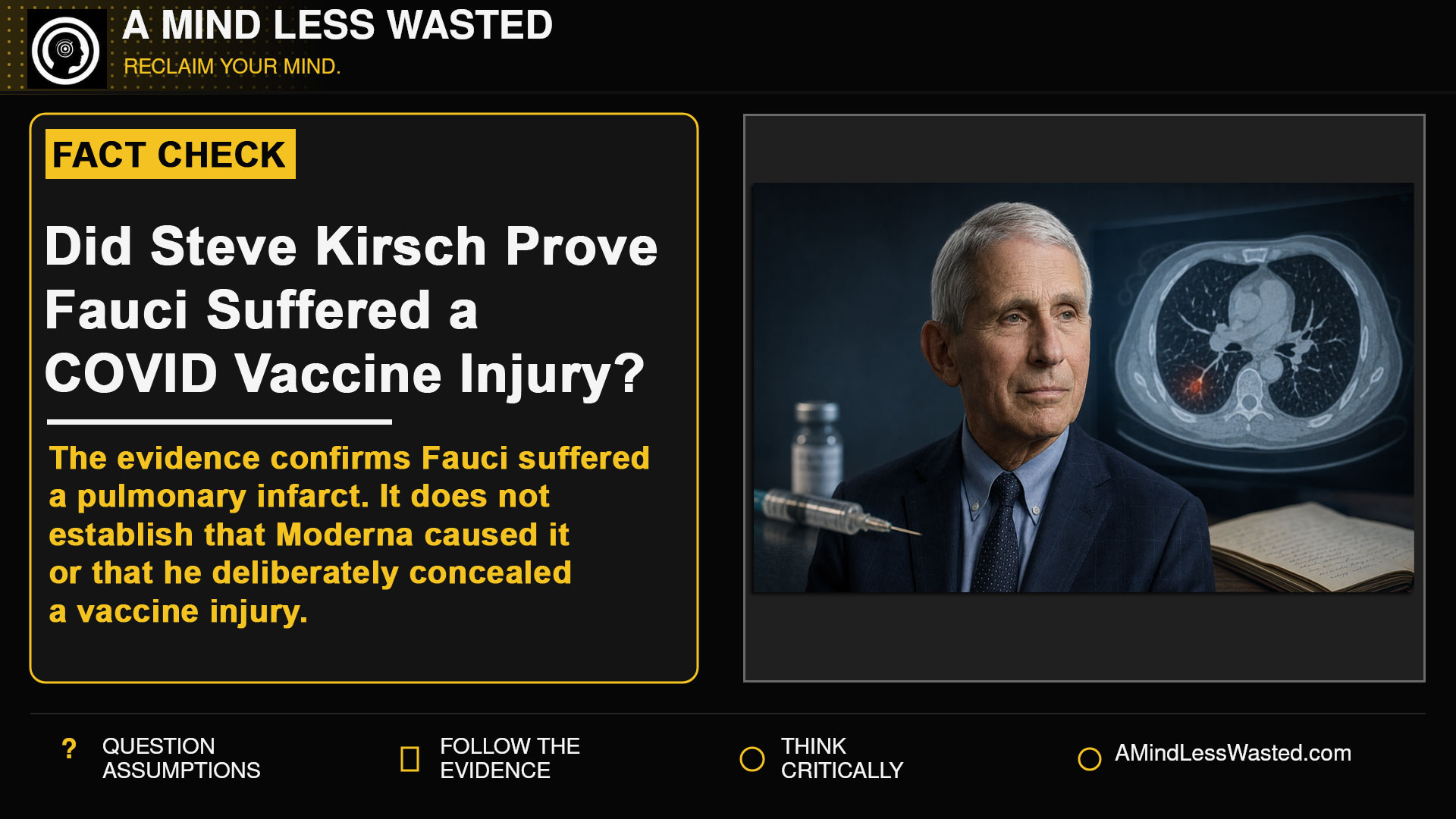
Steve Kirsch begins with a fact.
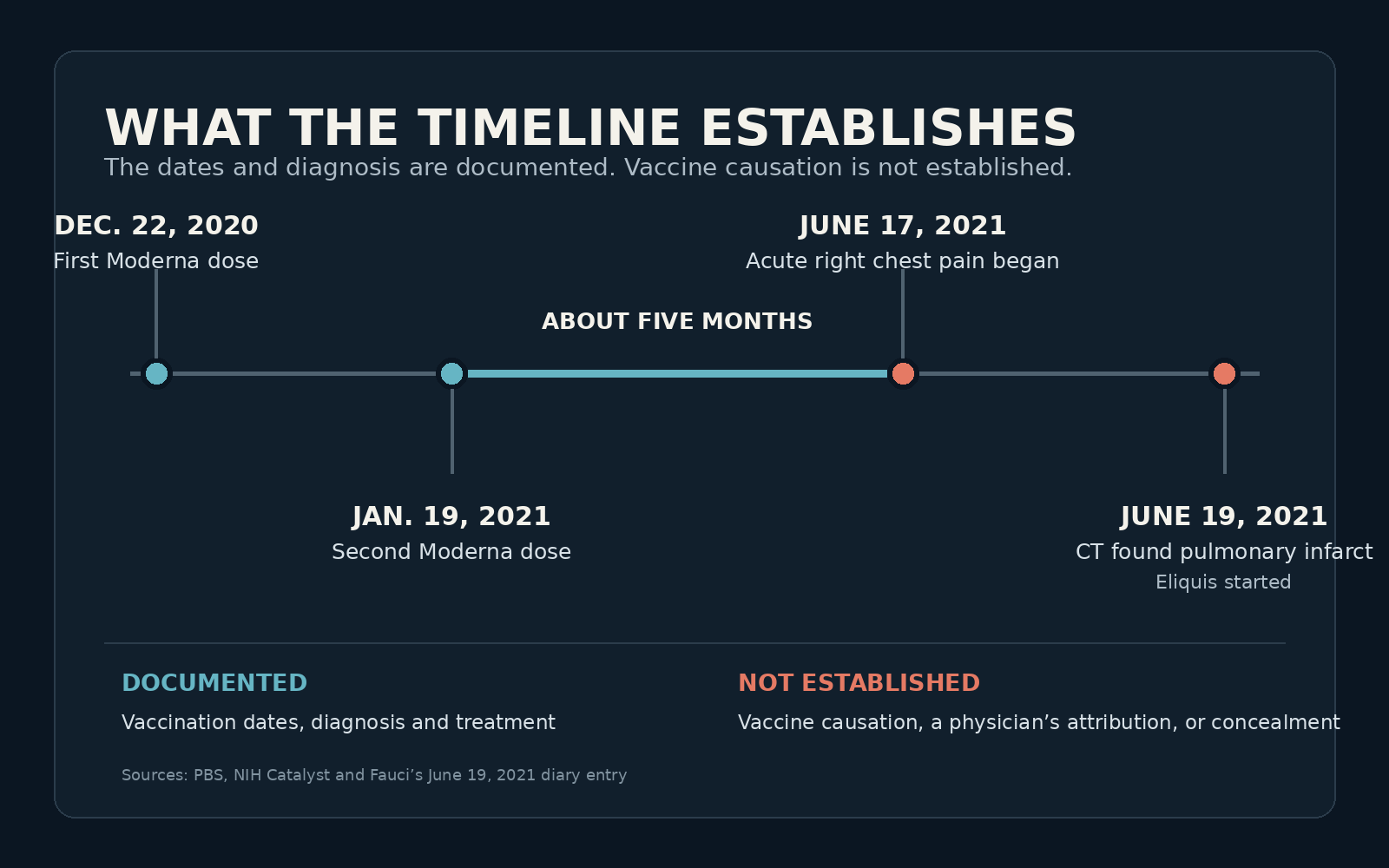
On June 19, 2021, Anthony Fauci noted in his diary that a pulmonary infarct had been found in his right lung via CT scan, and he was put on the anticoagulant Eliquis.
Kirsch makes two much grander accusations from there: that Fauci’s infarct was a result of Fauci’s Moderna vaccination, and that Fauci intentionally concealed the injury in order not to increase vaccine hesitancy.
Does the evidence support the claim?
The evidence provided does not support either claim.
That does not prove the vaccine played no role. The public record cannot rule out a contribution in one individual case. But Kirsch has not shown that it did. He turns “after vaccination” into “because of vaccination,” then uses that unsupported causal claim as evidence of a cover-up.
Our Assessment: Unsupported. Fauci’s pulmonary infarct is documented. The public evidence does not establish that vaccination caused it or that he intentionally concealed a vaccine injury.
What the diary actually says
Senator Rand Paul’s office published a large collection of Fauci’s diary entries on July 25, 2026. The version now available on Paul’s Senate website redacts the medical passage, but the initially released file remains available through an archived copy.
The entry describes a frightening day. Fauci had experienced acute pain in the back of his right chest two days earlier. A CT scan revealed several abnormalities. One radiologist initially worried that a lesion might be lung cancer. Other physicians thought it was more likely inflammatory and recommended another scan in three months.
The scan also showed a pulmonary infarct. According to Fauci’s account, one physician said it was “the only definite thing on the film.” Fauci wrote that he was told to begin Eliquis immediately.
That is meaningful evidence that the infarct occurred. It is not evidence that vaccination caused it.
The entry never mentions a vaccine. It does not say that Fauci suspected one. It does not say that any of his physicians suspected one. It records no diagnosis of a vaccine-related clotting disorder and no instruction to conceal anything.
Kirsch’s argument depends on supplying all of those missing conclusions himself.
A sequence is not a cause
Fauci publicly received his first Moderna dose on December 22, 2020, and received his second dose on January 19, 2021. The pulmonary infarct was identified on June 19, five months later.
That establishes a sequence:
Fauci was vaccinated.
Five months passed.
A pulmonary infarct was found.
It does not establish why the infarct occurred.
Pulmonary infarction is the death of a small area of lung tissue after its blood supply is obstructed, most often because of a pulmonary embolism. Emboli have many possible causes and risk factors, including age, immobility, surgery, cancer, previous clotting, inherited conditions, and other illnesses. Fauci was 80 at the time, and the risk of venous blood clots rises steeply with age. The National Heart, Lung, and Blood Institute notes that risk nearly doubles with each decade after age 40.
That does not prove age caused Fauci’s infarct either. It shows why an individual medical event cannot be assigned to a vaccine from timing alone. A credible assessment would require his relevant medical history, imaging, laboratory findings, other possible risk factors, and the judgment of clinicians who evaluated him.
Kirsch does not provide the medical history, laboratory findings, or clinical assessment needed to connect the infarct to vaccination.
What the VAERS chart can and cannot show
Kirsch’s main evidence is a chart based on the Vaccine Adverse Event Reporting System, or VAERS. His chart says the query found 515 reports coded with “pulmonary infarction,” with the COVID-19 vaccine category overwhelmingly dominant.
The chart can show how many reports Kirsch’s query returned and how they were categorized. It cannot show that COVID vaccines caused those events.
VAERS is an early-warning system. Anyone can report a health event that occurred after vaccination, even when it is unclear whether the vaccine played any role. The reports can help investigators notice patterns worth studying. They cannot, by themselves, determine that a vaccine caused a reported event.
That is not a minor disclaimer. It is the central limitation of the database.
Kirsch’s raw count leaves several essential questions unanswered:
How many doses of each vaccine were administered?
How old and medically vulnerable were the vaccinated populations?
How long was each product in use?
Were the reports medically verified?
How many were duplicates or follow-up submissions concerning the same event?
Did the patients have COVID, cancer, recent surgery, or other clotting risks?
Was the rate higher than the rate among comparable unvaccinated people?
Did the events occur more often than the ordinary background rate?
Kirsch’s chart also groups COVID-19 vaccines rather than isolating Moderna. That matters because mRNA vaccines and adenoviral-vector vaccines do not have identical clotting safety profiles. Fauci received Moderna. A count that combines different COVID vaccine products cannot establish a Moderna-specific risk.
VAERS also warns that its public data now include some secondary reports from additional sources concerning the same patient, vaccine, and dose. Those additions do not necessarily represent separate adverse events. A count from a public query should not be assumed to mean the same number of unique, confirmed cases.
COVID vaccines present an unusual comparison problem. Under the emergency-use authorizations, healthcare providers had to report all serious adverse events after vaccination regardless of whether vaccination caused them. COVID vaccination also involved hundreds of millions of doses, exceptional public attention, and intense safety surveillance. Raw report counts across different vaccines and different eras therefore cannot be interpreted as comparative incidence rates or causal risks.
A large number of reports can identify a signal to investigate. It cannot tell us whether a vaccine caused one person’s infarct.
Kirsch’s own chart appears to plot small nonzero counts for other vaccine categories, including influenza and pneumonia, despite his statement that COVID vaccines are the only vaccines linked to such reports. But even if every other category showed zero, his logic would still fail. A report does not prove causation, and the absence of a report does not prove that an event has never occurred.
Five months is not a validated risk window
Kirsch goes on to claim that Fauci’s five-month timeframe aligns with the onset reports from VAERS.
The graph he shares illustrates a wide array of events reported, ranging from the day of vaccination to several years later, including cases where the timing is unknown. If we consider any point within that timeline as proof, then the test is bound to succeed. Almost any subsequent medical event could be deemed “consistent.”
Before diving into individual cases, it’s essential to establish a meaningful risk window. Researchers typically look for a plausible biological timeframe and check if the event occurs more frequently during that period compared to a relevant comparison group or timeframe.
However, Kirsch doesn’t do this. He simply notes that some reports happened around the five-month mark and takes that as validation.
Kirsch is on firmer ground when he says events with long onset intervals are less likely to be reported. The CDC notes that events occurring within days or weeks of vaccination are more likely to reach VAERS than events with longer onset intervals. But that reporting bias does not establish the cause of an event or validate five months as a risk window.
Kirsch provides no estimate of how many reports were missed, no biological reason for selecting five months, and no comparison with the background rate. Underreporting cannot turn his onset graph into evidence that Moderna caused Fauci’s infarct.
What stronger evidence shows
Comparative epidemiological studies with defined risk windows and population denominators are better suited to assess pulmonary-embolism risk than raw reports without a comparison group. These studies can still miss extremely rare reactions or effects confined to particular subgroups, so their limitations matter.
Most of this research measures pulmonary embolism, not pulmonary infarction as a separate outcome. It is relevant because pulmonary embolism is the most common cause of pulmonary infarction, but it is not a direct study of infarction itself. Even with that limitation, the available evidence does not support calling pulmonary infarction a known Moderna side effect.
A 2024 National Academies review examined the evidence on deep-vein thrombosis and pulmonary embolism after COVID vaccination. For Moderna, the committee concluded that the available evidence was inadequate to accept or reject a causal relationship. That careful language reflects limitations in the research. It does not mean causation was shown. The two studies available to the committee did not find an increased risk after Moderna vaccination.
A later nationwide Swedish cohort study included more than 7.5 million people and examined pulmonary embolism across risk windows extending to 180 days. In its fully adjusted analyses, it found no increased risk after Moderna vaccination. It did find modest increases after a first Pfizer dose in the 28- through 180-day windows, after a third Pfizer dose in the 90- and 180-day windows, and after a first AstraZeneca dose across several windows.
The authors cautioned that prioritizing frailer people for early vaccination could have introduced selection bias or residual confounding. Pfizer was used about six times as often as Moderna, so the Moderna evidence came from a smaller exposure group.
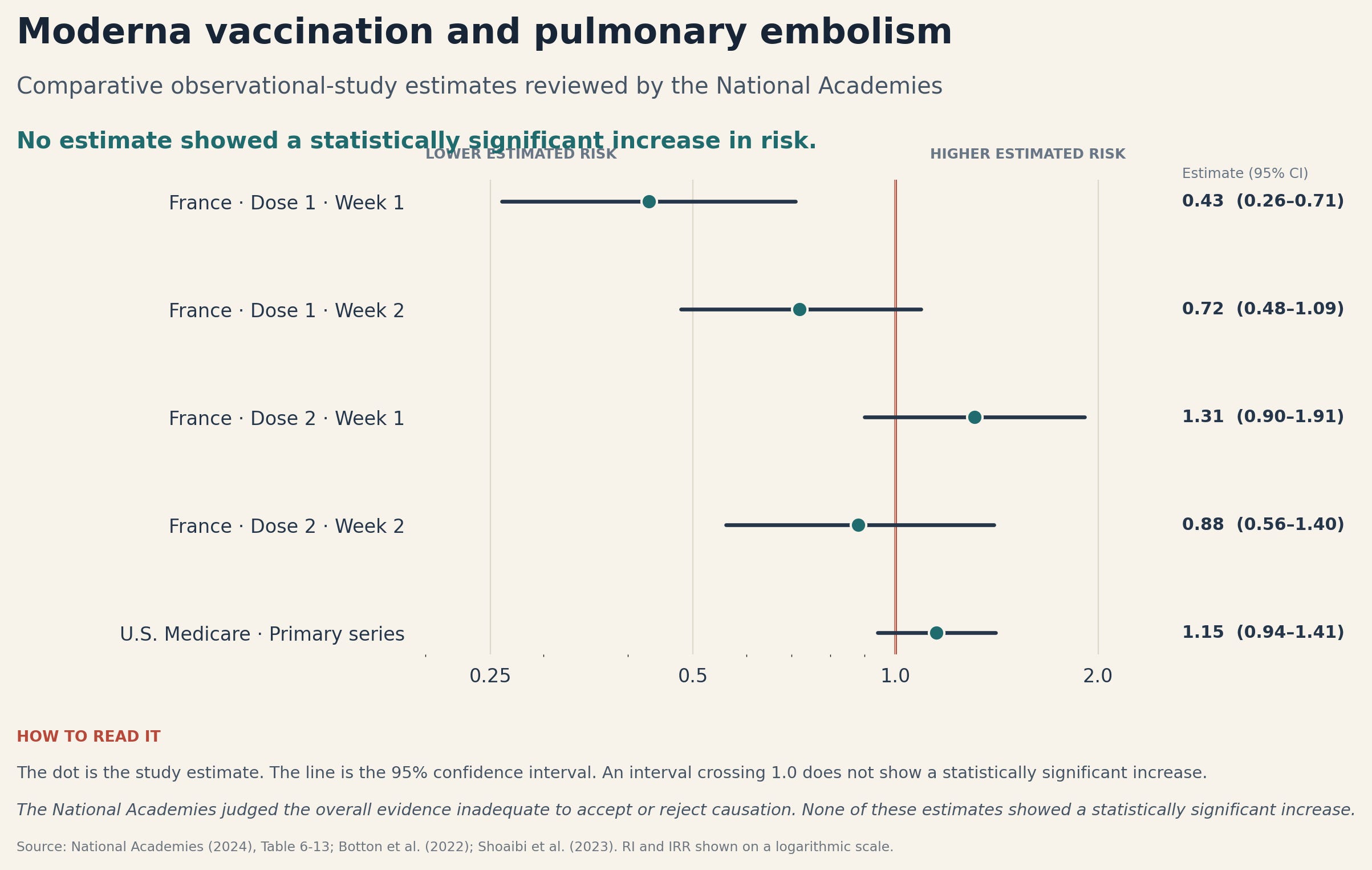
That 180-day analysis is especially relevant because Fauci’s infarct was discovered about five months after his second dose.
A U.S. Medicare self-controlled study of people 65 and older reported an adjusted incidence rate ratio of 1.15 after Moderna’s primary series, with a 95% confidence interval from 0.94 to 1.41. That result was not statistically significant. The Moderna booster estimate was 0.87, with a 95% confidence interval from 0.79 to 0.96.
The same study found a modest statistically significant increase after Pfizer’s primary series, with an estimate of 1.19 and a 95% confidence interval from 1.03 to 1.38. Its results were therefore not uniformly null across mRNA products. The study’s medical-record review also confirmed only 45% of the pulmonary-embolism cases identified from billing codes, showing how outcome misclassification complicated these estimates.
None of these studies can prove that vaccination played no role in every individual event. Rare adverse reactions can be difficult to identify, and population-level findings do not substitute for a patient’s full medical record. But they are far more informative than raw VAERS counts, and they do not establish the risk Kirsch claims is already known.
The current FDA prescribing information for Spikevax, Moderna’s COVID vaccine, warns about myocarditis and pericarditis. It does not list pulmonary infarction or pulmonary embolism as an established adverse reaction.
A real clotting syndrome, attached to the wrong evidence
COVID vaccines have caused serious adverse effects. TTS is one example, but it does not fit the public evidence in Fauci’s case.
Thrombosis with thrombocytopenia syndrome, or TTS, is a rare disorder involving unusual blood clots together with a low platelet count. It has been causally linked to the Johnson & Johnson vaccine and to AstraZeneca’s vaccine outside the United States, generally with onset within days to a few weeks.
The National Academies found that the evidence favors acceptance of a causal relationship between the Johnson & Johnson vaccine and TTS. For Pfizer and Moderna, it found that the evidence favors rejection of a causal relationship.
This shows how a suspected safety signal is evaluated: investigators identify a specific syndrome, a defined risk window, a concentration in particular vaccine products, and a plausible clinical mechanism. In the Johnson & Johnson case, that investigation ultimately supported causation.
In Fauci’s diary, he mentions a pulmonary infarct occurring five months after receiving a Moderna shot. However, there’s no mention of low platelets, TTS, or any other recognized vaccine-related clotting issue.
Labeling all post-vaccination clotting incidents as the same “known side effect” blurs crucial distinctions that are vital for understanding medical causation.
The concealment claim rests on another assumption
Even if Kirsch had established that vaccination caused Fauci’s infarct, he would still need evidence for his accusation that Fauci deliberately stayed silent to avoid fueling vaccine hesitancy.
He presents no such evidence.
The subject was raised directly at Fauci’s July 29 Senate hearing. Senator Ron Johnson asked whether the pulmonary infarction could have been caused by COVID-19 vaccination. Fauci declined to answer, invoking the Fifth Amendment, as he did repeatedly throughout the hearing. NOTUS reported the exchange.
Fauci’s refusal leaves his answer unknown. It does not establish that the vaccine caused the infarct, that Fauci believed it did, or that he deliberately concealed that belief.
Kirsch presents no statement from Fauci attributing the infarct to vaccination and no medical opinion in the diary doing so. He provides no message instructing anyone to suppress a diagnosis, no record of Fauci denying it when asked, and no evidence of his alleged motive.
Not publicly announcing a private medical condition is not proof of concealing a vaccine injury, particularly when the available record does not show that Fauci or his doctors considered it one.
The later redaction shows that the Senate office changed the publicly available file after the original release. It does not show who requested the change or why. It says nothing about what caused the infarct or what Fauci believed in 2021.
This point does not require anyone to trust Fauci. His conduct on other pandemic questions can be evaluated on its own evidence. Distrust of a person is not a substitute for proof of a particular medical cause or a particular act of deception.

Are we making the opposite mistake?
Saying Kirsch has not proved vaccine causation is not the same as saying Moderna definitely played no role.
The National Academies did not conclude that Moderna cannot cause pulmonary embolism. It concluded that the evidence was inadequate to accept or reject causation. The Medicare primary-series estimate was not statistically significant, but its confidence interval included both no increase and a potentially meaningful increase. VAERS may also contain genuine vaccine injuries, even though raw reports alone cannot tell us which ones they are.
There is also a fair ethical question: Given Fauci’s unusually public role, should he have disclosed a serious clotting event that occurred months after vaccination? People can reasonably disagree. But that is separate from Kirsch’s factual claim that Fauci knew the vaccine caused the infarct and concealed it to reduce vaccine hesitancy. The evidence presented does not establish either premise.
Our conclusion therefore has to remain narrow. The public evidence does not establish that Moderna caused Fauci’s infarct. It also does not allow us to prove that vaccination played no role.
What would change our conclusion?
This assessment should change if stronger evidence emerges.
Relevant evidence might include:
Medical records showing that Fauci’s treating physicians diagnosed a vaccine-related mechanism
Laboratory or pathology findings consistent with a recognized vaccine-induced clotting syndrome
Comparative epidemiological evidence showing an increased Moderna-associated risk of pulmonary embolism or infarction around five months
A message, diary entry or testimony showing that Fauci believed the vaccine caused the event and deliberately hid that conclusion from the public
Kirsch supplies none of these.
The bottom line
On June 19, 2021, a CT scan found that Anthony Fauci had a pulmonary infarct. That fact comes from his diary and should not be minimized.
The diary does not identify Moderna as the cause. Kirsch’s VAERS chart cannot establish that connection, and his onset graph does not validate a five-month causal window. The comparative studies discussed here did not detect a statistically significant increase in pulmonary-embolism risk after Moderna, while the National Academies judged the overall evidence inadequate to accept or reject causation.
The leap from “Fauci had a pulmonary infarct after vaccination” to “Fauci suffered a vaccine injury” is unsupported. The further claim that Fauci knew the vaccine caused it and hid that conclusion to protect vaccine confidence is speculation.
The public record cannot rule out a vaccine contribution to one individual event. Kirsch’s evidence does not establish one.
It certainly does not establish a cover-up.
If this helped you see how a documented event can be turned into a causal claim the evidence does not support, subscribe to A Mind Less Wasted. And if someone you know has encountered the claim that Fauci hid a vaccine injury, send them the evidence.
Resources
Archived copy of Fauci’s diary
National Academies: Deep-vein thrombosis and pulmonary embolism
National Academies: Thrombosis with thrombocytopenia syndrome
Swedish nationwide study of pulmonary embolism after COVID vaccination
U.S. Medicare study of thromboembolic events after COVID vaccination
National Heart, Lung, and Blood Institute: Venous thromboembolism