



Ask a dog to choose between two cups, and he will study your face, follow your hand, and make a decision. Ask a cat the same question and she may solve the problem, inspect the researcher, wash one paw and leave.
The obvious conclusion is that the dog is smarter.
The less obvious conclusion is that we may have designed an intelligence test that rewards behaving like a dog.
This is one of the problems scientists face when they study animal minds. Dogs and cats cannot explain how they reached an answer. They cannot tell a researcher, “I followed your finger because I understood that you were directing my attention,” or, “I understood perfectly, but your snack was inadequate.” Researchers have to infer what the animal knows from what it does.
That makes the original question, Can dogs and cats think critically?, harder than it sounds.
First, what do we mean by critical thinking?
When we use the term for people, we usually mean more than solving a puzzle. Critical thinking includes weighing evidence, comparing explanations, noticing contradictions, reconsidering assumptions, and recognizing when our information is incomplete.
There is no good evidence that dogs or cats can examine an argument, question the reliability of a source, or consciously audit their own beliefs. Your cat may look judgmental, but that is not the same as peer review.
What pets do show are some of the smaller abilities from which more complex thinking is built: memory, inference, expectation, flexible learning, impulse control, information seeking, and sensitivity to cause and effect. Scientists study those pieces one at a time.
And once they do, the familiar household stereotypes become considerably less reliable.

The dog is reading the room
Dogs are unusually attentive to human beings. They follow our gaze and gestures, distinguish some of our emotional expressions, and notice where our attention is directed. Point toward the cup containing food and many dogs understand that the gesture refers to something beyond the finger itself. Anyone who has watched a person point at an object while a cat stares directly at the finger will appreciate that this is not a trivial accomplishment.
Some of that sensitivity appears remarkably early. In a 2021 study of 375 eight-week-old puppies, the puppies successfully used human gestures despite having had limited experience with people. Within that group, genetic factors accounted for more than 40 percent of the variation in point-following and attention to human faces.
Dogs did not merely learn to tolerate us. Over many generations, they became specialists in us.
That specialization can look a lot like reasoning because sometimes it is. In one experiment, dogs watched a reward being placed behind one of two barriers. On other trials, they were prevented from seeing where it went. When they had not seen the hiding place, the dogs were more likely to seek additional visual information before choosing. The researchers cautiously described this as evidence consistent with a basic form of metacognition: the dogs behaved differently when they lacked information.
That does not prove a dog sits there thinking, I should reserve judgment until I have reviewed the evidence. Simpler learned strategies may produce some of the same behavior. Still, the dog recognized uncertainty well enough to investigate before committing. Plenty of internet arguments would improve immediately if humans did the same.
Some dogs also display startling powers of inference. Rico, a border collie studied in 2004, could retrieve more than 200 objects by name. When researchers placed a new object among familiar ones and used an unfamiliar word, Rico often selected the new object, apparently reasoning by exclusion: I know the names of those seven, so the new sound probably means this one. He could still retrieve some of the newly named objects four weeks later. It was an exceptional case, not a description of the average dog, but it showed that at least some dogs can do more than memorize commands. They can use what they already know to narrow down an answer. The Rico study appeared in Science.
Dogs are also so good at reading people that we sometimes mistake their skill for something else.
Consider the famous guilty look: lowered head, tucked tail, averted eyes, perhaps a slow retreat from the scene of a murdered sofa cushion. It certainly looks like remorse. In Alexandra Horowitz’s 2009 experiment, however, dogs showed more “guilty” behavior when their owners scolded them, including dogs that had obeyed and had not eaten the forbidden treat. The expression tracked the owner’s reaction better than the dog’s actual offense.
The dog may not have been confessing. It may have been reading the prosecutor.
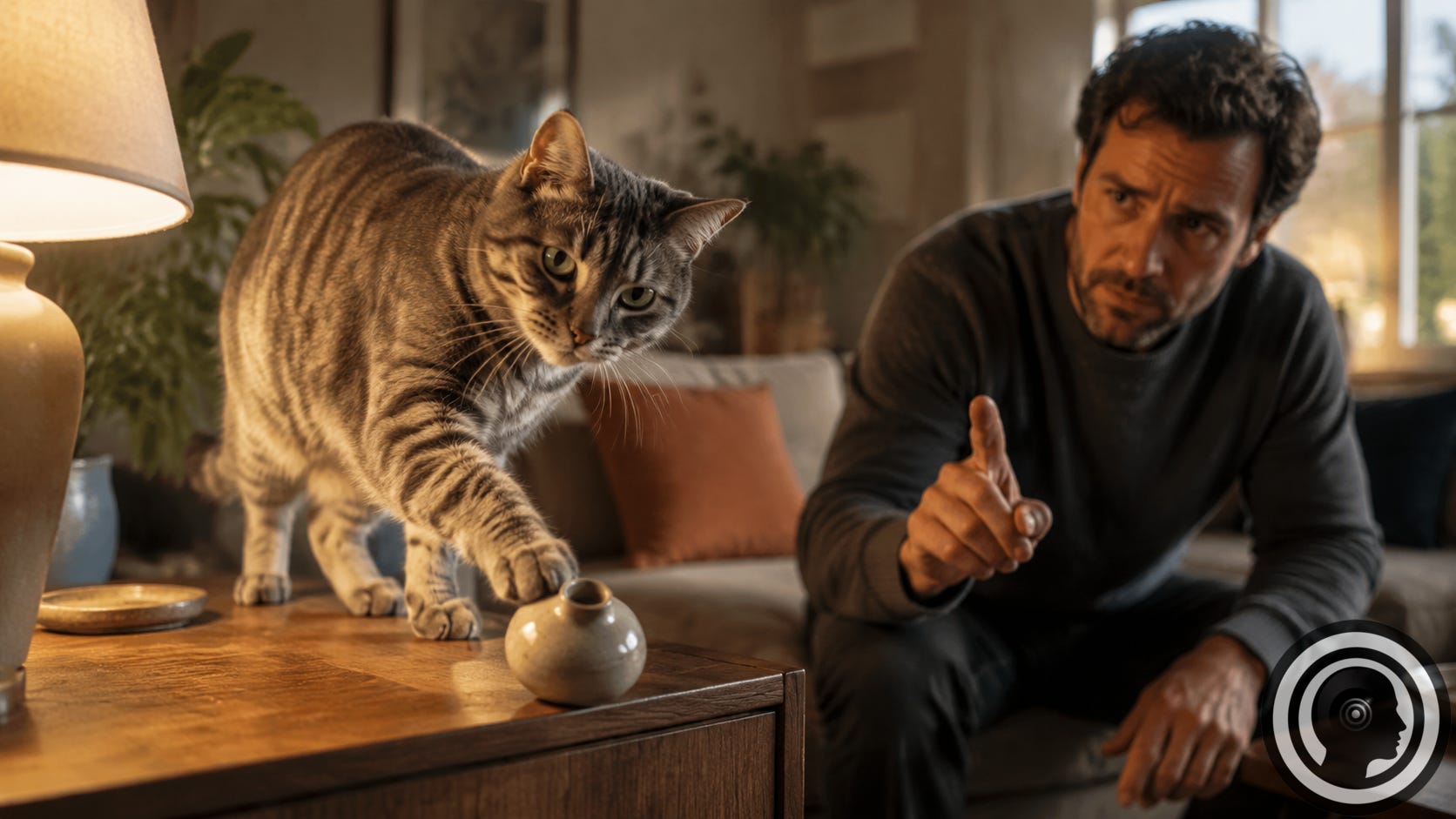
The cat received your message
Cats have a public-relations problem. A dog’s intelligence is easy to see because dogs often demonstrate it in cooperation with us. A cat may possess the information and see no reason to provide a live demonstration.
In a 2013 study, cats heard recordings of three strangers followed by their owner, all calling the cat’s name while out of sight. The cats became less responsive as the unfamiliar voices continued, then showed a renewed reaction to the owner’s voice. Their responses were usually small movements of the ears or head, not an enthusiastic reunion.
The finding was not that cats come when called. Let’s keep this within the boundaries of credible science. It was that they could recognize who was calling.
Research published in 2019 found that cats could also distinguish their own names from other words, even when an unfamiliar person spoke. This does not show that a cat understands a name as a human understands personal identity. The name may simply predict food, affection, play, a carrier appearing from the closet or some other event worth monitoring. But the cat is not necessarily ignoring you because the sound failed to register. Sometimes the message has been received and the request has been denied.
Cats also appear to learn more about household conversations than we deliberately teach them. In a 2022 study, household cats heard the name of a familiar companion cat and then saw a photograph. They looked longer when the name and face did not match, suggesting that they had learned which name belonged to which cat through ordinary life, without formal training.
Then there is the matter of surveillance.
Researchers placed cats in a room with speakers in different locations. The owner’s voice first came from one place and then suddenly from another. The cats appeared more surprised when their owner seemed to have teleported across the room, suggesting that they had been mentally tracking the unseen owner’s location.
Your cat may appear to be asleep. Your cat may also know exactly where you are.
Feline reasoning is not limited to keeping tabs on the staff. In a 2016 experiment, researchers shook a container that either rattled or remained silent, then turned it over. Cats looked longer when events violated the expected relationship between sound and object, such as a silent container suddenly producing an object. The results suggested that cats could use sound to predict the presence of something they could not see.
No, this does not mean cats understand Newtonian physics. It does mean they notice when the physical world fails to behave as expected. For an animal that often hunts prey it cannot see, reasoning from faint sounds is a useful talent.
More recently, a small 2024 experiment found that cats quickly associated two invented words with two animated pictures. When the pairings were switched, they looked longer, as if the change violated what they had just learned. The study involved only 31 cats and does not give them human language, but it adds to the evidence that cats are quietly collecting associations while we assume they are thinking about curtains.
They may be thinking about the curtains too. Both things can be true.
Are we giving them the wrong exam?
Comparing dogs and cats is tempting, but cognition is not one race with one finish line. A species can be excellent at social communication and less impressive at physical problem-solving. Another can be an expert at spatial tracking but uninterested in following instructions from a stranger holding a clipboard.
In a 2005 comparison, both dogs and cats used human pointing to locate hidden food, with no significant difference between them. When the food was made inaccessible, however, dogs were more likely to look toward a person and solicit help. Cats kept working on the problem more independently.
What does that tell us? Perhaps dogs are better communicators. Perhaps cats are more persistent. Perhaps dogs treat humans as partners while cats treat us as furniture capable of opening cans. The behavior is real, but the label we attach to it requires care.
A 2023 study illustrates the problem neatly. Dogs outperformed cats at following a distant pointing gesture, but cats also made far fewer choices and became less willing to participate as the laboratory trials continued. When tested at home, their willingness did not decline in the same way. The researchers discussed stress, motivation, restraint and the unfamiliar setting as possible influences.
So a laboratory result may measure several things at once: comprehension, attention, confidence, hunger, comfort and willingness to humor a graduate student.
This does not mean every failed test hides a secret feline genius. It means that a score is not pure intelligence poured into a measuring cup. Reviews of animal-cognition methods warn that attention, motivation, personality, sensory abilities and test design can all influence performance. A fair test has to fit the animal well enough to measure the ability it claims to measure.
If intelligence were judged by following a pointed finger, dogs would do very well. If the test involved locating a nearly silent movement behind a wall, the cat might demand a recount. If it required identifying the contents of a trash can from across the yard, the dog would regain the lead.
Humans would be eliminated in the first round.
So, can they think critically?
Not in the full human sense, as far as the evidence shows. Dogs and cats do not appear to evaluate formal arguments, compare published sources or deliberately challenge an ideology. They do, however, remember, infer, predict, seek information, and revise their behavior when circumstances change. Those are genuine cognitive abilities, and some are ingredients of critical thinking.
The most accurate answer is that pets possess forms of practical reasoning suited to their lives.
A dog’s world has been shaped by cooperation with people. Reading our faces, hands, voices, and attention can be more useful than solving an abstract mechanical puzzle. A cat’s world rewards spatial awareness, patience, sound-based inference and independent action. Neither mind is a smaller copy of ours, and the two are not smaller copies of each other.
The interesting question, then, is not whether a pet can think like a person. It is whether we can design a question that allows the animal to think like itself.
Your dog is reading you. Your cat heard you the first time. And both may be revealing as much about the intelligence of the examiner as the intelligence of the pet.
The dog reads the room. The cat reads the room and decides whether the room deserves a response.
If this made you look at your pets a little differently, subscribe to A Mind Less Wasted. There are always more questions hiding in plain sight—and we’re going to keep asking them.
Selected research and sources
Emily E. Bray et al., “Early-emerging and highly heritable sensitivity to
human communication in dogs”, Current Biology, 2021.
Julia Belger and Juliane Bräuer, “Metacognition in dogs: Do dogs know they could be wrong?”, Learning & Behavior, 2018.
Juliane Kaminski, Josep Call and Julia Fischer, “Word learning in a domestic dog: Evidence for ‘fast mapping’”, Science, 2004.
Alexandra Horowitz, “Disambiguating the ‘guilty look’”, Behavioural Processes, 2009.
Ádám Miklósi et al., comparison of dogs’ and cats’ use of human visual signals, Journal of Comparative Psychology, 2005.
Atsuko Saito and Kazutaka Shinozuka, “Vocal recognition of owners by domestic cats”, Animal Cognition, 2013.
Atsuko Saito et al., “Domestic cats discriminate their names from other words”, Scientific Reports, 2019.
Saho Takagi et al., “There’s no ball without noise: Cats’ prediction of an object from noise”, Animal Cognition, 2016.
Saho Takagi et al., “Socio-spatial cognition in cats: Mentally mapping owner’s location from voice”, PLOS ONE, 2021.
Saho Takagi et al., “Cats learn the names of their friend cats in their daily lives”, Scientific Reports, 2022.
Saho Takagi et al., “Rapid formation of picture-word association in cats”, Scientific Reports, 2024.
Attila Salamon et al., direct comparison of dogs and cats using human pointing gestures, Scientific Reports, 2023.
Michèle N. Schubiger, Claudia Fichtel and Judith M. Burkart, review of validity and confounding factors in animal-cognition tests, Frontiers in Psychology, 2020.