


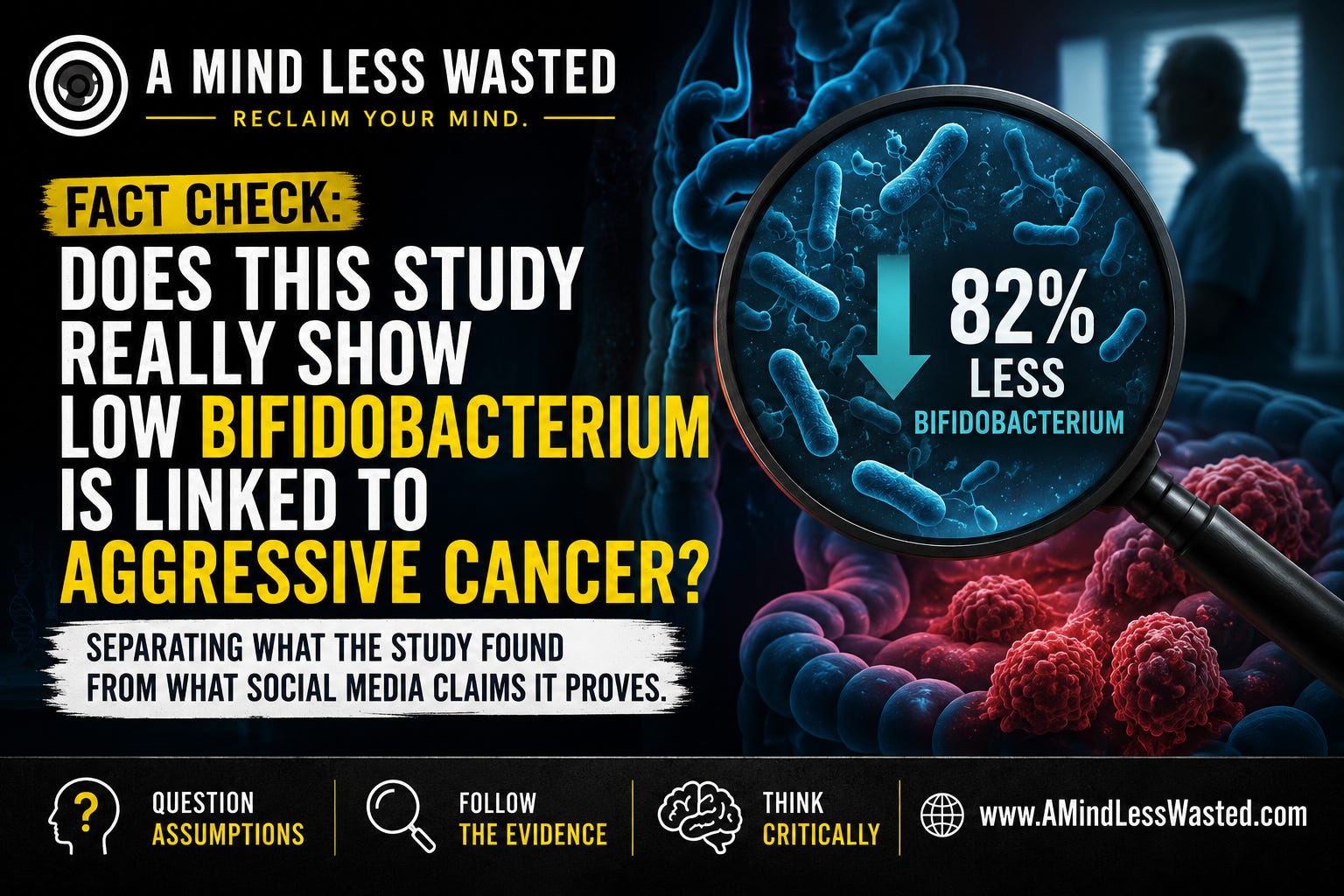
A recent article by Nicolas Hulscher at The Focal Points titled “New Study: Aggressive Cancer Patients Had 82% Less Bifidobacterium in Their Gut Compared With Healthy Adults” highlights a newly published microbiome study and suggests that aggressive cancers are associated with profound disruptions in beneficial gut bacteria.
The article makes several factual claims:
Aggressive cancer patients had approximately 82% lower relative abundance of Bifidobacterium than controls.
They also had lower levels of Collinsella and Faecalibacterium and higher levels of Bacteroides.
These bacterial groups are involved in immune regulation and intestinal barrier function.
The findings suggest aggressive cancer is associated with a disrupted gut microbiome.
The results support future research into microbiome-based diagnostics and therapies.
Let’s examine each claim.
If you enjoy evidence-based fact checks that separate headlines from what the research actually shows, consider subscribing to A Mind Less Wasted.
📬 Subscribe to receive future articles directly in your inbox.
🔄 Share this article if you know someone who values critical thinking.
Claim 1: Aggressive cancer patients had 82% less Bifidobacterium.
Assessment: Accurate, but the wording can easily be misunderstood.
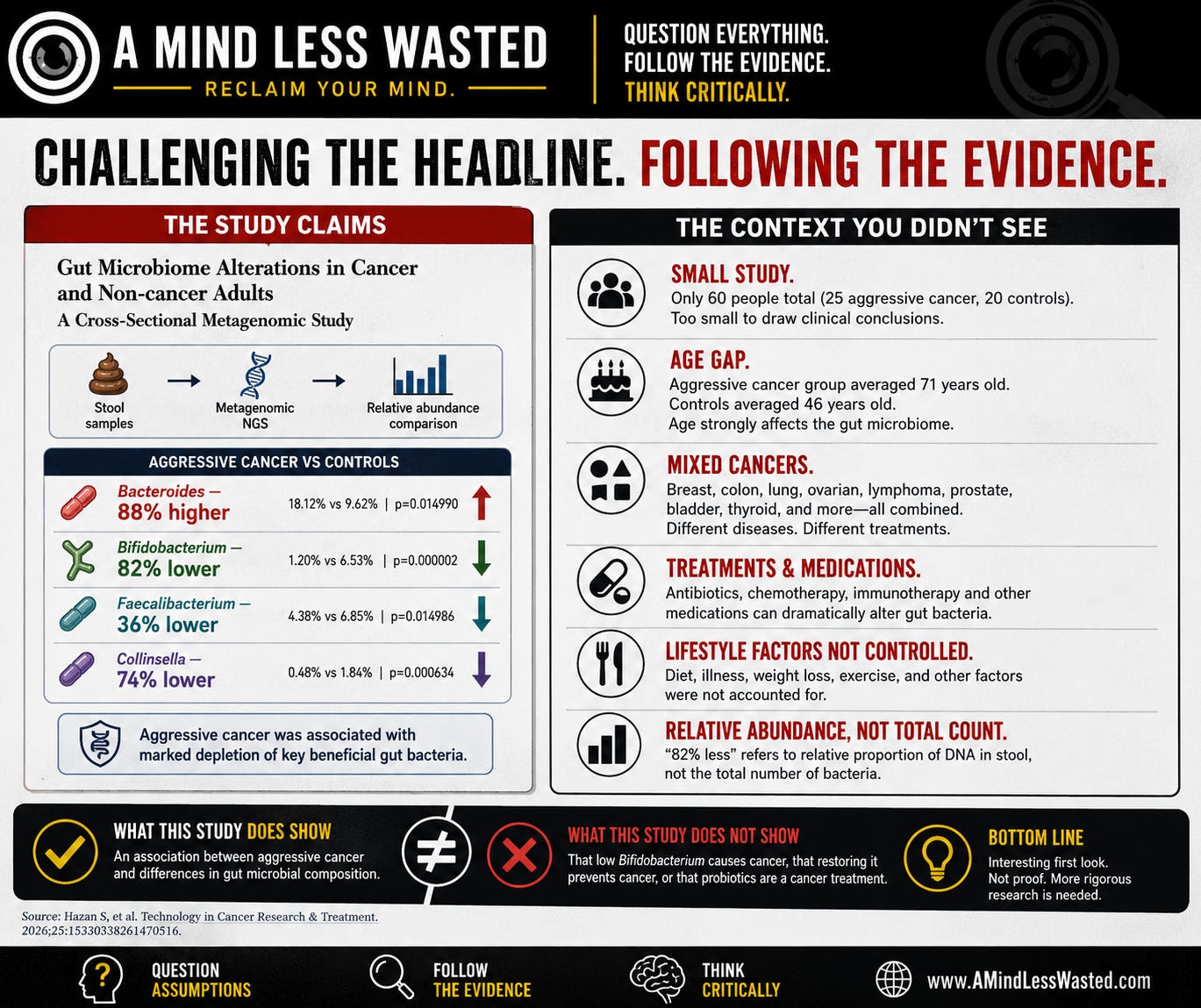
The published study reported an average relative abundance of Bifidobacterium of 1.20% in the aggressive cancer group versus 6.53% in the control group. That corresponds to roughly an 82% lower relative abundance.
However, this does not mean patients had “82% fewer Bifidobacterium“ in an absolute sense. The researchers measured the relative proportion of bacterial DNA in each stool sample, not the total number of bacteria present.
Relative abundance is compositional: if one bacterial group expands or contracts, the percentages of all other groups change as well. That means an 82% difference in relative abundance is not the same as an 82% loss of bacteria.
Claim 2: Other bacterial differences were statistically significant.
Assessment: Accurate.
The study also reported:
lower Collinsella
lower Faecalibacterium
higher Bacteroides
These differences reached statistical significance within this dataset.
Again, these are observations, not evidence that the bacteria caused the cancer.
Claim 3: These bacteria play important roles in immune function.
Assessment: Supported by existing research.
Numerous studies have associated Bifidobacterium and Faecalibacterium with immune regulation, intestinal barrier integrity, and anti-inflammatory activity. Researchers are actively investigating how the gut microbiome may influence responses to cancer immunotherapy.
While these associations are biologically plausible, none establish that altering these bacteria alone changes cancer risk or progression.
That does not establish that simply increasing these bacteria prevents or treats cancer.
Claim 4: Aggressive cancer is associated with a disrupted microbiome.
Assessment: Reasonable, but only as an association.
This was a cross-sectional observational study involving just 60 participants.
Because microbiome samples were collected after participants already had cancer, the study cannot determine whether:
microbiome changes contributed to cancer,
cancer altered the microbiome,
cancer treatments altered the microbiome,
or another factor affected both.
Association should never be mistaken for causation.
In fact, reverse causation is entirely plausible. Advanced cancer, reduced appetite, weight loss, inflammation, medications, chemotherapy, and antibiotics can all alter the gut microbiome. This study cannot distinguish among these possibilities.
Claim 5: The findings support future microbiome research.
Assessment: Yes.
This is actually one of the most appropriate conclusions from the paper.
The authors themselves do not claim they discovered the cause of aggressive cancer.
Instead, they recommend larger prospective studies to determine whether these microbial signatures could someday become useful biomarkers or therapeutic targets.
What the Study Did Not Show
One reason this distinction matters is that social media posts have gone far beyond the evidence. Many now claim that COVID-19 vaccination eliminates bifidobacteria, sometimes asserting that vaccinated people have “zero bifidobacteria” for months afterward. Others extend that claim to autism, cancer, Alzheimer’s disease, and numerous other conditions.
This study does not support those conclusions. It did not compare vaccinated and unvaccinated individuals, did not measure the effect of vaccination on the microbiome, and did not conclude that vaccines deplete bifidobacteria. Whatever future research may discover about the microbiome and vaccination, those claims cannot be attributed to this paper.
Important Limitations Missing From the Article
While The Focal Points accurately reports several numerical findings, readers should also know about important limitations discussed by the authors themselves.
The study was very small.
Only 60 individuals participated.
That’s appropriate for generating hypotheses, not establishing clinical conclusions.
The groups were poorly matched.
The aggressive cancer group averaged approximately 71 years old, while the control group averaged 46 years old, a difference of roughly 25 years.
Aging is independently associated with changes in gut microbial diversity and composition. Without better age matching or statistical adjustment, age alone could explain part of the observed differences.
Multiple cancers were combined.
Patients with breast, colon, lung, ovarian, lymphoma, prostate, bladder, thyroid, and several other cancers were analyzed together despite their very different biology and treatments.
Confounding factors were not fully controlled.
Diet, medications, antibiotics, chemotherapy, immunotherapy, chronic illnesses, and lifestyle can all substantially alter the gut microbiome.
The study cannot rule out these alternative explanations.
Cancer treatment was not analyzed separately.
Patients may have undergone very different treatments before providing stool samples.
Chemotherapy, immunotherapy, surgery, antibiotics, steroids, and nutritional changes can all substantially alter the gut microbiome.
Because treatment histories were not analyzed separately, it is impossible to know how much of the observed microbial differences were related to the cancer itself versus its treatment.
Bottom Line
The article accurately reports the study’s numerical findings.
Where readers should be cautious is in the interpretation.
The study demonstrates an association between aggressive cancer and differences in gut microbial composition.
It does not demonstrate that low Bifidobacterium causes aggressive cancer, that restoring it prevents cancer, or that probiotics are an effective cancer therapy.
Those are important hypotheses, but they remain hypotheses.
This study is best viewed as an early observational finding that justifies further research, not as evidence that changes clinical practice.
Critical Thinking Takeaway
“When an article leaves you feeling frightened, ask whether the study actually supports that feeling, or whether the headline did. The strongest evidence doesn’t need the strongest emotions.”
Now let’s look at what this study actually tells us. Good science rarely arrives as a single dramatic headline.
A small observational study can identify interesting patterns worth investigating, but it cannot establish cause and effect. The most reliable scientific conclusions come when independent researchers reproduce similar findings across larger, better-controlled studies.
That’s why critical thinking isn’t about rejecting new research; it’s about putting each study in its proper context.
If you found this analysis helpful, please consider subscribing to A Mind Less Wasted. Every article is built around the same goal:
Question assumptions.
Follow the evidence.
Think critically.
If this article helped clarify the science, share it with someone who appreciates evidence over headlines.
References
Primary Study
Hazan S, et al. Gut Microbiome Alterations in Cancer and Non-cancer Adults: A Cross-Sectional Metagenomic Study. Technology in Cancer Research & Treatment. 2026. doi:10.1177/15330338261470516
Nicolas Hulscher. "New Study: Aggressive Cancer Patients Had 82% Less Bifidobacterium in Their Gut Compared With Healthy Adults." The Focal Points, July 22, 2026.
Gut Microbiome and Cancer Reviews
Garrett WS. Cancer and the microbiota. Science. 2015;348(6230):80–86.
https://doi.org/10.1126/science.aaa4972
Helmink BA, Khan MAW, Hermann A, Gopalakrishnan V, Wargo JA. The microbiome, cancer, and cancer therapy. Nature Medicine. 2019;25:377–388.
https://doi.org/10.1038/s41591-019-0377-7
Sepich-Poore GD, et al. The microbiome and human cancer. Science. 2021;371(6536).
https://doi.org/10.1126/science.abc4552
Microbiome and Immunotherapy
Gopalakrishnan V, et al. Gut microbiome modulates response to anti–PD-1 immunotherapy in melanoma patients. Science. 2018;359:97–103.
https://doi.org/10.1126/science.aan4236
Matson V, et al. The commensal microbiome is associated with anti–PD-1 efficacy in metastatic melanoma patients. Science. 2018;359:104–108.
https://doi.org/10.1126/science.aao3290
Routy B, et al. Gut microbiome influences efficacy of PD-1–based immunotherapy against epithelial tumors. Science. 2018;359:91–97.
https://doi.org/10.1126/science.aan3706
Background on Gut Microbiota
The Human Microbiome Project Consortium. Structure, function and diversity of the healthy human microbiome. Nature. 2012;486:207–214.
https://doi.org/10.1038/nature11234