


President Donald Trump signed an executive order on August 10, 2026, declaring a new “Gold Standard” for childhood vaccination. It directs federal agencies to advance a framework that would narrow the vaccines recommended for every child, calls for measles, mumps, and rubella to be administered as separate single-disease shots once those products are available, and says childhood vaccines should be given at separate medical visits whenever feasible.
The order says these changes follow the scientific evidence and the practices of other developed countries.
The comparison with other countries is real.
The scientific conclusion drawn from it is much less certain.
Examining Denmark, Germany, Japan, or any other peer nation can raise interesting questions. But that alone won’t prove the U.S. schedule is too heavy, or that a vaccine’s benefit-risk profile is worse here, or that spreading doses over more visits is safer.
That requires a different kind of analysis. It requires evaluating each disease, each vaccine, and the population that will be affected. The administration’s central report does not consistently do that.
What the order declares and directs
The executive order places childhood immunizations into three categories.
Vaccines protecting against 11 diseases remain recommended for all children: measles, mumps, rubella, diphtheria, tetanus, pertussis, polio, Haemophilus influenzae type B, pneumococcal disease, human papillomavirus, and varicella.
Six vaccine categories would move out of universal status
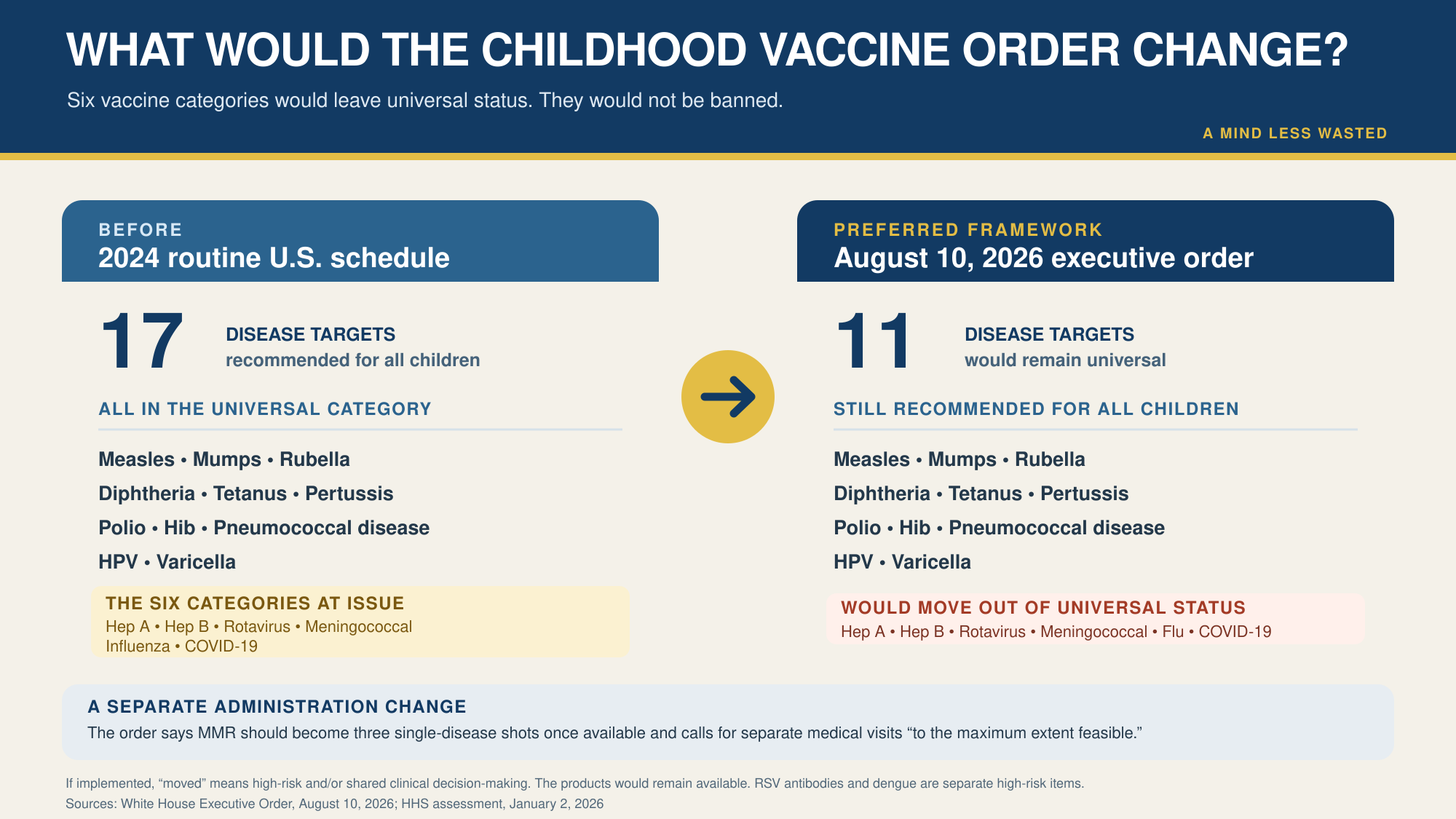
Compared with the 2024 schedule used in the HHS assessment, the change from 17 universally recommended disease targets to 11 would remove the universal recommendation for six vaccine categories: hepatitis A, hepatitis B, rotavirus, meningococcal disease, influenza, and COVID-19.
They are not banned or removed from the market. The order moves them into high-risk and/or shared clinical decision-making categories. Hepatitis A, hepatitis B, and meningococcal vaccines appear in both categories, depending on the patient and circumstances. The order also lists RSV monoclonal antibodies and dengue vaccination for certain high-risk groups, but those are not part of the 17-to-11 vaccine change.
The order also calls for three separate measles, mumps, and rubella products once they become available in the United States. It recommends administering all childhood immunizations at separate visits “to the maximum extent feasible.”
States are advised to reconsider school requirements, but the order does not automatically rewrite state vaccination laws.
Those distinctions matter. “Reducing the childhood vaccine schedule” is directionally accurate, but “banning vaccines” is not.
The international comparison is a benchmark, not a clinical trial
The administration’s foundation is a January 2026 HHS assessment written by Tracy Beth Høeg and Martin Kulldorff. It compares the United States with 20 developed nations and identifies vaccines recommended universally across nearly all of them.
The report is correct about the basic comparison. In 2024, the United States recommended routine protection against more diseases than Denmark and several other peer nations. Denmark’s official program offers all children free vaccination against 10 diseases, using 11 injections across childhood. The Danish schedule is not imaginary or inherently reckless.
But “Denmark recommends fewer vaccines” does not establish “fewer vaccines are better for American children.”
National schedules are policy decisions shaped by local disease prevalence, population demographics, healthcare access, screening systems, costs, product availability, delivery infrastructure, and political judgments about which benefits justify a universal program. The American Academy of Pediatrics notes that those factors explain why developed countries can reach different recommendations without one schedule proving the others unsafe.
The HHS report partly acknowledges this. It states that countries differ in disease exposure and healthcare systems. It then treats international agreement as the principal dividing line between vaccines recommended for everyone and vaccines left to individual decision-making.
That is a policy rule. It is not a demonstrated benefit-risk threshold.
Under this approach, one or a few countries can effectively veto the “consensus” label even when most peer nations recommend a vaccine. The HHS report itself says that 15 of the 20 peer countries routinely recommend meningococcal vaccination, yet the vaccine is downgraded because five do not. Varicella is kept as a universal recommendation despite limited international agreement because the authors believe removing it from the established U.S. program could create harm.
That exception exposes the weakness in the rule. Once U.S.-specific consequences matter for varicella, they must also matter for hepatitis A, hepatitis B, rotavirus, influenza, and meningococcal disease.
Comparing policies is not the same as reviewing the evidence
Federal vaccine recommendations normally go through the Advisory Committee on Immunization Practices. ACIP workgroups examine disease risk, vaccine effectiveness and safety, feasibility, equity, cost, and the strength of the evidence. Using the GRADE and Evidence to Recommendations frameworks, the committee presents its findings publicly, debates the evidence, and votes.
The entire childhood schedule has not been tested in a single trial against every possible alternative sequence. That does not mean vaccine timing has never been studied. Age, spacing, coadministration, disease risk, safety, and effectiveness are evaluated when recommendations are developed and revised.
The HHS assessment cites 179 references, but that alone does not make it a systematic review. It provides no reproducible search strategy, inclusion or exclusion criteria, or formal grading of evidence certainty. Nor does it indicate that the report underwent peer review.
More importantly, the report states explicitly that it “does not consider the timing or order of vaccines, nor the number of doses, with the exception of the HPV vaccine.”
The executive order nevertheless invokes that assessment while endorsing separate appointments for childhood vaccines and separate measles, mumps, and rubella shots.
That is the central problem. The White House presents the report as the scientific basis for its policy. Yet the report did not examine the timing or separation of vaccines, the very practices the president has now endorsed.
Comparing national policies may identify differences worth studying. It cannot provide evidence for recommendations the comparison was never designed to evaluate.
This is stronger because it acknowledges the legitimate schedule-level research gap without allowing “the entire schedule was never tested in one trial” to become “vaccine timing was never studied.”
The counting problem
The White House says the 2024 schedule included at least 84 vaccine doses and 57 shots. Those numbers come from the HHS report, but they need some context.
Dose counts can sound overwhelming without any sense of physical scale. Here is what the estimated total injected volume through age 18 actually looks like.
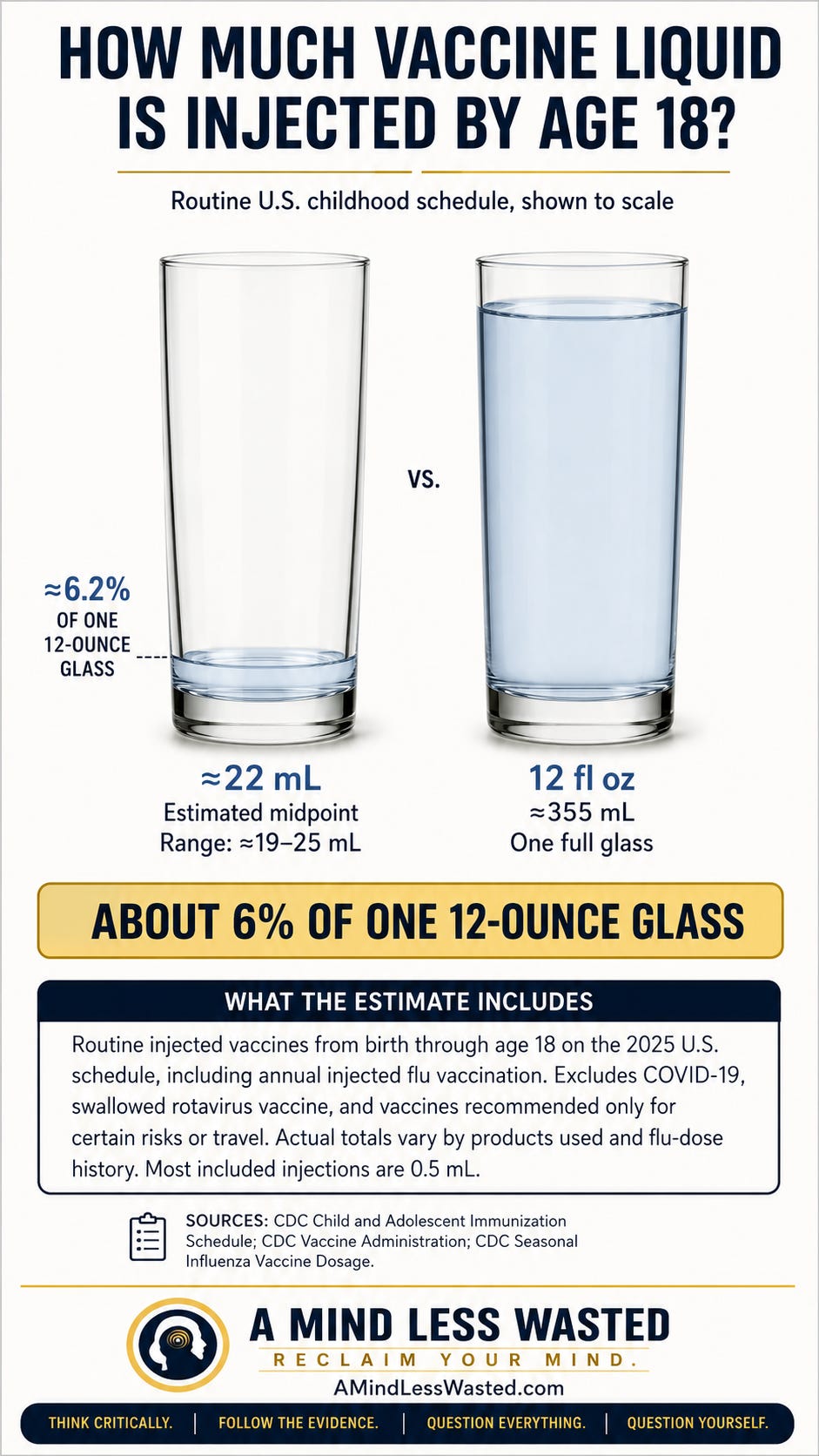
The report counts every disease component in a combination vaccine as a separate dose. So one MMR injection counts as three vaccine doses. It also assumes annual flu and COVID-19 vaccination throughout childhood, which drives the cumulative total much higher by age 18.
That method is disclosed in the report. It is not fake math. But it makes it easy to hear “84 doses” and picture 84 syringes, or 84 major exposures. That is not what the number means.
There is another contradiction here. The order points to the high number of shots as a reason to reform the schedule, then calls for one MMR shot to be split into three injections and for vaccines to be given at separate appointments.
That could mean more needles and more office visits, even as fewer vaccines are routinely recommended.
The report gives too little weight to measurable benefits
The international comparison becomes most misleading when a low present-day disease rate is treated as evidence that universal vaccination is no longer useful. Sometimes the rate is low because the vaccination program worked.
Rotavirus
The HHS report estimates one or two additional cases of intussusception per 100,000 vaccinated children. CDC summarizes the U.S. postlicensure evidence more broadly as approximately one excess case per 20,000 to 100,000 vaccinated infants, equivalent to about one to five per 100,000.
Deaths tell only part of the story. Before rotavirus vaccination became routine, the disease hospitalized an estimated 55,000 to 70,000 American children under five each year and sent more than 200,000 to emergency departments. After vaccination began, the CDC estimated that it prevented about 280,000 clinic visits, 62,000 emergency visits, and 45,000 hospitalizations annually. These estimates appear in the CDC’s Rotavirus Pink Book chapter.
A serious benefit-risk review can still debate whether those benefits justify universal vaccination. It cannot reduce the benefit side to deaths and chronic disability while treating tens of thousands of prevented hospitalizations as secondary.
Hepatitis B
The report points out that many peer nations give the birth dose primarily to infants whose mothers test positive. That approach assumes maternal infection is identified correctly, and the result follows the mother and infant through delivery.
The longstanding U.S. recommendation treats the birth dose as a safety net. Infants infected around birth have about a 90 percent risk of developing chronic infection, which can later cause cirrhosis or liver cancer. The ACIP hepatitis B recommendation explains why universal administration within 24 hours was adopted alongside maternal screening, not instead of it.
The relevant question is not simply how many countries use a universal birth dose. It is how often screening, documentation, and follow-up fail in the United States, what happens when they fail, and how the vaccine’s risks compare with the protection provided by a universal safety net.
Hepatitis A
Young children with hepatitis A are often asymptomatic, which makes them capable of spreading infection without anyone realizing they are infected. After the United States expanded childhood vaccination, reported hepatitis A incidence fell sharply and childcare outbreaks became rare. Those outcomes are described in the 2020 ACIP hepatitis A review.
Again, low incidence after a successful program is not automatically evidence that the program was unnecessary.
Influenza
The HHS assessment accurately notes limitations in randomized trials for rare outcomes such as pediatric hospitalization and death. Trials are often too small to measure uncommon severe outcomes reliably.
That does not mean there is no evidence. Observational studies have found protection against severe influenza outcomes. One U.S. analysis estimated that vaccination reduced influenza-associated death by about half among children with high-risk conditions and by nearly two-thirds among children without them. The study also explains its design limitations and sensitivity analyses. It is not perfect evidence, but it is evidence that a complete review must weigh.
The broader point is not that every previous recommendation must remain forever. It is that each change needs its own transparent benefit-risk analysis. A count of what other governments recommend cannot substitute for it.
The MMR and spacing recommendations are the weakest part
The executive order does not cite evidence showing that three separate measles, mumps, and rubella products are safer than the combined vaccine. The CDC states plainly that no published scientific evidence demonstrates a benefit from separating MMR into three individual shots. Single-antigen measles, mumps, and rubella vaccines are not currently available in the United States. The FDA lists two approved MMR products, M-M-R II and Priorix.
That does not mean MMR is risk-free. A Cochrane systematic review included 138 studies involving more than 23 million children. It found the vaccine effective and found no increased risk of autism or encephalitis, but it also confirmed small known risks, including febrile seizures and immune thrombocytopenic purpura. The reviewers rated the evidence for MMR effectiveness, autism, and febrile seizures as moderate certainty, not absolute certainty.
A large Danish cohort study estimated 1.56 additional febrile seizures per 1,000 children during the two weeks after MMR vaccination at 15 to 17 months of age. Among children who experienced a febrile seizure after vaccination, the study found no increased rate of later epilepsy compared with children whose febrile seizures occurred for other reasons.
The relevant question is therefore not whether MMR can cause an adverse reaction. It can. The question is whether administering the same three vaccine components separately prevents those reactions. No comparative evidence shows that it does.
There is one important combination-vaccine finding that can easily be confused with this issue. The first dose of the four-component MMRV vaccine, which adds varicella, has been associated with a higher risk of febrile seizures than giving MMR and varicella as two injections at the same visit.
That evidence led the CDC to recommend MMR plus a separate varicella vaccine for the first dose in children 12 to 47 months, unless a parent prefers MMRV. It does not show that separating measles, mumps, and rubella from one another is safer. In fact, it shows what an evidence-based change should look like: compare specific products, measure a defined outcome, quantify the difference, and revise the recommendation accordingly.
Splitting MMR does not remove any of the three target antigens. It adds injections. If the existing two-dose regimen remained in place, two combined injections would become six single-disease injections. Under the order’s preferred approach, each MMR round would generally mean three separate visits rather than one, where feasible.
If the future single-antigen products are injectable live vaccines, as the current MMR components are, existing CDC guidance would generally require products not given on the same day to be separated by at least 28 days. Three visits could therefore span at least 56 days. The exact schedule cannot be known until those products exist and are licensed.
Until all three components had been administered and immunity had time to develop, a child could remain without protection against one or more of the diseases.
If measles were not given first, protection against it would begin later. A postponed or missed visit could widen that gap or leave the series incomplete. The order does not say which vaccine should come first, and the administration cites no evidence that spacing the vaccines this way would improve safety.
Adding delays during a measles comeback
This is not an abstract concern. As of August 6, 2026, the CDC had confirmed 2,465 measles cases and 38 new outbreaks in the United States during 2026. That already exceeded the 2,289 cases reported during all of 2025 and was nearly nine times the 285 cases reported in 2024. Ninety-four percent of the 2026 cases were associated with outbreaks.
At the same time, MMR coverage among U.S. kindergarteners has fallen from 95.2% in 2019–2020 to 92.5% in 2024–2025, below the 95% target generally needed for community protection against a virus as contagious as measles. The CDC estimates that approximately 286,000 kindergarteners were at risk during the 2024–2025 school year.
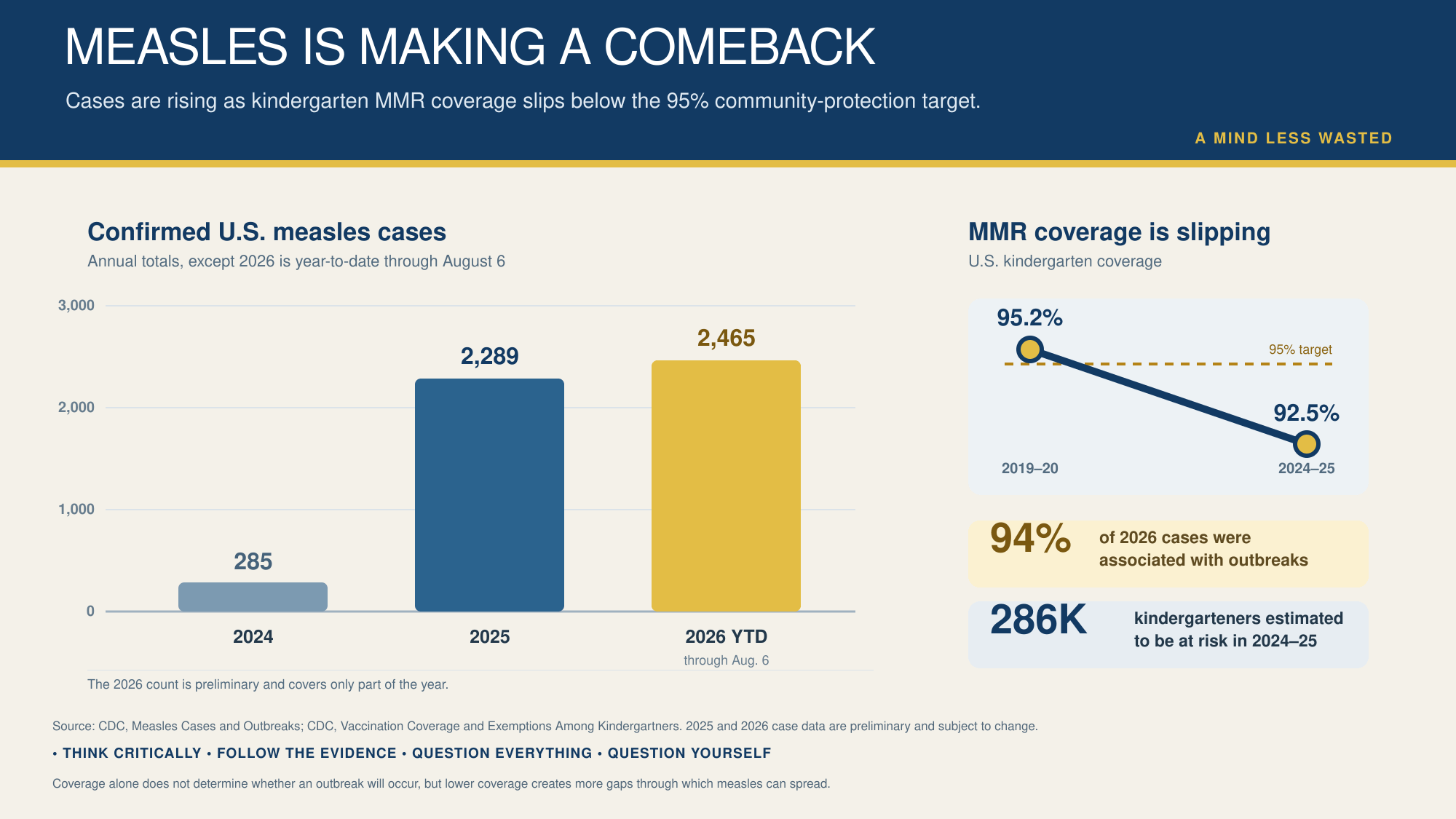
The resurgence does not prove that every child who experiences a scheduling delay will contract measles, nor does it mean scheduling alone caused the outbreaks. It does make the tradeoff more urgent.
The preferred approach could turn one visit into three, creating more needle sticks, more appointments, and more chances for delay or noncompletion at precisely the moment when measles is exploiting gaps in protection. No demonstrated safety advantage has been offered to compensate for that added risk.
Whether future monovalent products would cause more or fewer adverse reactions cannot be known until the specific products, formulations, and supporting evidence are available.
During the signing event, Trump said autism was part of the administration’s concern. The order itself does not mention autism, but the scientific evidence does not support separating MMR for that reason.
A nationwide Danish cohort of 657,461 children found no increased autism risk after MMR vaccination, including among children considered more susceptible. A 2014 meta-analysis covering more than 1.2 million children likewise found no association between vaccination, MMR, thimerosal, and autism.
There is no evidence that giving every vaccine at a separate appointment is safer. According to CDC guidance, routine vaccines given during the same visit produce immune responses and adverse-event rates similar to those seen when the vaccines are given separately.
An executive order is not a safety finding. The order cites no new evidence that combined MMR is unsafe, nor does it conclude that the vaccine failed safety testing. Pursuing separate products reflects the administration’s policy preference, not a scientific admission.
For some live vaccines, giving them on different days but less than four weeks apart can interfere with the immune response, which means “spacing out” is not a simple safety switch.
More appointments also create more opportunities for delay, missed visits, transportation problems, and incomplete vaccination. Calling that “choice” does not erase the practical effect.
Medical choice cannot be prescribed from the Oval Office
The order repeatedly invokes parental choice, personal autonomy, informed consent, and shared clinical decision-making. Those are legitimate principles.
But the same document declares that MMR “should” be split into three single-disease shots and that, “to the maximum extent feasible,” all childhood immunizations should be given at separate medical visits.
That is more than protecting a parent’s right to accept or refuse a vaccine. It is the president declaring how doctors should administer vaccines, even though the HHS assessment did not evaluate vaccine timing or order and no evidence shows that these changes are safer.
The order does not legally compel a doctor to follow this plan, and it says combined vaccines should remain available. Still, federal vaccine recommendations are not casual suggestions.
The order directs federal agencies to take steps to advance them and advises states to reconsider their vaccination laws and regulations. Policy decisions made in Washington can therefore shape the options doctors have, the guidance they are expected to follow, and the choices presented to families.
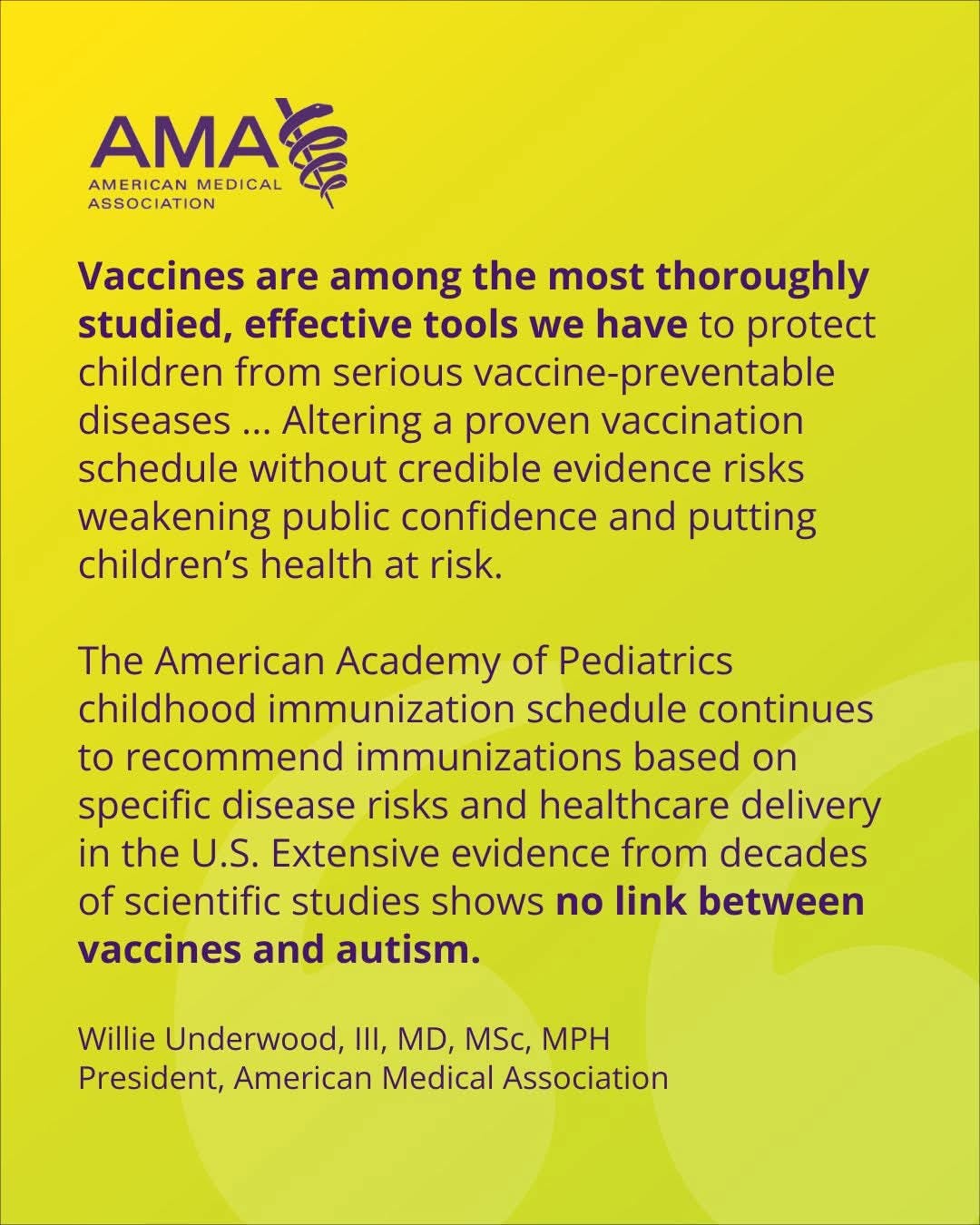
Statement released by the American Medical Association:
The American Academy of Pediatrics rejected the scientific premise behind the order. AAP President Dr. Andrew Racine stated:
“Today’s executive order is not based on ‘gold-standard science.’ There is no new evidence to justify significant changes to childhood immunization guidance.”
The order promises to restore medical choice while prescribing vaccine timing and administration from the Oval Office. Shared decision-making is not truly shared when the government has already declared which answer doctors should recommend.

Supporters of the order have a legitimate point. The United States recommends more childhood vaccines than many peer countries, and the complete schedule has not been tested in a single trial against every possible alternative. Other developed nations achieve good health outcomes with fewer universally recommended vaccines. Those differences deserve examination, not automatic dismissal.
We should also test our own reaction. Are we defending the existing schedule simply because it reflects established public-health policy? Would we judge the order differently if the same proposals came from an administration we trusted more? Are we treating uncertainty about the schedule as evidence that no change is justified?
Those questions expose a real need for continued research and vaccine-by-vaccine review. They do not, however, establish that fewer universal recommendations would produce better outcomes, that separate MMR vaccines would be safer, or that spreading routine vaccines across additional appointments would reduce adverse events.
Evidence could change that conclusion. A transparent review showing that the risks or limited benefits of a particular vaccine no longer justify universal recommendation would support changing its status. Comparative evidence showing that separate MMR vaccines or additional appointments improve safety without reducing completion or delaying protection would support those changes as well.
That evidence may eventually emerge. The problem is that the HHS assessment did not examine the timing or separation policies the order now endorses. The strongest argument for reconsidering the schedule supports conducting the review. It does not supply the results in advance.
Some goals are reasonable. The process still matters.
More transparent safety monitoring is a reasonable goal. So is continued study of timing, combinations, adjuvants, rare adverse events, and long-term outcomes. The order’s call for ongoing benefit-risk evaluation should not be dismissed merely because it came from Trump or Robert F. Kennedy Jr.
Not every underlying proposal is evidence-free. The report’s discussion of a one-dose HPV schedule cites randomized and long-term effectiveness evidence, along with countries that have already adopted one dose. The move to shared clinical decision-making for childhood COVID-19 vaccination also predates this order. Those are examples of changes that can be evaluated on their own evidence, rather than justified by the total number of vaccines on a national schedule.
The HHS report also makes a credible case that public trust was damaged during the COVID-19 pandemic. A public health system cannot simply demand that trust back.
But distrust is not repaired by labeling a policy “Gold Standard” before the gold-standard review has occurred.
There is a proper way to use international comparisons. Identify a meaningful difference. Ask why it exists. Examine the disease burden and outcomes in both countries. Review the evidence for each vaccine. Grade its quality. Publish the analysis. Invite criticism. Then change the recommendation if the evidence supports it.
This order reverses that sequence. It announces the answer, then directs the government to develop the science and products needed to carry it out.
That is policy first, evidence second.
The legal and practical reality
The administration had already tried to put much of this three-tier schedule into effect in January 2026. On March 16, a federal judge stayed the January schedule memo, the appointments of 13 reconstituted ACIP members, and every vote taken by those members.
The court found that the plaintiffs were likely to succeed in showing that the CDC acted contrary to law and arbitrarily and capriciously by bypassing ACIP and abandoning its longstanding process without adequate explanation. The August order acknowledges that litigation delayed the earlier policy.
The new order does not make separate MMR products suddenly available. It does not rewrite insurance contracts or state school-vaccine requirements overnight. Agencies still have to act within existing law.
Manufacturers would need to develop and license new products. The government has appealed the part of the ruling concerning the ACIP appointments, and further litigation is likely.
For parents and physicians, the immediate effect may be less dramatic than the announcement suggests. The larger issue is institutional. A president has declared a national medical recommendation by executive order after the established advisory process became an obstacle.
That should concern people whether they favor more vaccines, fewer vaccines, or greater parental discretion.
The standard should be the same under every administration: medical recommendations should follow a transparent review of the evidence, not depend on which president signs the paper.
If you value analysis that checks the argument instead of checking the speaker’s political jersey, subscribe to A Mind Less Wasted.
• Think Critically • Follow the Evidence
• Question Everything • Question Yourself
Resources
Executive Order: Delivering Gold Standard Childhood Vaccine Recommendations for Americans
HHS assessment of the U.S. childhood schedule compared with other countries
CDC: 2024 child and adolescent immunization schedule development
Cochrane: MMR, MMRV, and MMR plus varicella effectiveness and safety review
JAMA: MMR vaccination, febrile seizures, and long-term prognosis
CDC/ACIP: MMRV compared with MMR plus separate varicella vaccination
Annals of Internal Medicine: MMR vaccination and autism, nationwide cohort study
CDC: Health and economic benefits of routine childhood immunization, 1994–2023
Pediatrics: Influenza vaccine effectiveness against pediatric deaths
Federal court injunction summary from the American Public Health Association
Medical organizations
American Academy of Pediatrics statement on the August executive order
American Medical Association statement on the May executive order