No, the iPhone Did Not Make Cervical Cancer Disappear
The BBC oversimplified a new HPV-vaccine study. Its critics then misread the mortality data, the screening programme, the sexual-behaviour evidence—and even the wrong randomized trial.
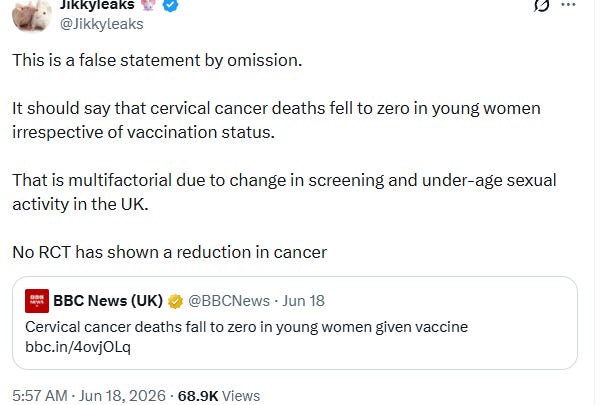
The BBC headline was too neat: “Cervical cancer deaths fall to zero in young women given vaccine.”
The study behind it did not link each woman’s vaccination record to her death record. It examined cervical-cancer mortality across England and related the pattern to the age and coverage of the national HPV vaccination programme. So the most exact headline would have been something like this:
No cervical-cancer deaths were recorded among women aged 20–24 in England from 2020 through 2024; 23.1 would have been expected if the earlier mortality rate had continued.
That caveat matters. It does not, however, turn the result into its opposite.
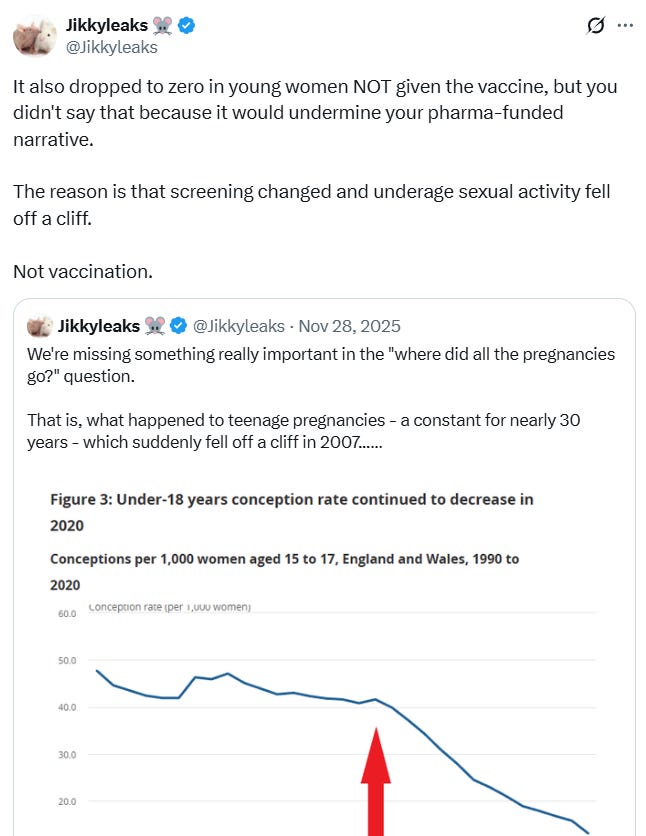
In a series of posts, the pseudonymous account Jikkyleaks claimed that deaths had fallen to zero “irrespective of vaccination status,” that screening and a sudden collapse in teenage sexual activity explained the result, and—eventually—that “it was the iPhone, not the HPV vaccine.”
A set of tiny country graphs was offered as evidence of a “secret rise” in cervical cancer. A disclosed competing interest became an insinuation of Merck ghostwriting. When challenged with the study’s actual design and findings, the substantive answer was simply that the rebuttal was “incorrect.”
The post uses the population-wide zero to imply that vaccination status made no difference. The study did not estimate separate mortality rates for vaccinated and unvaccinated women. View the original post on X.
There is a fair criticism here. The new mortality study is observational, so it cannot tell us what happened to each vaccinated or unvaccinated woman. But that limitation does not make the competing explanation true. The dates, age groups, randomized trials, and linked cancer registries all point away from it.
A limitation should narrow a claim, not reverse it.
What the mortality study actually found
England introduced routine HPV vaccination in September 2008 for girls aged 12–13, with a catch-up programme for girls aged 13 to under 18. Before the pandemic, programme-level vaccination coverage in the routine cohorts was generally around 80–90 percent. These were population estimates, not individually linked vaccination records.
The 2026 Lancet study by Peter Sasieni and Milena Falcaro analysed national cervical-cancer deaths from 2001 through 2024 among women aged 20–34. It used official coverage estimates by birth cohort and modelled how many deaths would have been expected without vaccination, based on earlier mortality patterns.
Its headline result was striking. From 2020 through 2024, no women aged 20–24 died from cervical cancer in England. The model expected 23.1 deaths. That corresponds to a population-level reduction of 100 percent, with a 95 percent confidence interval of 84–100 percent.
The result was not confined to that single age-period group. Other groups that included women eligible for routine or catch-up vaccination also showed reductions:
Among women aged 20–24 in 2015–19, mortality was 80 percent lower than expected (95% CI 51–94).
Among women aged 25–29 in 2020–24, mortality was 69 percent lower than expected (95% CI 55–79).
Across the women aged 20–34 included in the analysis through the end of 2024, the model associated vaccination with an estimated 199.6 fewer cervical-cancer deaths (95% CI 125.0–274.2).
“Associated with” is the right phrase. The study compared population cohorts rather than individually matched vaccinated and unvaccinated women, and the number of expected deaths came from a modelled counterfactual. It also relied on five-year age groups and assumed no herd-protection effect. Attributing the decline to vaccination therefore requires assumptions about the relationship between vaccine uptake and underlying cervical-cancer risk. The authors correctly described the evidence as observational.
Because the study was observational and used aggregate coverage data, it could not calculate individual mortality risk by vaccination status. The rebuttal goes wrong when it treats that absence of individual stratification as evidence that vaccination status was irrelevant.
An aggregate zero does not show that vaccination status was irrelevant
Because no one aged 20–24 died from cervical cancer during this period, the observed death count was necessarily zero among both vaccinated and unvaccinated members of the cohort. In that narrow, literal sense, saying the zero applied “irrespective of vaccination status” is true.
The study did not match individual vaccination records to mortality records, so it could not calculate separate death rates for vaccinated and unvaccinated women. It therefore cannot tell us whether the two groups had the same underlying risk or whether vaccination status made no difference. There is another complication: the unvaccinated minority lived in a highly vaccinated population and may have received some indirect protection.
So yes, the zero included everyone. But it is a mistake to turn that population-wide observation into evidence that vaccination was irrelevant. The study was not designed to make that individual-level comparison. Instead, it used earlier mortality patterns to estimate what might have happened without the national vaccination programme.
It did, however, find an age-and-coverage pattern. The largest declines occurred in the youngest cohorts, where vaccination coverage was highest. The declines were smaller in cohorts offered vaccination at older ages or with lower coverage, while the estimate for women aged 30–34 was much less certain. That pattern does not prove causation on its own, but it is what we would expect from a vaccine that works best before HPV exposure.
Routine screening is unlikely to explain the zero in 20–24-year-olds
Screening is essential to cervical-cancer prevention. It detects precancer so it can be treated, and vaccinated women should still attend when invited. But it cannot plausibly be the main explanation for the new mortality result.
The reason is simple: routine cervical screening in England begins at age 25. The first invitation is sent at 24½, and screening is not recommended below 25 for people who have not been invited. The group with zero deaths was aged 20–24.
Changes in screening can influence cancer incidence and mortality in older groups. They do not explain why the strongest decline appeared before routine screening began, nor why the effect followed eligibility for vaccination and age at vaccination.
The earlier incidence data make that pattern harder to wave away. In a 2021 English registry study covering 13.7 million person-years, cervical-cancer incidence was estimated to be 34 percent lower in the cohort offered vaccination at ages 16–18, 62 percent lower when offered at 14–16, and 87 percent lower when offered at 12–13, compared with an earlier birth cohort that was not eligible for the vaccination programme.
The same pattern appeared in CIN3, the most serious conventional grade of cervical precancer. The reductions were 39, 75 and 97 percent. By mid-2019, the researchers estimated that there had been 448 fewer cervical cancers and 17,235 fewer CIN3 cases than expected.
The age at vaccination matters. The HPV vaccine prevents new infections; it does not clear an infection that is already present. You would therefore expect it to work best when given before HPV exposure and less well when given later. That is exactly the pattern the researchers found. Better screening or cancer treatment might lower rates across the population, but it would not readily explain why the reductions closely followed age at vaccination and vaccine eligibility.
The claim that women offered vaccination in their late teens “did not see a drop” is simply wrong. They did see one. It was smaller, as expected when more of them may already have encountered HPV before being vaccinated.
The teenage-pregnancy theory fails three basic tests
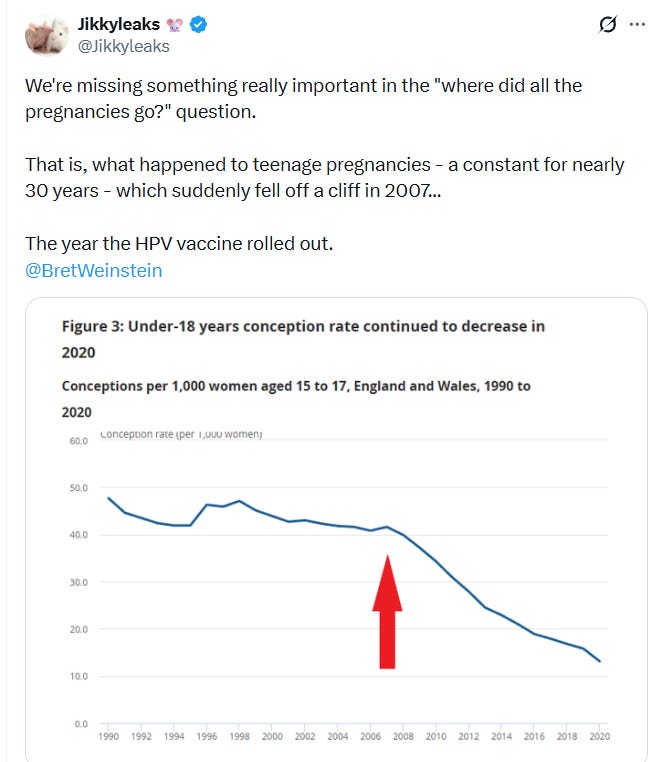
The next claim is that teenage pregnancy “fell off a cliff in 2007,” proving that adolescents abruptly stopped having sex and therefore stopped acquiring HPV.
This is the argument’s starting point. But England’s programme began in September 2008, and a conception rate is not a direct measure of sexual activity.
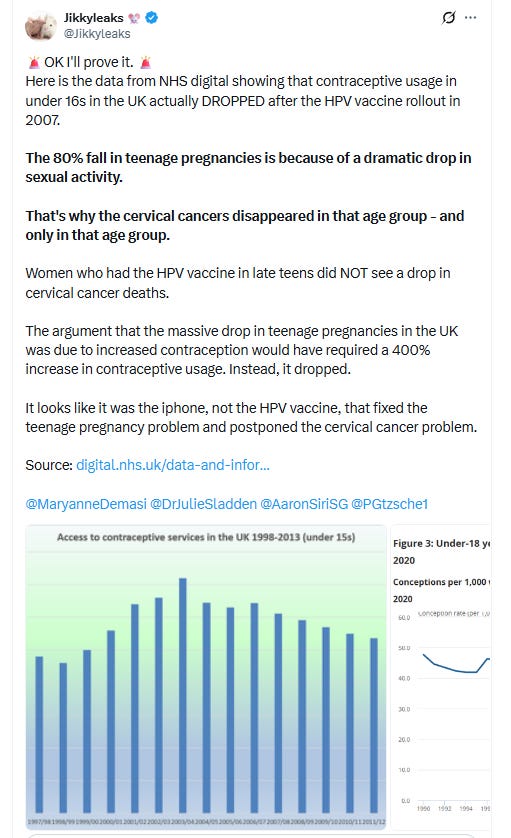
In a later post, the iPhone—launched in 2007—is floated as the real cancer-prevention intervention.
The proposed alternative explanation relies on a conception trend and a chart of clinic contacts, neither of which directly measures sexual activity.
This story fails on chronology, measurement and biological specificity.
First, the English HPV programme did not roll out in 2007. It began in September 2008. The first routine cohort received the bivalent Cervarix vaccine; England switched to quadrivalent Gardasil in 2012 and later to Gardasil 9. An arrow placed at 2007 on a pregnancy chart does not move the programme back a year.
Second, a conception rate is not a direct measure of sexual activity. It reflects exposure to pregnancy together with contraceptive use and effectiveness. ONS conception estimates count pregnancies ending in a maternity or legal abortion and exclude miscarriages. They therefore cannot reveal, by themselves, how frequently teenagers were having sex.
The trend was also not “constant for nearly 30 years” before a vaccine-year cliff. ONS data show a longer decline, with rates falling from the late 1990s and then falling faster after 2007.
Research comparing Britain’s national sexual-attitudes surveys found no statistically significant change in recent sexual activity among women aged 16–19 between 2000–01 and 2010–12. The researchers attributed most of the modelled reduction in pregnancy risk to increased use of more effective contraception. The study did not measure sexual behaviour among girls younger than 16, so it cannot settle that part of the argument.
The NHS graph used to “prove” contraception fell measures contacts with community contraceptive clinics. It is not a census of all contraceptive use. Young people can obtain contraception from general practice, pharmacies, retail outlets and other services; methods also differ greatly in effectiveness. Fewer clinic contacts cannot be converted into an 80 percent fall in sexual activity.
Third, English surveillance measured vaccine-type HPV prevalence among young females attending chlamydia-screening services. The UKHSA’s Green Book reports that HPV16/18 prevalence among 16–18-year-old females fell from about 15 percent in 2008 to 8.2 percent in 2010–11 and 1.6 percent in 2016. Among 19–21-year-olds it fell from 14 percent in 2010–11 to 0.7 percent in 2018; by 2018–20 it was below 1 percent among females aged 16–24.
A broad decline in sexual activity might reduce several sexually transmitted infections. It does not readily explain why the HPV types targeted by the vaccine collapsed in step with vaccine coverage, while surveillance also detected indirect protection in less-vaccinated groups and no evidence of type replacement.
The iPhone hypothesis is not a competing causal analysis. It is a date coincidence attached to an outcome that does not measure the proposed mechanism.
The “secret rise” graphs do not establish that vaccination increased cancer rates
Another post presents small, poorly labelled line charts and claims that countries introducing HPV vaccination around 2007 suffered a spike in cervical cancer among women aged 25–34 eight to ten years later.
The screenshots show calendar-period trends in broad age groups. Without the underlying sources, denominators and country-specific vaccination histories, they cannot establish what happened specifically in routinely vaccinated cohorts—or whether vaccination caused any change.
England’s 2008 rollout illustrates the cohort problem. The age arithmetic alone shows that most women in the displayed 25–34 age band were not members of the routine school-vaccination cohort.
A girl vaccinated at 12–13 in England in 2008 was about 20–21 eight years later. She was not 25–34. Most women aged 25–34 in 2016 were born between roughly 1982 and 1991 and were too old for the routine school programme; only the younger edge of that band could have entered the catch-up programme. A broad period-rate graph for 25–34-year-olds therefore cannot be labelled a post-vaccine effect in the routine adolescent cohort.
The cropped screenshots do not provide enough source information to reproduce and verify every plotted series, so the underlying rates should not be declared false on the basis of these images alone. What the graphs clearly lack is individual vaccination status, confidence intervals, and adjustment for screening or registration changes. Even if every plotted rate is accurate, an upward segment in an ecological age-period graph does not establish that vaccination caused the increase.
The appropriate question is not, “Can I draw an arrow near a bump?” It is, “Do women with documented vaccination have less cervical cancer than comparable women without it, and does protection increase when vaccination occurs earlier?”
Several national linkages answer that question.
In Sweden, researchers followed 1,672,983 girls and women and found 19 invasive cervical cancers among vaccine recipients and 538 among those not vaccinated. After adjustment, the incidence-rate ratio was 0.37 overall and 0.12 for those vaccinated before age 17.
In Denmark, linked national records likewise showed the largest reduction among women vaccinated at age 16 or younger.
A 2025 Dutch national linkage study is especially useful because it compared women from the same 1993 birth cohort and adjusted for differences in screening participation. There were 5 cervical cancers among 47,130 fully vaccinated women and 42 among 50,831 unvaccinated women. The adjusted cumulative risk ratio was 0.085 (95% CI 0.025–0.24).
Replace the Scotland bullet and the paragraph following the country list with this section:
Scotland’s “zero cancers” finding was oversold—but not erased
A separate criticism from Demasi concerns the 2024 Scottish linked-registry study. It reported no invasive cervical cancers among women vaccinated at ages 12–13, producing the BBC headline “No cervical cancer cases in HPV-vaccinated women.”
That zero deserved more caution. Most women in the routinely vaccinated group were still under 25 when follow-up ended, an age at which cervical cancer is rare. The absence of cases in that young subgroup was therefore encouraging, but it could not provide a precise estimate of long-term protection by itself.
In 2025, Samir Saidi and Mark Jones published a reanalysis and critique using data supplied by the original researchers. They argued that the vaccinated and unvaccinated groups differed substantially in screening participation and identified population-count anomalies that required explanation. Those are legitimate concerns. Screening can prevent invasive cancer by finding and treating precancerous changes, so higher screening participation among vaccinated women could account for part of the observed difference.
But Demasi’s conclusion that the Scottish result was “nothing more than a statistical illusion” goes beyond what that critique establishes.
The original study did not rely solely on the zero cases among the youngest women. Among women vaccinated at ages 14–22 who received three doses, invasive-cancer incidence was 3.2 per 100,000 person-years, compared with 8.4 among unvaccinated women. Screening differences weaken the certainty of that comparison; they do not prove that the vaccine’s true effect was zero.
The Scottish finding should therefore be treated as contested supporting evidence, not definitive proof. It also does not stand alone. Linked studies from Sweden, Denmark and the Netherlands found lower invasive-cancer incidence among vaccinated women, with the greatest reductions following vaccination at younger ages. The Dutch study compared women from the same birth cohort and adjusted for screening participation.
Demasi is right that vaccination must never be presented as a reason to abandon cervical screening. Both remain important. But showing that the Scottish headline overstated one young cohort’s zero-case finding does not erase the wider evidence that HPV vaccination reduces oncogenic infection, high-grade precancer and invasive cervical cancer.
“No RCT showed fewer cancer deaths” is true—and profoundly incomplete
The original HPV-vaccine trials were never set up to count cervical-cancer deaths decades later. That wasn’t an oversight. Cervical cancer is rare in young women and usually takes years to develop after a persistent HPV infection. A mortality trial would have needed an enormous number of participants and decades of follow-up.
There was also an ethical problem. Trial participants received cervical screening, and any high-grade precancer that was found was treated. Researchers could not leave CIN3 or adenocarcinoma in situ untreated simply to see which women eventually developed invasive cancer or died.
That is why the trials measured earlier stages in the disease process: persistent infection with cancer-causing HPV types and biopsy-confirmed precancer. Those outcomes are not the same as cancer deaths, but they are the stages the vaccine was designed to prevent.
Those are not arbitrary laboratory outcomes. Persistent high-risk HPV causes the overwhelming majority of cervical cancers; a landmark worldwide analysis detected HPV DNA in 99.7 percent of adequate cervical-cancer specimens. Modern classifications nevertheless recognize rare HPV-independent cervical cancers. CIN3 and adenocarcinoma in situ are established high-grade precursors, although not every lesion progresses to invasive cancer. Preventing these outcomes is therefore powerful evidence relevant to cancer prevention, but it is not the same as directly measuring invasive cancer or death in a randomized trial.
The randomized evidence is strong. A 2018 Cochrane review of HPV-vaccine trials found that among 15–26-year-olds negative for high-risk HPV at baseline, vaccination reduced HPV16/18-related CIN2 or worse from 164 to 2 per 10,000 and CIN3 or worse from 70 to 0 per 10,000. It also reduced high-grade disease from any HPV type, though by less, because the early vaccines did not target every oncogenic type.
Professor Jeffrey Morris has set out the causal argument: randomized trials show that vaccination prevents persistent oncogenic infection and high-grade precancer, while national registries show the predicted reduction in invasive disease. That reasoning depends on biological assumptions and does not produce a randomized estimate of cancer mortality. It does, however, show why the absence of a randomized death endpoint is not equivalent to an absence of causal evidence.
The honest formulation is therefore not “an RCT proved the vaccine prevents every cervical-cancer death.” Nor is it “there is no causal evidence.”
It is this: randomized trials show prevention of oncogenic HPV infection and high-grade precancer; individually linked registry studies show lower invasive-cancer incidence among vaccinated women; and the new English population study finds a mortality decline consistent with that evidence. Only the first part is randomized, and the mortality result is not individually linked.
The “14.0 versus 14.0” row is not a placebo comparison
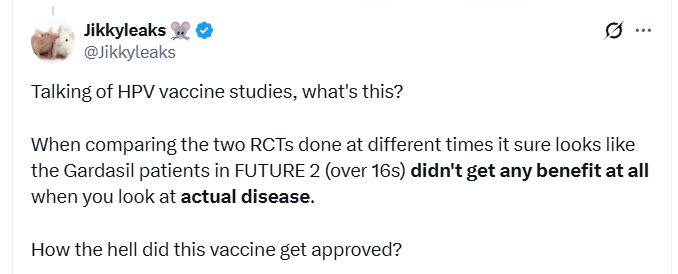
In the latest challenge, Jikkyleaks explicitly says he is comparing two RCTs conducted at different times. He highlights identical rates of 14.0 cases per 1,000 person-years in a later trial and argues that the Gardasil recipients therefore appeared to receive no benefit against “actual disease.” The comparison looks alarming, but it combines results from trials with different comparators, populations and endpoints.
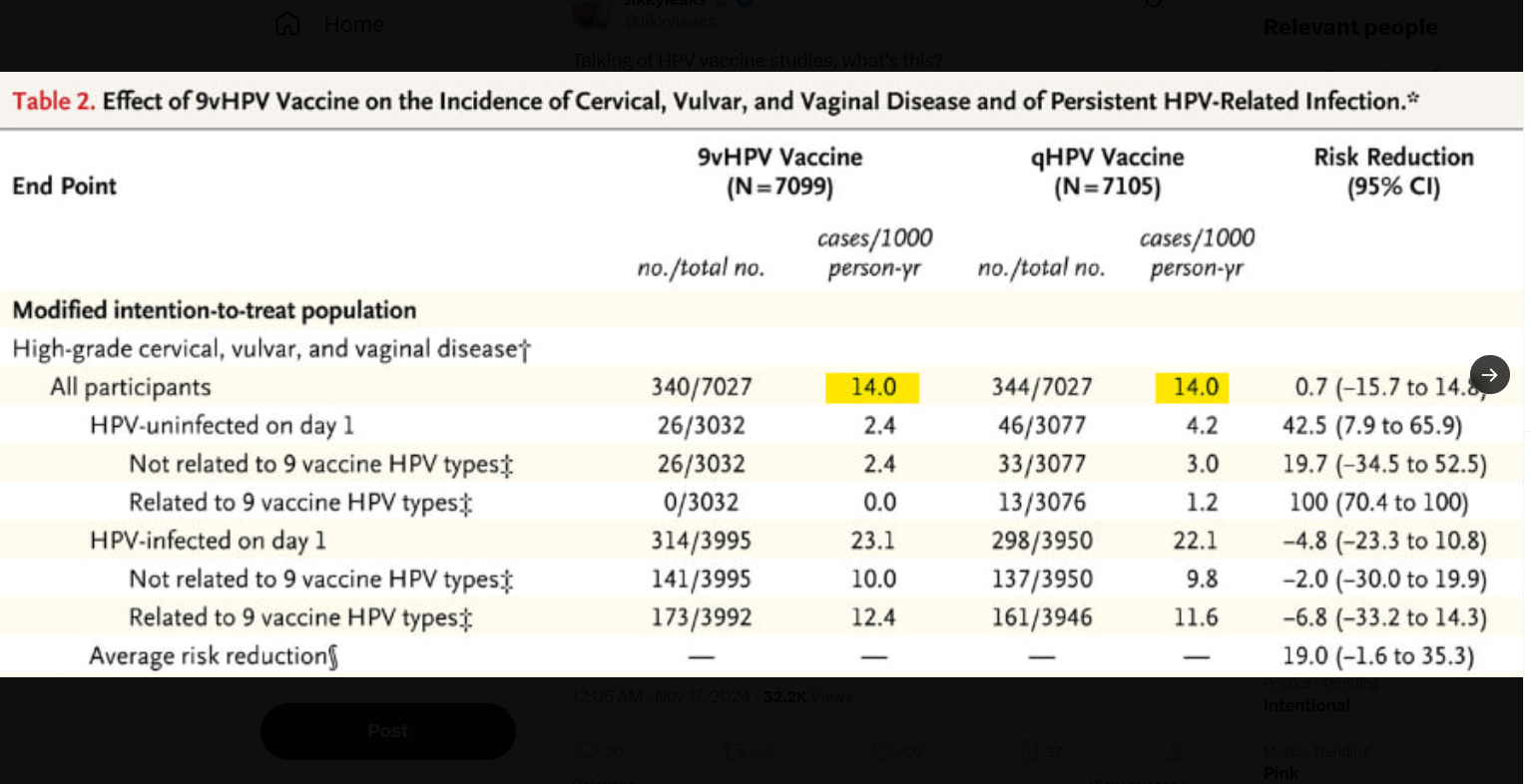
The highlighted row comes from the 2015 Gardasil 9-versus-original-Gardasil trial. It cannot be treated as a Gardasil-versus-placebo result from FUTURE II or compared with FUTURE II without accounting for the different endpoint and study population.
It comes from the 2015 trial of the nine-valent vaccine. One arm received Gardasil 9, labelled 9vHPV. The other received quadrivalent Gardasil, labelled qHPV. In other words, the table compares a nine-type HPV vaccine with a four-type HPV vaccine. There is no unvaccinated or placebo group in that comparison.
The identical 14.0 rates refer to all high-grade cervical, vulvar and vaginal disease, irrespective of HPV type, in a modified intention-to-treat population that included women already infected when vaccination began. Within this trial, the result means Gardasil 9 was not superior to original Gardasil on that broad all-type endpoint during the reported follow-up. It does not estimate original Gardasil’s benefit versus placebo. Both vaccines targeted the four HPV types they shared, neither could treat infections already present, and lesions caused by non-vaccine types were included in the total.
The more specific rows show why the broad 14.0-versus-14.0 endpoint does not isolate the added protection from Gardasil 9. Among women uninfected on day one, the rate of all high-grade disease was 2.4 with Gardasil 9 versus 4.2 with original Gardasil. For disease related to the nine vaccine types, there were 0 cases versus 13. In the susceptible per-protocol population, Gardasil 9’s efficacy against high-grade disease caused by its five additional oncogenic types—31, 33, 45, 52 and 58—was 96.7 percent (95% CI 80.9–99.8).
FUTURE II was a different trial, published in 2007. It randomized 12,167 women aged 15–26 to quadrivalent Gardasil or placebo and used actual high-grade cervical disease—CIN2, CIN3, or adenocarcinoma in situ related to HPV16/18—as its primary endpoint. Efficacy was 98 percent in women who were susceptible to those types and followed the protocol. It was 44 percent in the unrestricted intention-to-treat population, which included women already infected before vaccination. Against all high-grade lesions regardless of HPV type, efficacy in that broad population was 17 percent.
Those lower broad-population estimates are not evidence of concealment. They demonstrate two basic properties of the product: it is prophylactic, not therapeutic, and the original vaccine covered two major cancer-causing types, not every possible cause of a cervical lesion. Vaccinating before exposure is precisely why programmes target early adolescents.
Original Gardasil was supported by randomized, controlled endpoints measuring HPV-related high-grade cervical disease. Gardasil 9 was later compared with that active vaccine: efficacy was assessed for the five additional HPV types, while immune responses to the four shared types were tested for non-inferiority. The correct conclusion from the 14.0-versus-14.0 row is narrow: Gardasil 9 did not outperform original Gardasil on the broad all-type modified intention-to-treat endpoint. It does not show that original Gardasil provided no benefit versus placebo, and a cross-trial comparison cannot replace the randomized comparison within each trial.
Cochrane’s press language deserved scrutiny—but its data did not reverse direction
Editor’s note: This article addresses the central claim presented in the publicly available portion of Maryanne Demasi’s article that Cochrane’s own data contradict its conclusion. It does not purport to rebut every argument contained in the paywalled article.
Maryanne Demasi made a more serious methodological criticism of Cochrane’s 2025 reviews. She noted that the cervical-cancer estimates came from observational studies with important risks of confounding and argued that Cochrane’s public claim of “strong and consistent evidence” sounded more definitive than the technical review.
That is a fair issue to raise.
The Cochrane observational review included 225 studies covering more than 132 million people. Of the 20 studies reporting cervical cancer, nine were rated at critical risk of bias, seven at serious risk and four at moderate risk, chiefly because of confounding.
Five adjusted cohort studies including 4.39 million females produced a pooled risk ratio of 0.37 (95% CI 0.25–0.56), with substantial heterogeneity. For vaccination at age 16 or younger, the pooled risk ratio was 0.20 (95% CI 0.09–0.44). Cochrane graded the cancer evidence moderate certainty and concluded that vaccination “probably” reduces cervical-cancer incidence.
Public communications should have retained those words. “An approximately 80 percent lower observed risk when vaccination occurred by 16, based on moderate-certainty observational evidence” is more faithful than an unqualified promise that any girl vaccinated before 16 becomes 80 percent less likely to develop cancer.
But that does not mean Cochrane’s data pointed in the opposite direction. The review reported the limitations and graded the cervical-cancer evidence as moderate certainty. Its five adjusted cohort studies produced a pooled risk ratio of 0.37, but heterogeneity was substantial and none of the cervical-cancer studies was judged to be at low overall risk of bias. The result is observational evidence consistent with substantial protection—not bias-free proof.
Cochrane’s separate 2025 randomized-trial review included 60 studies and 157,414 participants, but it had no data showing an effect on cervical cancer itself. It found randomized evidence that vaccination reduces HPV infection and precancerous outcomes such as CIN2+. Cochrane’s public claim about preventing cancer therefore came from combining those trial findings with observational cancer evidence—not from randomized cancer endpoints.
The observational review does not stand alone. It sits beside randomized evidence on persistent HPV infection and high-grade precancer, established cervical-cancer biology, individually linked registry studies of invasive cancer and the new English mortality signal. The convergence of those different forms of evidence strengthens the causal inference, but it does not turn Cochrane’s observational cancer estimate into a randomized result.
A disclosed interest is a reason to inspect the work, not permission to invent its authorship
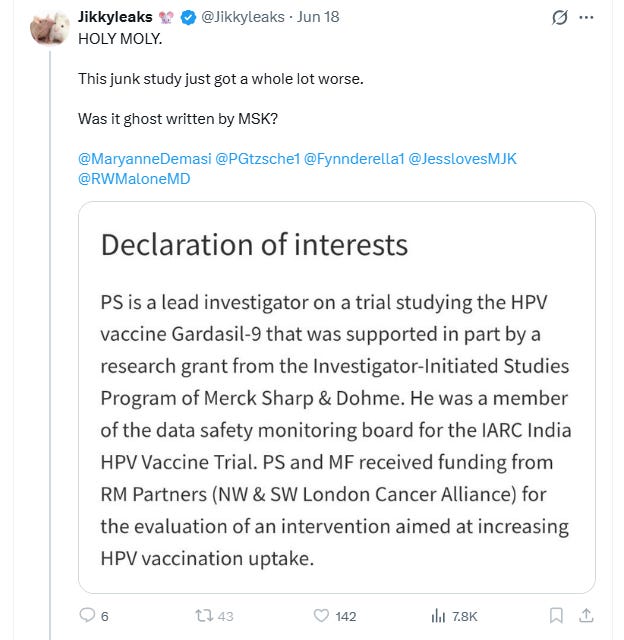
The mortality paper disclosed that Sasieni was lead investigator on a Gardasil 9 trial partly supported by a Merck investigator-initiated grant, had served on the data-safety board of an HPV-vaccine trial in India, and that both authors had received funding for an intervention intended to increase vaccine uptake. Readers are entitled to know that.
The disclosure is relevant context, but it is not evidence that Merck wrote the paper. View the original post on X.
That is relevant authorship context and should not be omitted, but it is not evidence that Merck wrote or controlled the study. No documentary evidence of Merck ghostwriting was presented in the posts reproduced here.
There is another awkward fact for that insinuation: the first English routine cohorts—the ones showing the greatest early reductions—were given Cervarix, made by GSK, not Merck’s Gardasil. Scotland’s zero-cancer result also followed a bivalent-vaccine programme, and the Dutch study used the bivalent vaccine. The signal appears across products, researchers and national systems.
Conflicts should sharpen scrutiny of the model, assumptions, outcome definitions and reproducibility. They are not a substitute for finding an error in any of them.
What the evidence actually shows
Before accepting either the BBC headline or the rebuttal, stop and separate four stages.
1. Observation
No cervical-cancer deaths were recorded in England among women aged 20–24 from 2020 through 2024. Based on earlier mortality patterns, the study estimated that 23.1 deaths would otherwise have been expected.
2. What the mortality study measured
The researchers analysed mortality by age, birth cohort and HPV-vaccination programme coverage. They did not link each woman’s vaccination record to her death record. The result is therefore a population-level association based partly on a modelled counterfactual.
3. Supporting causal evidence
Randomized trials show that HPV vaccination prevents persistent infection with cancer-causing vaccine types and prevents high-grade cervical precancer. Individual-level registry studies then show substantially less invasive cervical cancer among vaccinated women, with the largest reductions when vaccination occurs before likely HPV exposure.
4. Remaining uncertainty
The mortality paper cannot establish the exact share of the decline caused by vaccination, eliminate every possible confounder, or tell us the vaccination status of women in a cohort with zero deaths. Longer follow-up will also refine the size and durability of the mortality effect.
Evidence checkpoint
Did the mortality paper prove that every woman in the zero-death cohort was vaccinated? No.
Did the zero include women regardless of vaccination status? Yes. No deaths occurred anywhere in the age group, so the observed count was necessarily zero among both vaccinated and unvaccinated women. But the study did not calculate separate mortality rates by vaccination status and therefore cannot show that their underlying risks were equal or that vaccination made no difference.
Can routine screening explain the zero among 20–24-year-olds? Not plausibly as the main explanation. Routine cervical screening in England begins at age 25.
Does a fall in teenage conception prove an 80 percent fall in sexual activity? No. Conception rates reflect both exposure to pregnancy and contraceptive use and effectiveness. The cited clinic-contact data neither measure sexual activity nor capture every source or method of contraception.
Do the country graphs show that HPV vaccination caused a rise in cervical cancer? No. The cropped graphs do not provide enough source information to verify every plotted series, and they contain no individual vaccination status or adequate causal comparison. Even accurate population trends cannot, by themselves, establish that vaccination caused an increase.
Does the highlighted “14.0 versus 14.0” row show that original Gardasil failed? No. Within the later trial, it shows that Gardasil 9 did not outperform original Gardasil on a broad all-type endpoint. It does not compare Gardasil with placebo, and its event rates cannot be directly substituted for the within-trial results from FUTURE II.
Does the absence of a mortality RCT mean there is no causal evidence? No. Randomized trials show prevention of oncogenic HPV infection and high-grade precancer, while individual-level registry studies show lower invasive-cancer incidence among vaccinated women. The new mortality study adds population-level evidence consistent with that causal chain, but it is not a randomized or individually linked mortality comparison.
Does the declaration of interests establish Merck ghostwriting? No. It discloses Merck support for a separate trial, along with the authors’ use of ChatGPT for literature searching and Copilot for an initial draft of the Summary. Those disclosures warrant transparency and scrutiny, but neither demonstrates that Merck wrote, funded, or manipulated the mortality study.
Are we making the opposite mistake? We would be if we treated the mortality study as individual-level proof or claimed that vaccination alone explains every avoided death. The BBC headline was too causal-sounding, and the estimate of roughly 200 fewer deaths remains observational and model-dependent. Those limitations do not make the alternative explanations true.
What would make us reconsider? Credible linked evidence showing no reduction in vaccine-type precancer or invasive cancer among vaccinated women; a reanalysis showing that the age-at-vaccination gradient disappears after proper control for screening, behaviour and calendar trends; or evidence that type replacement cancels the reduction in disease caused by vaccine-targeted HPV types. I found no credible evidence meeting those tests in the sources reviewed for this article.
What can responsibly be said
The BBC compressed a nuanced study into a causal-sounding headline. The mortality paper itself cannot tell us that every woman in the zero-death cohort was vaccinated, or that vaccination alone accounts for every change in cervical-cancer mortality. Its estimate of roughly 200 fewer deaths depends on a modelled counterfactual and should be described that way.
Those are real limitations.
The rebuttal goes much further than the evidence allows. It takes a population-wide zero and uses it to imply that vaccination status made no difference, something the study could not test. It invokes routine screening as the explanation for a group younger than England’s routine screening age, treats conception rates as a direct measure of sexual activity, and places the vaccine rollout in the wrong year.
It presents cropped ecological graphs as evidence of vaccine-caused increases without individual vaccination data or adequate cohort comparisons. It turns a disclosed relationship with Merck into an allegation of Merck authorship without evidence. And it treats an all-type modified intention-to-treat result from the later Gardasil 9-versus-Gardasil trial as though it were directly comparable with FUTURE II’s within-trial efficacy estimates. None of those inferences follows from the evidence presented.
The strongest conclusion does not rest on the BBC headline, or even on the mortality paper by itself. It rests on the whole evidentiary chain:
randomized trials show that HPV vaccination prevents persistent oncogenic HPV infection and high-grade cervical precancer;
pathology and epidemiology show that persistent high-risk HPV causes the overwhelming majority of cervical cancers, while CIN3 and adenocarcinoma in situ are established high-grade precursor lesions; rare HPV-independent cervical cancers nevertheless exist;
individual-level national registries show substantially less invasive cervical cancer among vaccinated women, especially when vaccination occurs before likely exposure;
population studies find the largest incidence and mortality reductions in the earliest, highest-coverage cohorts, with smaller reductions after later vaccination; these patterns are consistent with a vaccine effect but remain observational.
One study can be confounded. One graph can mislead. One headline can overstate. But an alternative explanation has to account for all of the evidence, not merely point to something else that changed around the same time.
The iPhone does not do that.
Evidence reviewed through 9 September 2026. This article concerns vaccine effectiveness against cervical cancer; individual medical decisions should be discussed with an appropriately qualified clinician.
Claims travel fast. Checking them properly takes longer. If you value evidence-first fact-checks that scrutinize both official headlines and viral rebuttals, subscribe to A Mind Less Wasted.