


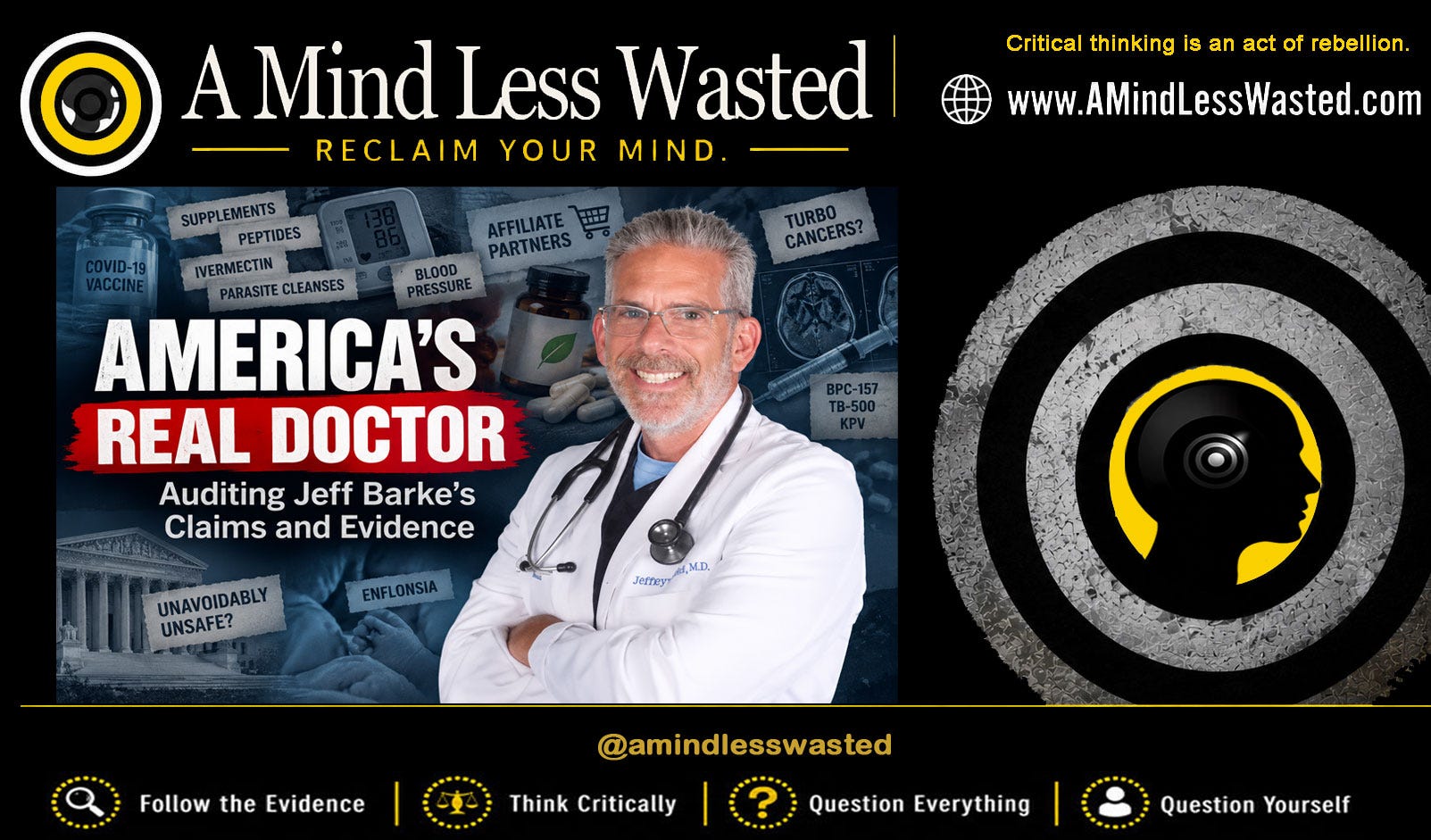
Dr. Jeff Barke calls himself “America’s REAL Doctor.” The capitalization is his.
He tells patients to question conventional medicine, demand better evidence, and follow the money. His newest posts, podcasts and product promotions raise a fair question:
Does he apply those standards just as rigorously to himself?
His current website does not treat the phrase as a casual social-media nickname. Visitors are invited to “BOOK AMERICA’S REAL DOCTOR,” schedule telehealth appointments, buy his vaccine books, and shop in what the site calls the America’s Real Doctor Marketplace. Barke’s public brand now spans medicine, podcasts, books, supplements, wellness products, speaking engagements and a substantial online following. Rx for Liberty
There is nothing inherently suspicious about a physician selling a book or supplement. Nor does disagreeing with public-health authorities make someone wrong. Barke is also right about an important principle: credentials should never end an argument.
A physician’s claim should stand or fall on the evidence behind it. That principle works in both directions.
I first looked closely at Barke because of his vaccine claims and his books Unavoidably Unsafe. Since then, his public platform has expanded. What he is saying in late 2026 gives us a better test than his old COVID arguments alone.
Some of his recent claims are reasonable. Others run well ahead of the evidence. And increasingly, some of those claims sit immediately beside products that Barke sells himself or recommends through personalized commercial links.
I am not going to tell you what label to put on that. I am going to show you what he says, what the evidence says, and where the two diverge.
A September podcast provides a surprisingly useful test
On September 28, Barke devoted an episode of his Informed Dissent podcast to hypertension.
Much of the beginning is sensible.
Barke says that one elevated blood-pressure reading should be confirmed rather than treated reflexively. He discusses sleep, alcohol, weight, stress, exercise and medical conditions that can contribute to hypertension. He explicitly says medication can be essential, tells listeners not to discontinue prescribed blood-pressure medication without consulting their clinician and argues that patients deserve more than a prescription handed across a desk. America Out Loud News
Those aren’t fringe ideas.
The current 2025 ACC/AHA hypertension guideline strongly emphasizes accurate measurement, home monitoring, lifestyle intervention and overall cardiovascular risk. In lower-risk adults with stage 1 hypertension—130–139/80–89—the guideline recommends lifestyle intervention first and medication if pressure remains elevated after three to six months. Treatment is therefore considerably more individualized than the caricature of a doctor seeing 130/83 and immediately reaching for a prescription pad. professional.heart.org
But the podcast then goes much further.
Barke tells listeners that he regards hypertension not as a disease but as a symptom, and says that when he sees newly hypertensive patients whose pressure is not immediately dangerous, he routinely sends them to a chiropractor several times a week for months. He offers a theory in which spinal alignment can effectively “dim” nerve activity to organs and blood vessels, contributing to high blood pressure. He then extends the idea to other medical conditions, citing stories of women becoming pregnant after chiropractic treatment and speculating about effects on thyroid function. America Out Loud News
This is precisely the kind of claim for which Barke normally demands rigorous evidence.
So what does that evidence show?
A randomized clinical trial involving 140 people with high-normal blood pressure or stage 1 hypertension found that adding chiropractic spinal manipulation to a dietary program provided no additional blood-pressure benefit over diet alone. A systematic review subsequently concluded that the low-bias evidence did not support spinal manipulation as a treatment for hypertension. A later sham-controlled trial likewise failed to show a reduction in blood pressure from upper-cervical manipulation. PubMed
An international systematic review examining spinal manipulation for disorders outside the musculoskeletal system went further: acceptable- or high-quality randomized trials did not show benefit for conditions including hypertension, asthma, migraine and infantile colic. PubMed
The infertility claim is thinner still. A review of chiropractic treatment for female infertility found only ten published articles—all case reports, covering just eleven women. Its authors concluded that chiropractic treatment for infertility should be approached cautiously because a robust body of evidence simply did not exist. PubMed
Pregnancy following chiropractic treatment proves that pregnancy followed chiropractic treatment.
It does not prove the adjustment caused the pregnancy.
That is exactly the distinction between after this and because of this that Barke asks people to make when evaluating conventional medicine.
And then the podcast arrives at Barke’s own product
There is another reason the hypertension episode deserves attention.
After discussing magnesium, beetroot, ashwagandha, L-theanine and omega-3 fatty acids, Barke explains that he has recommended those supplements individually for years. He then tells listeners that he combined them into a product of his own: RxForLiberty Blood Pressure Support.
He specifically frames the ingredients as useful for people who want to avoid blood-pressure medication or attempt to get off prescribed medication, while also cautioning listeners not to stop medication on their own and describing his supplement as supportive rather than a treatment.
That qualification matters. We shouldn’t omit it.
But so does what happens next.
The supplement is sold directly through Barke’s store. The current product page calls it a “clinical-strength” formula and markets a “Root-Cause Approach.” It says the blend supports healthy blood pressure, arterial elasticity, circulation, cortisol balance and cardiovascular health. The same page displays testimonials from purchasers reporting lower blood pressure, including one customer saying a family member wanted to get off medication and had begun taking it every other day. The site separately warns people taking prescription medication to consult their healthcare provider. Rx for Liberty
The individual ingredients are not inherently implausible.
A 2025 meta-analysis of 38 randomized trials found that magnesium supplementation produced a modest average blood-pressure reduction—about 2.8 mm Hg systolic and 2.1 mm Hg diastolic—with greater effects in certain hypertensive or magnesium-deficient populations and considerable heterogeneity among studies. A 2024 meta-analysis found that nitrate-rich beetroot juice reduced office systolic blood pressure by about 5 mm Hg in hypertensive patients, although certainty was low and effects on diastolic and 24-hour pressure were not significant. PubMed Central (PMC)
So the scientifically appropriate conclusion isn’t, “Supplements don’t work.”
It is more specific:
Evidence that some ingredients can affect blood pressure is not the same thing as evidence that Barke’s particular five-ingredient finished product produces the benefits implied by its marketing.
I could not locate a published randomized clinical trial of the finished RxForLiberty formulation itself.
Perhaps one exists and I missed it. If Barke can provide product-specific clinical evidence, it belongs in this article.
That seems a particularly fair request from a physician whose public message repeatedly insists that pharmaceutical companies should be required to test the actual products they sell.
The peptide experiment
Another recent Barke post raises the same question even more sharply.
Barke told followers that while recovering from an elbow injury, he had been experimenting with injectable BPC-157 and TB-500. He then said he had begun taking an oral product called Regenerate from The Wellness Company, describing BPC-157 in terms of tissue repair, TB-500 in terms of recovery, and KPV as supporting reduced inflammation.
He finished by directing interested followers to the product using his RXFORLIBERTY discount code.
The commercial product contains BPC-157, KPV and TB-500 and currently sells for $299.99 as a one-time purchase. Its manufacturer describes it as accelerating recovery, improving tissue repair, and promoting cellular regeneration.
Now compare that confidence with what FDA reported when it examined these substances in 2026.
For BPC-157, FDA said it had identified little human safety information for the proposed routes of use and lacked enough information to know whether the substance could cause harm. Its detailed review found limited human studies and no human pharmacokinetic data after oral, subcutaneous, nasal or transdermal administration. FDA also identified safety signals in animal studies that it said required further investigation. U.S. Food and Drug Administration
For KPV, FDA said it had found no human exposure data for drug products containing it.
For TB-500, FDA likewise reported that it could identify no clinical studies or human exposure data using TB-500 by any route, leaving its human safety risks unknown. U.S. Food and Drug Administration
That doesn’t establish that these peptides are dangerous.
It establishes something narrower and more important: the human clinical evidence is extraordinarily limited.
FDA convened an advisory committee in July specifically to consider BPC-157, KPV and TB-500-related substances for pharmacy compounding. That was a regulatory review of uncertain compounds—not an FDA finding that the recovery claims used to market products containing them had been clinically established. U.S. Food and Drug Administration
This is where Barke’s evidentiary philosophy becomes difficult to reconcile.
If insufficient long-term randomized human evidence is a reason to warn strongly about conventional medical products, why does extremely limited human evidence support recommending an oral peptide mixture for tissue repair and recovery?
The molecule doesn’t know whether it came from Pfizer or a wellness company.
The evidentiary standard shouldn’t know either.
Parasites, prescriptions and the discount code
Another recent Barke post turns to parasites.
He tells followers that conventional and holistic medicine approach parasites differently and discusses protocols involving ivermectin and mebendazole. The post then directs readers to The Wellness Company using RXFORLIBERTY for a discount.
Barke’s personalized Wellness Company page currently sells an ivermectin plus mebendazole “Dual-Action Parasite Cleanse” for $599.99. The same page labels a selection of commercial products as “Dr Jeff Barke’s Picks.”
Again, neither medication is imaginary medicine. Ivermectin and mebendazole are legitimate antiparasitic drugs when used for appropriate infections.
The question is what justifies moving from:
These medicines treat particular parasitic infections.
to a broadly marketed parasite cleanse.
Diagnosis matters. The suspected organism matters. Travel and exposure history matter. Dosing matters. Drug interactions matter. In some cases, treating the wrong suspected parasite without appropriate evaluation can create risks of its own.
And the commercial relationship matters.
Barke’s own website has a page explicitly titled “Affiliates and Partners.” It promotes The Wellness Company and numerous other health products, often using RXFORLIBERTY discount codes. Current offerings include nutraceuticals, parasite products, red-light devices, EMF shields, colostrum, detox products, air purification, organ supplements, magnesium products and water filtration. Barke’s site says he hand-selects these products for their clinical integrity, purity and effectiveness.
His legal notice separately acknowledges links to affiliate partners.
What I cannot establish from public records is precisely how Barke is compensated by every partner or how much money any individual sale generates for him.
So I won’t guess.
The documented point is enough: medical recommendations and commercial referral links occupy the same platform.
That isn’t proof that the recommendation is wrong. But it is exactly the sort of financial relationship readers should know about when evaluating medical advice.
One recent Barke headline has a legitimate point buried inside it
A fair audit cannot operate on the assumption that everything Barke says must be false.
A recent example is useful. Barke posted the headline:
“New mRNA COVID Vaccine: Tested Only on Mice, Not Humans.”
The statement sounds outrageous. But there is an important kernel of truth.
For the exact 2026–27 XFG-adapted formulation, regulators did not require a brand-new large human efficacy trial before updating the strain.
FDA says its strain-selection process incorporated human immunogenicity data from previous COVID vaccine formulations, existing vaccine-effectiveness evidence and animal immunogenicity data for newly updated candidate formulations. Pfizer likewise says approval of its XFG-adapted Comirnaty relied on the accumulated clinical, nonclinical and real-world evidence for Comirnaty along with manufacturing, quality and nonclinical data for the new XFG formulation.
So if Barke’s point is:
The exact XFG update did not undergo a fresh large preapproval efficacy trial in humans,
that is a legitimate regulatory criticism to discuss.
But “tested only on mice” can also leave readers with a very different impression: that regulators approved a completely new vaccine technology with nothing but a few animal experiments behind it.
That isn’t what happened.
Years of human clinical and real-world experience with the underlying vaccine platform remained part of the regulatory evidence base. Regulators then treated the strain update more like an update of an established platform than an entirely new biological product.
One can disagree with that regulatory approach. But the complete argument requires explaining it. This is one case where Barke is raising a genuine evidentiary question even if the headline compresses away important context.
“Turbo cancers”: a hypothesis is not yet a diagnosis
Barke recently posted another summary of his COVID-era positions, saying mRNA vaccination is now showing serious safety concerns, including what he describes as “turbo cancers.”
Notice his wording: what I describe as.
That qualification is useful because “turbo cancer” does not describe a defined clinical diagnosis with an established causal mechanism. It is a label being applied to claims that unusually aggressive or rapidly appearing cancers are occurring after COVID vaccination.
There is research worth discussing here rather than dismissing the subject with a sneer.
In 2026, Oncotarget published a case report involving a woman who developed acute lymphoblastic leukemia and lymphoblastic lymphoma after mRNA vaccination. Its authors also reviewed other reports and proposed potential biological mechanisms. Case reports are legitimate tools for generating safety hypotheses. Oncotarget
A large South Korean observational study published in 2025 also reported statistical associations between vaccination and several cancers during one year of follow-up. That study is real and shouldn’t simply be pretended away. PubMed
But association isn’t the end of the analysis.
A 2026 methodological commentary identified substantial problems with the Korean study, including different index dates for vaccinated and unvaccinated participants, residual confounding, possible surveillance bias, multiple comparisons without correction and the difficulty of attributing solid tumors appearing within one year to a new carcinogenic exposure. The authors concluded that the study could not establish causation and rated its evidentiary value as low.
The National Cancer Institute’s current position remains that there is no evidence COVID-19 vaccination causes cancer, recurrence or cancer progression. Cancer.gov
That does not mean researchers should stop looking for rare or unexpected effects.
It means that case reports, biological hypotheses and a disputed observational association do not yet establish a new syndrome in which vaccination causes rapidly accelerating cancers.
Barke is entitled to say the possibility deserves investigation.
Calling the phenomenon an emerging vaccine safety problem requires considerably stronger evidence.
The older claims matter because they show how the method works
The new material isn’t occurring in isolation.
Barke’s earlier article on Enflonsia remains one of the cleanest examples of the problem.
He presented Enflonsia as a new infant RSV vaccine. It isn’t a vaccine. It is clesrovimab, a long-acting monoclonal antibody manufactured by Merck. FDA approved it to protect infants entering their first RSV season.
More importantly, its pivotal infant trial included 3,614 infants in a randomized, double-blind, saline-placebo-controlled study. That is almost exactly the kind of trial design Barke routinely argues vaccine products should undergo.
The larger lesson isn’t merely that Barke got a product category wrong.
It is that the criticism remained highly confident even when the underlying facts did not fit the argument.
The same problem appears in discussions of Vaxelis.
Barke has emphasized that six infants died during trials of the combination childhood vaccine.
That number is true.
But the official prescribing information reports six deaths among Vaxelis recipients and one among active-comparator recipients; none of the deaths was assessed as vaccine-related. Causes included sepsis, SIDS, asphyxia, hydrocephalus, and an unknown cause, occurring from two days to eleven months after vaccination. Nonfatal serious adverse events within 30 days were 2.0% in the Vaxelis group and 2.2% in the comparison group. sotwe
Saying six babies died is not fabricated.
It is incomplete in a way that radically changes what a reader is likely to conclude.
Denominators matter.
Comparators matter.
Timing matters.
Causes matter.
Barke would rightly demand those things from a pharmaceutical advertisement.
They matter just as much in a warning about the pharmaceutical product.
And then there is Unavoidably Unsafe
The title of Barke’s vaccine books is itself built around an important legal phrase.
In excerpts from Unavoidably Unsafe for Adults that I reviewed, the authors connect the National Childhood Vaccine Injury Act and the Supreme Court’s decision in Bruesewitz v. Wyeth to the concept of vaccines as “unavoidably unsafe products.”
There really is an important liability story here.
Congress created a compensation system and gave manufacturers substantial protection from traditional design-defect litigation. Someone can reasonably argue that those protections are too broad.
But Bruesewitz did not constitute a scientific finding that vaccines as a class were proved unsafe.
Justice Antonin Scalia’s majority opinion specifically distinguished statutory language about vaccine side effects that were “unavoidable” from the Restatement of Torts category of “unavoidably unsafe products.” The majority said there was no reason to conclude that Congress had simply incorporated that product-liability category into the statute. Justice Sotomayor’s dissent interpreted the legal history differently, so there is a genuine legal debate—but not a Supreme Court scientific determination that vaccine risks outweigh their benefits.
The distinction matters because ordinary readers hear unavoidably unsafe very differently from lawyers arguing about design-defect preemption.
Another statement in the book is easier to test.
The excerpts claim, in substance, that MMR is the only vaccine that has been evaluated in relation to autism.
That is incorrect.
A 2014 meta-analysis included cohort data on more than 1.25 million children and separately examined vaccination generally, MMR, thimerosal, and mercury exposure. A 2013 study examined cumulative exposure to vaccine antigens during the first two years of life rather than MMR alone. Neither supported an association with autism.
Barke can reasonably say that scientists haven’t randomized children to every possible version of the complete vaccine schedule and followed them indefinitely for autism.
They haven’t.
That isn’t the same claim as saying researchers looked only at MMR.
This isn’t an argument for trusting institutions blindly
There is a temptation in articles like this to replace one oversimplification with another.
Don’t.
Drug companies have financial conflicts.
Government agencies make mistakes.
Medical journals publish bad papers.
Doctors sometimes follow habits long after the evidence has changed.
Postmarketing surveillance occasionally finds risks that preapproval trials were too small to detect.
And regulators do sometimes accept surrogate endpoints, immunobridging or extrapolation rather than demanding another gigantic efficacy trial.
Those are not conspiracy theories. They’re features, and sometimes weaknesses, of the real medical system.
Barke is also right that absolute risks are often more informative than dramatic relative percentages. He is right that a newly updated vaccine strain can reach the public without a fresh tens-of-thousands-person efficacy trial of that exact formulation. He is right that lifestyle measures are important in hypertension. He is right that patients should be told what we know and what we don’t know.
The question is whether those principles are applied consistently.
If a vaccine is criticized because the exact product hasn’t undergone enough human testing, an oral peptide product with almost no relevant human evidence should face at least as much skepticism.
If anecdotal post-vaccination events don’t prove vaccine injury, pregnancies after chiropractic manipulation don’t prove chiropractic treatment restores fertility.
If conflicts of interest matter at Pfizer, they matter when a physician recommends a $599 parasite product through his own branded discount code.
If regulators shouldn’t be allowed to hide behind “trust us,” neither should America’s REAL Doctor.

This review is not about guessing at Jeff Barke’s motives. It is about whether his public medical claims hold up when checked against the evidence.
Some do. Some raise legitimate questions about regulation, trial design, risk communication and medical conflicts of interest.
Others do not survive the same scrutiny. In several cases, important context is omitted, preliminary evidence is presented with more confidence than it warrants, or the evidentiary standard applied to conventional medicine is noticeably stricter than the standard applied to products and treatments Barke recommends himself.
Those patterns are documented here. Readers can decide what they mean.
Barke currently operates a broad commercial health platform alongside his medical commentary. His own store sells his blood-pressure supplement. His public partner directory contains numerous branded discount codes, and his legal notice acknowledges affiliate partners. The Wellness Company hosts a personalized Barke storefront offering products including peptide formulations, “spike detox” supplements, and an ivermectin-mebendazole parasite cleanse.
His September hypertension podcast contains prudent advice about lifestyle and medication, but also recommends repeated chiropractic treatment for hypertension despite weak or negative higher-quality evidence, invokes anecdotal chiropractic infertility stories and then promotes his own cardiovascular supplement.
His recent peptide promotion uses confident recovery language for compounds for which FDA reported extremely limited or absent human exposure data.
His “mice only” criticism of the newest COVID formulation contains a legitimate point about the absence of a fresh human efficacy trial for the exact strain update, but omits the extensive human evidence regulators relied on from previous formulations of the same platform.
And his use of “turbo cancers” moves ahead of what the current cancer evidence can establish. Hypotheses and observational signals exist; causation has not been demonstrated.
Those are factual observations.
What they add up to is for the reader to decide.
America’s “REAL Doctor”
I keep coming back to the branding because I do object to it.
Calling yourself “America’s REAL Doctor” is not a neutral slogan. It implies that other doctors are somehow less real - less independent, less honest, less willing to tell patients what they supposedly need to hear.
That kind of branding sets a standard.
What makes a doctor REAL?
Surely it cannot simply mean being more skeptical than other doctors.
Real skepticism is not a direction. It does not automatically point away from vaccines, pharmaceuticals, hospitals or regulatory agencies.
It points wherever the evidence requires it to point.
Sometimes that means challenging Pfizer.
Sometimes it means challenging the FDA.
Sometimes it means challenging a paper whose conclusions fit your own beliefs.
Sometimes it means challenging a supplement company.
Sometimes it means challenging a chiropractor.
And sometimes it means challenging the doctor you trust precisely because he told you not to trust everybody else.
Barke tells people to question authority.
They should.
He tells them to read studies instead of relying on headlines.
They should do that too.
He tells them to look for financial conflicts and ask who benefits.
Again, fair question.
But those rules do not stop at the boundary of conventional medicine.
They apply to the peptide bottle.
They apply to the parasite cleanse.
They apply to the blood-pressure supplement formulated by the doctor himself.
They apply to the affiliate relationship.
They apply to the discount code.
They apply to the claims that sound reassuring as well as the claims that sound frightening.
And they apply to America’s REAL Doctor.
That is the problem with building your brand around being the doctor who sees through everybody else.
Eventually, the same questions come back to you.
What is the evidence?
How strong is it?
What is missing?
What would change your mind?
And who stands to benefit?
No label is necessary.
Follow the evidence far enough, and readers can decide the rest.
Resources and Further Reading
Jeff Barke’s own platform and commercial relationships
RxForLiberty’s current site documents the America’s Real Doctor Marketplace, Barke’s Blood Pressure Support supplement, and his “Affiliates and Partners” page. That partner page promotes The Wellness Company and numerous wellness products, often using the code RXFORLIBERTY, while his legal notice acknowledges links to affiliate partners. Rx for Liberty
RxForLiberty Marketplace
Blood Pressure Support
Affiliates and PartnersThe Wellness Company products promoted through Barke’s page
Barke’s personalized Wellness Company storefront currently lists products including “Ultimate Spike Detox” and an ivermectin-plus-mebendazole “Dual-Action Parasite Cleanse” under “Dr Jeff Barke’s Picks.” The Wellness Company
Dr. Jeff Barke’s Wellness Company pageChiropractic treatment for high blood pressure
A randomized clinical trial of 140 adults found that adding chiropractic spinal manipulation to dietary treatment provided no additional blood-pressure reduction compared with diet alone. A later sham-controlled trial likewise found no significant blood-pressure benefit from upper-cervical manipulation. PubMed
Treatment of Hypertension with Alternative Therapies trial
Upper-cervical manipulation sham-controlled trialChiropractic and infertility
A review of the literature found only ten articles, all case reports involving just eleven women. The authors concluded that chiropractic treatment for infertility should be approached cautiously because a robust evidence base does not exist. PubMed
Scoping review of chiropractic management of infertilityBPC-157, KPV and TB-500
FDA convened its Pharmacy Compounding Advisory Committee in July 2026 specifically to review these substances. Their consideration for compounding should not be confused with FDA approval of claims that they accelerate healing, repair tissue or improve recovery. U.S. Food and Drug Administration
FDA 2026 peptide-compounding reviewThe 2026–27 COVID vaccine update and the “tested only on mice” claim
FDA explains that the 2026–27 XFG strain selection relied on a broader evidence base that included human immunogenicity and effectiveness data from existing COVID vaccines, human data from previous formulations, antigenic surveillance, and animal immunogenicity data for newly updated candidate vaccines. That supports a legitimate discussion about the absence of a fresh large human efficacy trial for the exact update, but not the broader impression that regulators relied only on mice. U.S. Food and Drug Administration
FDA: COVID-19 Vaccines, 2026–2027 FormulaCOVID vaccination and cancer
The National Cancer Institute states that current evidence does not show COVID-19 vaccines causing cancer, cancer recurrence or disease progression. That does not prevent researchers from investigating case reports or new hypotheses, but it is important context when evaluating claims about “turbo cancers.” Cancer.gov
National Cancer Institute: COVID-19 Vaccines and People with CancerCurrent FDA information on the 2026–27 vaccine formulations
FDA maintains current product pages for the approved 2026–27 COVID vaccines, including Moderna’s mRNA products and Novavax’s protein-based vaccine, with indications, formulation details and regulatory documents. U.S. Food and Drug Administration
FDA: MNEXSPIKE
FDA: SPIKEVAX
FDA: NUVAXOVID