

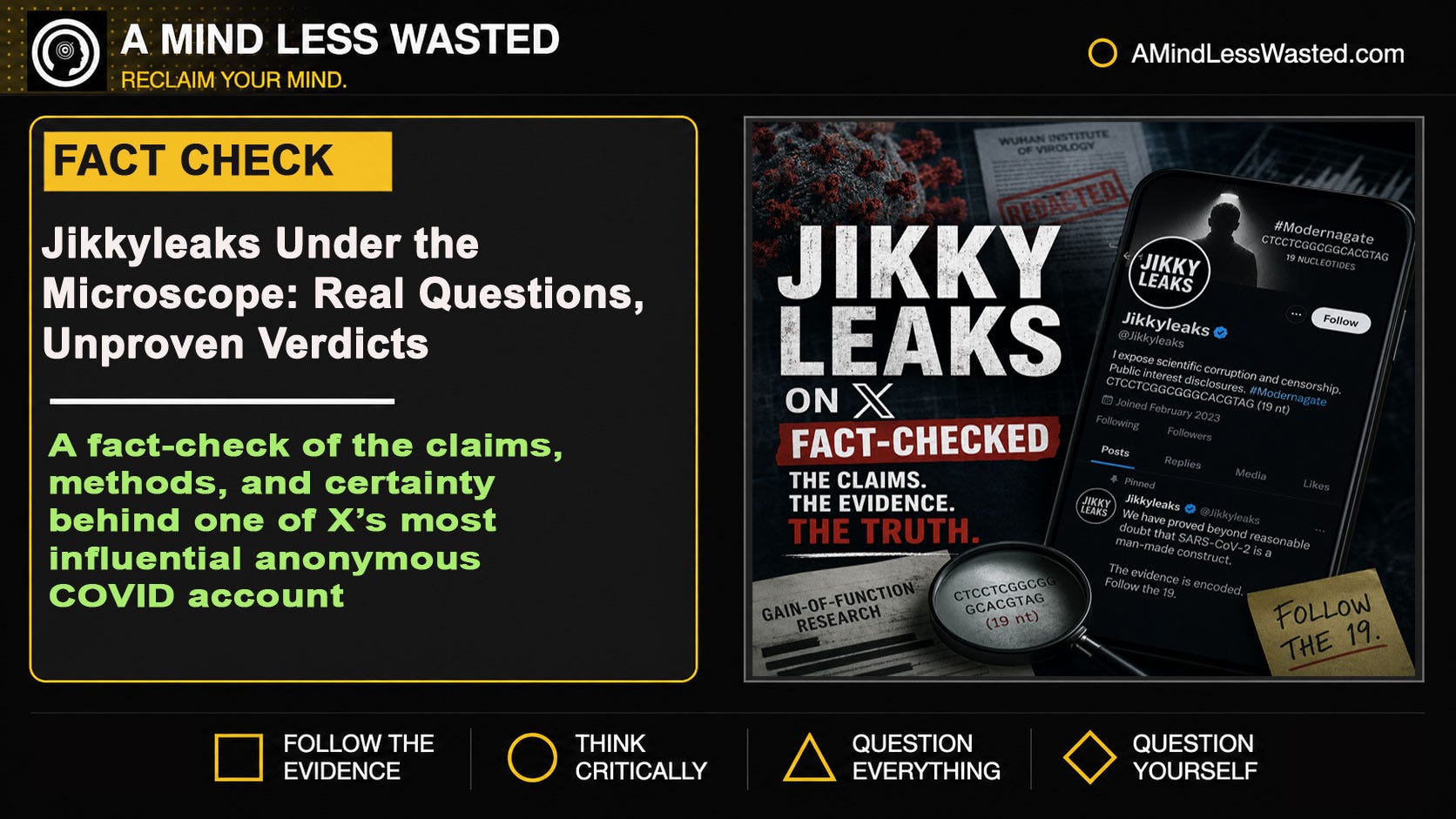
Jikkyleaks presents itself as a scientific whistleblower. Its X profile describes its posts as “public interest disclosures” and prominently displays the hashtag #Modernagate and the 19-nucleotide sequence CTCCTCGGCGGGCACGTAG.
The account has built a large audience by publishing allegations about the origin of COVID-19, vaccine development, regulatory failures and scientific misconduct.
Those claims deserve to be examined carefully.
This article is not an attempt to identify the anonymous person or people behind the account. It also does not assume that every question Jikkyleaks raises is illegitimate. Some of the subjects it covers deserve serious scrutiny, including risky coronavirus research, government transparency, vaccine manufacturing standards and recognized vaccine injuries.
The question here is more focused:
Does the evidence Jikkyleaks presents support the certainty of its conclusions?
In several important cases, it does not.
The recurring problem is not always the original observation. It is the leap from observation to conclusion. A real document becomes proof of a covert operation. A genuine sequence match becomes proof of engineering. A disputed laboratory measurement becomes evidence of widespread harm. An unusual-looking image becomes fraud. A plausible hypothesis becomes a solved case.
That is not careful investigation.
It is certainty outrunning the evidence.
Disclosure
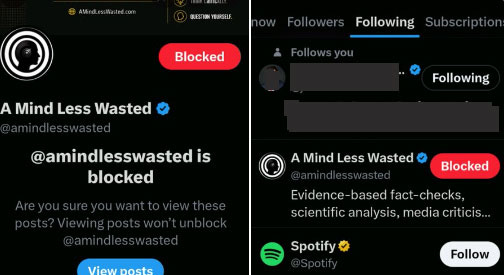
Jikkyleaks has blocked A Mind Less Wasted on X, even though we have never replied to, tagged, quoted or otherwise interacted with the account.
Because its posts are public, the block has not stopped us from reading and reviewing them. We do not know why we were blocked, and the decision has no bearing on whether any scientific claim is true or false.
We disclose it because readers should know about anything that might affect our perspective. The claims in this article are judged on public posts, primary documents and published scientific evidence, not speculation about the identity, motives or character of the person behind the account.
What Jikkyleaks Gets Right
Before getting into what Jikkyleaks gets wrong, we should be clear about what it gets right.
The origin of SARS-CoV-2 remains unresolved
Anyone claiming that a laboratory-related origin has been conclusively disproved is overstating the evidence.
In June 2025, the World Health Organization’s Scientific Advisory Group for the Origins of Novel Pathogens reported that crucial information was still missing. WHO said the main hypotheses, including zoonotic spillover and a laboratory-related incident, must remain under consideration. China had not provided all the requested early patient sequences, detailed information about animals sold at Wuhan markets or complete information about coronavirus research and biosafety conditions at Wuhan laboratories.
WHO nevertheless concluded that the weight of the available evidence favors zoonotic spillover, either directly from bats or through an intermediate animal.
That is not the same as saying the case is closed.
DEFUSE was a legitimate reason to scrutinize laboratory research
In 2018, EcoHealth Alliance and its collaborators submitted a roughly $14 million proposal called DEFUSE to the US Defense Advanced Research Projects Agency.
The proposal included work involving SARS-related bat coronaviruses and the possible introduction of human-specific cleavage sites. DARPA did not fund it.
That matters because SARS-CoV-2 contains a furin cleavage site at the S1/S2 junction of its spike protein. It was reasonable to ask whether similar work was carried out under different funding, at another location or without adequate documentation.
But a proposal is not proof that an experiment happened.
Even proof that a similar experiment happened would not, by itself, establish that the resulting virus was SARS-CoV-2 or that it escaped from a laboratory.
DEFUSE is important circumstantial evidence about the kind of work researchers were considering. It is not a laboratory notebook showing that they created the pandemic virus.
Vaccine regulators did not get everything right
The mRNA vaccines have recognized risks. Myocarditis and pericarditis occur rarely after vaccination, with the highest observed risk among younger males. In 2025, FDA updated the warning labels again and reported an estimated 27 cases per million doses among males ages 12 through 24 during the first week after a 2023–2024 formula dose.
Governments and manufacturers also deserve criticism for overconfidence, poor communication, delayed disclosures and attempts to minimize legitimate discussion of adverse events.
Questioning institutions is not anti-science.
The problem begins when questioning turns into a search for one predetermined answer and every new observation is made to fit it.
Claim One: The Laboratory Origin Has Already Been Proved
In the posts examined for this article, Jikkyleaks often treats a laboratory origin as a settled conclusion rather than an open hypothesis.
That goes beyond the available evidence.
What has been established
Several facts justify continued investigation of a laboratory-related origin:
Wuhan had laboratories conducting extensive research on bat coronaviruses.
Some experiments involved engineered or chimeric coronaviruses.
DEFUSE proposed work involving cleavage sites in SARS-related viruses.
Chinese authorities have withheld information needed to reconstruct the earliest infections and evaluate laboratory activity.
A laboratory accident would not require a deliberately engineered virus. A naturally collected virus could also be released accidentally.
Together, those facts make a laboratory-related origin plausible enough to investigate seriously.
What has not been established
No publicly available evidence has identified:
A laboratory database containing the immediate precursor of SARS-CoV-2.
A stored virus close enough to establish direct ancestry.
A laboratory record showing the construction of SARS-CoV-2.
A researcher infected with the precursor before the recognized outbreak.
A documented chain of transmission from a laboratory into the population.
Evidence that DEFUSE experiments were performed and produced SARS-CoV-2.
At the same time, market-centered epidemiological and environmental evidence continues to support zoonotic emergence. WHO’s independent group concluded that the weight of the available evidence favors zoonotic spillover, while emphasizing that missing information prevents a final conclusion.
Assessment
A laboratory-related origin remains plausible and unresolved. It has not been proved.
Jikkyleaks is right to reject claims that a laboratory incident is impossible. It is not justified in replacing one premature certainty with another.
The honest conclusion is not “case closed.”
It is not enough evidence for a final conclusion.
Related reading
This article examines how Jikkyleaks interprets evidence. For a deeper look at the origin question itself, read “Did COVID-19 Come from a Lab?” That companion article examines the Huanan market, gain-of-function research, the DEFUSE proposal, the cases for both zoonotic and laboratory-related origins, and Anthony Fauci’s role.
Claim Two: The “Modernagate” Sequence Match
Jikkyleaks prominently uses the sequence CTCCTCGGCGGGCACGTAG as part of its #Modernagate narrative.
The underlying observation came from a 2022 paper reporting that a 19-nucleotide region of the SARS-CoV-2 genome is a 100 percent complementary match to part of a patented, codon-optimized MSH3 sequence. The matching region overlaps the sequence surrounding the virus’s furin cleavage site.
The match is real.
What it means is not established.
Why the original probability was misleading
The paper reported an extraordinarily small probability that the match occurred by chance. A published commentary later identified several problems with that calculation.
The researchers did not begin with one predetermined 19-nucleotide sequence and test whether it appeared in one predetermined database. They began with the SARS-CoV-2 furin-cleavage-site region, searched a database, found a longer match and then calculated the probability of finding that successful extended match.
That uses information discovered after the search as though it had been specified before the search.
The commentary also noted that:
The match is to the reverse complement of the patented sequence.
Several different extensions of the original sequence could have counted as a match.
Both forward and reverse-complement matches should have been considered.
The database sequences were treated as independent and similarly sized, even though those assumptions were uncertain.
The original probability formula did not accurately represent the search that had been performed.
The correction was not minor. Under one set of assumptions used by the commentary authors, the final chance estimate increased from 3.21 × 10⁻¹¹ to approximately 0.0037.
The commentary also noted that if a much larger patent-sequence database were considered, the probability of finding at least one of the possible patterns could rise much higher. That estimate depended on additional assumptions, but it showed why the original “astronomical odds” claim could not be taken at face value.
The multiple-comparisons problem
Searching a vast genetic database is not the same as testing one sequence against one target.
There are many possible:
Starting positions.
Sequence lengths.
Databases.
Forward matches.
Reverse-complement matches.
Partial matches.
Extended matches.
Patented constructs.
Biological interpretations.
When a search includes many possible comparisons, surprising matches become more likely.
That does not make the MSH3 match meaningless. It means the probability must reflect the entire search process, not only the result that looked interesting afterward.
What would be needed to establish engineering?
To turn the sequence similarity into persuasive evidence of laboratory construction, investigators would need something more direct, such as:
The precursor viral backbone.
A plasmid or construct containing the sequence in the correct context.
Laboratory records describing the insertion.
Intermediate sequences.
Samples demonstrating an experimental lineage.
A documented route from the patented construct to SARS-CoV-2.
Independent analysis showing that the match remains genuinely exceptional after the full search space is considered.
None of that has been publicly demonstrated.
Assessment
The 19-nucleotide match is genuine, but its origin and significance remain uncertain. It does not prove that a patented MSH3 construct was used to create SARS-CoV-2.
Calling it “Modernagate” turns an observation into a scandal before the causal link has been established.
Claim Three: The Restriction-Site “Fingerprint”
Another argument in laboratory-origin discussions concerns the placement of BsaI and BsmBI restriction sites in the SARS-CoV-2 genome.
A 2022 bioRxiv preprint argued that the number, arrangement and spacing of these sites resembled a pattern that would be useful when assembling a viral genome from laboratory-generated fragments. The authors described the pattern as evidence of synthetic origin.
That is a scientific argument that can be tested. It should not be dismissed simply because it is controversial.
It is also heavily disputed.
Why the pattern looked suspicious
Type IIS restriction enzymes can be used to assemble complete viral genomes from smaller DNA fragments. A researcher building an infectious clone may prefer sites that divide the genome into manageable, reasonably even pieces while avoiding inconvenient internal sites.
Using the selected enzyme pair, SARS-CoV-2 can be divided into fragments of workable sizes. Viewed after the fact, that can resemble a convenient reverse-genetics system.
But convenience is not authorship.
A naturally evolved genome can also contain a useful distribution of restriction sites.
The selection problem
There are many restriction enzymes and many possible combinations. Selecting the pair that produces the most engineering-friendly map after examining the genome creates a familiar problem: the target may have been drawn around the result.
To show that the pattern is truly extraordinary, an analysis must account for:
All plausible enzyme combinations.
Different definitions of “evenly spaced.”
The range of fragment sizes a researcher could use.
Alternative assembly methods.
The distribution of the same sites among related natural viruses.
Viruses sequenced after the original analysis.
A published 2023 counteranalysis examined 1,316 pre-pandemic betacoronavirus genomes. It found numerous natural coronaviruses that met the proposed restriction-map criteria and concluded that SARS-CoV-2 was not the only apparent outlier.
A separate 2025 preprint used a larger collection of sarbecovirus genomes. It reported that related bat viruses matched SARS-CoV-2 at the disputed locations, found comparable “synthetic fingerprints” in natural pangolin viruses and recalculated the original claimed rarity from 0.07 percent to about 4.2 percent.
That 2025 analysis is still a preprint, so it should not be treated as the final word. It does, however, show that the original probability claim remains seriously contested.
A fingerprint must discriminate
A useful forensic fingerprint must distinguish engineered genomes from natural ones.
If the same criteria label several naturally occurring coronaviruses as apparently synthetic, the method has poor specificity.
That does not prove SARS-CoV-2 evolved naturally. It means this particular restriction-site argument cannot carry the weight being placed on it.
Assessment
The restriction map is compatible with laboratory assembly, but it is not diagnostic of laboratory assembly.
It is a clue worth examining, not a molecular confession.
Claim Four: “Blotgate” and the Alleged 24-Hour FDA Review
One of the clearest examples of Jikkyleaks moving too quickly from suspicion to accusation is the January 2023 #Blotgate thread.
The account claimed that Pfizer had submitted obviously fake Western blots, that nobody had examined them and that the FDA had reviewed 450,000 pages in about 24 hours. It described the advisory meeting as theater and declared that nobody had read the documents before authorization.
Several parts of that argument were wrong or misleading.
The FDA review did not begin on December 10
The FDA’s official review memorandum records Pfizer’s EUA submission date as November 20, 2020, with the review completed on December 11.
The memorandum identifies clinical, statistical, toxicology, manufacturing, facility, pharmacovigilance, data-integrity and labeling reviewers.
Pfizer’s advisory-committee briefing document was dated November 30, ten days before the public meeting on December 10.
That does not prove that every page was examined perfectly or that the emergency review was beyond criticism.
It does disprove the claim that the scientific review began with a document delivered on December 10 and was completed the next day.
Authorization was not full approval
The December 11, 2020 decision was an Emergency Use Authorization, not full FDA approval.
Full approval of Comirnaty for people 16 and older came on August 23, 2021.
Calling the EUA an “approval” may seem like a small wording issue, but the distinction matters when the accusation is specifically about the regulatory standard and timeline.
The “75 years” controversy concerned public-record processing
The FDA did propose an extraordinarily slow schedule for processing and releasing records requested through Freedom of Information Act litigation. A federal judge rejected that schedule and ordered a faster release.
That was a legitimate transparency controversy.
But the proposed FOIA schedule was not the amount of time FDA scientists said they needed to analyze the vaccine application.
FOIA production requires an agency to locate, review, redact and release records while protecting information that is legally exempt. Equating that administrative process with the scientific review creates a dramatic comparison, but not an accurate one.
The “fake Western blots” were automated Western blots
Jikkyleaks initially described the images as “absolutely impossible” and “totally fabricated.”
Two days later, the account acknowledged that the images were automated Western blots, sometimes called virtual blots, rather than photographs of conventional membrane blots.
That does not prove the underlying assay was valid, properly controlled or sufficient for the claim Pfizer was making. Automated systems can still be misused, and the underlying data should be available for review.
But their clean, standardized appearance is not evidence by itself that they were fabricated.
That distinction should have been established before accusing Pfizer of fraud.
The later clarification did not receive the same force or prominence as the original accusation.
Assessment
The 24-hour-review claim was false or seriously misleading. The thread confused FOIA processing with scientific review, treated an EUA as full approval and accused Pfizer of using fake blots before correctly identifying the method.
The FDA’s review can still be criticized for speed, emergency standards, reliance on manufacturer data and limited long-term information.
Those criticisms do not make the original claims accurate.
Claim Five: Residual DNA, SV40 Sequences and Cancer Claims
Claims about residual DNA in mRNA vaccines show why several separate questions must not be collapsed into one:
Is residual DNA present?
Does it include an SV40 regulatory sequence?
Does it exceed the applicable limit?
Has it been shown to integrate into human DNA or cause cancer, other adverse events or death?
Those questions are related, but they are not interchangeable.
What is true
DNA plasmids are used as templates when manufacturing mRNA vaccines. During purification, DNase is used to break down residual template DNA. Very small fragments can remain in the final product.
The Pfizer manufacturing plasmid includes an SV40 promoter-enhancer regulatory element. That is a genetic control sequence derived from simian virus 40.
It is not the complete SV40 virus.
It does not mean infectious SV40 is present in the vaccine.
FDA has stated that no SV40 proteins are encoded or present, that residual template material is fragmented during manufacturing and that safety surveillance has not identified a signal linked to residual DNA.
The measurement dispute
Some independent laboratories have reported residual DNA amounts they interpret as exceeding regulatory limits.
Regulators have challenged those measurements on methodological grounds.
Australia’s Therapeutic Goods Administration warned that fluorometry can overestimate DNA in a sample containing large quantities of mRNA because the fluorescent dye may bind to both. The agency also raised questions about sample provenance, storage conditions, small sample sizes, laboratory accreditation and whether the methods had been properly validated.
The TGA has since reported independently testing 28 batches of Pfizer and Moderna mRNA vaccines using validated quantitative PCR methods. All 28 were below the recommended limit of 10 nanograms of residual DNA per dose.
Those findings apply to the Australian batches tested. They do not prove that every vial manufactured worldwide met the same standard.
They do show why claims based on small, uncontrolled collections of vials and nonvalidated methods should not be treated as settled evidence of a global manufacturing failure.
What has not been demonstrated
Public evidence has not established that residual vaccine DNA:
Regularly enters the nuclei of cells in vaccinated people.
Integrates into human chromosomes at clinically significant rates.
Activates oncogenes.
Produces infectious SV40.
Causes a measurable increase in cancer.
Explains reported adverse events.
Caused large numbers of deaths.
It is possible to imagine a biological chain involving cellular uptake, nuclear entry, integration and harmful disruption of a gene.
But a conceivable mechanism is not a demonstrated clinical outcome.
Every step in that chain requires evidence.
Why “SV40 contamination” is misleading
The phrase creates the impression that vaccine vials contain the cancer-associated virus itself.
What has been identified is an SV40-derived regulatory DNA sequence within residual manufacturing-template fragments.
A promoter or enhancer is not a complete virus, just as one section of computer code is not a functioning program.
That does not make residual DNA irrelevant. Manufacturing limits should be enforced. Independent laboratories should use validated methods. Unexpected findings should be investigated rather than dismissed.
It means the claim should accurately describe what was found.
Assessment
Residual plasmid DNA fragments and an SV40-derived regulatory sequence are real manufacturing issues. Claims that the vaccines contain infectious SV40, cause cancer through integration or caused deaths through this mechanism have not been demonstrated.
Detection is the beginning of an investigation, not the end of one.
Claim Six: “You Can’t Vaccinate Against Cancer”
In a January 2025 post, Jikkyleaks argued that cancer vaccination cannot work because cancer antigens come from the body’s own cells, the immune system ignores them and producing more antigen only tires the immune system.
There is a real scientific problem inside that argument.
The conclusion is still false as stated.
The valid part
Cancer cells arise from a person’s own tissues. The immune system is trained not to attack normal self-antigens.
Tumors can also suppress immune responses, interfere with antigen presentation and create an environment that protects them from immune attack.
Immune exhaustion can occur during prolonged antigen exposure. Not every tumor antigen produces an effective response, and many experimental cancer vaccines have failed.
These are major obstacles.
What the argument leaves out
Cancer cells also acquire mutations. Those mutations can create neoantigens, abnormal protein fragments that are not found in healthy cells.
Researchers can sequence a patient’s tumor, identify promising neoantigens and design a personalized vaccine intended to direct T cells against cells carrying those mutations.
Cancer vaccines are usually therapeutic rather than preventive. They are designed to help attack an existing cancer or reduce the risk of recurrence, not necessarily to stop cancer from developing in the first place.
The FDA has already approved sipuleucel-T, sold as Provenge, an autologous cellular immunotherapy for certain men with metastatic prostate cancer. The National Cancer Institute describes it as an approved cancer treatment vaccine.
Personalized mRNA cancer vaccines are also being studied for melanoma, pancreatic cancer and other tumors. Many remain experimental, and encouraging early findings still need confirmation in larger controlled trials.
Why the blanket claim fails
“Cancer vaccines are difficult, and many will fail” is defensible.
“You cannot vaccinate against cancer” is not.
It ignores an FDA-approved treatment and a large field of tumor immunology built around cancer-specific and mutation-derived targets.
Assessment
False as stated. Cancer vaccines face serious biological limitations, but therapeutic vaccination against cancer is scientifically possible and already exists in an approved form.

What the Evidence Actually Shows
Before accepting a viral scientific thread, stop and separate four stages.
1. Observation
What was directly seen, measured or documented?
A rejected research proposal exists.
A 19-nucleotide reverse-complement match exists.
A particular restriction-site arrangement exists.
Automated blot images exist.
Residual plasmid fragments exist.
Tumors can evade immune detection.
These observations may be entirely real.
2. Interpretation
What might the observation mean?
The proposed coronavirus experiments might have been performed elsewhere.
The sequence match might reflect coincidence, recombination or laboratory activity.
The restriction map might be convenient for viral assembly.
Residual DNA might justify additional testing.
Tumor immune tolerance might reduce the effectiveness of a vaccine.
These are hypotheses.
3. Demonstrated mechanism
Has the proposed chain of events been experimentally or forensically established?
Was the precursor virus found?
Was the construct recovered?
Was the manufacturing fragment shown to enter cell nuclei?
Was genomic integration demonstrated in vaccinated people?
Was the alleged fake image shown to be fabricated rather than machine-generated?
Was the alleged health outcome shown to occur more often among exposed people?
Without this stage, the case remains circumstantial.
4. Causal assessment
Does the evidence establish who did what, how it happened and what outcome it caused?
This is where many Jikkyleaks threads arrive too soon.
Evidence checkpoint
The origin of COVID-19 has been proved: No. A laboratory-related origin remains possible, while the weight of the evidence reviewed by WHO currently favors zoonotic spillover.
The MSH3 match proves Moderna created the virus: No. The match exists, but no causal route has been demonstrated.
Restriction sites prove synthetic assembly: No. Similar patterns occur naturally, and the statistical rarity is disputed.
The FDA reviewed Pfizer’s entire application in 24 hours: No. The documented review began weeks earlier.
Pfizer submitted fake Western blots: Not demonstrated. The disputed images were generated by an automated Western blot system.
Residual DNA is present: Yes. Small fragments can remain as a manufacturing residual.
SV40 virus is present: No evidence shows that infectious SV40 or SV40 proteins are present.
Residual DNA causes vaccine-related cancer and deaths: Not demonstrated.
Cancer vaccination is impossible: False.
The Jikkyleaks Method
The scientific topics vary, but the pattern of reasoning is remarkably consistent.
Begin with a real anomaly
The starting point is often interesting enough to deserve attention:
An undisclosed proposal.
An unusual sequence.
A clean-looking laboratory image.
A disputed measurement.
A regulatory document.
An adverse event occurring after vaccination.
That gives the thread a solid foundation.
Select the most incriminating explanation
Less attention is usually given to alternatives such as:
Coincidence after a huge database search.
Naturally occurring restriction sites.
Automated laboratory imaging.
Administrative FOIA processing.
Assay interference.
Background disease rates.
Tumor neoantigens.
The suspicious explanation becomes the default before the alternatives have been ruled out.
Convert possibility into certainty
The language often moves through a predictable progression:
Could be → likely → obvious → proved → fraud → crime
The evidence may not change between those stages.
Only the rhetoric does.
Reverse the burden of proof
Readers are challenged to disprove the accusation.
But the person making the causal claim has the burden of demonstrating it.
“Regulators cannot prove that this DNA fragment never integrates” is not evidence that clinically significant integration occurs.
“No one has proved that DEFUSE-related work was never performed” is not evidence that the work produced SARS-CoV-2.
Failure to disprove a claim is not proof that the claim is true.
Correct quietly after accusing loudly
The #Blotgate episode is especially revealing.
The original thread used emphatic language about impossible images, fabricated evidence and a review that supposedly never happened. The later acknowledgment that the images were automated Western blots did not undo the accusation or necessarily reach everyone who had seen it.
A responsible correction should be at least as visible as the original claim.
Apply skepticism evenly
Jikkyleaks often distrusts statements from regulators, journals, universities and pharmaceutical companies because those institutions may have conflicts of interest.
That skepticism can be justified.
But it must also be applied to anonymous accounts, independent activists, advocacy laboratories, alternative-media personalities and researchers whose reputations have become tied to proving a controversial theory.
Distrusting institutions does not make outsiders automatically correct.
Is Jikkyleaks a Grifter?
The public record examined here cannot tell us the motives of the person or people behind Jikkyleaks.
The operator may sincerely believe every claim.
The account may genuinely see itself as exposing institutional failures.
It may also benefit from attention, status and a loyal audience, as nearly every influential social-media account does.
We do not need to know the motive to evaluate the argument.
A claim can be sincerely made and still be wrong. An account can uncover a legitimate issue and still exaggerate what the evidence proves.
The defensible criticism is not:
“Jikkyleaks knowingly fabricates everything.”
It is:
“Jikkyleaks repeatedly presents disputed or incomplete evidence with more certainty than the evidence supports.”
That conclusion can be tested directly against the account’s public claims.
What Responsible Scientific Whistleblowing Looks Like
A serious investigator should:
Separate observation from interpretation.
Present competing explanations before announcing a conclusion.
Calculate probabilities using the full search space.
Publish enough raw data and methodology for others to replicate the work.
Use validated assays and traceable samples.
Avoid accusations of fraud based only on appearance.
Separate a laboratory origin from an engineered-virus claim and a deliberate-release claim.
Distinguish a regulatory DNA sequence from an infectious virus.
Measure actual health outcomes rather than infer them from a hypothetical mechanism.
Correct mistakes prominently.
Change confidence when contrary evidence appears.
Say “unknown” when the evidence is incomplete.
None of that requires blind trust in Pfizer, Moderna, FDA, WHO, EcoHealth Alliance or the Chinese government.
It requires holding every source to the same standard.
Conclusion: The Clue Is Not the Case
Jikkyleaks has helped draw attention to information that institutions sometimes disclosed slowly, explained poorly or appeared reluctant to discuss.
DEFUSE deserved scrutiny.
Government transparency deserved criticism.
Residual DNA measurements deserve reproducible independent testing.
Vaccine injuries deserve acknowledgment and research.
The origin of SARS-CoV-2 deserves an independent investigation with access to early patient data, animal records and laboratory files.
But identifying a legitimate question does not give anyone ownership of the answer.
Across its claims about the origin of COVID-19, the MSH3 sequence, restriction sites, Pfizer’s review, automated blots, residual DNA, SV40-related sequences and cancer vaccines, Jikkyleaks repeatedly crosses the line between evidence of possibility and proof of causation.
That does not make every observation false.
It makes the advertised certainty unreliable.
A critical thinker should not dismiss Jikkyleaks automatically. Nor should anyone treat the account as an oracle. Each claim should be removed from the drama of the thread and tested against primary documents, competing analyses and evidence capable of establishing causation.
That is the larger lesson.
A scientific thread can contain real papers, real patents, real sequences, real screenshots and real regulatory documents and still reach an unsupported conclusion.
Evidence is not measured by the size of the file folder.
It is measured by whether the evidence rules out the reasonable alternatives.
Jikkyleaks often finds clues.
It has not proved the case.
Subscribe to A Mind Less Wasted
If you value evidence over narratives, skepticism over certainty, and questions over slogans, consider subscribing.
Our goal isn’t to tell you what to think. It’s to help you think more clearly by separating evidence from assumption, correlation from causation, and confidence from proof.
Join a growing community committed to following the evidence wherever it leads.
Subscribe today and never miss an article.
#ThinkCritically #FollowTheEvidence
#QuestionEverything #QuestionYourself