

It starts with a perfectly reasonable question. Why is there a Station Road when there isn’t a station?
You look it up. An old map shows a railway line where the supermarket now stands. A photograph reveals a platform, a waiting room, and an enormous clock. You wonder how they managed to keep all those station clocks telling the same time.
Half an hour ago, you were checking the weather. Now you’re researching the administration of Victorian punctuality.
And you’re enjoying yourself.
This is how a good rabbit hole gets you. One answer leads to another question, which leads to something you hadn’t even considered. You could stop at any point, theoretically. But now there’s this business about the clocks, and it would be irresponsible to leave it unresolved.
The clocks, incidentally, are worth investigating.
Before Britain adopted a common time standard, towns operated on local time. The expansion of the railways created an obvious problem. Running a timetable becomes rather difficult when neighboring towns can’t agree on what noon means.
Railway companies helped drive the adoption of Greenwich Mean Time, and the National Railway Museum maintains historical records of individual railway clocks, including their locations, manufacturers, and sometimes their repairs.
Yes, the railways kept records of their clocks. Some clocks even have records of when they were repaired, sold, or stolen. Victorian bureaucracy apparently had enough paperwork to keep the clocks busy, too.
The National Railway Museum has an excellent account of these records.
You could close the browser now, satisfied that you’ve learned something interesting about a road you pass every week.
But perhaps you’d like another look at that map.
1. The strange places curiosity takes us
Not every rabbit hole begins with something as ordinary as a road name. Sometimes the entrance is considerably stranger.
Consider medieval manuscripts.
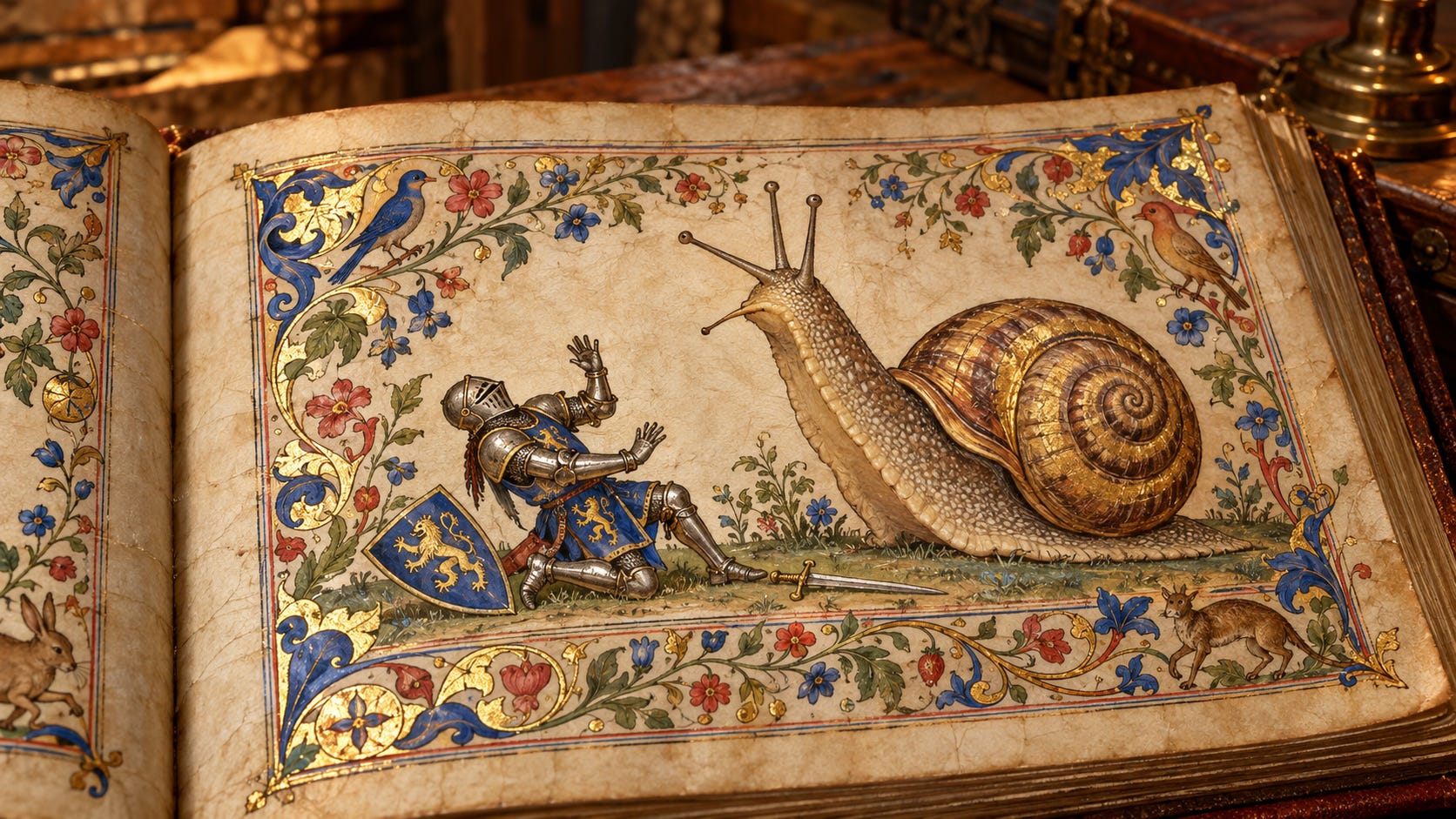
You’re looking through some beautifully illustrated pages when you encounter a knight in armor fighting a snail.
Naturally, you have questions.
Why is a fully armed knight confronting a snail? Is the snail dangerous? Has the knight offended it? And why does the knight appear to be losing?
It gets better. This wasn’t an isolated artistic lapse. Knights fighting snails appear in several medieval manuscripts from the thirteenth and fourteenth centuries.
The British Library has documented numerous examples, including one in which a knight appears to surrender to his slow-moving opponent.
Scholars have proposed different interpretations. The snail might represent the Lombards, a medieval European group associated with several negative stereotypes. Other explanations involve social satire, class conflict, or symbolic jokes whose meaning has largely been lost.
Nobody has established one explanation that accounts for every example.
Think about that. Hundreds of years later, historians are still trying to understand why medieval artists kept humiliating knights with snails.
I find that rather comforting. Apparently, people have always enjoyed absurdity.
Then there’s the octopus. You watch a short video of one exploring a rock with its arms. You wonder how it knows what it’s touching.
That leads to a remarkable discovery: octopuses possess specialized chemical receptors in their suckers, allowing them to detect certain substances through contact. Researchers have described the ability as a form of tasting by touch.
A 2020 study by Lena van Giesen and colleagues identified receptors involved in this sensory system.
Now imagine having hands that could taste what they touched. Grocery shopping would be a completely different experience, although I suspect supermarkets would have some objections.
A short animal video has led you into sensory biology and the question of how differently other creatures experience the world.
Music works the same way. You hear an interesting guitar sound and look up the recording credits. That takes you to an unfamiliar musician, then an earlier band, then a forgotten album recorded in 1973. Before long, you’re reading about the equipment used in a studio that closed forty years ago.
You started with a guitar tone. You’ve ended up researching the history of a recording console.
I don’t see a problem with that.
2. Why one question creates another
There’s a psychological explanation for why these little journeys can become so absorbing.
In 1994, psychologist George Loewenstein proposed what became known as the information-gap theory of curiosity.
The basic idea is that curiosity develops when we become aware of a gap between what we know and what we want to know. That distinction matters.
You probably don’t spend much time worrying about the thousands of subjects you know absolutely nothing about. Most of those gaps never enter your awareness.
But once something draws your attention to a specific missing piece of information, you may suddenly want to fill it.
Loewenstein’s research helps explain why a small, precise question can be more compelling than an enormous subject.
“Learn about British railway history” sounds suspiciously like homework.
“Why did railway stations need synchronized clocks?” sounds interesting.
The second question gives you a problem you can actually investigate. And here’s what makes rabbit holes so effective: an answer can reveal questions you didn’t know existed.
You learn that a station once stood on your road. That leads to a photograph. The photograph contains a clock. The clock leads to railway timekeeping, which leads to Greenwich Mean Time. You aren’t necessarily becoming more confused. In some ways, you’re becoming better informed. You simply know enough now to recognize additional things worth investigating.
Curiosity creates its own opportunities.
The pleasure of knowing versus the need to know
Psychologist Jordan Litman identified two related dimensions of curiosity in research published in 2008.
One involves the pleasure of discovering something new. The other involves the discomfort of not knowing a particular answer.
Researchers call these interest-type and deprivation-type curiosity. The distinction is easy to recognize. You’re browsing photographs of medieval manuscripts because they’re fascinating. That’s the enjoyable, exploratory side of curiosity.
But then you encounter that knight fighting a snail. Now you want an explanation. You may become genuinely irritated by the absence of one. There must be a reason. Somebody must know. You keep looking.
One form of curiosity says, “That’s interesting.” The other says, “Wait a minute. I need to know what the hell is going on here.”
Litman’s research found evidence for these related motivations across four questionnaire studies.
They’re not rigid personality categories. The same person can experience both, sometimes during the same search. And that may explain the moment when a pleasant diversion becomes a minor obsession.
3. Curiosity has its own rewards
One of the more interesting things about curiosity is that we don’t always need a practical reason to satisfy it.
In a 2009 study, Min Jeong Kang and colleagues investigated how people responded to unanswered trivia questions. Participants who were more curious about an answer were willing to sacrifice more limited resources, including tokens or waiting time, to obtain it.
In other words, people were prepared to pay a small price simply to know something.
The researchers also found relationships between curiosity and activity in brain regions associated with anticipating rewards. Apparently, learning something interesting can be rewarding even when the information has no obvious practical value.
This helps explain why you might spend twenty minutes discovering who played bass on an obscure recording from 1975. You’re unlikely to be examined on it. Nobody is offering a prize. There is no certificate waiting at the end.
You simply want to know. Curiosity may also influence memory.
In research published in 2014, Matthias Gruber and colleagues found that participants remembered more answers to trivia questions that had previously made them highly curious. Brain imaging also revealed activity in regions associated with reward and memory during curious anticipation.
These findings are interesting, but we should resist exaggerating them.
They don’t establish that spending five hours following Wikipedia links will improve your memory generally. Nor do brain scans directly demonstrate that every interesting discovery produces a “dopamine hit,” despite how casually that explanation gets thrown around.
What the studies suggest is more specific: curiosity can influence how people pursue information and how well they remember certain things they learn.
There’s another useful concept here.
Psychologists Richard Ryan and Edward Deci have written extensively about intrinsic motivation, the pleasure of engaging in an activity for its own sake.
Their work emphasizes the importance of autonomy and competence: having some control over what we do and experiencing the satisfaction of becoming more capable.
A rabbit hole can provide both. You choose the question. You decide where to look. You gradually understand something that puzzled you. Nobody assigned it. Nobody is grading you. And nobody gets to ask whether the material will be on the test.
Perhaps most importantly, there’s no requirement that your curiosity become something productive.
You can read about astronomy without buying a telescope. You can enjoy learning about octopuses without considering a career in marine biology. You can become interested in an obscure historical event for an afternoon and never return to it.
Not every interest needs to become a project, a qualification, or a new personal identity.
Sometimes it’s enough to know something you didn’t know an hour ago.

4. When the rabbit hole stops being fun
Of course, curiosity isn’t always harmless.
There’s an important difference between following an interesting question and becoming unable to leave it alone.
In 2016, researchers Christopher Hsee and Bowen Ruan published a series of experiments called The Pandora Effect. Their findings were peculiar and a little unsettling.
Under certain experimental conditions, people exposed themselves to unpleasant experiences, including possible electric shocks, simply to resolve uncertainty.
You read that correctly. Some people were willing to risk an electric shock because they wanted to find out what would happen.
The study demonstrated that curiosity can sometimes motivate choices with foreseeable costs.
It doesn’t mean that browsing the internet is equivalent to volunteering for electric shocks. But it does challenge the comfortable assumption that satisfying curiosity is always beneficial.
And anyone who has spent time arguing on social media knows how easily that can happen. You begin by investigating a claim. You examine the evidence, read a study, and discover that the original claim was misleading.
That should settle it.
But someone replies with another claim. Then another person introduces an unrelated study. Before long, you’re explaining basic research methods to someone whose principal objection to your argument appears to be that you made it.
Three hours later, nobody has learned anything, nobody has changed their mind, and you’re still waiting for a person on the internet to acknowledge a mistake.
Good luck with that.
Here’s where I think the distinction matters.
Curiosity is valuable when you’re genuinely trying to learn. It becomes something else when you’re merely trying to confirm what you already believe.
That applies to all of us. An investigation should allow for the possibility that the answer isn’t what we expected. Otherwise, we’re just collecting material for a conclusion we’ve already decided to defend.
And sometimes the available evidence doesn’t provide a definitive answer.
The medieval snail is a good example. Historians have offered plausible explanations, but there isn’t enough evidence to establish one universal meaning.
An honest investigation may end with uncertainty. That doesn’t make the investigation a failure. Knowing where the evidence stops is itself something worth learning.
5. How to make the most of a rabbit hole
I wouldn’t suggest turning curiosity into another self-improvement program. That would rather defeat the purpose.
But a few habits can make these little journeys more satisfying.
Start with something that actually interests you
Forget the vague instruction to “learn something new every day.”
It sounds admirable, but it also sounds like an assignment. Instead, pay attention to the things that genuinely catch your interest.
An unusual word. A forgotten building. A strange sound on a record. A historical photograph with something unexpected in the background.
A question that arises naturally is often a better starting point than a subject chosen out of obligation.
Make a prediction before looking up the answer
This is a surprisingly useful technique.
In a 2019 study, researchers Garvin Brod and Jasmin Breitwieser investigated whether generating a prediction could stimulate curiosity.
Participants who made predictions about numerical facts reported greater curiosity than those who generated related examples.
It’s a modest finding from a specific experimental task, but the idea is worth trying.
Before looking something up, guess.
Why did that railway station disappear? Perhaps the route became unprofitable. Perhaps another station replaced it. Perhaps the railway was removed when the road system changed.
Now you have something to test. And if your guess turns out to be wrong, so what? Being wrong is considerably more useful when you’re willing to find out why.
Follow the evidence, not just the next link
One of the problems with online rabbit holes is that not all paths are equally useful.
A museum archive, an original research paper, or a well-documented historical account may provide an answer.
A blog repeating another blog that quoted an anonymous social media account may provide an afternoon of entertainment, but it shouldn’t automatically earn your confidence.
It’s worth checking where the information originated.
And if several sources all repeat the same claim, find out whether they’re independently supporting it or simply copying one another. Ten repetitions of an unsupported claim don’t turn it into evidence. That little distinction alone can save an enormous amount of wasted time.
Know when you’ve had enough
This may be the most important suggestion. Curiosity should be allowed to end. If you’re still learning, enjoying yourself, or getting closer to an answer, by all means continue.
If you’re rereading the same arguments, opening the same sources, or waiting for someone to concede a point they’ve already demonstrated no interest in understanding, you may have reached the end of the useful part.
Close the tab.
The internet will still be wrong tomorrow.
6. The value of a good detour
We live in a culture that likes to measure the usefulness of almost everything.
Read a book to improve yourself. Learn a skill to advance your career. Take a course to become more productive. Even relaxation is sometimes presented as a way to improve performance when you return to work.
I think we can afford to give curiosity a little breathing room.
There’s nothing wrong with spending an afternoon learning something simply because it interests you. You don’t have to become an expert. You don’t have to retain every detail. You certainly don’t have to turn your discovery into a presentation.
Some of the satisfaction comes from returning to ordinary life with a slightly different understanding of something familiar.
That road outside the supermarket isn’t quite the same road anymore. You know there was once a railway station there. You know something about the clocks that kept its timetable running.
An octopus is no longer just an animal with eight arms. You have some appreciation of how differently it senses its surroundings.
And somewhere in a medieval manuscript, a knight is losing a confrontation with a snail for reasons historians are still arguing about.
I like the idea that the world contains an almost unlimited supply of these little mysteries. Most of them are waiting in plain sight. They don’t announce themselves as important, and they rarely offer any obvious reward beyond the satisfaction of understanding something new.
That’s enough for me.
So the next time an odd detail catches your attention, follow it for a while. Look something up. Ask another question. See where it takes you.
Just remember that a good rabbit hole should leave you knowing more than when you entered. And if you happen to discover why those medieval knights were so intimidated by snails, please let the British Library know.
They’ve been working on that one for centuries.
Resources and further reading
The psychology of curiosity
Loewenstein, G. (1994). The psychology of curiosity: A review and reinterpretation. Psychological Bulletin, 116, 75–98.
Litman, J. A. (2008). Interest and deprivation factors of epistemic curiosity. Personality and Individual Differences, 44, 1585–1595.
Kang, M. J., et al. (2009). The wick in the candle of learning: Epistemic curiosity activates reward circuitry and enhances memory. Psychological Science, 20, 963–973.
Gruber, M. J., Gelman, B. D., & Ranganath, C. (2014). States of curiosity modulate hippocampus-dependent learning via the dopaminergic circuit. Neuron, 84, 486–496.
Ryan, R. M., & Deci, E. L. (2000). Intrinsic and extrinsic motivations: Classic definitions and new directions. Contemporary Educational Psychology, 25, 54–67.
Hsee, C. K., & Ruan, B. (2016). The Pandora effect: The power and peril of curiosity. Psychological Science, 27, 659–666.
Brod, G., & Breitwieser, J. (2019). Lighting the wick in the candle of learning: Generating a prediction stimulates curiosity. npj Science of Learning, 4, Article 17.
The historical and scientific rabbit holes
Thorpe, P. (2019). Time detectives: Discovering the history of railway clocks. National Railway Museum.
British Library. (2013). Knight v Snail. Medieval Manuscripts blog.
van Giesen, L., et al. (2020). Molecular basis of chemotactile sensation in octopus. Cell, 183, 594–604.e14.