

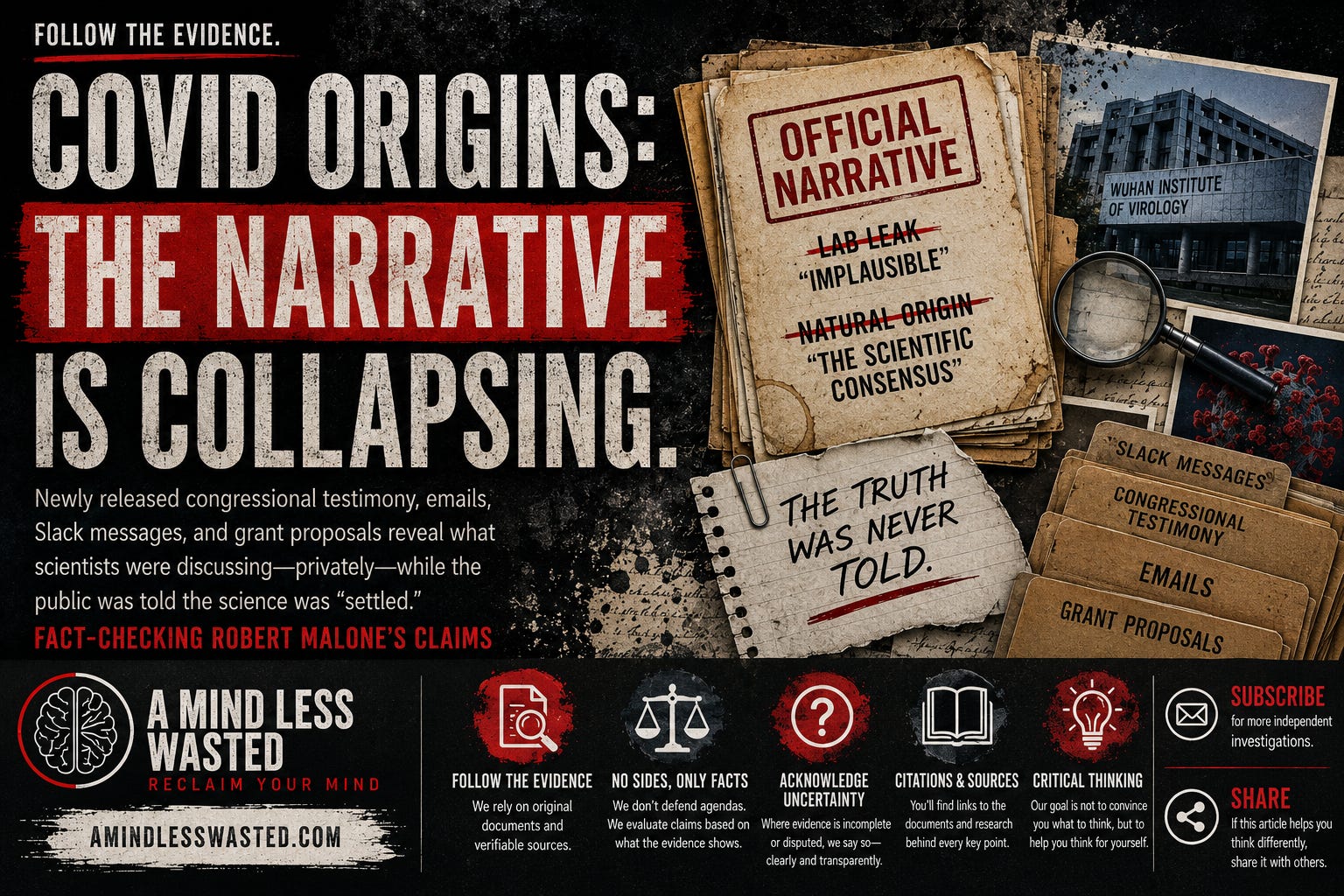
For more than six years, the origins of COVID-19 have remained one of the most fiercely debated scientific questions of the 21st century. Early in the pandemic, many public officials, scientific organizations, and news outlets portrayed a laboratory origin as highly unlikely or even dismissed it outright. Over time, however, newly released emails, grant proposals, intelligence assessments, congressional investigations, and testimony have shown that the question was far more complex than many public statements suggested.
Today, the precise origin has not been conclusively established. Published epidemiological and genomic evidence supports a zoonotic emergence associated with the wildlife trade, while incomplete laboratory records, risky coronavirus research in Wuhan, and the absence of full Chinese cooperation leave a research-related accident unresolved. U.S. intelligence agencies have also reached differing judgments, generally with low or moderate confidence rather than definitive proof.
Recently, Dr. Robert Malone published an article titled “Ralph Baric Just Blew Up the Official COVID Origins Narrative,” arguing that newly released congressional testimony from coronavirus researcher Dr. Ralph Baric—along with thousands of pages of emails, Slack messages, and other documents released through Senator Rand Paul’s COVID-19 Reading Room—fundamentally changes what we know about the pandemic’s origins. If you haven’t read it yet, you can find it here:

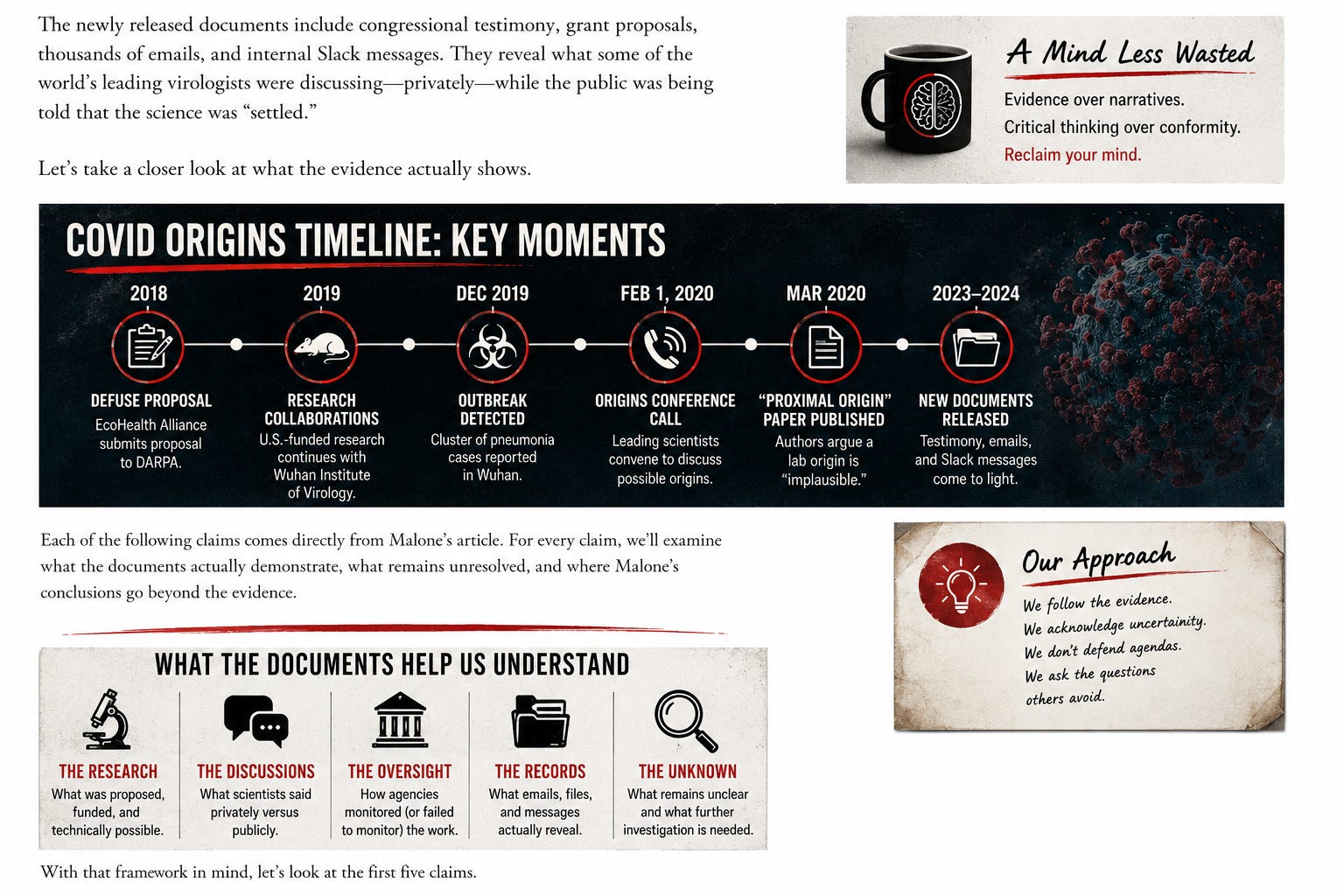
The documents Malone discusses are unquestionably significant. They provide new insight into gain-of-function research, private scientific discussions, research oversight, and how some of the world’s leading virologists debated the origins of SARS-CoV-2 behind closed doors.
But an important distinction must be made.
New evidence can change a narrative. It cannot replace evidence with certainty.
One of the guiding principles of A Mind Less Wasted is that we should resist replacing one unquestioned narrative with another. Whether a claim comes from a government agency, a major news outlet, or a respected scientist, it should be measured against the evidence—not accepted because it confirms what we already believe.
That’s the purpose of this article.
Rather than asking whether Robert Malone is “right” or “wrong,” we’ll examine his major claims one at a time and ask a simpler question:
Does the available evidence support this conclusion?
Some of Malone’s claims are well supported. Others raise legitimate questions that deserve further investigation. And some go beyond what the released documents actually establish.
Let’s follow the evidence wherever it leads.
Before we begin: If you enjoy evidence-based analysis that challenges claims from every side of the debate, please consider subscribing to A Mind Less Wasted. Every subscription helps support independent research, careful sourcing, and long-form fact-checking.
Claim #1
DARPA’s PREEMPT Program Solicited Work Baric Characterized as Gain-of-Function
Assessment: Supported, with an important regulatory distinction.
One of Malone’s strongest claims concerns DARPA’s 2018 PREEMPT program, which sought research into the biological mechanisms that allow animal viruses to cross into new species.
During his congressional interview, Baric explained that identifying, down to the nucleotide level, which changes permit a cross-species jump would require altering viruses and testing the effects. He characterized that work plainly:
“That’s a gain-of-function experiment. There’s no other way to think about it.”
That testimony is important, but it does not resolve every argument over terminology. Gain of function is a broad scientific description, while federal policies have used narrower categories such as gain-of-function research of concern and research involving enhanced potential pandemic pathogens. An experiment may qualify under the broad scientific meaning without necessarily falling within every regulatory definition.
Baric’s statement supports Malone’s claim that the proposed work involved gain-of-function experimentation in the ordinary scientific sense. It does not establish that the work violated federal rules, that DEFUSE was funded, or that any resulting experiment produced SARS-CoV-2.
Malone accurately reports Baric’s testimony here. This is one of the strongest-supported claims in the article.
Claim #2
DEFUSE Proposed Inserting a Furin Cleavage Site
Assessment: Supported, but Malone goes further than the evidence.
Another claim is that DEFUSE proposed inserting a furin cleavage site into SARS-like bat coronaviruses.
This is accurate.
The publicly available DEFUSE proposal describes experiments involving the introduction of proteolytic cleavage sites into novel bat coronaviruses to study whether those changes altered infectivity or host range.
Baric also confirmed during testimony that his laboratory at the University of North Carolina would have performed portions of that work had DARPA funded the proposal.
This matters because SARS-CoV-2 possesses a polybasic furin cleavage site that was not present in the closest SARS-related coronaviruses known when the virus emerged. Polybasic cleavage sites are not unprecedented across coronaviruses more broadly, but their presence in SARS-CoV-2—and absence from its closest known sarbecovirus relatives—has made the feature central to the origins debate.
Where Malone moves beyond the evidence is what comes next.
He suggests that substantially similar experiments were “highly likely” carried out later under NIH funding.
That may ultimately prove true.
But the congressional documents released so far do not establish that conclusion.
There is an important distinction between:
A proposal is not a protocol.
A protocol is not an experiment.
An experiment is not proof of a pandemic.
The proposal establishes that the experiment was contemplated and that participating laboratories possessed relevant technical capabilities. It does not establish that the proposed insertion experiments were subsequently performed.
That question remains one of the most important unresolved issues for investigators.
The DEFUSE proposal is real.
Its proposed experiments deserve scrutiny.
Whether those experiments were later conducted remains an open question.
Claim #3
Baric Had Unpublished Data That Weakened One of Proximal Origin’s Arguments
Assessment: Supported as a criticism of one argument, but not as proof of engineering.
Perhaps the most interesting revelation in Baric’s testimony involves unpublished experiments concerning ACE2 receptor binding.
One argument presented in the influential 2020 paper The Proximal Origin of SARS-CoV-2 was that if scientists had intentionally engineered SARS-CoV-2, they likely would have optimized its receptor-binding domain differently.
According to Baric’s testimony, his unpublished experiments indicated that increasing receptor-binding affinity did not necessarily improve viral performance and could produce disadvantages. If accurately characterized, that complicates the assumption that a deliberately modified virus would necessarily possess the strongest computationally predicted ACE2-binding configuration.
If accurate, those findings suggest that one argument made in Proximal Origin was less definitive than readers may have believed.
That is an important scientific point.
However, Malone argues that this revelation effectively undermines one of the paper’s central conclusions.
That overstates what the testimony demonstrates.
The receptor-binding discussion was only one component of Proximal Origin. The paper also examined genomic structure, evolutionary relationships, known viral backbones, and other evidence before concluding that a laboratory construct appeared unlikely.
Weakening one supporting argument does not automatically invalidate the paper’s broader analysis.
Nor does it demonstrate that SARS-CoV-2 was engineered.
Baric’s unpublished results may weaken the certainty attached to one inference in Proximal Origin. They do not reverse the paper’s entire analysis or establish that the virus was engineered.
Claim #4
The Authors of Proximal Origin Didn’t Believe Their Own Paper
Assessment: Overstated
This is one of Malone’s strongest accusations—and one of his weakest-supported conclusions.
Private Slack messages reportedly show Kristian Andersen and other scientists continuing to discuss laboratory-related possibilities after publication of Proximal Origin.
Malone argues this proves they “did not believe their own story.”
That is a much stronger claim than the documents establish.
Scientific uncertainty is not unusual.
Researchers routinely continue questioning their own conclusions as new evidence emerges.
In fact, that’s exactly how science is supposed to work.
What the messages do appear to show is that some scientists remained more uncertain privately than many public statements suggested.
That deserves discussion.
It also raises reasonable questions about whether public messaging became more confident than the underlying evidence justified.
But none of that demonstrates that the authors knowingly published conclusions they believed to be false.
There is a considerable difference between:
changing your assessment as evidence develops,
and
deliberately deceiving the public.
The documents released so far support the first far more strongly than the second.
Timing matters. A message written months after publication cannot, by itself, establish what Andersen believed on March 17, 2020. It may show that his confidence changed as new information emerged, but it is not proof that he knowingly published a conclusion he already regarded as false.
The private discussions reveal ongoing scientific uncertainty. They do not, by themselves, prove dishonesty.
A fair criticism is that the paper’s final language was unusually categorical given its own acknowledgment that laboratory passage could not be conclusively disproved. That tension deserves scrutiny. It still does not establish that the authors knowingly lied.
Claim #5
Scientists Continued Privately Discussing Laboratory Scenarios
Assessment: Supported, but not incriminating by itself
Malone correctly notes that private Slack discussions continued exploring topics including:
tissue culture adaptation,
furin cleavage sites,
recombination,
host-range experiments,
and research conducted at the Wuhan Institute of Virology.
This is an important finding.
It shows that scientists did not immediately abandon laboratory-related hypotheses after Proximal Origin was published.
Instead, they continued evaluating different possibilities as additional evidence became available.
That is exactly what scientists should do.
The existence of these discussions, however, does not establish that a laboratory accident occurred.
Exploring a hypothesis is not the same as proving it.
What these documents primarily reveal is that the public often received a simplified narrative that understated the degree of uncertainty still present among experts.
That may help explain why trust eroded as additional information emerged over the following years.
Malone is correct that laboratory scenarios remained under discussion.
He is not justified in treating those discussions as evidence that the laboratory origin hypothesis has been proven.
Interim Thoughts
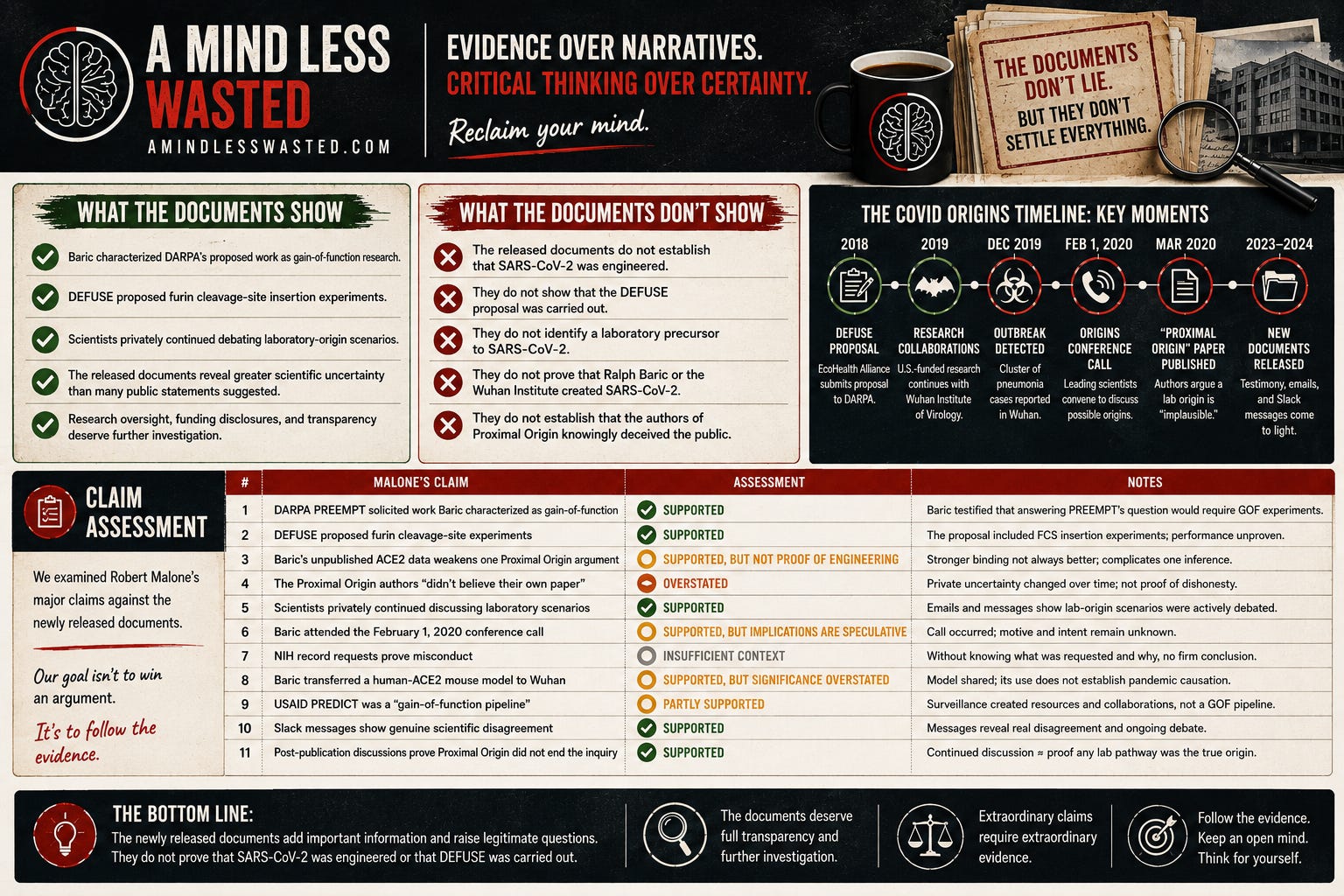
After examining Malone’s first five claims, a clear pattern begins to emerge.
Many of his underlying facts are accurate.
The newly released documents genuinely raise important questions about transparency, scientific communication, and oversight of coronavirus research.
Where readers should exercise caution is in following Malone from what the documents show to what he concludes they prove.
Repeatedly, the evidence establishes that scientists discussed possibilities, proposed experiments, or possessed technical capabilities.
Those are important facts.
But they are not, by themselves, proof that those possibilities occurred or that SARS-CoV-2 originated from a laboratory.
That distinction matters because science advances by evidence, not by filling gaps in the evidence with assumptions, regardless of how plausible those assumptions may seem.
In the second half of this review, we’ll examine Malone’s remaining claims concerning the February 1 conference call, NIH oversight, Wuhan collaborations, the Slack archive, and his broader conclusion that the new documents fundamentally rewrite the history of COVID-19.
Claim #6
Baric Confirms He Attended the February 1, 2020 Origins Call
Assessment: Supported, but the implications are speculative.
One of Malone’s more interesting observations is that Ralph Baric confirmed he participated in the now-famous February 1, 2020 teleconference organized by Sir Jeremy Farrar.
This meeting has attracted considerable attention because it brought together many of the scientists who would later play central roles in the COVID origins debate, including Anthony Fauci, Francis Collins, Kristian Andersen, Robert Garry, Andrew Rambaut, Eddie Holmes, Ron Fouchier, Christian Drosten, and others.
Several participants later became authors—or closely involved in discussions surrounding—the influential Proximal Origin of SARS-CoV-2 paper.
Baric testified that he attended the meeting but could not explain exactly why he had been invited. According to Malone, Baric’s recollections about whether he spoke during the call were somewhat inconsistent.
Those inconsistencies are fair subjects for congressional questioning.
However, Malone implies that the meeting itself was evidence of something improper.
That conclusion does not follow.
In early February 2020, scientists were confronting a newly identified SARS-related coronavirus with uncertain origins, rapidly emerging epidemiological consequences and potentially serious biosecurity implications.
Scientific meetings are often confidential precisely because researchers need to exchange unpublished data and preliminary opinions without every sentence becoming tomorrow’s headline.
The meeting deserves scrutiny because of its historical importance—not because its existence demonstrates a conspiracy.
The documents confirm Baric’s participation.
They do not establish that the meeting was orchestrated to manufacture a false scientific narrative.
Claim #7
NIH Requested Records It Supposedly Already Reviewed
Assessment: Insufficient context to draw a firm conclusion.
Malone notes that NIH officials reportedly requested research records from Baric during the early origins discussions despite having supposedly reviewed aspects of that work years earlier.
If accurate, that naturally raises questions.
How complete were NIH’s oversight records?
Were different offices maintaining different documentation?
Did reviewers have immediate access to previous submissions?
These are reasonable questions for Congress to investigate.
However, Malone presents the request as though it demonstrates NIH never truly understood—or perhaps never actually reviewed—the research it funded.
The available documents do not establish that.
Large federal agencies routinely ask investigators to resubmit records for numerous reasons, including updated reviews, incomplete files, interdepartmental communication issues, or personnel changes.
Poor recordkeeping deserves criticism.
It is not, by itself, evidence of a cover-up.
If NIH requested materials that should already have been preserved and readily accessible, that may indicate weaknesses in recordkeeping or oversight. But without knowing which office originally reviewed the records, what form that review took, and why the documents were requested again, the episode cannot establish that no prior review occurred or that officials were concealing misconduct.
Claim #8
Baric Sent His Human ACE2 Mouse Model to Wuhan
Assessment: Supported, but Malone overstates what it means.
Baric confirmed that he provided his NIH-funded human ACE2 transgenic mouse model to Shi Zhengli’s laboratory at the Wuhan Institute of Virology.
This is an important fact.
Human-ACE2 transgenic mice became valuable tools for studying SARS-like coronaviruses because early SARS-CoV-2 strains could not efficiently use ordinary mouse ACE2. By expressing the human receptor, these animals allowed researchers to study infection and disease in a living model.
Such models allow scientists to evaluate viral mutations, test vaccines and therapeutics, and study disease progression.
They can also be used in experiments involving reverse genetics, viral adaptation, and studies that some scientists would classify as gain-of-function.
Malone correctly notes that the mouse model enabled these kinds of research.
Where he stretches the evidence is by implying that providing the mice somehow implicates Baric in the creation of SARS-CoV-2.
The distinction matters.
A laboratory tool is not evidence of how that tool was used.
Sharing the mice increased Wuhan’s research capabilities.
It does not demonstrate that the mice were used in experiments that produced SARS-CoV-2.
Nor does it establish that Baric knew how every subsequent experiment would be conducted.
Those are separate questions requiring separate evidence.
The transfer of the mouse model is well documented.
Its role in the origins of SARS-CoV-2 remains unproven.
Claim #9
USAID Built the Scientific Pipeline Behind Wuhan Coronavirus Research
Assessment: Partly Supported
Malone argues that USAID’s PREDICT program created the scientific infrastructure that later enabled coronavirus gain-of-function research involving researchers in Wuhan.
There is an element of truth in that characterization.
Beginning in 2009, PREDICT supported international efforts to collect wildlife samples, identify and sequence previously unknown viruses, strengthen laboratory capacity, and develop research collaborations intended to detect pathogens before they spilled over into humans. The program worked in more than 60 countries and identified hundreds of previously unknown viruses.
EcoHealth Alliance participated in this surveillance network and published coronavirus research involving Zhengli Shi and other researchers at the Wuhan Institute of Virology, which acknowledged USAID PREDICT support. The influential 2015 Baric–Shi study specifically listed “USAID-EPT-PREDICT funding from EcoHealth Alliance” as support for Shi’s work.
That means PREDICT helped generate samples, viral sequences, technical expertise, laboratory capacity, and international relationships that could later be used in experimental coronavirus research.
But describing it as a “gain-of-function pipeline” goes beyond what the funding record alone establishes.
PREDICT’s stated purpose was wildlife-virus surveillance, pathogen discovery, and outbreak preparedness, not the engineering of enhanced viruses. The fact that samples, sequences, and scientific infrastructure developed through surveillance could later support laboratory experimentation does not mean the program itself was designed primarily for gain-of-function research.
Malone also points out an omitted acknowledgment of USAID funding in the original online version of the 2015 Baric–Shi paper. That omission was real, but the public record shows it was corrected eleven days after the paper first appeared online…not five years later…the separate correction issued in 2020 concerned deposition of the sequence for the mouse-adapted SHC014-MA15 virus.
The omission still raises a reasonable transparency question: funding sources should be disclosed correctly when research is first published. But it does not establish that USAID secretly funded the creation of SARS-CoV-2.
PREDICT contributed to the surveillance networks, samples, expertise, and collaborations that supported coronavirus research involving Wuhan scientists. Calling that infrastructure a “gain-of-function pipeline” is an interpretation, not a demonstrated purpose of the program. Nothing in the cited funding record establishes that USAID funded the creation of SARS-CoV-2.
Claim #10
The Slack Archive Shows Genuine Scientific Disagreement
Assessment: Supported
This is one of Malone’s strongest observations.
The private Slack discussions appear to show scientists debating laboratory scenarios, asking difficult questions, challenging one another’s assumptions, and continuing to examine multiple possible origins for SARS-CoV-2.
That is important.
For much of the pandemic, public messaging often gave the impression that reputable scientists had reached an overwhelming consensus against any laboratory-associated origin.
The Slack discussions paint a more nuanced picture.
Scientists disagreed.
They questioned one another.
They considered competing hypotheses.
In many respects, that is exactly how scientific inquiry should operate.
Where Malone goes further is describing Andersen’s later public statements as “duplicitous.”
That accusation requires evidence that Andersen knowingly said something he believed to be false.
The released discussions certainly suggest that Andersen’s private uncertainty was greater than many readers appreciated.
Whether that amounts to deliberate deception is a different question altogether.
The documents demonstrate genuine scientific disagreement.
They do not, by themselves, establish intentional dishonesty.
Claim #11
Post-Publication Discussions Show That Proximal Origin Did Not End the Inquiry
Assessment: Supported, but not evidence that its authors rejected the paper.
Malone notes that the Slack discussions continued examining template switching, recombination, furin cleavage-site formation, coinfection, and other possible evolutionary pathways after Proximal Origin was published.
That observation is important because it shows that the publication did not end scientific consideration of laboratory-associated mechanisms. The scientists involved continued discussing new evidence and testing alternative explanations.
But continued investigation is not proof that the authors had abandoned their published conclusion. Scientists often revisit hypotheses after publication, particularly during a rapidly developing outbreak in which new sequences, reports and research records continue to emerge.
The more important criticism concerns public communication. If laboratory-related scenarios remained under serious private consideration, public statements should have reflected that uncertainty rather than implying that every research-related possibility had been conclusively eliminated.
The post-publication discussions show that the origins question remained scientifically active. They do not confirm any particular laboratory pathway or prove that the authors knowingly rejected their own paper.
A Real-World Example
Almost immediately after Ralph Baric’s testimony was released, commentator Steve Kirsch summarized the documents this way:
“The documents show that the authors of Proximal Origin privately considered a laboratory origin a serious possibility and continued debating laboratory scenarios while publicly presenting a much more confident natural-origin conclusion. They did not update the paper OR inform the public of that continuing uncertainty. I wonder why?
The record also shows that the U.S. government funded coronavirus experiments that qualify as gain-of-function under the ordinary scientific meaning of the term, although Fauci and NIH denied that they met the government’s narrower regulatory definition...”
Kirsch correctly identifies several important facts. The released documents do show that scientists continued discussing laboratory-related scenarios after Proximal Origin was published. They also show that Ralph Baric characterized some proposed coronavirus research as gain-of-function in the ordinary scientific sense, while NIH relied on narrower regulatory definitions when discussing whether particular experiments met federal oversight criteria.
Where the interpretation begins to outrun the evidence is in the conclusions drawn from those facts.
The documents do not establish that the authors believed Proximal Origin was false when it was published. They show continuing scientific discussion, not proof of deliberate deception. Likewise, they do not demonstrate that NIH officials lied about gain-of-function research. They demonstrate that different participants were using different definitions of the term, a distinction that was often poorly communicated and contributed substantially to years of public confusion.
These differences may seem subtle, but they matter. Concluding that scientists continued debating laboratory scenarios is supported by the documents. Concluding that they knowingly deceived the public is a separate claim requiring additional evidence.
That distinction lies at the heart of this article.
The newly released documents deserve careful study. They also deserve careful interpretation. Following the evidence means resisting the temptation to treat every unanswered question as though it has already been answered.
Following the evidence means resisting the temptation to treat every unanswered question as though it has already been answered.
Final Thoughts
After reviewing Malone’s article alongside the newly released testimony, Slack discussions, DEFUSE materials and published scientific record, the documents clearly add important information to the COVID-origins debate.
They show that laboratory-related scenarios were discussed seriously in private. They confirm that DEFUSE proposed risky coronavirus experiments and that Ralph Baric regarded at least some of the work solicited by DARPA as gain-of-function research in the ordinary scientific sense. They also reveal a level of uncertainty and disagreement that was often missing from simplified public messaging.
That deserves acknowledgment.
But the documents do not show that DEFUSE was carried out, identify a laboratory precursor to SARS-CoV-2, connect a specific experiment to the outbreak, prove that Ralph Baric or Wuhan researchers created the virus, or establish that the authors of Proximal Origin knowingly published conclusions they believed to be false.
Malone is therefore on firm ground when he argues that the early public narrative was more settled than the underlying scientific discussion. He moves beyond the available evidence when he concludes that gain-of-function research “probably caused” the pandemic or that SARS-CoV-2 was “almost certainly man-made.”
None of this erases the published evidence supporting zoonotic emergence. At the same time, the continuing absence of complete laboratory records, early patient data and full cooperation from China prevents a responsible investigator from declaring every research-related scenario closed.
None of this erases the evidence supporting zoonotic emergence, including the early geographical concentration of known cases around the Huanan market and SARS-CoV-2-positive environmental samples collected from areas associated with live-animal sales. Nor does that evidence identify the infected animal or conclusively exclude a research-related accident. The honest position is that the two hypotheses do not rest on identical evidence, but neither has been proved to the point that further investigation is unnecessary.
The newly released documents do not solve the origin of COVID-19.
They show why uncertainty should have been communicated more honestly, why potential conflicts of interest deserved greater scrutiny, and why proposals, capabilities and suspicions must never be mistaken for proof.
The documents narrow the debate. They do not end it.
That standard should apply equally to government officials, scientific institutions…and Robert Malone. Extraordinary claims require extraordinary evidence, whether they come from government officials or from the people challenging them.
That's how we reclaim our minds.
Science advances by evidence, not by filling gaps in the evidence with assumptions, regardless of how plausible those assumptions may seem.
🙏🏼 If you made it this far, thank you.
A Mind Less Wasted exists for one reason: to follow the evidence wherever it leads—even when it challenges beliefs we already hold.
If that’s the kind of conversation you’d like to see more of, please subscribe, share this article, and join the discussion in the comments.
🤔 Critical thinking begins with questioning our own assumptions. Reclaim your mind.
Resources
Editorial Note: This article relies primarily on publicly released congressional testimony, published scientific literature, and original source documents. Where evidence remains incomplete or disputed, those uncertainties are identified rather than resolved by speculation.
Primary Sources
U.S. Senate Homeland Security Committee – COVID-19 Reading Room
(Contains the Ralph Baric testimony, emails, Slack messages, and other congressional records.)
https://www.hsgac.senate.gov/covid-19-reading-room/
Ralph Baric Congressional Testimony
(Released by Senator Rand Paul’s committee.)
DARPA DEFUSE Proposal (2018)
https://www.documentcloud.org/documents/21066966-defuse-proposal
The Proximal Origin of SARS-CoV-2
Andersen KG, Rambaut A, Lipkin WI, Holmes EC, Garry RF.
Nature Medicine (2020)
https://www.nature.com/articles/s41591-020-0820-9
Scientific Literature
WHO Scientific Advisory Group for the Origins of Novel Pathogens (SAGO)
https://www.who.int/groups/scientific-advisory-group-for-the-origins-of-novel-pathogens-(sago)
Office of the Director of National Intelligence
Updated Intelligence Community Assessment on COVID-19 Origins
https://www.dni.gov/
National Institutes of Health (NIH)
Research on Coronavirus Grants and Oversight
https://www.nih.gov/
National Science Advisory Board for Biosecurity (NSABB)
Recommendations on Oversight of Enhanced Pathogen Research
https://osp.od.nih.gov/biotechnology/national-science-advisory-board-for-biosecurity-nsabb/
Background Reading
Bloom, J.
Recovery of deleted SARS-CoV-2 sequencing data
https://academic.oup.com/mbe/article/38/12/5211/6351332
World Health Organization
WHO-China Joint Study on the Origins of SARS-CoV-2
https://www.who.int/
EcoHealth Alliance
Coronavirus research information
https://www.ecohealthalliance.org/
Related Reading
Robert Malone
Ralph Baric Just Blew Up the Official COVID Origins Narrative