

You know the routine.
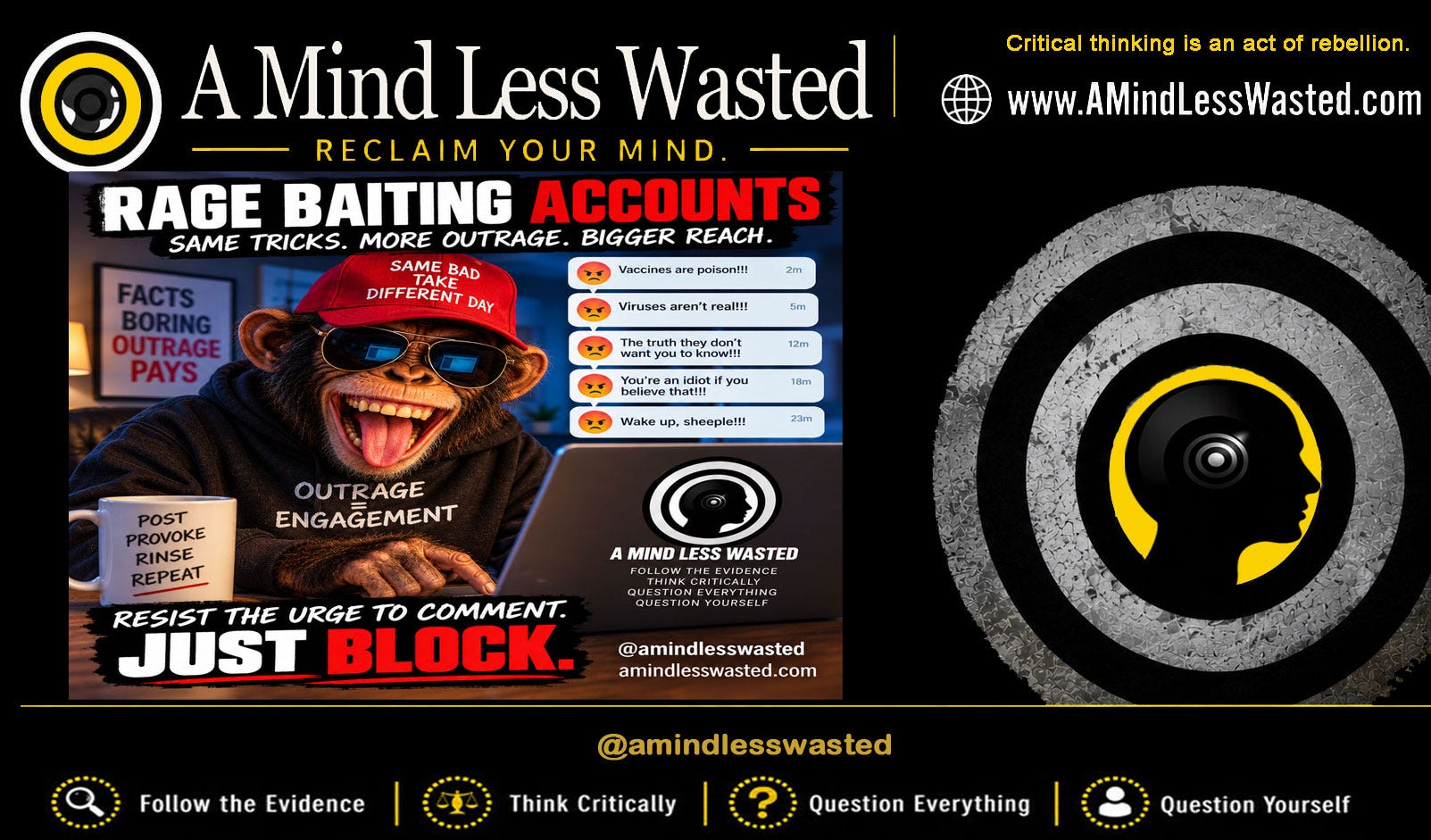
An account posts something outrageous: a distorted statistic, a conspiracy dressed up as a question, or a claim so obviously wrong that ignoring it feels irresponsible. You reply with evidence. The account dodges it, changes the subject, demands a different source, or adds three new claims. You answer those too.
Twenty replies later, the falsehood is still standing, the account has a larger audience, and you have donated an hour of your life to someone who spent thirty seconds writing the original post.
You thought you were correcting misinformation. The account saw engagement.
That is the rage-bait trap.
Oxford University Press named rage bait its 2025 Word of the Year and defined it as online content deliberately designed to provoke anger or outrage, usually to increase traffic or engagement. The phrase became popular because people recognized the experience immediately. We know we are being baited. We can often see the hook.
We bite anyway.
The question is why, and how we challenge misinformation without becoming unpaid promoters for the people spreading it.
The claim is not always the product. Your reaction is.
A normal disagreement has some path toward resolution. Evidence can narrow the dispute. A clear correction can change the conversation. Someone may admit that a statistic was wrong or that a source did not support the claim.
A rage-bait exchange behaves differently. Every answer creates another demand. Every source becomes evidence that the system is corrupt. Every correction produces a pivot. The discussion never moves toward resolution because resolution would end the content.
At that point, the account’s private thoughts hardly matter. Repeated behavior tells us what the account is doing. When someone recycles claims after they have been corrected, strips away context, ignores every answer, and immediately posts the next provocation, the account is functioning as rage bait. It does not need to issue a signed confession.
The incentive is built into the platform. X says its “For You” system ranks posts using a neural network trained on interactions including likes, reposts, and replies. That does not mean every angry reply automatically boosts every post by a fixed amount. It means your reaction is not invisible. It becomes data inside a system designed to predict what will hold attention.
A quote-post is even more direct: it places the original claim in front of your audience. The caption may say, “Look at this garbage,” but the garbage still gets delivered.
Agreement is useful to a rage-bait account. Disgust can be just as useful.
Outrage works
The effectiveness of outrage is not a guess.
In a large analysis of randomized headline tests from Upworthy. about 105,000 headline variations, 5.7 million clicks and more than 370 million impressions. researchers found that each additional negative word in an average-length headline increased the click-through rate by 2.3 percent.
A 2017 study of more than half a million political posts found that every additional moral-emotional word was associated with roughly a 20 percent increase in sharing. A preregistered replication published in 2025 examined 849,266 posts and found about 17 percent more expected shares for each additional moral-emotional word. In the same paper, a meta-analysis of 27 studies covering more than 4.8 million messages estimated the broader effect at about 13 percent.
Then there is tribal conflict. A 2021 study examining 2.7 million Facebook and Twitter posts from American politicians and news organizations found that each term referring to the political out-group was associated with a 67 percent increase in the odds of a post being shared.
Negativity catches attention. Moral outrage helps it travel. Attacking the other side helps it travel even farther.
Rage-bait accounts did not invent human psychology. They industrialized it.

Why we keep taking the bait
We do not reply only because we are angry. We reply because letting a lie pass feels wrong.
Misinformation creates a sense of unfinished business. If nobody challenges it, readers may assume it cannot be challenged. Silence feels like surrender, and blocking someone feels as if we allowed the person to have the last word.
There is also an audience beyond the person posting. We tell ourselves, often correctly, that the reply is not meant for the account. It is meant for the people quietly reading the exchange.
That is what makes rage bait effective: it borrows our conscience. It turns the desire to protect other people from misinformation into fuel for the account spreading it.
And there is one more reason we stay: we expect arguments to end when one side runs out of evidence. That expectation works only when both sides care about evidence. A person who is performing for engagement never runs out of material. When one claim fails, another appears.
You cannot win a game whose purpose is to keep you playing.
The necessary counterpoint: corrections can work
“Never engage” is too simple. False claims left completely unanswered can spread, and research shows that visible corrections can help the people watching.
In three preregistered experiments involving 6,621 people in the United Kingdom, Italy and Germany, corrective comments from ordinary users reduced both the perceived accuracy of false posts and people’s willingness to engage with them.
The same research also found a warning worth taking seriously: falsely “correcting” accurate information damaged belief in the truth. A correction has power, which is precisely why it should be accurate.
Another experiment found that corrections reduced misperceptions whether the tone was neutral, affirming, or uncivil. But uncivil replies made the surrounding conversation appear less civil. The facts still worked; the hostility contaminated the room.
So the answer is not silence. It is controlled correction.
Correct the claim once. Make the evidence easy for bystanders to see. Then stop. Do not allow one useful correction to become a forty-reply performance that supplies the original account with an afternoon of content.
I got blocked. That’s a good thing, I guess.
The grifter’s advantage
The person spreading misinformation has an enormous time advantage.
It takes seconds to write, “Childhood strokes are a vaccine-era phenomenon.” Properly answering it may require historical records, medical data, and multiple sources. The claim fits on a meme. The correction needs paragraphs.
Then, after you provide the evidence, the account can dismiss all of it with one word: “controlled.” Now you are expected to prove that every hospital, researcher, government database, and medical association is not part of the same conspiracy.
The account makes a claim. You are assigned homework.
This is not an honest burden-of-proof dispute. It is an attention-extraction method. The person making the sensational claim keeps transferring the burden back to anyone who challenges it, while feeling no obligation to establish the original accusation.
By the tenth reply, the thread is no longer educating anyone. You are staffing the account’s engagement desk.

Before replying, stop for thirty seconds. That pause matters. A meta-analysis of 20 experiments involving 26,863 participants found that prompts directing attention toward accuracy improved the quality of what people intended to share, largely by reducing intentions to share false headlines by about 10 percent.
Ask five questions:
What is my actual goal? Am I correcting the record for readers, or trying to force an account to admit defeat?
Is anyone reachable? Are undecided people seeing this, or is the thread populated entirely by performers and committed partisans?
Can I answer the central claim clearly? One strong correction is more useful than chasing five new claims introduced after the first one failed.
Will my response inform more people than it exposes? If the post has almost no reach, quote-posting it to a larger audience may solve a problem that did not yet exist.
What is my exit point? Decide before replying: one correction, one follow-up if genuinely necessary, then mute or block.
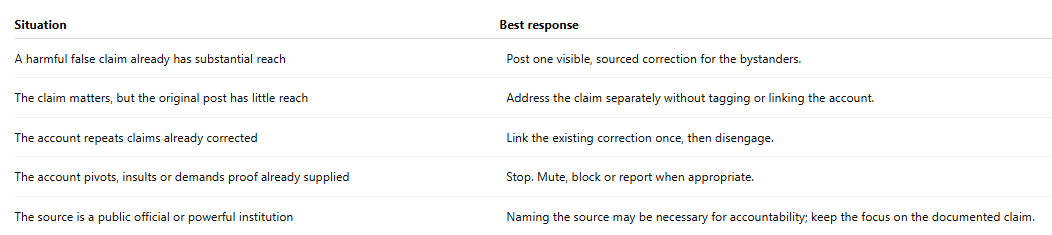
The checkpoint is not a test of whether the falsehood deserves an answer. It is a test of where that answer will do the most good.
Correct the misinformation without promoting the account
The Debunking Handbook 2020, written by a large group of misinformation researchers, recommends a useful structure: lead with the fact, warn briefly that a myth is coming, explain how the myth misleads, and finish by reinforcing the fact.
In practice:
Lead with what is true. Do not make the false claim the headline of your correction.
Name the specific error. “This graph changes the denominator halfway through” is stronger than “Everything you post is nonsense.”
Use one or two strong sources. A link avalanche gives the account ten new exits and gives readers homework.
Write for the people watching. The original poster may be unreachable. Bystanders are the real audience.
Avoid unnecessary quote-posting. If the claim is obscure, answer it without delivering the account to your followers.
Do not chase the pivot. When the subject changes, the original point has been conceded in practice, even if the account refuses to say so.
End the exchange yourself. Rage bait depends on the belief that the other person is entitled to one more answer.
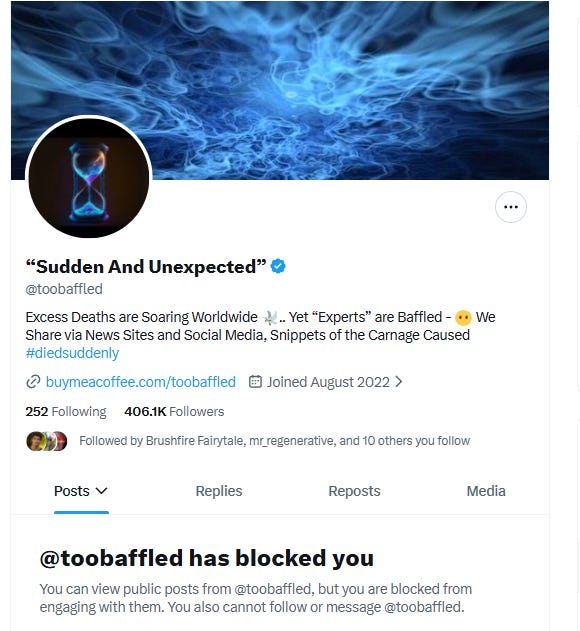
If the account violates platform rules, report it. If it is merely exhausting, mute it. If it repeatedly targets you or uses your replies as material, block it.
Blocking is not an admission that the account was right. It is the withdrawal of free labor.
The lie deserves an answer. The account does not own your time.
Social media trained us to confuse the last word with victory. Rage-bait accounts thrive on that confusion. They know that if they remain shameless long enough, a responsible person will keep returning with better evidence, clearer explanations, and more links.
We should challenge misinformation. We should also recognize when the challenge has stopped informing the public and started feeding the machine.
Correct what matters. Preserve the evidence. Speak to the people who may still be listening. Then leave.
The lie may deserve an answer.
The person spreading it is not entitled to your afternoon.
Sources and further reading
Oxford University Press, “The Oxford Word of the Year 2025 is rage bait,” December 1, 2025.
X Help Center, “For You Home Timeline Recommendations.”
Robertson, C. E., et al., “Negativity drives online news consumption,” Nature Human Behaviour 7, 812–822 (2023).
Brady, W. J., et al., “Emotion shapes the diffusion of moralized content in social networks,” Proceedings of the National Academy of Sciences 114, 7313–7318 (2017).
Brady, W. J., et al., “Estimating the effect size of moral contagion in online networks: A pre-registered replication and meta-analysis,” PNAS Nexus 4 (2025).
Rathje, S., Van Bavel, J. J., and van der Linden, S., “Out-group animosity drives engagement on social media,” Proceedings of the National Academy of Sciences 118 (2021).
Stoeckel, F., et al., “Social corrections act as a double-edged sword by reducing the perceived accuracy of false and real news in the UK, Germany, and Italy,” Communications Psychology 2 (2024).
Bode, L., Vraga, E. K., and Tully, M., “Do the right thing: Tone may not affect correction of misinformation on social media,” Harvard Kennedy School Misinformation Review (2020).
Pennycook, G., and Rand, D. G., “Accuracy prompts are a replicable and generalizable approach for reducing the spread of misinformation,” Nature Communications 13, 2333 (2022).
Lewandowsky, S., et al., “The Debunking Handbook 2020,” 2020.