

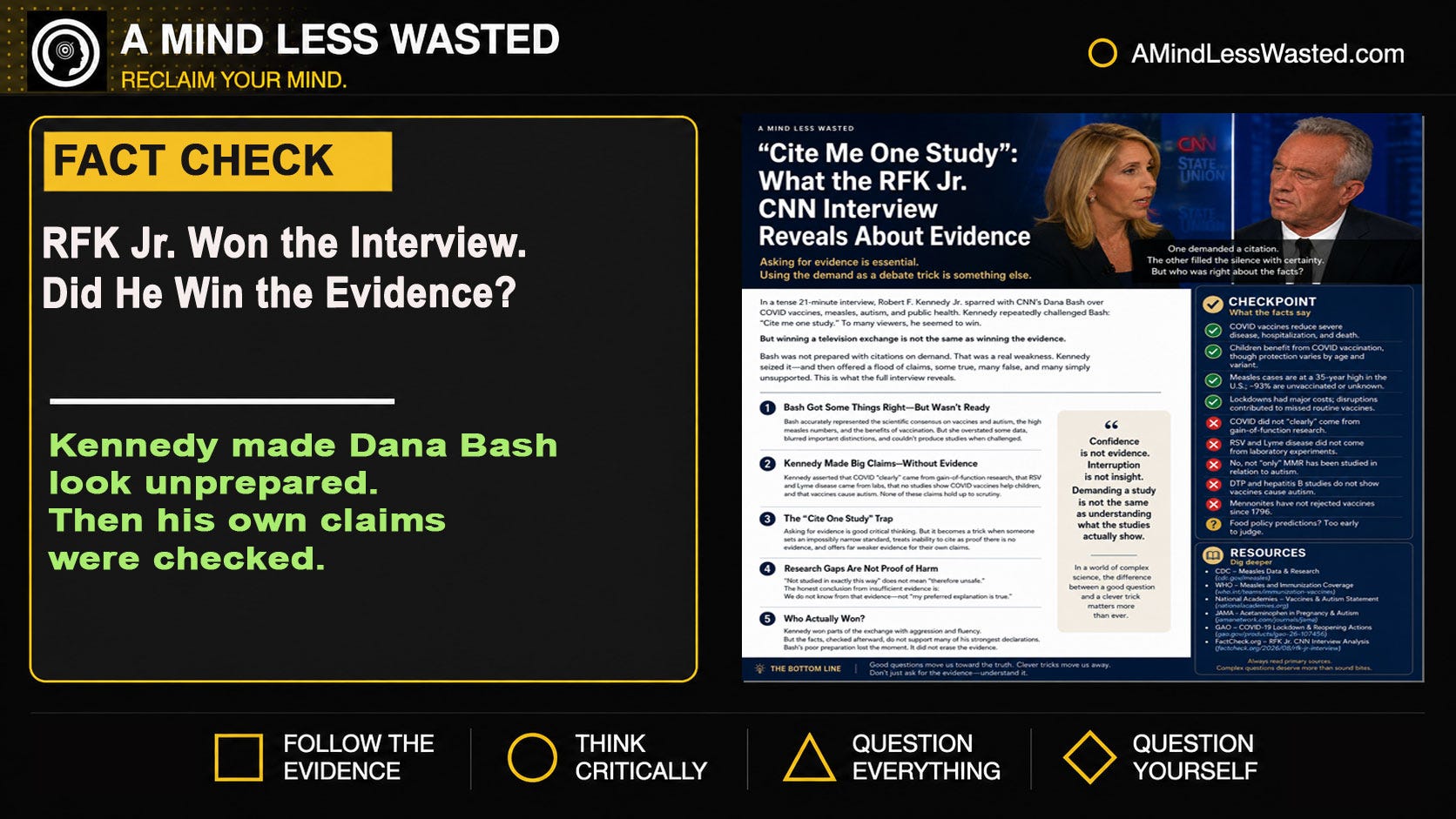
Robert F. Kennedy Jr. found Dana Bash’s weak spot almost immediately.
“Cite me the study.”
He said it again. And again.
It worked.
Bash stated the broad scientific case. COVID vaccines reduced deaths. Studies found benefits for children. Vaccines and autism have been examined for decades.
But stating the conclusion is not the same as being ready to defend it on live television.
When Kennedy asked for names, papers, and specifics, Bash had none at hand. She kept saying the studies existed without being able to identify one.
That made her look unprepared. Worse, it made her look as though she was repeating something she had been told but had never examined herself.
Kennedy did not just challenge Bash. He bashed Bash.
He kept her on the defensive, pressed every hesitation, and turned her inability to name a study into the defining moment of the interview.
Kennedy looked confident. He knew how to use his material and controlled most of the exchange.
For a few minutes, he appeared to have won.
But then I checked the claims.
That is where the interview begins to look very different.
Bash was often vague, occasionally sloppy, and badly prepared for the questions Kennedy was certain to ask. But many of the conclusions she struggled to defend were supported by substantial evidence.
Kennedy had the better performance. He also made claim after claim that did not survive scrutiny.
Some were accurate. Some contained a piece of truth stretched much further than the evidence allowed. Others were simply unsupported or false.
And that is what made this interview worth examining.
Not because CNN was right about everything. It wasn’t.
Not because Kennedy was wrong about everything. He wasn’t.
It was worth examining because it showed how easily a strong performance can be mistaken for a strong argument.
Bash often had the better evidence and could not explain it.
Kennedy explained himself far better, but frequently claimed more than the evidence could support.
On television, the second person usually looks like the winner.
The facts are not impressed.
Bash got some important things right
Bash was right about several of the larger points.
The United States did not have the highest COVID death rate of every country in the world. Kennedy made that claim, then backed away from it when Bash challenged him.
She was also right that COVID vaccination reduced severe illness, hospitalizations, and deaths. One published analysis estimated that at least 232,000 deaths among unvaccinated American adults might have been prevented over 15 months.
Then Kennedy asked her to name a study showing that COVID vaccination did more good than harm for children.
She couldn’t name one.
That was a bad moment for Bash. She stated the conclusion, but she was not ready to support it with a specific paper when challenged.
Still, her failure to name a study did not mean the studies did not exist.
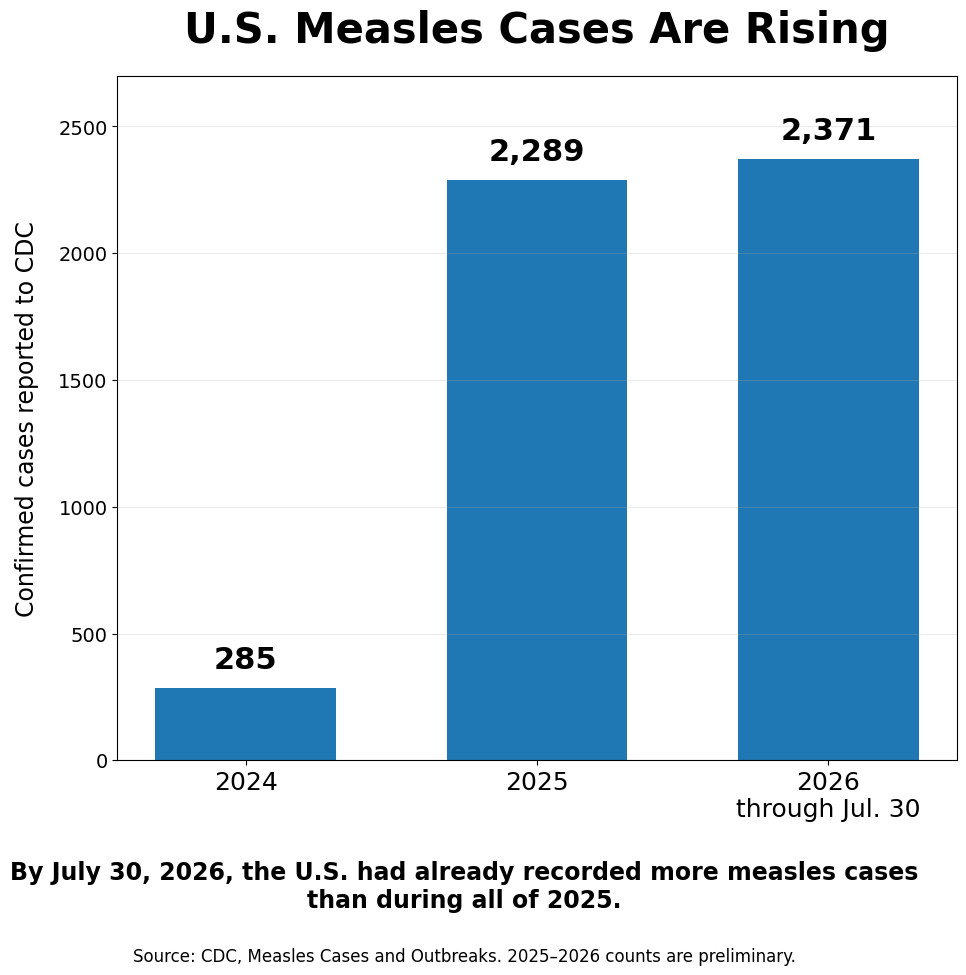
She was broadly right about measles too. Cases have risen sharply, and outbreaks are concentrated among people who are unvaccinated or have unknown vaccination status. Two doses of the MMR vaccine are about 97 percent effective at preventing measles.
She was also right that the evidence does not support vaccines as a cause of autism. The World Health Organization reaffirmed that conclusion in its 2025 review, and the National Academies has reached the same conclusion.
But Bash did herself no favors by overstating parts of the case.
She said roughly 93 percent of measles cases were among the unvaccinated. But CDC’s national dashboard combines confirmed unvaccinated cases with cases where vaccination status is unknown. That does not overturn the larger pattern, but she should have described the data accurately.
She also connected an estimate of 100,000 to 200,000 preventable COVID deaths directly to vaccine disinformation.
The evidence supports the claim that many deaths were associated with remaining unvaccinated. It does not prove that misinformation was the reason every one of those people declined vaccination.
Those were real weaknesses.
A fact-check that ignores them would not be much of a fact-check.
Kennedy made much larger claims with much less evidence
Kennedy demanded precision from Bash. He was far less demanding of himself.
He said COVID “clearly” came from gain-of-function research.
It did not clearly come from gain-of-function research.
The origin of SARS-CoV-2 is still unresolved. In our earlier fact-check, Did COVID-19 Come from a Lab?, we examined the evidence for both zoonotic spillover and a laboratory-related origin. The World Health Organization’s 2025 assessment said the available evidence leans toward zoonotic spillover, while also acknowledging that a laboratory-related incident cannot be ruled out because important information is still missing.
That is an unresolved question.
Kennedy presented it as a solved one.
He then said the RSV epidemic came from the same kind of laboratory research and called RSV the biggest killer of children in the country.
Neither claim holds up.
RSV is serious. It sends many infants to the hospital and causes an estimated 100 to 300 deaths each year among children under five.
But it is not the leading cause of childhood death in the United States, and there is no credible evidence that it originated in gain-of-function research.
Kennedy made a similar claim about Lyme disease, saying it “almost certainly” came from this kind of research.
He offered no evidence for that either.
Then came the claim that doctors had treated thousands of COVID patients with no deaths and that millions of lives might have been saved had officials listened to them.
Which doctors?
Which treatments?
What ages were the patients?
How sick were they?
How long were they followed?
What happened in a comparable group that did not receive the treatment?
Kennedy did not say.
A doctor can treat a large number of low-risk patients and report very few deaths. That does not prove the treatment saved them. Most younger and healthier people survived COVID regardless of what they were prescribed.
Without a valid comparison group, the claim tells us almost nothing. This was the contradiction running through the interview. Kennedy demanded studies, names, and precise evidence from Bash. When it came to his own claims, anecdotes and assertions were apparently enough.
That is not skepticism applied consistently.
It is skepticism aimed in only one direction.
The “cite one study” trap
Asking for a study is good critical thinking.
It becomes a debate trick when the request is used in one of four ways.
First, the challenger may define the acceptable evidence so narrowly that nearly all existing research is excluded.
Second, the challenger may treat another person’s inability to recall a citation instantly as evidence that no citation exists.
Third, the challenger may demand flawless evidence from opponents while accepting weak evidence for his own position.
Fourth, when a study is eventually produced, the challenger may move the goalposts by demanding a different population, outcome, vaccine, ingredient, time period, or study design.
Kennedy’s exchange with Bash contains several of these features.
He asked whether one study showed that COVID vaccination did more good than harm in children. That is not a single, simple question. The answer depends on age, sex, prior infection, circulating variant, dose number, the outcome being measured, and the time period studied.
A study might show fewer hospitalizations without answering every question about myocarditis. Another might examine infection but not mortality. A third might apply to adolescents but not toddlers. Scientific evidence often consists of multiple studies answering different parts of a larger question.
Demanding a single perfect paper that addresses every dimension is not a realistic standard. It is a rhetorical standard designed to be difficult to satisfy in real time.
Kennedy narrowed the autism question
The autism exchange followed the same pattern.
Bash said vaccines and autism had been studied extensively.
Kennedy responded with a much narrower claim. He said the first eight vaccines given during the first six months of life had not each been studied separately for a connection to autism. He then argued that most of the research involved either MMR or thimerosal.
That sounds like a direct rebuttal.
It isn’t.
Bash was talking about the broader question: Do vaccines cause autism?
Kennedy shifted the discussion to a narrower question: Has each of the vaccines administered during the first six months been studied individually in relation to autism? Those are not the same question.
The broader issue has been studied in many ways. Researchers have examined MMR, thimerosal, vaccine timing, ingredients, cumulative exposure, vaccination records, and autism diagnoses across large populations. There have been cohort studies, case-control studies, systematic reviews, and meta-analyses.
The National Academies concluded that the evidence does not support a causal relationship between MMR and autism or between thimerosal-containing vaccines and autism. WHO’s updated review reached the same overall conclusion after examining research published through 2025.
Kennedy could have made a narrower and more defensible point:
Some individual vaccines have less direct autism-specific research than others. That would be fair.
But that is not where he stopped. He used the narrower gap to cast doubt on the much larger body of evidence.
The argument works like this:
Not every early-childhood vaccine has the same amount of direct autism-specific research.
Therefore, we cannot say vaccines do not cause autism.
But research does not require every imaginable version of a question to be tested one at a time before a broader conclusion can be reached.
Evidence can come from several directions at once. Researchers can examine timing, ingredients, dose exposure, biological plausibility, population trends, and specific vaccines. When those different lines of evidence point in the same direction, they matter.
A narrow gap does not cancel the evidence already on the table.
Research gaps are not proof of harm
Kennedy repeatedly treated unanswered questions as though they favored his explanation.
They do not.
Suppose a specific vaccine has not been studied in exactly the age group, schedule, subgroup, and outcome someone asks about.
The honest conclusion is simple:
That exact question is still uncertain. It does not follow that the vaccine may be causing autism. It certainly does not follow that the larger body of evidence is wrong.
“Absence of evidence is not evidence of absence” is true.
But people often stop there.
The other half matters just as much:
Absence of evidence is not evidence for the explanation we happen to prefer.
A research gap is a gap.
It is not a finding.
And uncertainty does not automatically belong to the person making the more alarming claim.
The Tylenol claim had the same problem
Kennedy said there were 73 studies linking Tylenol use during pregnancy or around birth to autism.
That sounds overwhelming.
But a large number of studies does not automatically mean a strong body of evidence.
Some observational studies have found an association between prenatal acetaminophen use and later neurodevelopmental diagnoses. The problem is that pregnant women do not take Tylenol at random. They take it for fever, infection, inflammation, pain, and other medical reasons.
Any of those factors could help explain the association.
A large study published in JAMA looked at nearly 2.5 million children. When researchers compared siblings within the same families, the apparent link disappeared.
That suggests the earlier association may have been driven by family, health, or genetic factors rather than Tylenol itself.
Kennedy presented a mixed and heavily confounded body of research as though it had already identified a likely culprit. The evidence was not strong enough to support that conclusion.
An association may justify more research. It does not justify announcing a culprit.
Kennedy was right about some things
Kennedy was not wrong about everything.
The lockdowns caused real damage. Businesses closed. Children lost time in school. Families were isolated. Civil liberties were restricted, sometimes with very little debate.
He was also right that the pandemic disrupted routine childhood vaccination. Many children missed scheduled doses, and those gaps helped create the conditions for later measles outbreaks.
He was right that the measles problem is not limited to the United States. Other countries have seen major outbreaks as well. And when Bash finally asked him directly whether parents should vaccinate their children against measles, Kennedy said yes.
That answer was correct.
Two doses of the MMR vaccine are about 97 percent effective at preventing measles.
Kennedy was also right about something larger.
Journalists should not simply repeat what experts tell them. They should understand the evidence well enough to explain it, especially when interviewing someone certain to challenge them.
Bash should have been better prepared.
But her poor preparation did not make Kennedy’s unsupported claims true.
So, who won?
Kennedy won the interview. At least, he won it on television.
He did not win the evidence.
That should not be surprising. Kennedy is a lawyer, and he used a lawyer’s skill set. He controlled the frame, narrowed the questions, exposed weak answers, and kept pressing whenever Bash hesitated. He did not have to prove every one of his own claims in that moment. He only had to make her look uncertain.
That is a skill.
Bash made his job easier than it should have been.
She relied too often on “studies show” without being able to name the studies or explain what they actually found. She overstated some of the data. And each time she struggled, Kennedy treated that struggle as evidence that the research did not exist.
That was a failure of preparation.
But a successful cross-examination does not settle the facts. Those can still be checked afterward.
COVID vaccines did reduce severe illness and death.
Studies did find benefits for children, although those benefits varied by age, risk, prior infection, and the variant circulating at the time.
The United States did not have the highest COVID death rate in the world.
SARS-CoV-2 has not been proved to have come from gain-of-function research.
RSV and Lyme disease have not been shown to have originated in laboratory experiments.
RSV is not the leading killer of American children.
Vaccines have been studied in relation to autism far more broadly than Kennedy suggested.
And the evidence does not support vaccines as a cause of autism.
So yes, Kennedy had the better performance. He controlled the interview. He made Bash look unprepared.
But once the claims are checked, the advantage starts to disappear.
Kennedy won the exchange.
He did not win the evidence.
The lesson
The lesson is not that we should stop asking for studies. We should ask more often. But “cite one study” is the beginning of critical thinking, not the end.
Once a study is cited, we still have to ask:
What population did it examine?
What outcome did it measure?
Was there a valid comparison group?
How large was the effect?
Could confounding explain it?
Has it been replicated?
How does it fit with the rest of the evidence?
A citation can support a claim. It can also be irrelevant, weak, misrepresented, or contradicted by better research.
The goal is not merely to demand evidence.
The goal is to understand what the evidence actually shows.
That is much harder than winning an interview.
It is also far more important.

Before deciding who “won” a scientific argument, ask yourself:
Am I judging the evidence, or the performance?
Did the speaker produce evidence for the claim, or merely demand it from someone else?
Is uncertainty being acknowledged, or being converted into support for a preferred conclusion?
Would I accept the same quality of evidence if it supported the opposing side?
Did the speaker answer the original question, or narrow it until a different answer became easier to defend?
A confident challenge may expose weak preparation.
It does not automatically establish the challenger’s claim.
Checkpoint is where we pause the argument and question our own reasoning before moving forward.
Enjoyed this article? Subscribe to A Mind Less Wasted and join a growing community committed to following the evidence, even when it challenges our own beliefs. Free subscriptions keep you informed. Paid subscriptions help fund the time-intensive research and fact-checking that articles like this require.
#ThinkCritically #FollowTheEvidence
#QuestionEverything #QuestionYourself
Resources
CNN: Full RFK Jr.–Dana Bash Interview Transcript
The official CNN transcript is the primary source for Kennedy’s and Bash’s statements during the August 2, 2026 interview. (CNN Transcripts)
CDC: Measles Cases and Outbreaks
Current U.S. measles case totals, outbreak information, vaccination-status data, and historical comparisons. (CDC)
CDC: COVID-19 Vaccine Effectiveness Against Hospitalization in Children and Adolescents
This study found that vaccination was 52% effective against pediatric COVID-19 hospitalization and 57% effective against critical illness when the most recent dose had been received within the previous four months. Protection declined over time.
CDC: About Measles
Information about measles transmission, complications, prevention, and MMR effectiveness. Two doses are approximately 97 percent effective, while one dose is approximately 93 percent effective. (CDC)
WHO: Expert Review Reaffirms No Link Between Vaccines and Autism
WHO’s December 2025 summary of its updated evidence review, which found no causal link between vaccines and autism spectrum disorders. (World Health Organization)
Full WHO evidence review:
Vaccines, Thimerosal and Autism Spectrum Disorder: Evidence Review 2010–2025
National Academies: Statement on Vaccines and Autism
The National Academies’ current statement explaining that the scientific evidence does not support vaccines as a cause of autism. (National Academies)
Full National Academies evidence review:
Immunization Safety Review: Vaccines and Autism (National Academies)
JAMA: Acetaminophen Use During Pregnancy and Children’s Risk of Autism, ADHD, and Intellectual Disability
A nationwide study of 2,480,797 children. The apparent associations disappeared in sibling-controlled analyses, suggesting that earlier signals may have resulted from familial or other confounding factors. (JAMA Network)
WHO: Scientific Advisory Group Report on the Origins of COVID-19
WHO’s June 2025 summary states that the weight of available evidence favors zoonotic spillover, while acknowledging that important information remains unavailable. (World Health Organization)
Full WHO report:
Independent Assessment of the Origins of SARS-CoV-2 (World Health Organization)
CDC: RSV in Infants and Young Children
CDC information about RSV’s risks to infants and young children, including its importance as a cause of infant hospitalization. (CDC)
CDC burden estimates:
How CDC Estimates the Burden of RSV (CDC)
Preventable COVID-19 Deaths Among Unvaccinated Adults
The study estimated that at least 232,000 deaths among unvaccinated U.S. adults might have been prevented during the 15-month study period had they been vaccinated. (pubmed.ncbi.nlm.nih.gov)