

The good news: Social media can be a wonderful source of information.
A large percentage of teens get their news from social media, and it's becoming their primary source of news.1
That is disturbing.
The bad news: Social media can be a cesspool of misinformation.
With so much misinformation in cyberspace, how do we sift through the garbage and separate fact from fiction?
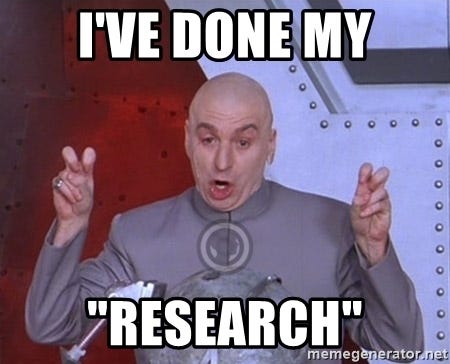
What Is Research?
Research is a systematic investigation or study of a particular subject matter to discover new facts or information, usually involving the collection and analysis of data to answer a specific question or test a hypothesis, contributing to a broader understanding of a topic or field; essentially, it's the process of actively seeking new knowledge through careful examination and analysis.2
What is NOT Research?
Watching Rumble videos
Personal opinions or anecdotes
Simple data compilation
Unstructured exploration
Biased investigations
Poorly designed experiments
Case reports
Fortunately, there are ways to sift through the noise. However, we must put aside our biases and do it objectively, even if it leads us to be wrong about a subject.
The SIFT Method
The SIFT method is an evaluation strategy developed by digital literacy expert, Mike Caulfield, to help determine whether online content can be trusted for credible or reliable sources of information.3
STOP
Before you read the article, stop. Before you share the video, stop.
Don’t just blindly share a source without thinking about whether is it credible. Is it biased? How are the opinions on this site compatible with your own? Have you put aside your own bias? Am I sharing this just because this is how I feel? Leave your emotions and feelings at the door. Move on to the next step.
INVESTIGATE
Who is the author? Is there a motive? Is it an authority? Is it a false authority? Hover.4
Move on to the next step.
FIND
It’s time to fact-check. Look for compatible sources. Can you find consensus or is this source the lone wolf?
TRACE
Trace Claims, Quotes, and Media back to their original context. Be conscious of cherry-picking and out-of-context claims.
Scientific misinformation is harmful, Professor Greg describes six misinformation tactics and how you can spot them before you decide to circulate them.
Resources
Back To The Science With Susan Oliver