


This fact check examines the claims made in Steve Kirsch's Substack article,

"Stop Protecting Vaccines: Sign Petition to Repeal 1986 Law" This fact check is based on the version of the article available on July 22, 2026.
Update (July 21, 2026): After publishing the original petition article, Steve Kirsch posted a follow-up explaining that it had been released prematurely by a staff member without his express approval. He cited technical and procedural problems with the petition, including issues with the submission form, instructions for non-U.S. readers, and other errors, and asked readers to hold off on signing while those issues are corrected. This follow-up does not retract the underlying arguments for repealing the National Childhood Vaccine Injury Act, which are the focus of this fact check.
Steve Kirsch recently urged his readers to sign a petition calling for the repeal of the National Childhood Vaccine Injury Act of 1986 (NCVIA).
His argument is straightforward: vaccine manufacturers have been granted significant liability protections, vaccines are not tested to the same standards as other drugs, and repealing the law would restore accountability and lead to safer vaccines.
It’s a compelling message, but does it accurately describe what the law actually does?
Let’s examine the facts.
If you enjoy evidence-based fact checks that separate headlines from what the research actually shows, consider subscribing to A Mind Less Wasted.
📬 Subscribe to receive future articles directly in your inbox.
🔄 Share this article if you know someone who values critical thinking.
What Is the National Childhood Vaccine Injury Act?
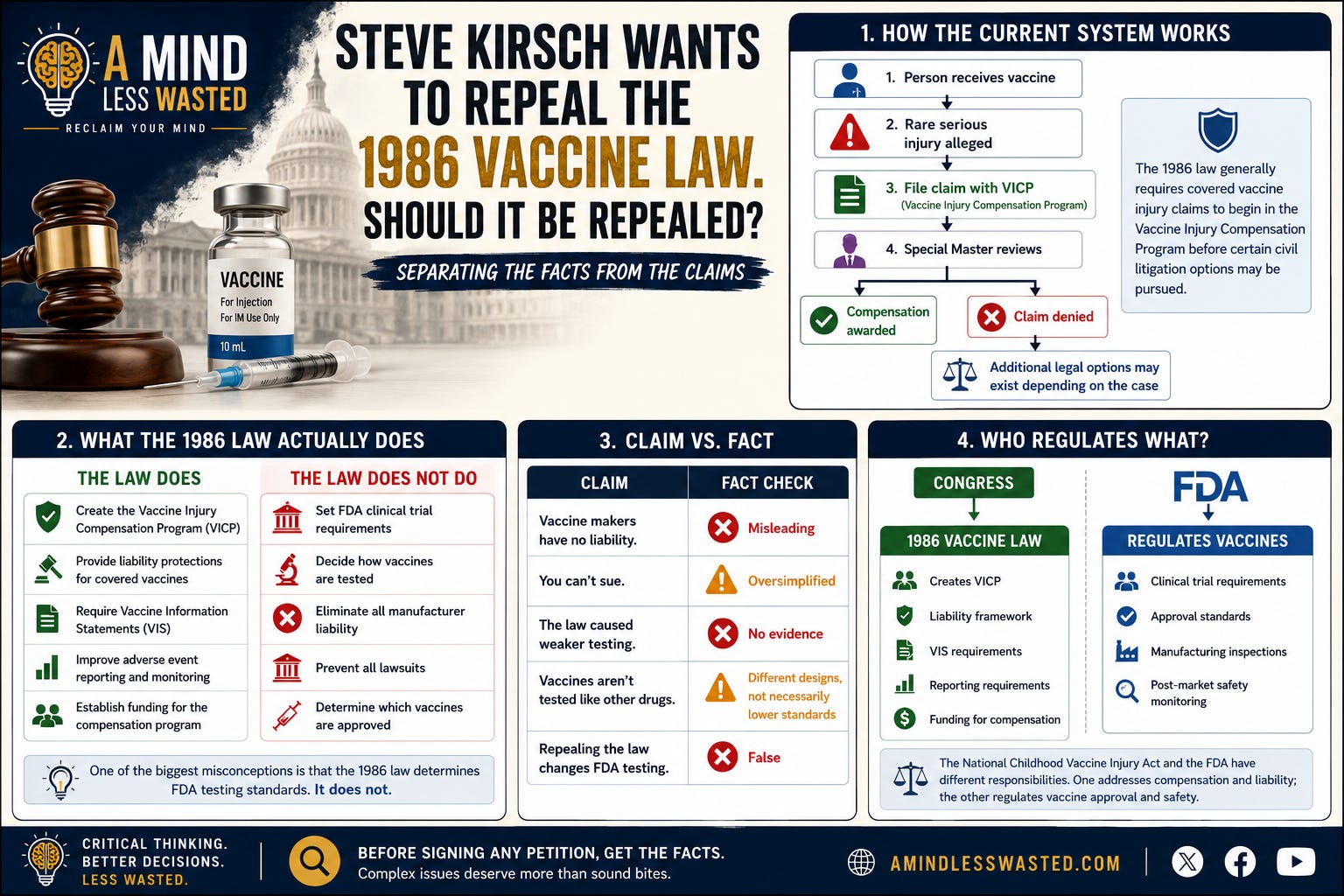
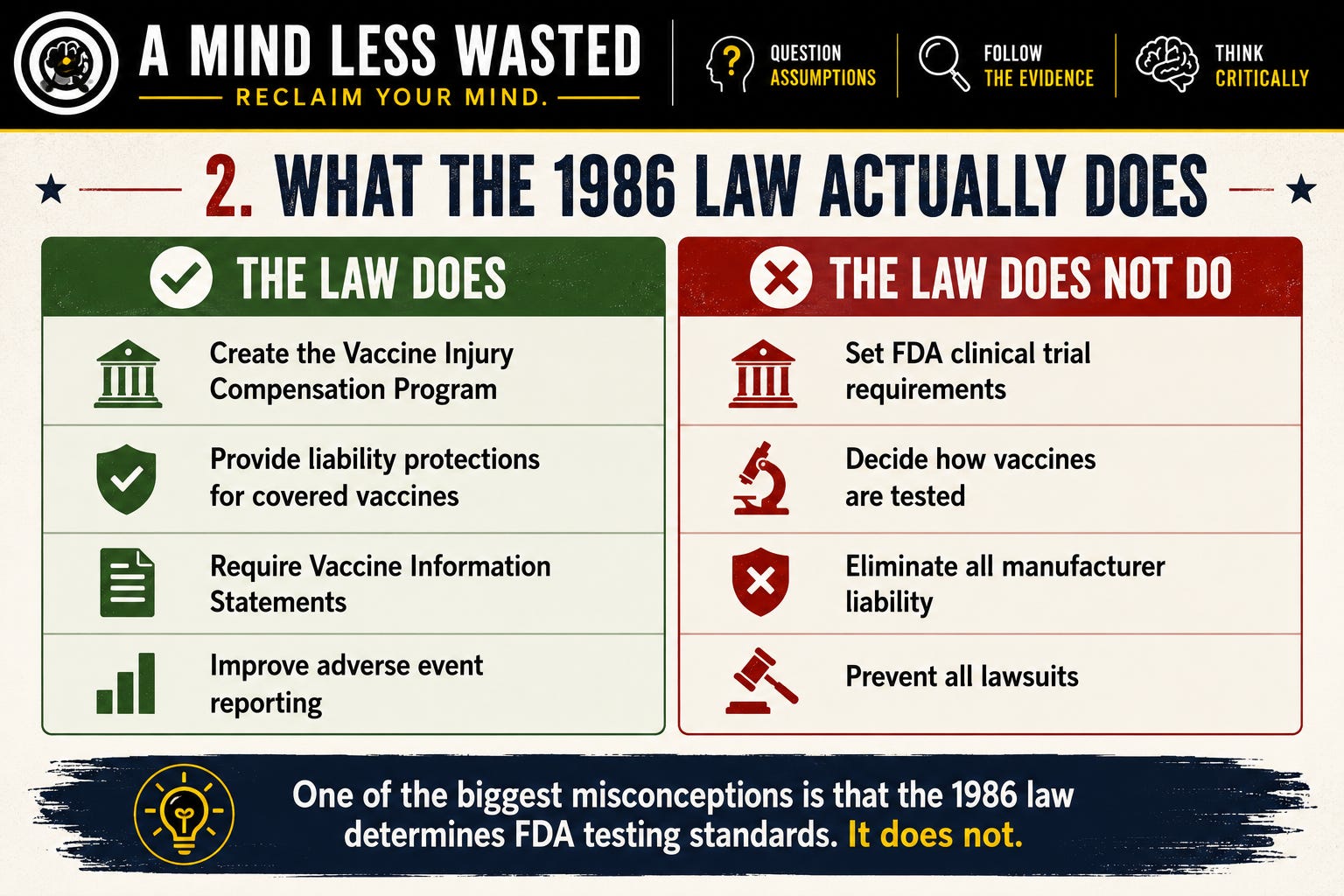
Importantly, the NCVIA is not a vaccine approval law. It is primarily a liability and compensation law. Understanding that distinction is essential because many of the claims made in support of repeal assume the law governs how vaccines are tested and approved. It does not.
Congress passed the NCVIA in 1986 during a period when vaccine manufacturers were leaving the U.S. market due to rising litigation. Lawmakers feared that if manufacturers stopped producing routine childhood vaccines, shortages could threaten public health.
The law had several major goals:
Maintain a stable vaccine supply.
Create a no-fault compensation system for people who experience rare vaccine injuries.
Improve vaccine safety monitoring.
Require Vaccine Information Statements (VIS) to be given to patients.
Establish reporting requirements for adverse events.
The law did not establish or modify FDA clinical trial requirements or approval standards for vaccines. Those requirements are governed separately through federal law and FDA regulations.
Claim 1: “Vaccine makers have no liability.”
What the Evidence Shows
This is one of the most common claims made about the 1986 law.
The NCVIA does provide manufacturers with important legal protections, but it does not eliminate liability altogether.
For vaccines covered by the law, individuals who believe they were injured generally must first file a claim through the National Vaccine Injury Compensation Program (VICP) rather than immediately filing a civil lawsuit.
The law channels many claims into the Vaccine Injury Compensation Program rather than eliminating legal remedies altogether.
Manufacturers can still face legal action in situations involving, for example:
Manufacturing defects
Failure to comply with FDA regulations
Certain claims outside the scope of the VICP
Vaccines not covered by the compensation program
The Supreme Court also clarified in Bruesewitz v. Wyeth (2011) that many design-defect claims involving covered vaccines are preempted under the Act. That decision strengthened liability protections, but it did not create complete immunity.
Saying manufacturers have “no liability” overstates what the law actually provides.
Claim 2: “If something goes wrong, you can’t sue.”
What the Evidence Shows
People can and do seek compensation for alleged vaccine injuries.
The process is simply different from ordinary product liability litigation.
Instead of immediately suing a manufacturer, most claims begin in the Vaccine Injury Compensation Program, which was designed to resolve claims more quickly while reducing litigation costs.
After the VICP process concludes, some claimants may pursue additional legal remedies depending on the facts of the case and applicable law.
The statement “you can’t sue” leaves out these important legal distinctions.
Claim 3: “The 1986 law is why vaccines aren’t tested to the same standard as other drugs.”
What the Evidence Shows
This claim connects two legally separate issues.
The NCVIA governs compensation and liability.
The FDA governs vaccine approval.
Clinical trial requirements are established through federal statutes, FDA regulations, and decades of scientific and ethical standards—not by the 1986 Act.
Repealing the NCVIA would not, by itself, change how the FDA designs, regulates, or evaluates vaccine clinical trials.
Claim 4: “Vaccines aren’t tested to the same standard as other drugs.”
What the Evidence Shows
Vaccines are tested differently because they are different types of medical products.
Like other biologics, vaccines undergo:
Laboratory testing
Phase 1 clinical trials
Phase 2 clinical trials
Large Phase 3 clinical trials
FDA review
Manufacturing inspections
Ongoing safety monitoring after approval
Trial designs vary depending on the disease, whether an effective vaccine already exists, and ethical considerations.
Different trial designs reflect differences in disease, ethics, and available medical alternatives. They do not, by themselves, demonstrate lower scientific standards.
Claim 5: “There are no true placebo trials.”
What the Evidence Shows
Some licensed vaccines have been evaluated in randomized placebo-controlled trials using saline placebos.
Others have been compared with:
Existing licensed vaccines
Adjuvants
Other control groups considered ethically appropriate
When an effective preventive intervention already exists, researchers and ethics boards may determine that withholding it solely to create a placebo group is unethical. As a result, some vaccine trials use active comparators rather than saline placebos.
This approach is not unique to vaccines; it is a common principle in clinical research.
Claim 6: “If a product is safe, it should hold up in civil court.”
What the Evidence Shows
Whether liability protection encourages or discourages safer products is a policy question rather than an established scientific fact. Supporters and critics of the NCVIA disagree on this issue, and reasonable arguments exist on both sides.
Would Repealing the Law Improve Vaccine Safety?
This is ultimately a policy question rather than a scientific one.
Supporters of repeal argue that:
Greater legal exposure would encourage manufacturers to improve safety.
Injured individuals should have broader access to civil courts.
Liability protection reduces accountability.
Opponents argue that:
Increased litigation could discourage companies from manufacturing vaccines.
Some economists and policy analysts argue vaccine prices could rise because manufacturers would need to account for increased litigation risk.
The vaccine supply could become less stable.
The compensation program provides a faster, less adversarial alternative to traditional lawsuits.
Because the United States has not operated a modern vaccine market without the NCVIA, the long-term effects of repeal cannot be known with certainty.
Reasonable people can disagree about which approach is better.
But neither side should misrepresent what the law actually does.
Before Signing Any Petition
Petitions often simplify complex issues into a few emotionally compelling talking points.
That’s understandable.
But before supporting legislation, especially one involving public health, it’s worth asking a few questions:
Does the law actually do what critics say it does?
Are the factual claims accurate?
Would repealing the law accomplish the stated goals?
What unintended consequences might follow?
Those questions deserve careful consideration regardless of where you stand on vaccines.
Bottom Line
Steve Kirsch is asking readers to support a significant change in U.S. vaccine policy.
Reasonable people can disagree about whether repealing the National Childhood Vaccine Injury Act would be beneficial.
What shouldn’t be in dispute is what the law actually does.
The NCVIA is primarily a liability and compensation law—not a law that establishes FDA vaccine testing standards.
Whether Congress should repeal it is ultimately a policy decision.
That decision should be based on an accurate understanding of the facts rather than common misconceptions about the law.
If you enjoy evidence-based fact checks that separate headlines from what the research actually shows, consider subscribing to A Mind Less Wasted.
📬 Subscribe to receive future articles directly in your inbox.
🔄 Share this article if you know someone who values critical thinking.
Sources
National Childhood Vaccine Injury Act of 1986 (42 U.S.C. §§ 300aa-1 to 300aa-34)
Bruesewitz v. Wyeth LLC, 562 U.S. 223 (2011)
U.S. Department of Health and Human Services – National Vaccine Injury Compensation Program
U.S. Food and Drug Administration – Vaccine Development, Testing, and Approval Process
Institute of Medicine. Adverse Effects of Vaccines: Evidence and Causality (2012)
Belmont Report (1979): Ethical Principles and Guidelines for the Protection of Human Subjects of Research
HRSA – National Vaccine Injury Compensation Program
Congressional Research Service – National Vaccine Injury Compensation Program (overview)
As someone who has studied health for 65 years, so called, vaccines have no validity. Injecting toxic matter, such as, aluminum sulfate, thimerosal(mercury), formaldehyde, polysorbte80, and a slew of other noxious substances into the bloodstream will damage the natural immune system, the organs, glands, and every cell. It is a sad commentary on human nature to think that money is more important than human life.