


A Mind Less Wasted | Fact Check | August 12, 2026
If someone tells you that 75% of the people who received a new vaccine had an adverse reaction, your first instinct probably isn’t to ask what kind. It sounds awful on its face.
That number is now everywhere. Nicolas Hulscher used it in the headline of an article about Moderna’s new mRNA flu vaccine. Peter McCullough shared the same figure and said the data were consistent with mRNA being more dangerous. Jimmy Dore interviewed oncologist Angus Dalgleish under the title, “FDA Approves Dangerous New mRNA Flu Vaccines.” Mary Talley Bowden has raised questions about the price, the FDA committee that reviewed it, and what the arrival of an mRNA flu shot will do to public confidence.
The 75% figure isn’t made up. It appears in the FDA documents.
But a number can be accurate while the story built around it is not.
I went through the prescribing information, the FDA clinical review, the advisory committee briefing, and the posts and broadcasts making the rounds. What I found wasn’t a spotless vaccine being smeared by dishonest critics. The mRNA product clearly caused more short-term reactions than the conventional vaccines used for comparison. Some of those reactions were severe enough to interrupt normal activity. The FDA also identified uncertainties that will require years of follow-up.
What I did not find was evidence that 75% of recipients were seriously injured, or that the trials established that MFLUSIVA is broadly dangerous.
The real picture sits between Moderna’s sales pitch and the most alarming social media posts. It deserves to be examined without cleaning up the inconvenient parts for either side.
First, what did the FDA approve?
On August 5, 2026, the FDA approved MFLUSIVA, the first mRNA influenza vaccine licensed in the United States. It is approved for adults 50 and older. This was one new product, not a conversion of the entire flu vaccine supply to mRNA.
There is an important wrinkle in the approval that most short accounts leave out.
For people 50 through 64, MFLUSIVA received traditional approval. The main evidence came from a randomized trial of more than 40,000 people comparing it with a licensed standard-dose flu vaccine.
For adults 65 and older, the FDA used accelerated approval. In that age group, the decision relied heavily on antibody responses measured against a high-dose vaccine. Those immune measurements were treated as a surrogate reasonably likely to predict clinical benefit. Moderna still has to confirm that benefit.
The FDA’s vaccine advisory committee voted 9–0 that the benefits outweighed the known and potential risks in both age groups. A unanimous vote is meaningful, but it doesn’t erase the difference between traditional and accelerated approval. It also doesn’t settle every safety question.
Where the 75.3% figure came from
The number comes from a study of adults 65 and older. An earlier quadrivalent version of Moderna’s mRNA flu vaccine was compared with Fluzone High-Dose. Participants recorded a list of expected symptoms every day for the first week.
At least one of those solicited reactions was reported by 75.3% of people in the mRNA group and 49.3% in the high-dose group.
A similar pattern appeared in the larger efficacy trial. There, 75.7% of mRNA recipients reported at least one solicited reaction, compared with 46.7% of people who received the standard-dose vaccine.
Here are the figures in one place:
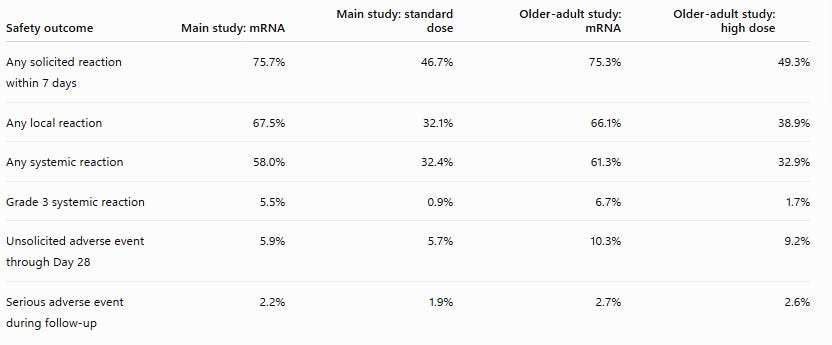
What matters is what the category included. Participants were specifically asked about injection-site pain, redness, swelling, underarm tenderness, fatigue, headache, muscle pain, joint pain, chills, fever, and nausea or vomiting. A person with a sore arm was counted. So was someone who felt tired for a day. So was someone whose symptoms prevented normal activity.
The FDA reported that most reactions were mild or moderate. They generally appeared soon after vaccination and lasted about two days.
“Adverse reaction” is the FDA’s own term. Hulscher did not invent it. The problem comes when that technical label is presented to a general audience with no explanation of what was counted. Most people hear “75% adverse reactions” and picture medical injuries, not a checklist that includes temporary arm pain and fatigue.
That gap between the technical meaning and the ordinary meaning is doing most of the work in the viral headline.
The severe reactions were real
McCullough and Hulscher also highlighted the Grade 3 systemic reactions. In the older-adult study, they occurred in 6.7% of mRNA recipients and 1.7% of high-dose vaccine recipients. That is about four times as frequent. In the main study, the comparison was 5.5% versus 0.9%, an even larger ratio.
Those numbers should not be waved away as nothing more than a sore arm.
Grade 3 generally meant that a symptom prevented normal daily activity. Someone might have been unable to work, exercise, shop, or handle the usual routine. Even if the problem passed in a day or two, that is relevant when choosing between vaccines.
It still isn’t the same as a hospitalization, permanent disability, life-threatening event, or death. Trials record those outcomes separately.
So the critics are right about a real disadvantage. The mRNA vaccine caused considerably more reactions, including more reactions that temporarily disrupted daily life. They go too far when they use those numbers as though they were counts of serious medical injuries.
The final FDA review also recorded two Grade 4 systemic reactions in the older-adult mRNA group. Both were high fevers, 104.9°F and 105°F. Neither participant sought medical attention, and no Grade 4 systemic reactions occurred in the high-dose comparator group.
Serious events and the death imbalance
The main trial followed roughly 20,000 people in each group for a median of about six months. Serious adverse events occurred in 2.2% of MFLUSIVA recipients and 1.9% of standard-vaccine recipients. Medically attended events were reported by 12.3% and 12.0%. The differences were small, although the serious-event total was numerically higher with MFLUSIVA.
Across the four studies reviewed together by the FDA, serious events were reported in 3.1% of mRNA recipients and 2.9% of comparator recipients. There were 102 deaths in the mRNA groups and 97 in the comparator groups. Both round to 0.3%. During the first 28 days, the totals were 13 and 14.
The pooled review also found small imbalances in certain serious-event categories. Anemia was reported in 9 mRNA recipients versus 2 comparators, and urinary tract infection in 25 versus 12. Broader searches identified 14 versus 8 anemia cases and 38 versus 22 urinary infections. FDA reviewers found no temporal clustering, identified plausible alternative explanations, and concluded that the patterns were unlikely to be vaccine-related.
Those overall figures don’t show a large increase in serious harm or mortality. But the death analysis contains a detail that shouldn’t be buried.
The FDA found 29 deaths classified as unspecified, sudden, or sudden cardiac among mRNA recipients, compared with 12 among comparator recipients. Reviewers examined the timing, causes, and medical histories. Most deaths occurred months after vaccination. There was no clear cluster around a particular time, total mortality remained balanced, and many of the people who died had serious underlying conditions. The FDA considered a vaccine-related explanation unlikely.
That judgment is not the end of the matter. Many of the deaths were not followed by autopsies, and there was no systematic adjudication capable of fully resolving the difference. The FDA review says, in effect, that the pattern did not look causal, but the available records could not eliminate all uncertainty.
This is where both confident narratives become uncomfortable.
Someone arguing that the trials proved a deadly safety signal has to explain why overall deaths were almost identical, why deaths during the first month did not favor the comparator, and why no timing pattern emerged. Someone claiming there is nothing left to investigate has to explain the narrower 29-to-12 imbalance and the incomplete information surrounding those deaths.
The FDA required a large Phase 4 confirmatory efficacy trial for adults 65 and older. Moderna also committed to a separate postmarketing safety study that will evaluate deaths in a randomized population and monitor myocarditis, pericarditis, myopericarditis, and Guillain-Barré syndrome observationally. These are appropriate responses to uncertainty. They are neither an admission that MFLUSIVA caused the deaths nor proof that the concern is meaningless.
The myocarditis findings available at approval were more reassuring. No cases occurred in the mRNA group during the prespecified 42-day risk window, and adjudicated cases over the full follow-up period were balanced between groups. The trials were not large enough to rule out a very rare risk.
“26.6% more effective” needs context too
The same care applied to the 75% safety claim should be applied to Moderna’s efficacy claim.
During the 2024–2025 flu season, laboratory-confirmed influenza-like illness occurred in 411 of 20,179 MFLUSIVA recipients and 557 of 20,124 standard-vaccine recipients. That works out to about 2.0% versus 2.8%.
The FDA reported a relative vaccine efficacy of 26.6% against the standard-dose comparator. In plain numbers, the absolute difference was about 0.73 percentage points. For every 1,000 people vaccinated under the trial conditions, MFLUSIVA prevented roughly seven additional protocol-defined cases compared with the standard-dose shot. About 137 people would need to receive MFLUSIVA instead of the comparator to prevent one additional case.
That is a genuine benefit. It is also more modest than “26.6% more effective” may sound when the underlying rates are left out.
An exploratory analysis found fewer cases requiring an emergency room, urgent care, or hospitalization. The study was not designed to establish a separate reduction in hospitalizations or deaths, so it did not demonstrate a survival benefit. McCullough is correct on that narrow point. But a trial that was not powered to prove a mortality benefit cannot tell us that no mortality benefit exists.
There are other limits. The trial covered one season, and flu vaccine performance changes as circulating strains change. The B/Victoria result was inconclusive because too few cases occurred. The studies also leave unanswered questions about frail older adults, some immunocompromised patients, and people receiving COVID-19, RSV, or pneumococcal vaccines at the same visit.
Was there really “no control group”?
There was no saline placebo in the pivotal Phase 3 trials. There were, however, randomized control groups receiving licensed flu vaccines.
There was a control group, but it did not receive saline. Those participants received an approved flu vaccine. This allowed researchers to compare MFLUSIVA with vaccines already being used, so saying the trial had “no control group” is inaccurate. It also avoided withholding flu vaccination from older adults who face a meaningful risk from influenza. FDA and international guidance permit this type of active comparison.
That design does not answer every question. Because both groups received a vaccine, the trial shows which product caused more reactions. It cannot tell us how many reactions either vaccine caused beyond what might occur after a saline injection or during ordinary follow-up. A saline group could have helped answer that narrower question about absolute reactogenicity.
The more important comparator problem involved adults 65 and older. The main efficacy trial used a standard-dose vaccine even though high-dose, adjuvanted, and recombinant products are generally preferred for seniors.
This was not a complaint that appeared only after approval. The FDA initially refused to file Moderna’s application because the pivotal trial had not used what the agency considered the best available comparator for that age group.
Moderna responded by splitting the regulatory request. Ages 50 through 64 would be considered for traditional approval. Ages 65 and older would be considered through accelerated approval using antibody results from a separate comparison with Fluzone High-Dose.
That compromise addressed the FDA’s immediate objection, but it left patients without the clinical comparison many would reasonably want: Does MFLUSIVA prevent more actual illness than an enhanced senior vaccine, and is any added benefit worth the added reactions?
The FDA has required a postmarketing randomized study of about 800,000 adults 65 and older across two flu seasons, comparing MFLUSIVA with Fluzone High-Dose. The final report is scheduled for May 31, 2030.
Is it gene therapy, and was it tested for cancer?
Dalgleish and McCullough describe mRNA vaccines as gene therapy or “genetic shots.” That language suggests the product alters a person’s genes. MFLUSIVA does not do that.
The mRNA provides temporary instructions in the cell’s cytoplasm. It does not need to enter the nucleus, where the DNA is stored, and it is not intended to add, remove, or edit human genes. Infectious-disease mRNA vaccines are not classified as gene therapy by major regulators. The European Medicines Agency explains that distinction here.
The prescribing information also says MFLUSIVA was not evaluated for carcinogenicity, genotoxicity, or effects on male fertility in animals. That line is already being used to suggest the product was released without meaningful safety testing or could cause cancer.
The wording is real. The implication does not follow from it.
Similar language appears in the labels of many vaccines that have been used for years. World Health Organization guidance explains that genotoxicity studies are not normally required for vaccine adjuvants and carcinogenicity studies generally are not required. Regulators can request them when a platform, ingredient, distribution pattern, or toxicology finding gives them a specific reason to do so.
FDA reviewers did examine nonclinical pharmacology and toxicology and reported no clinically relevant problem that prevented approval. It would therefore be inaccurate to say that MFLUSIVA had no preclinical safety testing.
It would also be too strong to claim that a trial lasting several months settles every possible long-term question. It doesn’t. The fair description is that the usual vaccine development program did not include lifetime cancer studies, not that the vaccine was shown to cause cancer or that regulators forgot to consider toxicology.
How the most prominent claims hold up
Nicolas Hulscher: His 75.3% figure and fourfold Grade 3 comparison are taken from the FDA’s tables. The numbers are correct. The article gives readers too little help understanding that “any solicited adverse reaction” was dominated by expected short-term symptoms, not serious injuries.
Peter McCullough: MFLUSIVA was more reactogenic, and the trial did not demonstrate a survival benefit. Those points are fair. Describing the data as proof that mRNA is more dangerous goes beyond the serious-event and mortality results. Saying the vaccine lacked preclinical safety data is also too broad.
Jimmy Dore: The title “FDA Approves Dangerous New mRNA Flu Vaccines” declares the verdict before the evidence is discussed. The FDA approved one mRNA flu vaccine, not a new formulation for every flu shot. The program raised worthwhile questions, but the word “dangerous” is not established by the comparative trial results.
Angus Dalgleish: His argument is much wider than MFLUSIVA. He says there is no need for a specific flu vaccine and that mRNA products for infectious disease have unacceptable risks. The MFLUSIVA trial cannot settle every debate about the mRNA platform, but it did show fewer laboratory-confirmed flu cases than the standard-dose comparator. Claims carried over from COVID-19 controversies cannot replace product-specific evidence.
Mary Talley Bowden: Her comments combine opinions about public trust and FDA governance with more testable claims about price and vaccine choice. Conventional flu vaccines remain available. MFLUSIVA has not turned ordinary flu shots into mRNA shots. It is more expensive than many standard-dose products, but her comparison between $140.75 and $26.95 per dose uses one of the cheapest conventional products as the baseline. For 2026–2027, Medicare listed payment allowances of about $171.21 for MFLUSIVA and $122.52 for the adjuvanted Fluad vaccine. Wholesale price, reimbursement, acquisition cost, and profit are not the same thing.
None of this tells us whether these commentators are right or wrong about every other issue. It tells us how their claims about this vaccine compare with the evidence currently available.
Are conventional flu shots being replaced?
No. MFLUSIVA adds another option for people 50 and older. It does not replace egg-based, cell-based, recombinant, high-dose, adjuvanted, or nasal vaccines. The CDC’s product list continues to include those alternatives.
FDA approval also does not require a hospital, employer, pharmacy, physician, or patient to choose the mRNA product. Decisions about recommendations, purchasing, mandates, and insurance coverage happen through separate processes.
MFLUSIVA does appear to carry a price premium over many existing options. Whether the extra cost and added short-term reactions are worthwhile will depend on how its efficacy compares over several seasons, particularly against the enhanced vaccines already used in older adults.

Checkpoint is where I stop defending the article’s conclusion and make the strongest reasonable case against it.
What if the critics are closer to the truth?
Start with what we know. This product caused more reactions than either conventional comparator. Grade 3 systemic symptoms affected about 1 in 15 older recipients in the high-dose comparison. Those people were not necessarily hospitalized or permanently harmed, but their symptoms were strong enough to prevent normal activity. That matters.
Serious adverse events were also slightly more common in the mRNA groups, even though the difference was small. Then there is the 29-to-12 imbalance in unspecified, sudden, and sudden-cardiac deaths. The FDA did not find a convincing causal pattern, but it also could not reconstruct many of those deaths well enough to close the question. No autopsy means one less opportunity to identify a mechanism. Missing adjudication leaves room for misclassification.
The approval in seniors rests on another uncertainty. MFLUSIVA has not yet proved superior clinical outcomes against a high-dose vaccine. Antibody levels are useful, but they are not the outcome patients care about. People want to know whether they are less likely to become seriously ill, enter a hospital, or die.
Preapproval studies also have limits. Roughly 36,000 exposed recipients can reveal common problems and some uncommon ones. That number cannot exclude very rare events or harms that take years to appear. Anyone saying a new platform is “proven completely safe” would be claiming more than these studies can establish.
That is a solid case for caution and close follow-up. It is also a reason to preserve conventional choices and give patients honest information about the tolerability tradeoff.
Now test the other side of the argument. Total deaths were 102 versus 97. Both groups had a mortality rate of 0.3%. Deaths during the first 28 days were 13 versus 14. Medically attended events were nearly identical, and confirmed myocarditis did not increase. The disputed deaths did not cluster around vaccination or reveal a common mechanism.
The safety concern is therefore unresolved, not established. That wording may feel unsatisfying, but it matches the evidence better than either “nothing to see here” or “the vaccine is killing people.”
This is not a permanent conclusion. The evidence could change it. A consistent increase in deaths or another serious outcome would matter. So would a properly reviewed pattern pointing to a common vaccine-related cause. If the large comparison with the high-dose flu vaccine finds that seniors experience more reactions without receiving meaningful added protection, the benefit-risk judgment would need to be reconsidered.
What we should watch next
The loudest claim is the 75% figure. The more important questions will take longer to answer.
Will MFLUSIVA still outperform conventional vaccines when the circulating flu strains change? Will it prevent more clinical illness than a high-dose product in seniors? What explains the death-category imbalance? Does careful surveillance identify any rare risk that the original studies were too small to detect?
The FDA also raised a technical concern about the antibody testing. Some assays used cell-derived viruses, which might favor the mRNA product over egg-produced comparators. Moderna must repeat that work using both cell-derived and egg-derived viruses.
These are not reasons to declare the vaccine a failure. They are reasons not to treat approval as the final chapter.
The bottom line
About three-quarters of MFLUSIVA recipients in the solicited safety groups reported at least one reaction during the first week. The figure is accurate. It mostly reflects expected short-term symptoms, but the added burden was substantial, and Grade 3 reactions were several times more common.
Serious events were nowhere near 75%. Overall serious-event rates and mortality were close between the mRNA and comparator groups. The FDA nevertheless found a narrower imbalance in certain death classifications that could not be completely resolved. That deserves continued investigation.
The vaccine prevented more laboratory-confirmed influenza-like illness than a standard-dose shot during one season. The relative improvement was 26.6%. The absolute difference was about seven cases per 1,000 people.
Whether that benefit justifies the additional reactions, price, and remaining uncertainty is a reasonable question, especially for adults who already have access to enhanced conventional vaccines.
The evidence does not support saying that three out of four recipients were seriously harmed. It also does not support pretending that MFLUSIVA arrived without drawbacks or unanswered questions.
For now, the most defensible conclusion is a limited one. MFLUSIVA was more effective than a standard-dose flu vaccine in one season, and considerably more reactogenic.
No clear serious safety hazard was established, but several questions still need answers from the FDA-required confirmatory trial and Moderna’s separate postmarketing safety commitments.
When those results arrive, the conclusion should be allowed to change with them.
Independent fact-checking takes time. It means reading the full documents, checking the numbers, and confronting the strongest evidence on both sides. If you value this work and want to help A Mind Less Wasted keep doing it, please consider becoming a paid subscriber. Your support makes deeper investigations like this possible. Thank you.
