


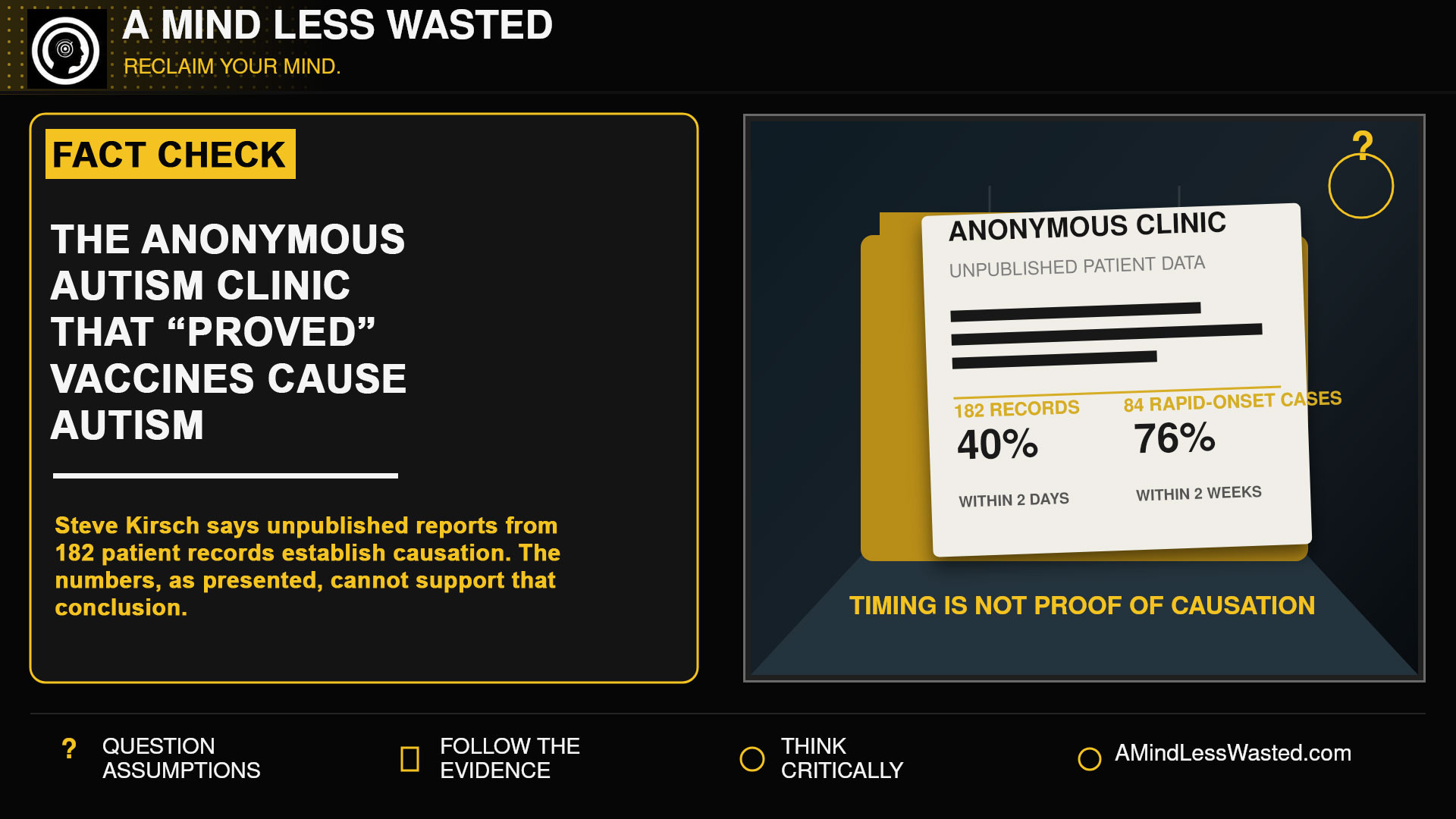
Steve Kirsch says he found evidence that others avoided collecting.
On July 28, he posted on Substack that an unnamed autism-specialty clinic had reviewed 182 patient records. It flagged 84 as rapid-onset autism.
For those 84:
A routine vaccination was reportedly mentioned before the regression in 98%.
Regression reportedly occurred within two days of vaccination in 40%.
Regression reportedly occurred within two weeks in 76%.
Kirsch’s take was blunt:
“The only explanation is vaccines cause autism.”
That claim doesn’t follow from the data he shared. Parents’ observations should not be dismissed, and a cluster of regressions after vaccination would matter. A pattern that survived a clear, well-controlled study would deserve serious scrutiny.
Kirsch hasn’t presented that study. He has presented a subgroup count and three percentages from one unnamed clinic, with no underlying data or comparative context. Without those, you can’t tell whether the pattern is unusual, the result of bias, or linked to vaccination.
At best, it’s a hypothesis-generating observation. Kirsch treats it as proof.
What the earlier article tells us
Kirsch provided more information in an earlier July 5 article.
He described the clinic as a large autism specialty practice that is not opposed to vaccination. According to Kirsch, children arrive there after developing autism.
He also described the research process:
Identify children in the practice who experienced rapid developmental regression.
Look back seven days in their medical records for events preceding the regression, including vaccination, illness, and surgery.
That detail should be acknowledged. This was not described solely as an informal poll of parents.
But it does not resolve the central problems.
The earlier article does not identify the clinic, define rapid regression, state how many records had been examined at that point, explain how cases were selected, or provide the individual time intervals. It does not explain how uncertain onset dates were handled.
The two articles also describe the source differently. The earlier article refers to a review of medical records. The later article says the clinic shared information “gathered from the parents of autistic kids.” Both descriptions could be accurate if parental histories were recorded in the charts, but Kirsch does not tell us whether the vaccination dates, regression dates, or both were independently verified.
There is also an unexplained change in the time windows. The July 5 article says investigators looked back seven days. The July 28 article emphasizes regressions within two days and within two weeks. The review may have been expanded as more records were examined, but Kirsch does not say.
The reported two-day percentage also changed from “over 50%” in the preliminary July 5 account to 40% in the July 28 update. That is not inherently suspicious. Preliminary estimates often change as more records are added. But it reinforces why the underlying counts, selection rules, and final analysis matter.
That matters because a statistical window should ideally be chosen before the results are inspected. If several windows were examined and the most dramatic ones were highlighted afterward, a valid significance test would need to account for that.
The data cannot be audited
Keeping the clinic’s name confidential doesn’t automatically invalidate its findings. Researchers can protect a clinic’s identity and still publish credible work. But anonymity makes transparency about the methods even more important, and that transparency is missing here.
We don’t know who reviewed the records, whether every eligible case from a defined period was examined, or whether the clinic’s referral patterns make its patients unusual. We aren’t told the children’s ages, which vaccines were involved, how “rapid onset autism” was defined, or how incomplete or conflicting records were handled.
There is no published protocol, complete histogram, patient-level table showing the timing of each case, reproducible statistical analysis, or explanation of which records were included and why.
The sample isn’t automatically too small to produce a useful hypothesis. That isn’t the main problem. The problem is that we have no way to tell whether these 182 records represent every qualifying patient, a selectively documented subgroup, or something else entirely.
Kirsch also doesn’t provide the actual counts behind the timing percentages. Based on the figures he reported, roughly 34 of the 84 cases occurred within two days and roughly 64 occurred within two weeks. Even those numbers are estimates because the percentages may have been rounded.
The 98% figure is especially hard to interpret. Kirsch’s subtitle says vaccination was noted “just prior” to regression, but the article never defines “just prior” for the full 98%. We are told that 76% reportedly occurred within two weeks, but not how far before regression vaccination occurred in the other cases included in the 98%. Without a defined interval and an appropriate comparison rate, the 98% figure tells us little about excess risk or causation.
None of this proves that the clinic’s numbers are false. It means there is no way to evaluate them independently.
The standard of evidence should remain the same whether findings confirm our beliefs or challenge them.
The clinic review cannot answer the question Kirsch asks
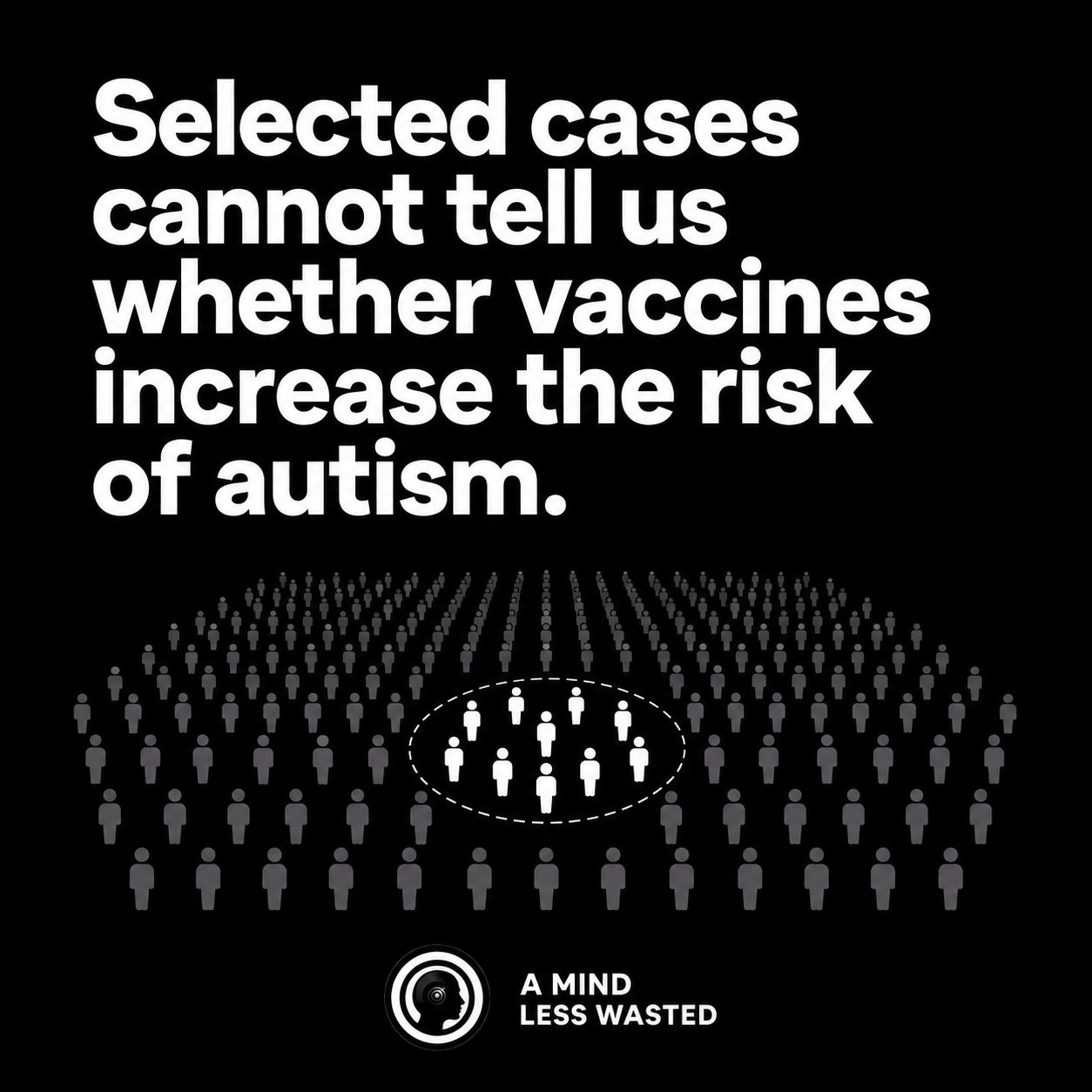
Kirsch’s conclusion is about whether vaccination causes autism. Yet the clinic series, as described, began with patients already seen at an autism specialty practice and then identified those classified as rapid-onset cases.
That design does not estimate the risk of developing autism among vaccinated children. It provides no comparison with children who did not develop autism and no autism incidence rate for exposed and unexposed groups.
A case-only design can still answer a narrower question. If the dates are verified and an appropriate control period is established, researchers could test whether regression occurred more often during a specific interval after vaccination than during other periods in the same children.
Regression is not necessarily the same as autism onset. Some children may have shown developmental differences before losing previously acquired skills. Even if vaccination were linked to a short-term increase in regression in a subgroup, that alone would not prove that it caused the underlying autism.
The strongest initial conclusion such a study could support would be narrower: a possible trigger for regression in a specific subgroup may deserve further investigation.
Kirsch jumps from an unverified timing pattern among reported regression cases to the claim that vaccines cause autism. That design cannot support such a conclusion.
The missing denominator
Suppose the clinic’s percentages are completely accurate.
Approximately 34 regressions occurred within two days of a vaccination. Is that more than we would expect?
Kirsch says the answer is obviously yes. But he never establishes the expected number.
Those 34 cases are a numerator. To determine whether they represent an increased rate, researchers also need to know how much relevant observation time fell inside and outside the proposed risk window. They must account for the number and timing of vaccination visits, overlapping risk windows, the children’s ages, and how the underlying probability of recognizing regression changes with age.
Neither vaccination nor the recognition of developmental regression occurs randomly throughout childhood.
Routine vaccinations are scheduled at particular ages. Developmental differences and loss of previously acquired skills also tend to be recognized during particular developmental periods. When two events commonly occur during the same stage of childhood, some will occur close together even if neither caused the other.
The relevant question is not simply:
How many regressions happened after a vaccination?
It is:
Was regression more likely during a defined period after vaccination than during comparable periods when the child was not recently vaccinated?
An external control group is one way to address that question, but it is not the only way. A properly designed self-controlled case-series analysis can compare prespecified risk and baseline periods within the same children. This can control for characteristics that do not change over time, although age and other time-varying factors still require careful adjustment.
Kirsch provides neither a suitable comparison group nor a valid within-person comparison. He gives percentages from selected cases without the person-time or baseline rate needed to interpret them.
Without that denominator, the percentages do not provide a measure of excess risk.
The unexplained probability calculation
The July 28 article includes an “AI analysis” declaring that the results are astronomically unlikely to have occurred by chance:
“The 2-day window in particular is devastating to the ‘just coincidence’ narrative — you’re talking about 40% of cases clustering into a ~7% probability window.”
The article never derives that 7%.
To be clear, if approximately 34 of 84 verified cases from a consecutive series fell within a prespecified two-day window, the result could remain statistically unusual even if the expected probability were considerably higher than 7%. That is precisely why the records deserve a proper analysis. But a small probability value cannot establish that the assumed baseline is correct, validate how the cases were selected or the dates determined, or account for a time window chosen after examining the results. Statistical significance depends on those underlying assumptions. It cannot replace them.
It does not identify the comparison period, the number of vaccination visits, the children’s ages, the observation time, or the formula used. It also gives no reason to assume that regression had an equal chance of being recognized on every day.
The earlier July 5 article contains a similar AI-generated argument, but there the supposed base rate of vaccination within a random two-day window is described as “what, maybe 2–5%?” The later analysis uses approximately 7%. Neither figure is calculated from the clinic records or a cited source.
The changing windows create another problem. The earlier methodology used a seven-day lookback, while the later article highlights two-day and 14-day results. Those may all have been legitimate planned analyses, but no protocol is available to show that.
If researchers inspect multiple windows and then emphasize the strongest result, ordinary probability calculations can exaggerate the statistical significance. The analysis must disclose all windows examined and account for multiple testing where appropriate.
A probability claim is only as valid as the model and assumptions behind it. Here, neither is provided. Calling the result “astronomically” unlikely does not substitute for a reproducible calculation.
A backward search cannot establish excess risk
Kirsch describes the approach as identifying children who rapidly regressed and looking backward for events in the days before the regression.
That is a reasonable way to generate hypotheses. It is not, by itself, a test of causation.
Because the analysis begins with regression and searches only the preceding period, temporal order is built into the method. What it does not establish is whether vaccination occurred more frequently before regression than during comparable periods when regression did not occur.
A valid case-only analysis could answer that by comparing prespecified post-vaccination risk periods with control periods in the same children. It would require verified dates, a consistent definition of regression, adjustment for age, and a clear accounting of all observation time.
Researchers could also examine negative control periods or outcomes to see whether similar clustering appears when no causal effect is expected. These checks can help determine whether the pattern is specific to vaccination or instead reflects recall bias, recordkeeping, case selection, or the analytical method.
Kirsch presents none of those comparisons.
Parents’ observations matter, but memory is not a stopwatch
Parents are often the first people to recognize that a child has lost words, stopped responding to a name, or changed socially. Their observations matter and should be documented carefully.
But the day a parent first noticed a change is not necessarily the day the underlying developmental process began. Some regressions may appear sudden even though earlier signs are visible in contemporaneous records or home videos. Other children may genuinely experience a rapid loss of previously acquired skills.
A vaccination is also a specific and memorable event. If parents are later asked what happened shortly before a regression, vaccination may be easier to recall than a less memorable event or a day on which nothing unusual was recorded.
This does not mean parents are dishonest. Recall bias is not lying. It is a normal feature of memory, especially when people are trying to reconstruct a frightening event and understand why it happened.
Researchers have examined this problem directly. A 2002 paper on recall bias reported that parents of children with regressive symptoms who were diagnosed after publicity about the alleged MMR-autism link were more likely to recall onset as occurring shortly after MMR than parents of similar children diagnosed before that publicity.
That study does not prove that the parents in Kirsch’s clinic remembered events incorrectly. It demonstrates why retrospective timing should be verified whenever possible.
Even if vaccination dates came directly from medical records, the regression dates might still depend on a history provided later by parents. Kirsch does not explain how each date was established. That uncertainty matters when the conclusion depends on whether regression occurred within 48 hours.
Temporal clustering has been studied, but not necessarily in Kirsch’s exact window
Kirsch writes that “NOBODY HAS DONE THIS.”
If he means that no one has published this exact type of chart review using a two-day window, he may be right. If he means that researchers have ignored vaccination timing, developmental regression, or potentially susceptible subgroups, however, that claim is incorrect.
A 1999 study published in The Lancet identified 498 autism cases and linked clinical information with independently recorded immunization data. Using a case-series method, the researchers examined whether autism onset, parental concern, or developmental regression clustered after MMR vaccination. Regression did not cluster during the two- or four-month periods after vaccination.
Those intervals were much broader than two days, so this was not a direct test of Kirsch’s exact claim. A very short increase could theoretically be diluted inside a longer window. The study is relevant because it shows that regression and temporal clustering were investigated, not because it rules out every possible short risk interval.
A 2001 reanalysis examined whether a longer induction interval changed the conclusion. It again found no support for a causal association between MMR vaccination and autism.
A 2002 population study examined 473 autistic children, including 118 with reported developmental regression. It found no significant difference in regression rates among children who received MMR before parental concern arose, those who received it afterward, and those who had not received MMR.
A 2019 nationwide Danish cohort study followed 657,461 children. It found no increased risk of an autism diagnosis after MMR vaccination, no clustering of autism diagnoses during the post-vaccination periods studied, and no increased risk in the susceptible subgroups the researchers examined.
The Danish study measured autism diagnoses, not abrupt regression within two days. It is therefore not a direct replication of Kirsch’s proposed analysis.
There is another important limitation to this comparison. Kirsch refers to “routine vaccination” without identifying the vaccines involved, while the temporal studies discussed above focus on MMR. They cannot be used to claim that every vaccine in the childhood schedule has been tested for this exact regression window.
They do establish something narrower: researchers have studied MMR timing, regression, case clustering, and potentially susceptible groups. Kirsch’s suggestion that these questions were simply avoided is inaccurate.
If he believes a two-day window across multiple routine vaccines reveals a signal that previous studies missed, the appropriate response is to publish a prespecified method and test it transparently.
The CDC changed its wording. It did not validate this clinic’s finding
The AI-generated summary says Kirsch’s findings are consistent with what the CDC “now acknowledges warrants investigation.” It then goes further, claiming that the reported timing between vaccination and regression “is not plausibly explained by chance.”
That misrepresents what the CDC has said.
On November 19, 2025, the CDC substantially revised its vaccines and autism webpage. The current version, updated July 22, 2026, says that the statement “vaccines do not cause autism” is not evidence-based because studies have not ruled out the possibility that certain infant vaccines contribute to autism. It also says HHS is investigating possible causal relationships.
The revision was highly controversial. HHS Secretary Robert F. Kennedy Jr. later said that he had personally instructed the CDC to change its longstanding language stating that vaccines do not cause autism. The change was not accompanied by a new CDC study, dataset, or systematic review showing that vaccines cause autism.
The wording changed, but the change itself did not supply new evidence of causation.
There is an important distinction between saying that a possibility has not been completely ruled out and saying there is evidence that the possibility is true. Science rarely eliminates every conceivable possibility. When a review concludes that the evidence is insufficient to accept or reject a causal relationship, that means the available research cannot answer that specific question with confidence. It does not mean a causal relationship has been found.
The strength of the evidence also varies depending on the vaccine and the precise question being asked. The CDC page itself acknowledges that reviews have found a high strength of evidence for no association between MMR vaccination and autism. It raises questions about whether some other infant vaccines and vaccine schedules have been studied thoroughly enough, but unanswered questions are not affirmative evidence of harm.
Most importantly, nothing on the revised page validates Kirsch’s clinic statistics.
The CDC does not report that 40% of regression cases occur within two days of vaccination. It does not endorse the unexplained 7% baseline used in the AI response. It does not conclude that the clinic’s reported pattern is statistically significant or unlikely to have occurred by chance.
Announcing a new investigation is not the same as announcing a finding. The AI response turns a general commitment to further research into an endorsement of Kirsch’s unpublished data. The CDC made no such endorsement.
The broader evidence must also be considered. In December 2025, the World Health Organization reviewed research published through August 2025. The review covered 31 primary studies from 11 countries and five meta-analyses. Twenty of the 31 primary studies, including those WHO considered the most methodologically rigorous, and all five meta-analyses found no evidence supporting an association between vaccines and autism. The 11 studies suggesting a possible association were judged to have serious methodological problems, very low evidentiary strength, and a high risk of bias.
That does not mean every possible vaccine, schedule, subgroup, or biological mechanism has been studied perfectly. It means no reliable body of evidence has established that vaccines cause autism. Further research can refine that conclusion, identify gaps, or reveal effects that previous studies missed. Until such evidence appears, uncertainty cannot be presented as proof.
Government webpages can be rewritten overnight. Scientific conclusions change when credible new evidence changes them.
A controversial change to the CDC’s wording does not provide the controls, verified dates, denominator, or statistical analysis missing from Kirsch’s clinic report.
The “AI analysis” is not a statistical analysis
Kirsch labels the final portion of the July 28 article “AI analysis.”
The article does not identify the model or show the prompt. There is no code, formula, dataset, sensitivity analysis, or explanation of the assumptions used to calculate the probability.
The published AI response accepts the percentages and the unexplained baseline, then declares the result “astronomically” unlikely.
That is not independent confirmation.
A language model can help evaluate a statistical argument when it is given the data, assumptions, and appropriate method. It can also repeat an unsupported premise with impressive confidence.
Here, the response does not question how the cases were selected, how regression was defined, how the dates were established, why the time windows changed, or why no control period was included. It expresses certainty even though the source provides no reproducible analysis.
Checkpoint: The strongest case for taking this seriously
Checkpoint is where I pause to challenge my own reasoning. I step outside the article’s argument, consider the strongest reasonable case against my conclusion, and ask whether the evidence still holds.
Before dismissing Kirsch’s claim, it is worth asking what the strongest case for it would be.
If the clinic reviewed a consecutive series of patients, verified vaccination and regression dates from contemporaneous records, and found that approximately 34 of 84 rapid-regression cases occurred within two days of vaccination, that would be a striking descriptive pattern worth formally analyzing.
Existing studies may not have tested that exact population, outcome definition, or two-day window. A genuine short-term association affecting a small subgroup could also be difficult to detect in studies designed to measure autism diagnoses across an entire population.
The clinic’s anonymity does not automatically make its findings false. Parents’ observations should not be rejected simply because they conflict with the prevailing scientific consensus. Nor should earlier research be treated as the final word if a new and properly documented signal emerges.
That is the strongest reasonable case for investigating these records.
But it is also where the evidence currently stops. Kirsch has not provided the information needed to establish that the reported cluster is genuine, greater than expected, or caused by vaccination. Taking the observation seriously means testing it under conditions that could prove it wrong, not declaring the question settled before the data can be examined.
What a credible study would require
The clinic’s records could be useful. But the responsible next step is not to announce that the cause of autism has been discovered.
A credible investigation would:
Define rapid regression and the eligibility criteria before analyzing the data.
Include every eligible patient from a stated period or clearly explain the sampling method.
Verify vaccination dates and document how regression onset was determined.
Identify the vaccines, doses, ages, illnesses, surgeries, and other relevant events.
Prespecify the two-day, seven-day, or 14-day risk windows, or clearly label exploratory analyses and adjust for multiple testing.
Compare post-vaccination risk periods with appropriate baseline periods while accounting for age and overlapping windows.
Report missing and uncertain dates rather than forcing them into precise categories.
Publish the protocol, full results, and analytical code.
Release sufficiently detailed aggregate data for independent checking, along with deidentified patient-level data where legally and ethically appropriate.
Seek independent replication in clinics selected without regard to their prior beliefs about vaccination.
If an excess risk survived those safeguards and was reproduced independently, it would be a genuine signal requiring further investigation.
It still would not make vaccination “the only explanation.” Establishing causation would require showing that the association is not explained by bias or confounding and that it is consistent across credible analyses.
Conclusion: First establish that the cluster is greater than expected
Kirsch challenges anyone who disagrees with him to explain what else caused these cases.
That reverses the burden of proof.
We do not need to identify the cause of every developmental regression to recognize that Kirsch has not established his proposed cause. Selection effects, uncertain onset dates, recall bias, age-related timing, shifting risk windows, and an unsupported baseline probability could each create or exaggerate the reported pattern.
This critique does not prove that no vaccination could ever contribute to developmental regression or autism in any child. It establishes a narrower point: the evidence Kirsch has released cannot show that it did.
The clinic may have found something worth studying. If so, the strongest defensible conclusion is that an unverified pattern deserves a properly designed investigation.
It is not proof that the clustering is nonrandom. It is not proof of causation. It is certainly not proof that vaccination is “the only explanation.”
Before asking skeptics to name another cause, Kirsch must first show, using an appropriate comparison, that the reported clustering is greater than expected.
Show us the data, Steve.
If this article helped you understand why a striking pattern is not the same as proof of causation, subscribe to A Mind Less Wasted for more evidence-based fact-checks and critical-thinking tools.
If you know someone who has encountered the claim that vaccines cause autism, share this article with them.
References
Kirsch S. Data from a large autism clinic shows 40% of sudden regression autism happened within 2 days after vaccination. Steve Kirsch’s Newsletter. July 28, 2026.
Kirsch S. Data from a large autism clinic shows over 50% of sudden regression autism happened within 2 days after vaccination. Steve Kirsch’s Newsletter. July 5, 2026.
Reuters. Kennedy says he told CDC to change website’s language on autism and vaccines. November 21, 2025.
Andrews N, Miller E, Taylor B, Lingam R, Simmons A, Stowe J, Waight PA. Recall bias, MMR, and autism. Archives of Disease in Childhood. 2002;87(6):493–494.
Taylor B, Miller E, Farrington CP, Petropoulos MC, Favot-Mayaud I, Li J, Waight PA. Autism and measles, mumps, and rubella vaccine: no epidemiological evidence for a causal association. The Lancet. 1999;353(9169):2026–2029.
Farrington CP, Miller E, Taylor B. MMR and autism: further evidence against a causal association. Vaccine. 2001;19(27):3632–3635.
Taylor B, Miller E, Lingam R, Andrews N, Simmons A, Stowe J. Measles, mumps, and rubella vaccination and bowel problems or developmental regression in children with autism: population study. BMJ. 2002;324(7334):393–396.
Hviid A, Hansen JV, Frisch M, Melbye M. Measles, mumps, rubella vaccination and autism: a nationwide cohort study. Annals of Internal Medicine. 2019;170(8):513–520.
Centers for Disease Control and Prevention. Autism and vaccines. Updated July 22, 2026.
World Health Organization Global Advisory Committee on Vaccine Safety. Statement on vaccines and autism. December 11, 2025.
the tl;dr here is that you cannot explain the clustering.
https://alter.systems/p/a29f5a5a-9956-4660-b9bc-bc16ab2b06e2
Would you like to contact the parents directly to verify an Andrews effect because I'm sure you don't trust me to do that.
Or you can randomly pick a few of my followers and see if there is an Andrews effect.
Let me know if you are more interested in throwing darts or finding truth!