


The Joe Tippens story: How one remission became a cancer protocol
Joe Tippens entered remission after adding a dog dewormer to his cancer treatment. His story is remarkable. It is not proof of a cure—or evidence for the protocols and sales pitches built around it.
The Joe Tippens story has everything a medical miracle story needs: an aggressive cancer, a devastating prognosis, a chance conversation with a veterinarian, a cheap drug intended for dogs, and scans that went from riddled with disease to “all clear.”
It is easy to understand why the story spread. Small-cell lung cancer is fast-growing and often deadly. The American Cancer Society reports a five-year relative survival rate of 4 percent for people diagnosed after it has spread to distant parts of the body. Those population figures cannot predict an individual outcome, and they do not verify Tippens’s own estimate that he had only months to live. They do show why his reported survival is extraordinary.
But the viral version leaves out the fact that matters most. Tippens did not take fenbendazole in isolation. Before the remission he had received chemotherapy, chest radiation and preventive brain radiation. When his cancer reportedly spread, he entered a clinical trial. He began fenbendazole and several supplements during that same period.
That is not a minor complication. It is the difference between a powerful personal story and evidence that a drug works.
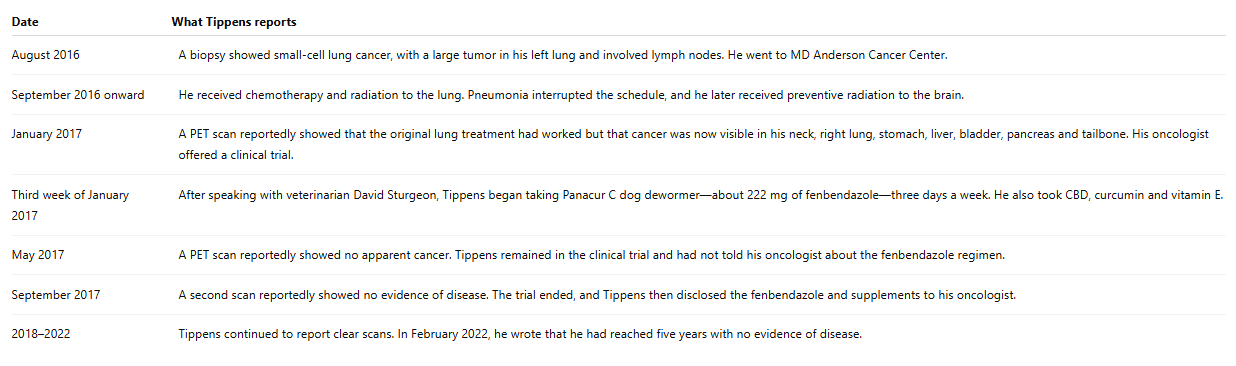
The timeline in Tippens’s own words
The detailed chronology comes from Tippens’s website. It is his account, not an independently published case report, and the site does not provide the complete medical record, pathology, scan files, trial identifier or treatment protocol needed to audit it. That does not mean the story is false. It means every medical claim drawn from it has to be described for what it is: self-reported.
Tippens says the veterinarian told him about an unnamed Merck Animal Health scientist who had supposedly cleared stage IV brain cancer after taking a canine medicine. The scientist is not identified on his site, and no medical documentation is linked. That story is therefore another anecdote nested inside the better-known anecdote.
The part we can say plainly is that Tippens lived far beyond the prognosis he says he received. The part we cannot honestly say is that fenbendazole cured him.
Checkpoint
Tippens’s remission can be genuine and fenbendazole can still be unproven. A striking outcome establishes what happened after several treatments; it does not identify which treatment caused it.
The treatment that disappears from the miracle retelling
Tippens’s own timeline places fenbendazole beside a clinical-trial drug, not before it or after it. He says he agreed to the trial in January 2017 and began his alternative regimen in the third week of that month. By May, his scan was clear.
His site does not name the trial drug. A joint American Cancer Society and American Society of Clinical Oncology explainer describes the well-known lung-cancer story as involving an immunotherapy treatment that was approved for that type of cancer. Without the trial number and medical record, it is safer not to guess which drug he received.
What matters is that immunotherapy can sometimes produce unusual and durable responses in small-cell lung cancer. In pooled results from two pembrolizumab studies, 16 of 83 previously treated patients responded, including two complete responses. An estimated 61 percent of responders had a response lasting at least 18 months. That study does not prove Tippens received pembrolizumab, and it does not prove immunotherapy caused his remission. It demonstrates why dismissing the clinical-trial treatment is unjustified.
Tippens reached the opposite conclusion. After his first clear scan, he wrote that he was certain the trial drug was not responsible. He later described himself as the trial’s exceptional outlier and took that as confirmation that his alternative regimen had done the work. But an outlier is not an explanation. Every effective cancer treatment has nonresponders, typical responders and rare exceptional responders. Finding the exceptional case does not tell us why it occurred.
There is another problem. Tippens says he concealed the fenbendazole and supplements from his oncologist until the trial ended and he had already had multiple clear scans. That decision may be understandable from the perspective of a frightened patient worried about losing access to a trial, but it destroyed the chance to document the experiment prospectively. His care team could not assess interactions, attribute adverse effects, measure exposure or incorporate the products into the trial record while the response was happening.
The result is permanent uncertainty. Fenbendazole may have helped. It may have contributed alongside the trial drug. It may have done nothing. The supplements may have mattered, or not. The prior chemotherapy and radiation may have played a role in later disease control. The available record cannot separate those possibilities.
How a personal experiment became “the protocol”
The regimen now called the Joe Tippens Protocol is not even a stable description of what Tippens took before his first clear scan.
His original 2017 routine was one gram of Panacur C granules—approximately 222 mg of fenbendazole—on three consecutive days each week, followed by four days off. He also took CBD, a curcumin product and vitamin E. That already creates a basic attribution problem: four nonstandard products were added during a cancer clinical trial, so the effect of any one ingredient cannot be isolated.
The instructions then changed. In a July 2020 update, Tippens said daily fenbendazole was now prudent for virtually everyone and removed vitamin E as a required ingredient. His current protocol page, updated in December 2025, specifies 222 mg every day and adds four branded “ONCO ADJUNCT” pathways containing combinations of CBD, frankincense, C60, curcumin, quercetin, berberine, green-tea compounds, resveratrol, fisetin and beta-glucans.
None of those versions has been tested as a complete regimen in a controlled human cancer trial. No study establishes that 222 mg is an effective human cancer dose, that daily use is better than three days on and four days off, that lifelong use improves survival, or that the growing supplement stack adds benefit. There are no validated cancer-specific adjustments, treatment-duration rules, laboratory-monitoring requirements or stopping criteria.
This evolution matters. If the original story is offered as evidence for the protocol, only the original combination can even claim to have coincided with the remission. A later daily schedule and newly added products cannot inherit evidence from an earlier anecdote.
Tippens repeatedly says he is not a doctor and is only telling his story. That disclaimer deserves to be quoted accurately. So does the rest of the page. On the same site he recommends taking the regimen with chemotherapy, radiation or immunotherapy, advocates daily use for virtually everyone, and says he plans to continue for life. A disclaimer does not turn dosing instructions and broad recommendations back into autobiography.
A protocol is more than a recipe
In medicine, a protocol defines who should receive an intervention, the exact formulation and dose, how long it is used, what else can be given with it, how benefit and harm are measured, and when treatment must be changed or stopped. Those decisions are built from pharmacology and clinical evidence.
The Joe Tippens Protocol has a list of ingredients, but not that evidentiary foundation. It is better described as a personal regimen that became a public recipe.
One statement on Tippens’s blog illustrates the problem. He wrote that fenbendazole had already undergone human clinical trials as a dewormer and had been deemed safe for human consumption. That is incorrect for fenbendazole. The American Cancer Society states that the FDA has never approved fenbendazole for any human use. A 2024 scientific review likewise noted that its human pharmacokinetics and safety are poorly documented and called for trials to determine anticancer effects, optimal doses, schedules and tolerability.
Other members of the benzimidazole family, including albendazole and mebendazole, are used in human medicine. That does not make fenbendazole approved or establish an equivalent dose. Drugs in the same class can differ in absorption, metabolism, toxicity and activity.
Checkpoint
“It worked for me” is a reason to investigate. “Here is the dose for everyone” requires evidence that the story does not provide.
What the laboratory science actually shows
There is real preclinical research behind the interest in fenbendazole. It should neither be exaggerated nor waved away.
In a widely shared 2018 study, researchers found that fenbendazole disrupted microtubules, interfered with glucose uptake and killed human cancer cells at micromolar concentrations. It also inhibited human-tumor xenograft growth in mice. The authors concluded that it deserved evaluation as a potential anticancer agent. The study was published in Scientific Reports.
That is a plausible starting point for drug development. It is not a clinical result. Cancer cells in a dish do not model a whole patient, and a dose that reaches a mouse tumor may not produce a safe or useful exposure in humans. Absorption is a particular concern with fenbendazole because it is poorly water-soluble.
Animal findings are also not uniformly positive. A Yale study of mice with mammary tumors found that a therapeutic fenbendazole diet did not alter tumor growth, invasion, metastasis or the response to radiation, although higher concentrations inhibited cells in culture. Mixed preclinical results are normal. They are one reason human testing is necessary before a mechanism becomes a treatment claim.
The human evidence does not validate the protocol
The human literature remains a collection of anecdotes, small case reports and uncontrolled observations—not a demonstration that fenbendazole treats cancer.
A 2021 three-patient case series described favorable responses in genitourinary cancers. Yet the patients also received treatments including nivolumab, surgery, chemotherapy or other alternative products. The fenbendazole dose was one gram three times weekly, not Tippens’s current 222 mg daily regimen. The report itself shows the concurrent treatments. It cannot establish that fenbendazole caused the responses, and it did not test Tippens’s own case.
A more recent paper by William Makis and colleagues reported three people with advanced cancers who took fenbendazole alongside other treatments. The paper was retracted in January 2026. The publisher said the first author had offered services related to the paper’s subject when it was submitted, had not declared that potential conflict, and gave an unsatisfactory response when questioned. The editor concluded that the issue affected interpretation and recommendation.
The retraction does not prove that the patients were invented or that their outcomes were fabricated; the notice does not allege either. It does mean the paper should not be presented as dependable clinical support, especially without disclosing why the journal withdrew it. Even before retraction, three selectively reported successes with concurrent treatments could not establish efficacy or a dose.
As of this review, no randomized or adequately controlled human trial has reported evidence that fenbendazole improves tumor response, progression-free survival, overall survival or quality of life in cancer patients. No trial has validated the Joe Tippens combination. In May 2026, ASCO issued a clinical notice strongly cautioning against using fenbendazole or ivermectin to treat cancer, or as an adjunct, outside well-designed clinical trials.
That conclusion is compatible with continued research. Promising laboratory results and dramatic case histories can justify carefully designed studies. They cannot substitute for them.
What about the “84.4 percent clinical benefit” study?
A 2026 study of ivermectin and mebendazole is now being promoted as stronger human evidence. The headline number sounds impressive: “84.4 percent clinical benefit.” But it is not a remission rate, a survival rate or proof that either drug treated cancer.
The study began with 197 cancer patients who were prescribed compounded capsules containing 25 mg of ivermectin and 250 mg of mebendazole through a U.S. telemedicine platform. Only 122—61.9 percent—completed the six-month follow-up survey. Among those who responded, 32.8 percent reported no evidence of disease, 15.6 percent reported tumor regression and 36.1 percent reported stable disease. The researchers combined all three groups to produce the 84.4 percent figure.
Those categories do not tell us what the drugs caused. The study had no untreated comparison group, mixed many different cancers, relied on patients to report their own cancer status and had no follow-up data for 75 participants. Many respondents also reported chemotherapy, radiation, surgery, supplements or diet changes. Someone who was already free of detectable cancer after surgery, or whose disease remained stable during chemotherapy, could still be counted as a “clinical benefit.” The paper itself called the findings hypothesis-generating rather than proof of effectiveness.
The study was also not independent of the seller. Its conflict-of-interest statement says every author was affiliated with and/or received salary support from The Wellness Company, which operated the telemedicine service that prescribed the capsules and offers compounded ivermectin and mebendazole. The company now uses the 84.4 percent figure on a page promoting the regimen. That financial relationship does not automatically make the findings false. It does make transparent methods, independent verification and cautious marketing especially important.
The journal, Anticancer Research, issued a formal Expression of Concern in June after questions were raised about the data’s verifiability, statistical reliability and ethical oversight. A September 1 update narrowed that concern. The journal said it was no longer pursuing the ethical-oversight question, would draw no adverse inference from materials that were not produced and was not accusing the authors of fabrication, falsification, plagiarism or other misconduct.
But the update did not clear the study’s methods. The journal said its review was continuing on the meaning of the combined “clinical benefit” measure, the self-reported survey data, when patients were assessed, the dose and side-effect analysis, whether the 122 respondents represented the full group, and how missing follow-up data and conventional cancer treatments were handled. As of this review, the paper has not been retracted, corrected or otherwise finally resolved.
Even if those questions are eventually answered, this was a different regimen. It combined ivermectin with mebendazole—not fenbendazole—and did not test the Joe Tippens supplement combination or the Makis dosing chart. It cannot pass its headline number on to either protocol.
A separate registered phase 2 study at the University of Florida is designed to test ivermectin alongside standard immune-checkpoint treatment. It uses 0.2 or 0.4 mg/kg on three days each week for four weeks and is designed primarily to measure an immune-system marker and safety. The registry’s latest posted update, dated July 15, listed it as not yet recruiting, and it has not reported results. Its existence shows that researchers can ask the question in a structured trial; it does not show that ivermectin works against cancer. Its doses and schedule also bear little resemblance to the chart’s highest-tier anecdote of 2.5 mg/kg every day.
Checkpoint
A large percentage from an uncontrolled survey is not a treatment effect. Without a comparison group and verified outcomes, the study cannot tell us what the drugs caused.
The ivermectin chart is not the Joe Tippens story
The supplied dose chart adds another drug—and another layer of unsupported certainty. It is headed as a William Makis cancer protocol and carries Ivermectinkart branding. The image alone does not establish who designed it, whether Makis approved that wording, or what relationship exists between the named protocol and the seller whose brand appears on it.
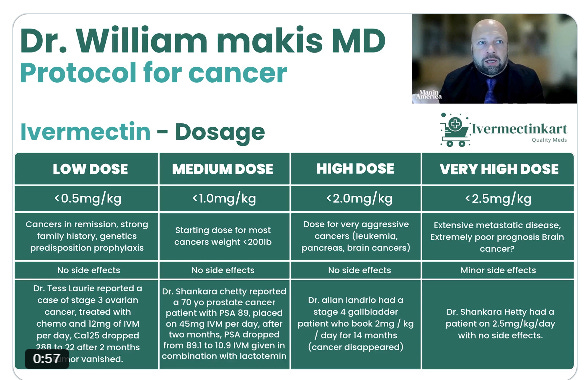
It is also not Tippens’s original regimen. Tippens’s story centers on fenbendazole, CBD, curcumin and, initially, vitamin E. An ivermectin chart circulating beside his name should not be treated as evidence from his remission.
The chart places people into four groups based on their cancer risk or how advanced their cancer is. It recommends higher doses of ivermectin for each group. It even recommends ivermectin for people who do not have cancer but have a family history or genetic risk.
The dose labels are confusing. They say “less than” 0.5, 1.0, 2.0 and 2.5 milligrams for each kilogram of body weight. Read literally, those ranges overlap. A dose below 0.5 is also below 1.0, 2.0 and 2.5. The highest-dose column then describes someone taking exactly 2.5 mg/kg every day, even though its heading says less than 2.5. The first three columns also make the unsupported promise of “No side effects.”
No controlled human evidence validates those cancer categories, the dose escalations or preventive use. The chart provides no pharmacokinetic rationale, interaction rules, monitoring plan or stopping criteria. Putting mg/kg beside a recommendation makes it look medical; it does not make it evidence-based.
One of its own testimonials changes when traced to the source. The chart describes a woman with ovarian cancer taking 12 mg of ivermectin daily with chemotherapy. The underlying account republished by Tess Lawrie says she took it every other day, not daily, while also receiving paclitaxel and carboplatin followed by surgery. The source itself acknowledges that ivermectin’s contribution is unknown. A response during established ovarian-cancer treatment cannot validate ivermectin dosing, much less prevention.
There is preliminary human cancer research on ivermectin. A 2025 early-phase study combined it with the investigational immunotherapy balstilimab in metastatic triple-negative breast cancer. Nine patients enrolled; among eight evaluable patients, one had a partial response, one had stable disease and six had progressive disease. Median progression-free survival was 2.5 months. The small, uncontrolled combination study cannot isolate ivermectin’s effect and used an intermittent schedule, not the chart’s broad daily recommendations.
Checkpoint
The existence of early research means the question is worth studying. It does not mean an online chart has already answered it.
“No side effects” is demonstrably false
No drug can honestly be guaranteed to cause no side effects in everyone. The assurance is especially indefensible here because serious harm has been reported in the same setting being promoted: cancer patients self-treating after reading online claims.
Fenbendazole has been linked to clinically significant liver injury. In a 2021 report, an 80-year-old woman with lung cancer took one gram a day for three days followed by four days off—the schedule popularized online—while receiving pembrolizumab. After about a month, her AST reached 386 U/L and ALT 487 U/L. Her liver function improved after she stopped fenbendazole, and her tumors did not shrink during its use.
A 2024 case report described severe biopsy-confirmed liver injury in a 67-year-old woman who had been taking fenbendazole. Her tests normalized over three months after stopping it.
A January 2026 case is especially relevant to Tippens’s current daily schedule. A 47-year-old woman with metastatic colon cancer took 222 mg of fenbendazole three times a week for six weeks, then increased it to 222 mg every day. One week after the increase, she developed symptoms of severe liver injury. Her AST reached 2,435 U/L and ALT 2,407 U/L. She was also receiving nivolumab and relatlimab, but the authors assessed fenbendazole as the probable cause. Her liver tests improved rapidly after she stopped it and remained normal after immunotherapy was restarted. The full case report documents the timing and causality assessment.
Another 2026 report described a 65-year-old man with prostate cancer who developed jaundice and severe liver injury after alternating veterinary fenbendazole and ivermectin for about three months based on online advice. His liver enzymes improved after both drugs were stopped; the authors assessed the drug relationship as highly probable. The report provides the exposure and laboratory details.
Ivermectin has an established role in treating human parasitic infections, but its label does not promise zero risk. The official STROMECTOL prescribing information lists adverse reactions and postmarketing reports including seizures, hepatitis and neurotoxicity with altered consciousness, confusion, coma and death.
In a 2026 cancer case, a 73-year-old woman with metastatic breast cancer took high-dose ivermectin after finding information online. She developed altered mental status, generalized seizures and respiratory failure, requiring intubation and mechanical ventilation. She recovered neurologically within 48 hours. The published abstract does not state the numerical dose or connect her exposure to this chart, so it would be wrong to claim that the chart caused her hospitalization. It does establish that life-threatening toxicity can occur during high-dose cancer self-treatment.
Case reports cannot tell us how often these events happen, and they do not prove that every user will be harmed. They are more than enough to disprove “No side effects.”
The chart’s highest anecdotal exposure also deserves context. The labeled ivermectin dose for strongyloidiasis is approximately 0.2 mg/kg once. Each 2.5 mg/kg dose is 12.5 times that labeled amount—and the chart’s anecdote repeats it every day. That comparison is not a toxicity threshold, but it shows why safety data from a standard single antiparasitic dose cannot be casually extended to months of high-dose cancer use.
Then comes the sales pitch
The account question needs precision because two profiles were initially mistaken for Tippens himself.
The first, @JoeTippensl, displays X’s “Commentary account” label. According to X’s own explanation, parody, fan and commentary labels identify profiles that depict another person or organization while remaining unaffiliated. It is therefore not evidence of Tippens’s personal presence on X. Its blue check does not change that: X says a blue check now primarily indicates an active Premium subscription and does not carry the old review for notability and authenticity.
The second, @JoeTippens_, calls itself “Joe Tippens Protocol.” In the supplied screenshot its bio says “My name is Joe Tippens,” claims “MD. Oncologist,” and advertises an “Ivermectin & Fenben online-shop” with worldwide shipping. That biography conflicts directly with Tippens’s own site, where he describes a career in accounting, finance and business and states emphatically that he is not a doctor or scientist.
As of September 15, 2026, Tippens’s official website links readers to a Facebook community and YouTube videos but does not list a Twitter or X profile. That cannot prove he has never opened an X account, but it gives no basis for treating either reviewed profile as official.
The responsible conclusion is narrow and strong: someone is using Tippens’s name, photograph and survival story to offer the promoted drugs for sale. The screenshot establishes a commercial sales pitch, not completed sales, revenue or profit. It does not establish that Joe Tippens operates, endorses or benefits from the account.
In fact, his own history points the other way. In November 2019, Tippens wrote that a seller was using his name to market fenbendazole capsules and said he had sent a cease-and-desist demand. In 2020 he again warned followers about what he called entrepreneurial companies selling questionable products. Those warnings remain on his blog.
There is a separate commercial issue on Tippens’s current protocol page. It links directly to purchasable branded supplements and praises their claimed properties. That is product promotion, regardless of intent. The same page explicitly says Tippens receives no financial remuneration and owns no stock in the company. No evidence reviewed for this article contradicts that disclosure, so it would be unfair to claim he profits from those links.
The online-shop account is different. Its sales interest is explicit. The Ivermectinkart branding on the ivermectin chart likewise puts a retailer’s name on dosing claims. A commercial interest does not automatically make a medical claim false, but it creates an obvious reason to demand stronger evidence and full disclosure. Here, the sales pitch is far more developed than the clinical evidence.
What the story can, and cannot, support
The most defensible reading of Joe Tippens’s story is neither “fenbendazole cured him” nor “fenbendazole definitely had nothing to do with it.” The evidence cannot support either conclusion.
What it can support is a hypothesis. A patient with a grim cancer history reported an exceptional, durable remission while taking a clinical-trial treatment, fenbendazole and several supplements after chemotherapy and radiation. Laboratory research gives fenbendazole plausible anticancer mechanisms. That combination of facts can justify serious study.
What it cannot support is the leap from one confounded outcome to a universal protocol. It cannot establish the active ingredient, effective dose, best schedule, duration, compatible treatments, target cancers, survival benefit or risk. It provides no evidence for cancer prevention. Adding more testimonials does not repair those missing controls, particularly when unsuccessful users are not systematically counted.
There is a human cost to pretending those answers already exist. People with cancer may spend money on unproven products, conceal them from clinicians, suffer interactions or toxicity, or delay treatment with evidence of benefit. Patients deserve curiosity without credulity and hope without a sales funnel.
Final checkpoint
Joe Tippens is an exceptional survivor. His story is a reason to ask a research question, not an answer to one. No clinical evidence validates the Joe Tippens Protocol, its dose, its changing supplement combinations, the ivermectin chart or the preventive claims. And the accounts selling these drugs in his name should not be mistaken for him.
Anyone considering fenbendazole, ivermectin or supplements during cancer treatment should tell their oncology team exactly what they are taking. That is not an instruction to abandon research or dismiss repurposed medicines. It is the minimum needed to manage interactions, monitor harm and keep a difficult medical decision anchored to evidence.
Research checked September 15, 2026. Tippens’s diagnosis, treatment sequence, scans and conversations with clinicians are described from his own website because independent medical records were not available for this review. The X-profile and chart descriptions come from supplied screenshots; their operators and the chart’s creator were not independently authenticated. This article is an evidence review, not medical advice.
Resources and further reading
Joe Tippens, “The Blog” — his first-person chronology, original regimen, later updates and past warnings about sellers using his name.
Joe Tippens, current protocol page — the daily fenbendazole schedule and four branded supplement pathways, including his no-remuneration disclosure.
Joe Tippens, 2026 posts and Q&As — recent official-site activity; it is not an independent medical record.
American Cancer Society and ASCO, “What to Know About Fenbendazole” — patient-facing review of evidence, human approval status, interactions and liver risk.
National Cancer Institute, small-cell lung cancer treatment — staging, prognosis factors and established treatment categories.
Dogra et al., Scientific Reports (2018) — the frequently cited cell and mouse study supporting further investigation.
Duan et al., Journal of the American Association for Laboratory Animal Science (2012) — a mouse study that found no effect on mammary-tumor growth, spread or radiation response at the tested exposure.
Nguyen et al., Anticancer Research (2024) — review of preclinical rationale, bioavailability, unanswered human dosing questions and the need for clinical trials.
Hulscher et al., Anticancer Research (2026) — the uncontrolled ivermectin–mebendazole cohort that reported an 84.4 percent self-reported “clinical benefit” among follow-up respondents.
The Wellness Company’s study-promotion page — the company’s use of the 84.4 percent figure to promote the regimen tested through its telemedicine service.
Expression of Concern and September update — the journal’s initial concerns, later narrowing of the audit and still-pending methodological review.
ICONIC phase 2 trial, NCT07487805 — a registered study of ivermectin with immune-checkpoint therapy; no results have been reported.
Yamaguchi et al., Case Reports in Oncology (2021) — liver injury after a Tippens-style fenbendazole schedule in a patient receiving pembrolizumab.
Krishnan et al., World Journal of Clinical Cases (2026) — severe liver injury after a patient increased fenbendazole from 222 mg three times weekly to 222 mg daily.
Powderly et al., Cureus (2026) — severe liver injury after veterinary fenbendazole and ivermectin self-treatment.
ASCO clinical notice (2026) — professional guidance against use for cancer outside well-designed trials.
Retraction notice for Makis et al. (2026) — the publisher’s stated reason for withdrawing the three-patient fenbendazole paper.
STROMECTOL prescribing information — approved human uses, standard dosing and documented adverse reactions for ivermectin.
X Help, profile labels and blue checks — X’s explanation of commentary accounts and what a blue check does and does not establish.