

“If I can bury you under enough links, you’ll assume I must be right.”
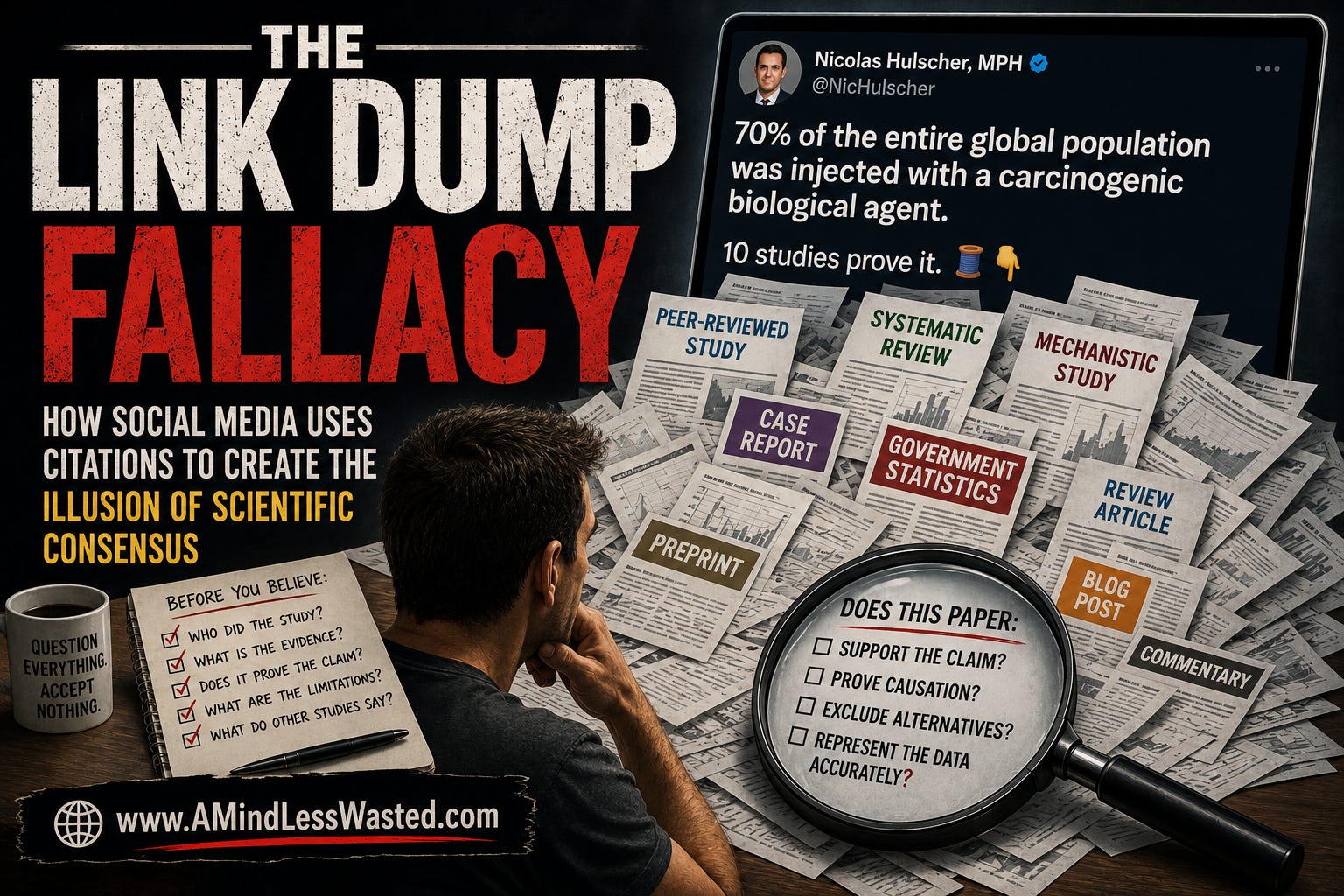
It happens every day on X, Facebook, Reddit, and even Substack.
Someone makes an extraordinary scientific claim.
Then comes the avalanche.
Ten studies
Twenty studies.
One hundred studies.
Government data.
Peer-reviewed papers.
Systematic reviews.
Mechanistic studies.
Preprints.
Blog posts.
By the time you’re finished scrolling, the conclusion seems almost unavoidable.
“There couldn’t possibly be this many citations if the claim weren’t true. It's a natural reaction, and it's exactly why Link Dumps work.”
Whether intentional or not, this presentation encourages readers to equate the number of citations with the strength of the evidence.
Recently, Nicolas Hulscher posted the following on X:
“70% of the entire global population was injected with a carcinogenic biological agent.”
I refer to this as the Link Dump Fallacy: using a long list of citations to create the appearance of overwhelming evidence before those citations have actually been evaluated.
To support this extraordinary claim, he attached ten references ranging from peer-reviewed papers to blog posts, government statistics, mechanistic research, and review articles. The message was clear:
“Look at all this evidence.”
At first glance, it looks impressive.
It also illustrates one of the most effective, and least understood, persuasion techniques on social media.
A long list of citations isn’t evidence of deception. Sometimes it’s exactly what good scholarship looks like.
The mistake isn’t providing many sources. The mistake is assuming that the number of sources tells us whether the conclusion is correct.
Editorial Note: This article is not an evaluation of Nicolas Hulscher’s overall argument. It examines a common reasoning error that appears across the political and scientific spectrum. The same principles apply regardless of whether the underlying claim ultimately proves true or false.
Before we begin: If you enjoy evidence-based analysis that challenges claims from every side of the debate, please consider subscribing to A Mind Less Wasted. Every subscription helps support independent research, careful sourcing, and long-form fact-checking.
The Difference Between Evidence and the Appearance of Evidence
There’s an old debating tactic called the Gish Gallop.
Instead of making one well-supported argument, someone throws out so many claims that it’s practically impossible for the other person to address them all. The point isn’t necessarily to prove every claim. It’s to overwhelm the audience before anyone has time to separate the strong arguments from the weak ones.
The first time I encountered one of these massive collections of scientific citations, it reminded me of the Gish Gallop. The tactic was different, but the psychology was the same.
Instead of overwhelming readers with arguments, it overwhelms them with citations.
That’s why I call it the Link Dump.
It works because it asks almost nothing of us.
Most people won’t open ten papers. Fewer will read them carefully. Almost nobody will compare each paper’s conclusions with the claims being made about it.
So our brains do what they often do when faced with too much information: they take a shortcut.
If there are this many citations, the evidence must be overwhelming.
It’s an understandable assumption. It’s also one of the easiest ways to be misled.
Science doesn't work by counting citations. A bibliography is not an argument. A citation is not proof. And ten papers do not automatically outweigh one carefully designed study that directly answers the question.
Counting Papers Isn’t Science
This isn't the first time I've encountered this tactic. When I audited the famous list of 105 ivermectin studies, I realized I wasn't evaluating one claim; I was evaluating dozens of different claims hiding behind a single headline.
In my earlier article, “Are There Over 105 Studies That Prove Ivermectin Is Effective for COVID-19?”, I didn’t ask readers to count studies.
I asked a different question:
Do these studies actually support the conclusion being claimed?
That’s a fundamentally different exercise.
There’s nothing wrong with assembling dozens—or even hundreds—of scientific papers.
The mistake comes when someone assumes the number of citations settles the question before the evidence has been evaluated.
Science isn’t a vote.
It’s not decided by whichever side can produce the longest bibliography.
Science is decided by the quality, relevance, and consistency of the evidence.
That’s the standard we’ll use here.
The Anatomy of a Link Dump
At first glance, Nicolas Hulscher's post looks compelling.
Ten citations. Ten pieces of evidence. Ten reasons to believe the conclusion. Except that’s not what you’re actually looking at.
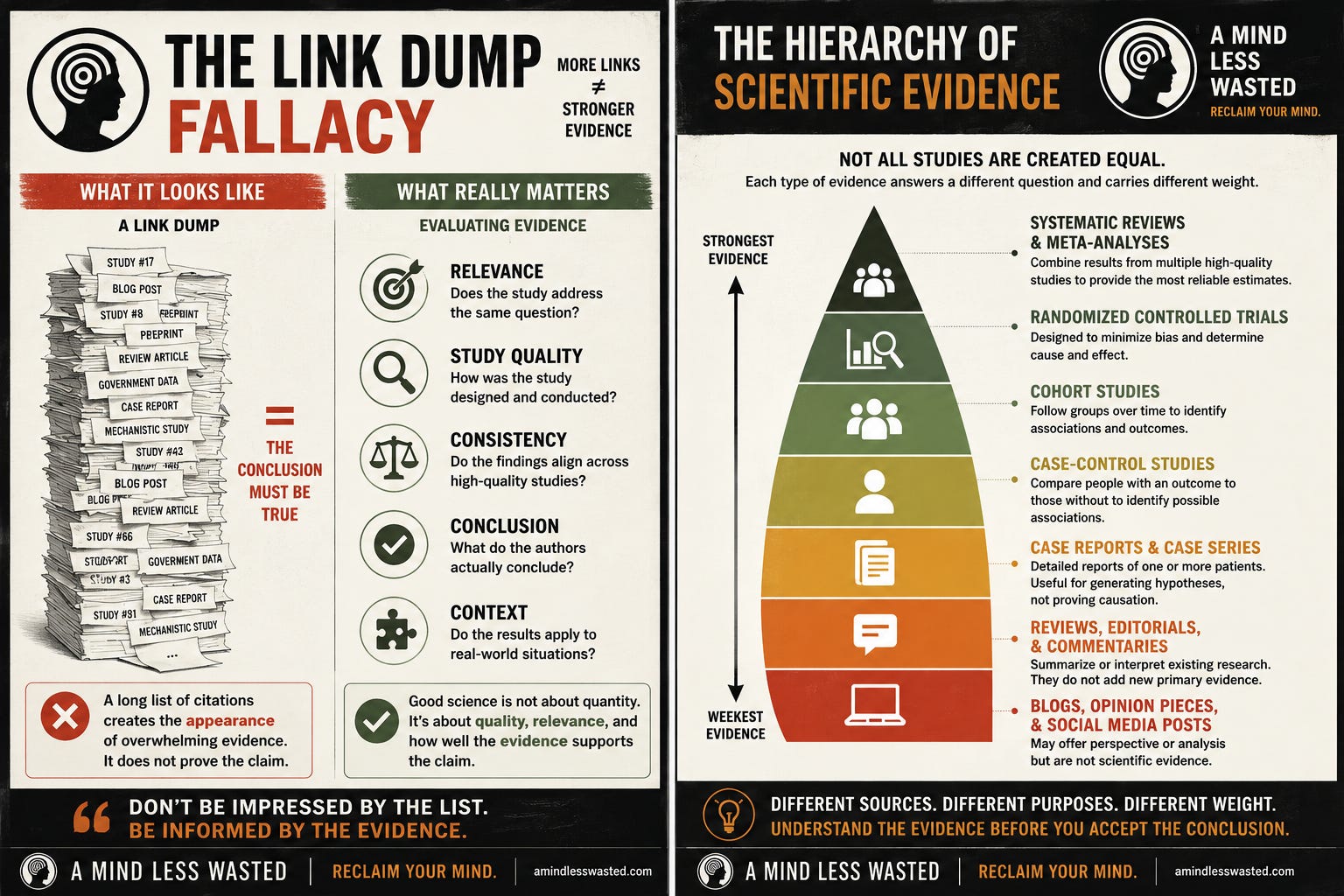
You’re looking at a collection of very different kinds of information, all presented as though they carry the same scientific weight.
They don’t.
To most readers, a citation is just a citation. A blue hyperlink that suggests, “There’s science behind this.”
But scientific evidence isn’t all created equal. Different types of studies answer different questions, and they deserve different weight.
For example,
A mechanistic study may show that a biological process is theoretically possible. That’s valuable science. But demonstrating that something can happen in a laboratory isn’t the same as showing that it does happen in people.
A case report describes what happened to one patient—or perhaps a small handful of patients. These reports are excellent for generating new hypotheses, but they aren’t designed to determine whether one event caused another.
An epidemiological study can identify patterns across large populations. That’s an important piece of the puzzle, but researchers still have to rule out bias, confounding variables, and other explanations before concluding that one factor caused another.
Then there are review articles, which summarize existing research rather than producing new evidence themselves.
And finally, there are blogs and opinion pieces. Some offer thoughtful analysis. Others selectively interpret the literature. Either way, they aren’t primary scientific evidence.
On social media, however, those distinctions tend to disappear.
A mechanistic study sits next to an epidemiological study. A blog post appears beside a peer-reviewed journal article. A case report is presented as though it carries the same weight as a large population study.
To someone scrolling through a feed, they all look identical.
Just another blue link.
That’s where the illusion begins. The list gets longer. The author’s confidence grows. And it’s easy to assume the evidence has grown just as much.
Sometimes it has.
Sometimes it hasn’t.
The only way to know is to look at each citation on its own merits. That’s exactly what we’ll do in Part 2 because science isn’t about counting hyperlinks. It’s about answering a much harder question:
Does this paper actually support the conclusion being claimed?
Before You Click the First Link
Whenever someone presents a massive list of scientific citations, resist the temptation to ask:
“How many studies are there?”
Instead, ask a much better question:
“What exactly is each study claiming?”
This sounds obvious, yet it's remarkable how often the headline says one thing while the paper says something much more modest.
Let’s use Hulscher’s post as an example.
His opening claim is extraordinary:
“70% of the entire global population was injected with a carcinogenic biological agent.”
That statement makes a very specific scientific assertion. It isn’t suggesting there might be a risk. It isn’t proposing a hypothesis for further investigation. It is asserting that COVID-19 vaccines are carcinogenic.
If that’s true, then the evidence should directly support that conclusion.
Now look at the kinds of citations that follow.
Some discuss possible biological mechanisms. Others report individual cancer cases. Some analyze population trends. Others are opinion pieces or blog posts interpreting publicly available data.
These are not interchangeable forms of evidence.
A paper showing that a biological pathway could exist is not evidence that the pathway has caused disease in a population. A case report describing one patient’s experience is not proof of a population-wide effect.
An observed increase in cancer diagnoses after 2021 is not, by itself, evidence that vaccines caused the increase. Correlation raises questions. It does not answer them.
This is one of the most common mistakes made in online science discussions.
Different kinds of evidence are stacked together as though they all answer the same question.
They don’t.
Imagine someone arguing that smoking causes lung cancer.
Would they convince you by showing:
a laboratory study on cigarette smoke chemistry,
a single patient’s medical history,
a newspaper article about rising cancer rates,
a blog analyzing government statistics,
and a review paper discussing possible mechanisms...
...and then declaring the case closed?
Of course not.
You would want to know which evidence actually demonstrates causation. The same standard should apply to every extraordinary scientific claim.
Before accepting any extraordinary claim, ask yourself one simple question:
Which of these citations actually demonstrates the conclusion being claimed, and which merely provides background, raises a hypothesis, or offers an opinion?
That question alone will eliminate a surprising amount of confusion.
The Questions Every Critical Thinker Should Ask
You don't need a Ph.D. to evaluate scientific claims. You don't need advanced training in epidemiology. You need to ask the same questions that good scientists ask every day.
Whenever you encounter a massive list of citations on social media, start here:
1. Does the paper actually support the headline?
This is the single most important question.
Not:
“Is it peer reviewed?”
Not:
“Was it published?”
But:
“Does this paper actually say what the person claims it says?”
You’d be surprised how often the answer is no.
A paper might conclude that a biological mechanism deserves further investigation, while a social media post presents it as an established cause of disease.
Those are very different conclusions.
2. What type of evidence is this?
A laboratory experiment.
A case report.
A review article.
An epidemiological study.
A systematic review.
A blog post.
They are not interchangeable.
Each answers a different question.
Each has different strengths.
Each has different limitations.
Treating them as equivalent simply because they all have hyperlinks attached is a mistake.
3. Is the conclusion stronger than the evidence?
This is one of the most common ways scientific findings become distorted on social media.
A study reports an association, and the headline turns it into proof of causation.
A paper proposes a possible biological mechanism, and the post presents it as something already confirmed in people.
Researchers call for further investigation, while the social media summary declares that the science is settled. One habit that will make you a much better reader of scientific papers is paying attention to the cautious language researchers use. Words like:
may
might
could
associated with
consistent with
suggests
aren’t signs of weakness. They’re signs of scientific discipline.
Researchers are careful to distinguish what their data show from what they suspect may be true.
Unfortunately, by the time a paper is condensed into a headline, tweet, or social media post, those qualifying words are often gone—and the conclusion can sound far more certain than the authors ever intended.
4. Are independent lines of evidence pointing to the same conclusion?
Science rarely rests on a single paper.
Confidence grows when independent researchers, using different methods and different datasets, arrive at similar conclusions.
It doesn’t grow simply because someone pasted ten links into a tweet.
Those ten papers may all cite the same underlying hypothesis.
Ten blog posts may repeat the same interpretation.
Ten review articles may rely on the same handful of original studies.
That’s not ten independent confirmations.
It’s often the same evidence being echoed through different publications.
That’s why experienced researchers don’t count citations—they ask whether each one contributes genuinely independent evidence.
That’s exactly what we’ll do in Part 2.
We’re not going to examine all ten citations at once. Instead, we’ll start with the very first one and ask a simple question:
Does this paper actually support the claim being made?
If the strongest citations don’t support the headline, then the size of the bibliography becomes far less impressive.
A Principle Worth Remembering
A citation doesn’t inherit the claims made about it. It stands, or falls, on what the authors actually wrote.
If someone tells you a study proves something extraordinary, don’t ask how many studies they have. Ask them to show you where the authors reached that conclusion.
That’s where science begins.
The next time you’re confronted with a social media post boasting 10 studies, 100 studies, or even 1,000 studies, remember this:
The length of the bibliography tells you almost nothing about the strength of the argument.
Science isn’t decided by counting links. It’s decided by evaluating evidence.
And that’s exactly what we’ll do next.
Knowing how to evaluate evidence is one thing. Doing it is another.
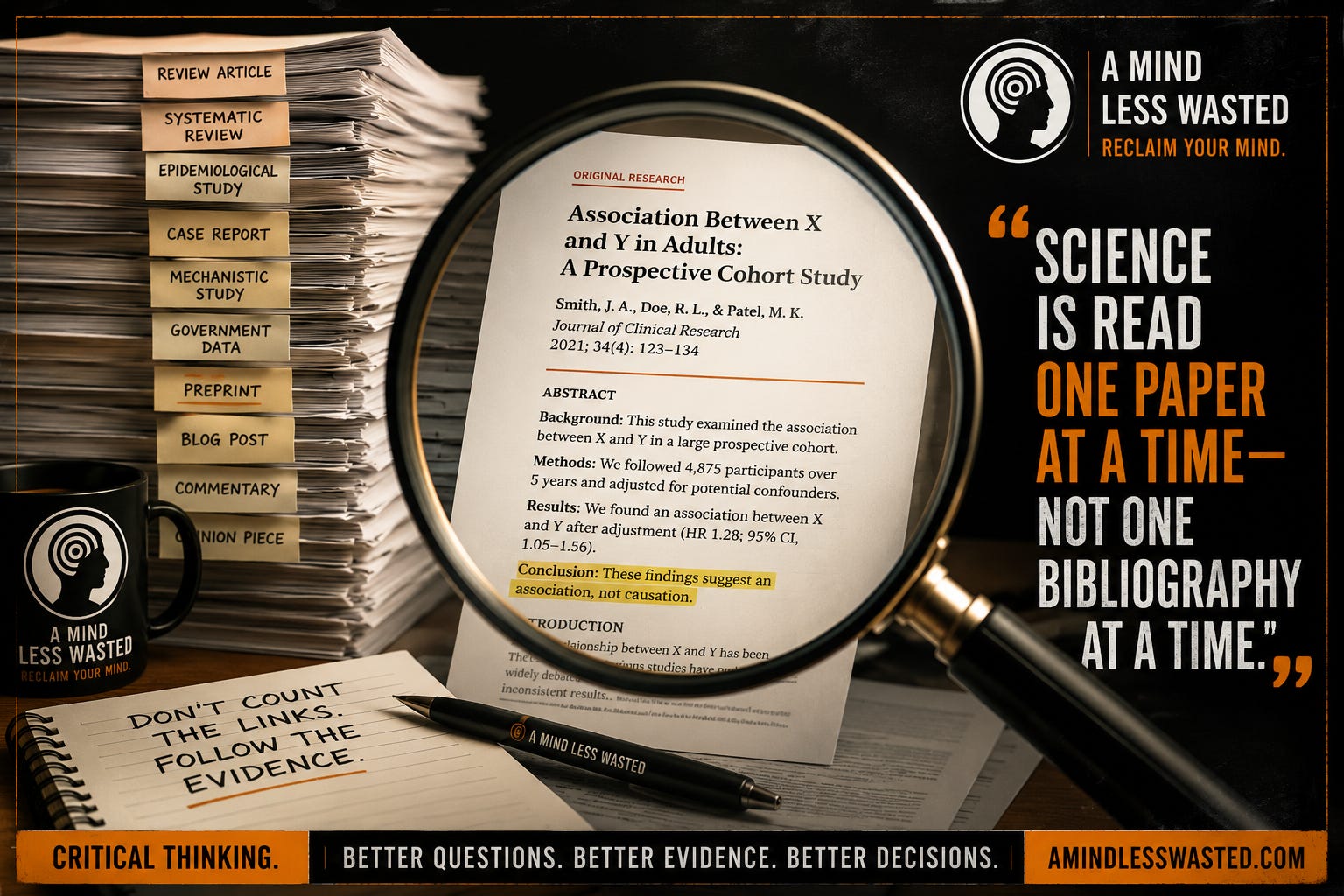
Science is read one paper at a time, not one bibliography at a time.
Coming Next
The Link Dump Fallacy — Part 2
In Part 2, we’ll put these principles into practice by auditing the first citation in Nicolas Hulscher’s thread and comparing what the paper actually concludes with what the social media post claims it concludes.
You’ll see, step by step, whether the evidence supports the headline or whether the headline overstates the evidence.

If this article made you stop and think, please share it. Thoughtful conversations begin when good ideas are passed along.
Enjoyed this article? Subscribe to A Mind Less Wasted for more evidence-based analysis, primary source research, and practical tools for thinking more critically in an age of information overload.
Resources
Critical Thinking
Carl Sagan. The Demon-Haunted World: Science as a Candle in the Dark. Random House, 1995.
Daniel Kahneman. Thinking, Fast and Slow. Farrar, Straus and Giroux, 2011.
Jonathan Baron. Thinking and Deciding. Cambridge University Press.
Stuart Firestein. Ignorance: How It Drives Science. Oxford University Press.
University of Texas at El Paso. A Guide to Critical Thinking.
Robert Todd Carroll. The Skeptic’s Dictionary.
Stanford Encyclopedia of Philosophy. Scientific Method.
Evidence-Based Medicine & Research Methods
GRADE Working Group. Grading the Quality (Certainty) of Evidence and Strength of Recommendations.
Oxford Centre for Evidence-Based Medicine (CEBM). Levels of Evidence.
EQUATOR Network. Reporting Guidelines for Health Research.
Cochrane Collaboration. Cochrane Handbook for Systematic Reviews of Interventions.
Research Databases
PubMed
Google Scholar
Crossref
Europe PMC
Related Articles
Are There Over 105 Studies That Prove Ivermectin Is Effective for COVID-19? — A Mind Less Wasted