


In Part One, I explained how a long list of citations can create the appearance of overwhelming evidence before anyone checks what those sources actually show.
Now let’s examine a textbook example.
Nicolas Hulscher claimed that more than 70% of humanity had been injected with a “CARCINOGENIC biological agent.” He then asserted that COVID-19 vaccines increase the risk of seven major cancers through 17 biological mechanisms.


He followed that claim with ten links.
At first glance, the list looks formidable: two large population studies, government cancer data, reports involving more than 300 patients, claims of genomic integration and spike protein in cancer cells, and 17 proposed mechanisms supposedly backed by more than 100 studies.
That is exactly why a link dump is persuasive. The reader absorbs the combined weight of the list before having time to ask three basic questions:
What did each source actually study?
What can that type of evidence establish?
Are these ten independent lines of evidence, or is some of the same material being counted more than once?
Once those questions are asked, the “wall of evidence” starts to look very different.
The burden of proof
This article isn’t saying that every source is useless, that no cancer signals could ever pop up, or that COVID-19 vaccines have been definitively shown to have no impact on cancer in any situation.
Those are entirely different assertions.
The question here is narrower: Do these ten links establish the categorical claim attached to them?
Calling something a carcinogenic agent is a causal claim. So is saying that it increases the risk of seven cancers through 17 mechanisms. Evidence that raises a question, describes an event after vaccination, identifies a possible mechanism, or shows two trends moving together may justify further research. By itself, it does not establish either conclusion.
That distinction is crucial. If a strong claim shifts to “this needs more research” as soon as we dig into the citations, then those citations didn’t really support the claim as it was originally presented.
What is actually in the list?
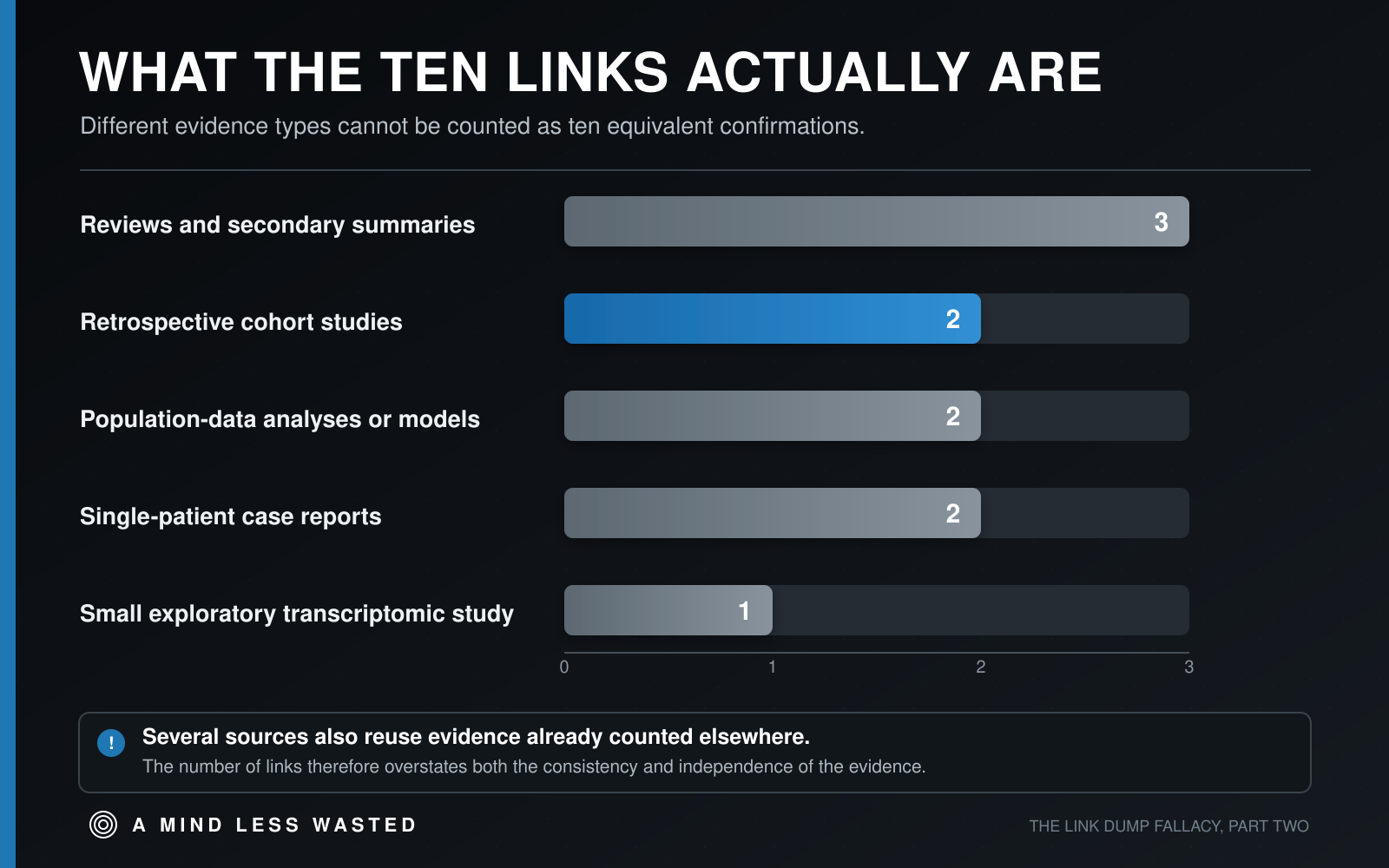
The ten links are not ten studies that independently reached the same conclusion. They are a mixture of very different forms of evidence:
A South Korean retrospective cohort study. It reports statistical associations between vaccination and six cancer diagnoses during one year of follow-up.
An Italian retrospective cohort study. It reports associations with cancer hospitalization that change when the analysis uses a different lag period.
Hulscher’s analysis of federal cancer statistics. It identifies population-level trends, but the data do not connect individual cancer diagnoses with individual vaccination histories.
A pseudonymous analyst’s model of CDC mortality data. It produces an excess-death estimate from the analyst’s chosen baseline and adjustments. The underlying death records come from the CDC. The conclusion does not.
A scoping review dominated by case reports and small case series. It collects malignancies reported after vaccination or SARS-CoV-2 infection and proposes questions for further study.
A single bladder-cancer case report. It reports one short genetic sequence in circulating tumor DNA that the authors interpret as a possible vaccine-related integration event.
A small exploratory transcriptomic study. It compares three patients with new health problems and seven patients with cancer after vaccination against historical reference samples.
A single metastatic breast-cancer case report. It reports spike-protein staining in one patient’s metastatic tumor cells.
A narrative review promoting the “turbo cancer” hypothesis. It relies on case reports, VAERS reports, and proposed mechanisms. The authors acknowledge that “turbo cancer” is not a formally recognized oncologic classification.
A Substack article summarizing another writer’s proposed mechanisms. It collects mechanistic arguments and describes them as 17 ways mRNA vaccines may cause cancer.
This is the first thing the wall of links conceals. Population studies, individual cases, ecological trends, laboratory findings, reviews, and blog posts are presented as if they were interchangeable pieces of proof.
They are not.
Ten links are not ten independent confirmations
The list also creates an impression of independence that is not there.
Links three and ten are actually Hulscher’s own Substack articles. Plus, Hulscher coauthored links six and seven, which also feature other members from the same research team. While this doesn’t invalidate the work, it does mean those links can’t be seen as independent support for Hulscher’s claims.
As for the fifth source, the Oncotarget review, it pulls in the South Korean and Italian cohort studies that we’ve already counted as links one and two. It also includes the metastatic breast-cancer case that’s separately listed as link eight.
So, the same evidence is essentially being counted twice. First, it shows up as its own citation, and then it pops up again in a review, adding another link to the tally.
This doesn’t amount to ten independent pieces of evidence. Instead, it’s a smaller set of evidence repackaged in a few different ways.
☕ Coffee Break
Ten links can look like ten witnesses telling the same story.
But some of these witnesses are repeating one another. Some describe a single unusual event. Others explain what might be biologically possible. Only two attempt to measure cancer outcomes in large populations.
That is the argument so far, in plain English: ten citations are not necessarily ten independent pieces of evidence.
Now refill your coffee. It is time to open the strongest links and see what they actually show.
Start with the strongest evidence
The two large cohort studies are the most relevant sources because they compare cancer outcomes across defined populations.
The South Korean study
The first paper drew from health records for more than 8.4 million people in South Korea. After propensity-score matching, the analysis included 595,007 vaccinated participants and 2,380,028 unvaccinated participants. The researchers reported statistical associations between vaccination and six cancer diagnoses during one year of follow-up.
That result should not be ignored. It is a signal that deserves careful examination.
It is not proof that vaccination caused those cancers.
The authors called their results “epidemiological associations” and said further studies were needed to clarify possible causal relationships. The journal also carries an editor’s note, added on October 22, 2025, stating that concerns had been raised and were under investigation. The paper has not been retracted, but readers should know that its methods are being formally questioned.
A published methodological commentary identified several problems that could materially affect the findings:
Vaccinated and unvaccinated participants were assigned different index dates, creating a risk of calendar-time bias.
The analysis could not adequately control for important factors such as smoking, alcohol use, family history, genetic susceptibility, and screening frequency.
Vaccinated participants may have used health care and cancer screening differently, increasing the chance that pre-existing cancers would be detected.
Thirty site-specific and subgroup analyses were performed without a correction for multiple comparisons, increasing the likelihood of chance findings.
A one-year window is poorly suited to attributing the development of most solid tumors to a new exposure, especially without excluding cancers diagnosed soon after vaccination.
These criticisms do not prove that every reported association is false. They do show why the study cannot carry the conclusion Hulscher places on it.
An observational association, particularly one vulnerable to timing, surveillance, confounding, and multiple-testing problems, does not establish that a vaccine is a carcinogen.
The Italian study
The second paper followed 296,015 residents of Pescara province for up to 30 months. In its main analysis, people who received at least one dose had a modestly higher rate of hospitalization with a cancer diagnosis than unvaccinated residents.
Again, that finding deserves examination. But the paper’s own sensitivity analyses make the result far less definitive than the link dump suggests.
When the researchers required at least 365 days between vaccination and cancer hospitalization, the association for people who received at least one dose was no longer statistically significant. Among those who received three or more doses, the association reversed, with a slightly lower rate of cancer hospitalization.
The study also found no clear dose-response pattern. People who received three or more doses did not show a higher overall cancer-hospitalization risk than people who received at least one dose. The authors noted residual confounding, differences in health-care-seeking behavior, possible misclassification of prior infection, and healthy-vaccinee bias. They also stressed that hospitalization records are only a proxy for all new cancer diagnoses.
The paper’s conclusion was appropriately cautious: the results varied by infection status, cancer site, and the lag period selected, and the findings were preliminary.
The link-dump version removes that uncertainty and turns the paper into “a second study proves vaccines increase cancer.”
That is not what the paper shows.
Government data, private conclusions
The third and fourth links borrow credibility from the agencies that produced the underlying data: the National Cancer Institute and the CDC.
Neither agency produced the conclusions attached to those links.
Cancer-incidence trends
The third source is Hulscher’s analysis of National Cancer Institute SEER data. He compares cancer rates among Americans younger than 50 from 2021 through 2023 and attributes the increase to the vaccination campaign.
The reported rates come from SEER. The causal attribution does not.
Population-level trend data can indicate shifts in cancer rates during times of widespread vaccination. However, they can't definitively prove that vaccination was the reason for those changes. The dataset referenced in the article doesn't connect an individual's vaccination status to their cancer diagnosis. It lacks comparison groups for vaccinated and unvaccinated individuals and fails to distinguish between the effects of vaccination and factors like infections, changes in screening practices, delayed diagnoses, demographic shifts, or cancer trends that may have started before the vaccine was introduced.
The National Cancer Institute has also warned that pandemic-related disruptions in screening and diagnosis complicate cancer-trend analysis. That does not explain every increase after 2021, and it should not be used as a catch-all dismissal. It does mean that a raw change across a few years cannot be assigned to one exposure simply because the timelines overlap.
That would be an ecological inference, not an individual-level causal result.
Cancer-mortality trends
The fourth source uses CDC death records to estimate more than 138,000 excess cancer deaths since 2021. But that figure is not a CDC estimate. It comes from a model produced by the author of The Ethical Skeptic.
Every excess-death estimate depends on choices about the expected baseline, population changes, age structure, time periods, exclusions, and adjustments. Different defensible choices can produce different estimates.
The CDC supplies the underlying records. It does not endorse this model, its assumptions, or the attribution of the modeled excess to vaccination.
Saying “CDC data show” blurs the line between the source of the numbers and the source of the conclusion. Government data do not turn a private analysis into a government finding.
Most importantly, the model does not contain individual vaccination histories. Even if the excess estimate were accepted exactly as calculated, it would not identify vaccination as the cause.
Case reports are signals, not verdicts
Several of the remaining sources depend heavily on case reports.
Case reports matter. They can document an unusual event, alert clinicians to a possible pattern, and generate hypotheses for larger studies. Many genuine medical discoveries began with one careful observation.
But case reports have no unexposed comparison group and no denominator. They cannot tell us how often an event occurs, whether it occurs more often after vaccination than without vaccination, or whether vaccination caused it.
The review of 333 patients
The fifth link sounds like a large clinical investigation involving 333 patients. It was actually a scoping review of 69 publications about cancers reported in temporal association with either vaccination or SARS-CoV-2 infection.
The review identified 66 article-level reports describing 333 patients, plus two retrospective population studies and one longitudinal population analysis. Fifty-five of the 69 publications were single-patient case reports or small case series.
The authors openly described the limits of that evidence. They said the review was not designed to estimate cancer risk, establish causality, or guide individual vaccination decisions. They noted publication bias, selective reporting, inconsistent clinical information, heterogeneous cases, and the absence of comparable control observations.
The authors believe the recurring reports and proposed mechanisms form a biologically plausible signal that deserves organized surveillance. That is a fair description of their interpretation. It is still a hypothesis drawn from an evidence base they acknowledge cannot estimate risk or establish causation.
They also stated that no current study had demonstrated oncogenic transformation or tumor initiation causally attributable to a COVID-19 mRNA vaccine or its components.
Those admissions answer the question this article is asking.
The review documents reports that occurred after vaccination or infection. It does not document 333 cancers caused by vaccination. It also recycles several sources counted elsewhere in Hulscher’s list.
The bladder-cancer report
The sixth link is a case report about a 31-year-old woman who developed aggressive stage IV bladder cancer after receiving three Moderna doses.
The authors reported a single host-vector chimeric read in circulating tumor DNA. A 20-base segment aligned with a portion of a Pfizer spike-plasmid reference, even though the patient had received Moderna. The paper argues that the vaccines share spike-coding sequences and that no official Moderna plasmid reference was available for comparison.
The paper’s own table, however, reports a viral mapping quality of 6, labeled “low confidence,” and classifies the finding as “Possible Host Translocation: TRUE.” The authors also call for validation using an independent method such as long-read sequencing.
Those details are important. The paper’s conclusion describes genomic integration as documented, but the reported evidence is a single short read from circulating tumor DNA that still requires orthogonal confirmation.
Even if future testing confirms that an integration event occurred, one event in one patient would not establish that it initiated her cancer, that such events are common, or that vaccination increases cancer risk in the population.
The authors themselves acknowledge that causality cannot be established from a single case.
The metastatic breast-cancer report
The eighth link describes an 85-year-old woman who had already been treated for breast cancer. A skin metastasis appeared after her sixth Pfizer dose. The tumor cells stained positive for spike protein and negative for nucleocapsid protein, leading the author to suggest that the spike protein may have come from vaccination.
This was not a new cancer arising in a previously cancer-free patient. It was metastatic disease in a patient with a prior breast-cancer diagnosis.
The finding may justify further investigation into the origin and significance of the staining. It does not show that the vaccine initiated the cancer, caused the recurrence, or drove the metastasis.
Even if the protein’s vaccine origin were confirmed, presence is not causation. Detecting a protein in tumor cells does not demonstrate that the protein created the tumor or changed its clinical course.
The control group determines what a study can claim
The seventh link examines gene expression in three patients with new nonmalignant health problems after vaccination and seven patients diagnosed with cancer after vaccination.
The authors compared those ten patients with 803 historical RNA-sequencing samples from the GTEx database, collected before the COVID-19 vaccination era.
That comparison can show that the selected patients’ gene-expression profiles differ from the historical reference samples. It cannot identify vaccination as the reason.
The cancer patients already had a condition known to profoundly alter gene expression. The study did not include a matched group of vaccinated people without cancer or a matched group of unvaccinated people with the same cancers. Without those comparison groups, the analysis cannot separate the effects of cancer, treatment, age, sex, tissue handling, laboratory procedures, infection history, or other patient differences from any possible effect of vaccination.
The sample was also tiny and selected because the participants had already experienced the outcomes under investigation.
The study may generate hypotheses about pathways worth testing. It does not establish that vaccination caused the cancers in those seven patients or that it raises cancer risk in the wider population.
A mechanism is not a measured disease risk
The ninth and tenth links move from observed outcomes to proposed biological mechanisms.
Mechanistic evidence can be important in causal inference. It may show that a biological effect is possible under particular experimental conditions and can help explain a pattern found in well-designed epidemiological studies.
What it cannot do by itself is establish how often that mechanism occurs in vaccinated people, at what dose, in which tissues, for how long, or whether it produces a measurable increase in cancer.
The “turbo cancer” review
The ninth source promotes “COVID-19 mRNA-induced turbo cancers” as a proposed syndrome. Its authors acknowledge that “turbo cancer” is not a formally recognized oncologic classification. The article draws on case reports, proposed mechanisms, and VAERS reports to support a multi-hit hypothesis.
VAERS is an early-warning system. It is designed to identify reporting patterns that may deserve further investigation. It cannot calculate cancer incidence from report counts, and a report does not establish that a vaccine caused the event. The VAERS program itself states that reports alone cannot determine causation, frequency, severity, or rates.
The review can propose a hypothesis. Naming that hypothesis and collecting reports around it do not validate the diagnosis or establish the causal mechanism.
Seventeen proposed mechanisms
The tenth link is Hulscher’s summary of a separate article claiming that mRNA vaccines may cause cancer through 17 pathways supported by more than 100 studies.
That wording creates the impression that 100 studies directly compared cancer outcomes in vaccinated and unvaccinated people.
They did not.
The supporting material includes general cancer biology, laboratory experiments, research on SARS-CoV-2 infection, case reports, narrative reviews, and studies of molecular pathways. Much of it does not directly test whether COVID-19 vaccination causes cancer in humans.
A substance can affect a pathway involved in cancer biology without causing cancer. Cells use many of the same immune, inflammatory, repair, stress, and growth pathways in ordinary physiology and in disease. To move from pathway effects to a real-world causal claim, researchers still need evidence about exposure, dose, timing, persistence, effect size, clinical outcomes, and what happens in an appropriate comparison group.
Seventeen proposed pathways are not seventeen demonstrated causes. One hundred references are not one hundred studies of cancer incidence after vaccination.
What the citations actually support
Once the links are separated by evidence type and read on their own terms, the collection supports a much narrower conclusion.
It contains:
two observational signals whose results are limited by design choices, confounding, surveillance, and inconsistent sensitivity analyses;
two population-level interpretations that cannot link vaccination to individual cancer outcomes;
case reports that document unusual observations but cannot measure comparative risk or establish causation;
one very small transcriptomic comparison without the control groups needed to isolate a vaccine effect;
reviews and articles proposing biological mechanisms that have not been shown to produce increased cancer incidence in vaccinated people;
repeated evidence and overlapping authorship that make the ten links less independent than they appear.
That evidence can support continued monitoring, independent replication, better-designed cohort studies, and targeted mechanistic research.
It does not establish that COVID-19 vaccines are a carcinogenic biological agent. It does not show that they caused seven major cancers across the global population. It does not demonstrate that the proposed 17 mechanisms produce cancer in vaccinated people.
There is an important difference between saying, “Here are signals that deserve further investigation,” and declaring that most of humanity was injected with a carcinogen.
The first is a research question.
The second is a conclusion.
These citations do not bridge the distance between them.
Assessment
Claim: COVID-19 vaccines are a carcinogenic biological agent that increases the risk of seven major cancers through 17 distinct mechanisms.
Finding: Not established by the cited evidence.
That finding does not prove that the true risk must be zero. It means the person making the categorical claim has not met the burden of proof with the evidence presented.
Conclusion
The Link Dump Fallacy works because quantity becomes a shortcut for credibility. Most readers do not have time to open ten papers, examine the methods, trace repeated citations, identify missing control groups, and distinguish an agency’s data from a blogger’s interpretation.
The person posting the links knows that. The size of the list becomes part of the persuasion.
It also creates an enormous imbalance of effort. A claim and ten links can be posted in seconds. Checking them can take hours or days. By the time someone has finished auditing the evidence, the original post may have reached thousands of people.
That does not make every long bibliography suspicious. Serious arguments often require many sources. The warning sign is when the number of citations is treated as the argument and unlike forms of evidence are stacked together as if they all prove the same thing.
The defense often changes once the links are examined. A claim that began as certainty becomes “Are you saying we should not investigate?” No. Questions should be investigated. Signals should be followed. Case reports should be documented. Plausible mechanisms should be tested.
But a call for research cannot be used to defend a conclusion that the research has not established.
When you encounter a wall of citations, do not begin by counting them. Open the first source. Ask what was studied, what the design can show, whether the authors reached the conclusion being attributed to them, and whether the next citation provides new evidence or merely repeats the first.
You do not need to prove that every source is worthless. Some may contain valuable observations. The fallacy lies in treating the collection itself as proof before the individual sources have earned that conclusion.
The next time someone says, “Here are 100 studies,” ask a better question:
How many still support the claim after they have been opened?
If this article gave you a better way to evaluate a wall of citations, subscribe to A Mind Less Wasted for more evidence-based fact-checks and critical-thinking tools.
And if you know someone who has ever been confronted with “Here are 100 studies,” share this article with them.
Resources
Original post
The ten links in the original post
1-year risks of cancers associated with COVID-19 vaccination: a large population-based cohort study in South Korea, Biomarker Research
COVID-19 vaccination, all-cause mortality, and hospitalization for cancer: 30-month cohort study in an Italian province, EXCLI Journal
“U.S. Government Cancer Data Shows Early-Onset Cancers Surged 6.4% From 2021 to 2023”, Nicolas Hulscher, The Focal Points
“The State of Things Pandemic: Week 38 2024”, The Ethical Skeptic
COVID vaccination and post-infection cancer signals: Evaluating patterns and potential biological mechanisms, Oncotarget
Genomic Integration and Molecular Dysregulation in Aggressive Stage IV Bladder Cancer Following COVID-19 mRNA Vaccination, International Journal of Innovative Research in Medical Science
Synthetic messenger RNA vaccines and transcriptomic dysregulation: Evidence from new-onset adverse events and cancers post-vaccination, World Journal of Experimental Medicine
A case of metastatic breast carcinoma to the skin expressing SARS-CoV-2 spike protein possibly derived from mRNA vaccine, Journal of Dermatological Science
COVID-19 mRNA-Induced “Turbo Cancers”, Journal of Independent Medicine
“17 Ways mRNA Shots May Cause Cancer, According to Over 100 Studies”, Nicolas Hulscher, The Focal Points
Additional sources used in this analysis
Commentary: 1-year risks of cancers associated with COVID-19 vaccination: a large population-based cohort study in South Korea, Frontiers in Public Health
Impact of COVID-19 on SEER Data Releases, National Cancer Institute
VAERS data: key considerations and limitations, U.S. Department of Health and Human Services
Related
The Link Dump Fallacy, Part One, A Mind Less Wasted