


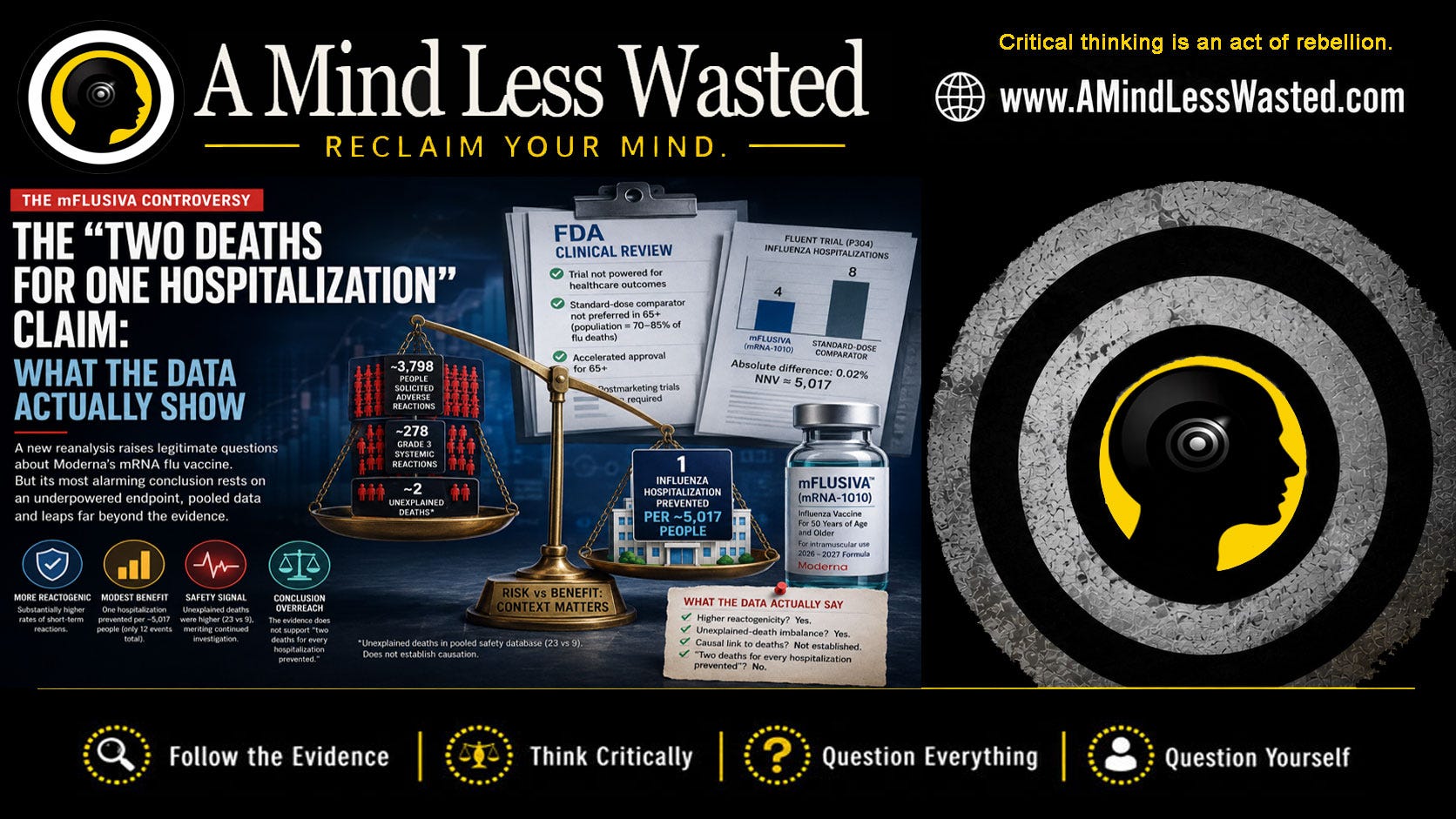
A new reanalysis raises legitimate questions about Moderna’s mRNA flu vaccine. But its most alarming conclusion rests on an underpowered hospitalization endpoint, pooled safety data, and biological claims that reach much further than the evidence.
A graphic circulating online makes a remarkable claim about Moderna’s newly approved mRNA influenza vaccine, mFLUSIVA.
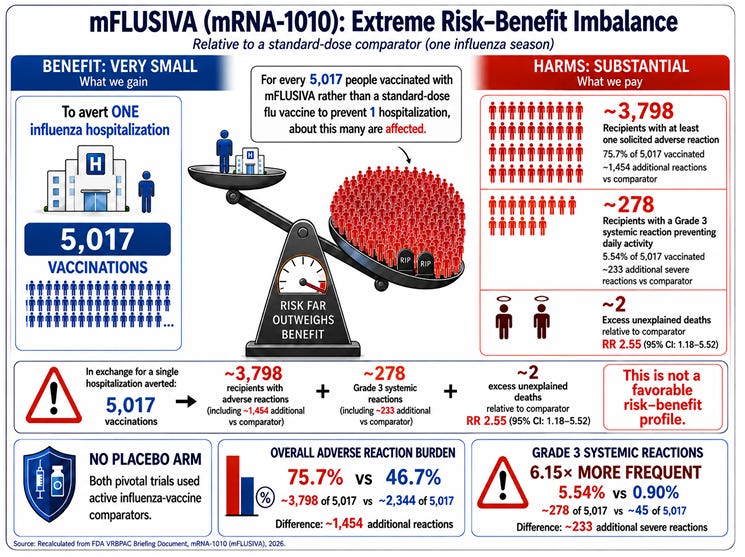
To prevent one influenza hospitalization, it says, roughly 5,017 people must be vaccinated. In return, thousands will experience adverse events, hundreds will have severe reactions, and approximately two people will die.
If that were what the clinical trial actually demonstrated, there would be little left to debate.
It isn’t.
I went through the 34-page paper behind that graphic, checked its calculations against the FDA’s clinical review, read the published Phase 3 trial, looked at the FDA approval documents, and followed several of the paper’s molecular citations back to their original studies.
The result is more interesting than simply declaring the paper right or wrong.
Much of its arithmetic is correct.
Several of the safety observations are legitimate.
One particular mortality imbalance deserves continued investigation.
And mFLUSIVA unquestionably causes substantially more short-term reactions than conventional flu vaccines.
But the paper then takes those findings considerably further than the evidence allows.
The biggest problem is hiding in plain sight: the dramatic “two deaths for every hospitalization prevented” comparison is constructed from different datasets, anchored to an exploratory hospitalization endpoint involving just 12 total hospitalizations, and presented in a way that can easily be mistaken for evidence that the vaccine caused deaths.
The paper itself admits that it does not establish that.
That distinction matters.
First, What Is This Paper?
The document is Reanalysis of FDA Clinical Data for mFLUSIVA (mRNA-1010): Unfavorable Risk-Benefit Profile Supports Market Withdrawal, by Nicolas Hulscher, Peter McCullough and John Catanzaro. The version examined here was posted to Zenodo on August 19, 2026 as Version 1.
This is not another clinical trial.
The authors did not enroll patients, collect new outcomes or obtain the participant-level trial dataset. They took publicly available FDA data and published trial results and recalculated absolute risk differences, numbers needed to vaccinate, numbers needed to harm and unadjusted risk ratios. They explicitly state that they had no participant-level data and that some counts were reconstructed from published percentages.
There is nothing inherently wrong with doing that. Reanalysis can be valuable.
But it means the strength of the paper depends almost entirely on whether the authors interpret those existing numbers appropriately.
That is where the problems begin.
What the Actual Phase 3 Trial Found
The pivotal Fluent trial was large: 40,703 adults age 50 and older received either mRNA-1010 or a licensed standard-dose influenza vaccine.
RT-PCR-confirmed influenza-like illness occurred in 411 of 20,179 participants in the mRNA group, compared with 557 of 20,124 in the conventional-vaccine group.
That translated to 26.6% relative vaccine efficacy compared with the standard-dose vaccine, with a 95% confidence interval of 16.7% to 35.4%.
So mFLUSIVA did outperform the standard-dose comparator on the trial’s prespecified primary clinical endpoint.
The tradeoff was reactogenicity.
Injection-site pain occurred in 65.8% versus 29.8%, fatigue in 45.1% versus 20.3%, headache in 37.8% versus 18.0%, and muscle aches in 35.4% versus 11.6%.
That difference is real. It shouldn’t be minimized.
The FDA ultimately approved mFLUSIVA on August 5, 2026 for adults 50 and older, with the indication specifically being prevention of influenza disease, not prevention of influenza death. The indication for those 65 and older was granted through the accelerated approval pathway.
Now we get to the number driving the controversy.
Is “5,017 Vaccinations to Prevent One Hospitalization” Correct?
Mathematically, yes.
As a robust estimate of mFLUSIVA’s hospitalization benefit, that’s another matter.
There were:
4 influenza hospitalizations among 20,179 mFLUSIVA recipients
versus
8 among 20,124 standard-dose flu-vaccine recipients.
That works out to an absolute difference of approximately 0.02 percentage points and a number needed to vaccinate of roughly 5,017.
I independently recalculated it. The arithmetic checks out.
The critical fact missing from the dramatic graphic is that the FDA classified medically attended outcomes such as hospitalization as exploratory endpoints. FDA explicitly said it could not calculate relative vaccine efficacy for hospitalization alone because there were too few cases and that the trial was not powered to evaluate healthcare outcomes.
There were only 12 hospitalizations total.
That makes 5,017 a point estimate built from extremely sparse data, not a precisely established biological constant.
Move a few events from one group to the other and that number changes dramatically.
There is another important wording issue.
The finding does not mean:
Give 5,017 people mFLUSIVA and one hospitalization is prevented.
It means that, during this trial and this influenza season, there was approximately one fewer hospitalization per 5,017 people receiving mFLUSIVA instead of a standard-dose influenza vaccine.
The comparator was already vaccinated.
That distinction disappears remarkably easily when the figure gets converted into social-media shorthand.
The Adverse-Reaction Numbers Are Real, Too
The authors calculate that for every 5,017 people switched from the standard flu vaccine to mFLUSIVA, approximately 1,454 additional people would experience a solicited adverse reaction and roughly 233 additional people would experience a Grade 3 systemic reaction.
Again, the arithmetic follows from the reported trial rates. The paper summarizes those figures in its conclusion.
And mFLUSIVA clearly was much more reactogenic.
In the solicited safety subset, 75.7% of mFLUSIVA recipients reported at least one solicited reaction versus 46.7% of conventional-vaccine recipients. Grade 3 systemic reactions occurred in 5.5% versus 0.9%.
That’s meaningful information for anyone deciding between vaccines.
But terminology matters.
A “solicited adverse reaction” here includes things such as injection-site pain, headache, fatigue, muscle aches, joint aches, nausea, chills and fever. It is not synonymous with a serious injury.
A Grade 3 reaction is more substantial. For symptoms such as headache, fatigue, muscle aches and chills, Grade 3 meant the reaction prevented normal daily activity.
But even here context matters: FDA reported that solicited systemic reactions had a median duration of two days in both groups.
That doesn’t make a Grade 3 reaction pleasant or irrelevant.
It does mean that placing “233 Grade 3 reactions” on one side of a scale and “one hospitalization” on the other is not a self-interpreting risk-benefit equation.
Severity, duration and clinical consequence matter.
Numbers can be put into the same denominator without becoming medically equivalent.
And because the 233 figure is generated by multiplying the reaction-rate difference by that fragile 5,017 hospitalization estimate, all of the uncertainty in the hospitalization number travels with it.
Now the Big One: The “Two Deaths”
Here the paper identifies something that should not be dismissed.
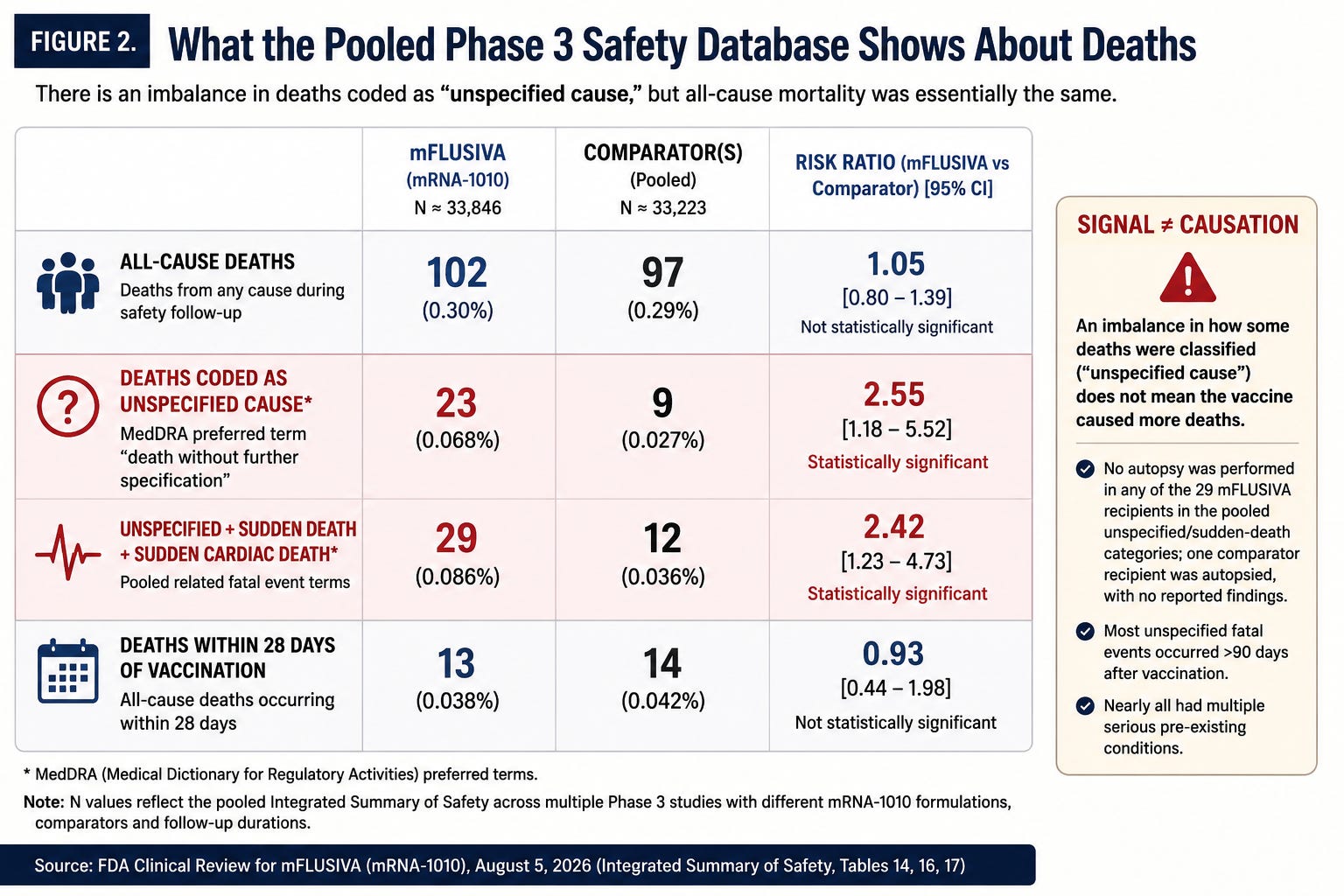
Across the FDA’s pooled Phase 3 safety database, deaths coded under the MedDRA preferred term death without further specification occurred in:
23 mFLUSIVA recipients versus 9 comparator recipients.
When FDA pooled death without further specification, sudden death and sudden cardiac death, the numbers became:
29 versus 12.
That is a genuine numerical imbalance.
The Hulscher paper calculates risk ratios of 2.55 and 2.42 respectively, with confidence intervals excluding 1.
It is reasonable to ask what happened.
FDA asked the same question.
There was another troubling limitation: no autopsy was performed on any of the 29 mRNA-1010 recipients in that pooled unspecified-fatal-event category. One comparator recipient was autopsied, with no reported findings.
That’s a legitimate criticism of the available evidence.
But now look at the rest of the mortality data.
All-cause mortality was 102 versus 97.
Both groups had an overall mortality rate of approximately 0.3%.
Within 28 days of vaccination, deaths were actually 13 versus 14.
And within that shorter window, the pooled unspecified/sudden-death categories were 3 versus 2.
In other words, there was an imbalance in how some deaths were classified, but there was not a corresponding statistically persuasive imbalance in total deaths.
FDA also reported that most unspecified fatal events occurred more than 90 days after vaccination and that nearly all of those patients had multiple serious pre-existing conditions. FDA therefore judged a causal relationship unlikely.
Importantly, FDA did not say the issue was magically resolved.
The agency acknowledged residual uncertainty and required active postmarketing surveillance specifically including deaths.
That’s exactly how this should be described:
A safety signal worth following.
Not:
Two vaccine-caused deaths.
Where the “Two Deaths Per Hospitalization” Number Comes From
This is the most important methodological issue in the entire paper.
The hospitalization number comes from Study P304.
The mortality number comes from the pooled Integrated Summary of Safety across multiple Phase 3 studies.
Those are not the same dataset.
FDA explicitly warns that the pooled safety database contains different mRNA-1010 formulations, different conventional comparators, different follow-up durations and different populations across the contributing studies.
The authors acknowledge the mismatch themselves.
They take the excess rate of unspecified fatal events from the pooled safety database and apply it to the 5,017-person denominator derived from the four-versus-eight hospitalization result in P304.
That produces roughly two excess unspecified deaths per estimated hospitalization prevented.
And then comes a sentence that should accompany every graphic based on this paper:
“This does not establish that mFLUSIVA caused those deaths.”
Exactly.
Yet online, the distinction becomes “2 DEATHS ... required to prevent ONE hospitalization.”
Those aren’t the same claim.
The first describes a cross-dataset numerical comparison involving an unresolved safety signal.
The second sounds like a measured causal tradeoff.
The trial did not demonstrate that tradeoff.
The Paper Actually Has a Stronger Criticism
Ironically, one of the best criticisms in the manuscript needs no dramatic death calculation at all.
For adults 65 and older, the main efficacy trial compared mFLUSIVA against a standard-dose flu vaccine.
But CDC preferentially recommends certain enhanced vaccines for this age group, including high-dose products.
FDA recognized this problem before approval.
In fact, FDA explicitly said that because the standard-dose comparator was not the preferred standard of care for adults 65 and older, P304’s relative-efficacy results were insufficient to serve as the primary basis for approval in that age group.
That’s significant.
And it deserves scrutiny.
FDA’s solution was to split the approval pathway.
Adults 50 through 64 received traditional approval based largely on the clinical efficacy trial. Adults 65 and older received accelerated approval using immunogenicity results from a separate trial directly comparing mRNA-1010 with Fluzone High-Dose, along with supporting efficacy evidence from P304.
There was still uncertainty, particularly around influenza B/Victoria, and FDA said so.
The agency therefore required a large postmarketing randomized trial comparing mFLUSIVA directly with a CDC-preferred vaccine in adults 65 and older.
So the authors are justified in asking whether clinical-outcome evidence against the preferred older-adult comparator should have been available before approval.
That’s a real policy argument.
But saying FDA simply ignored the comparator problem isn’t accurate.
FDA identified the problem, changed the approval pathway because of it, and required another trial.
Whether that was cautious enough is a legitimate debate.
The “Phase 4 Assumes Zero Benefit” Argument Gets the Statistics Wrong
The manuscript makes another dramatic claim about that confirmatory trial.
It says the Phase 4 trial is powered on the assumption that the vaccine’s benefit is zero, and therefore cannot verify benefit.
That sounds devastating until you look at what “zero” means.
The planned study compares mFLUSIVA with a CDC-preferentially recommended active vaccine, not placebo.
FDA’s protocol synopsis says the study assumes a true relative vaccine effectiveness of 0% between the two vaccines for sample-size planning.
A relative efficacy of zero in this context means:
mFLUSIVA performs about as well as the high-dose comparator.
It does not mean:
mFLUSIVA provides zero protection against influenza.
Those are completely different statements.
The trial is designed as a noninferiority trial with a −15% margin, enrolling roughly 800,000 adults over as many as two seasons. Its primary endpoint is laboratory-confirmed medically attended influenza, with hospitalizations among the secondary endpoints.
There are fair questions to ask.
Is a −15% noninferiority margin too generous?
Should hospitalization have been the primary endpoint?
Should superiority rather than noninferiority be demanded for a new platform?
Those are legitimate arguments.
But calling the trial “powered on the assumption that the benefit is zero” without explaining that zero refers to the difference versus another effective influenza vaccine is statistically misleading.
What About the Lack of a Placebo?
The paper repeatedly emphasizes that neither pivotal trial used an unvaccinated saline placebo.
That’s true.
But this needs context too.
mFLUSIVA is entering a market where licensed influenza vaccines already exist. An active comparator directly answers an important clinical question: is the new vaccine better, worse or similar to a vaccine patients would otherwise receive?
FDA’s longstanding seasonal-influenza guidance specifically allows comparison with licensed influenza vaccines and explains that placebo may be inappropriate in populations already recommended to receive influenza vaccination because of increased risk of complications.
The absence of a placebo does create a limitation.
It means these trials cannot tell us the absolute frequency of reactions attributable to any influenza vaccination versus no vaccination.
But it does not invalidate the randomized comparison between mFLUSIVA and existing flu vaccines.
In fact, for the practical question facing a 70-year-old—which flu vaccine should I receive?—an active comparator can be more directly useful than saline.
“They Never Measured Death” Sounds Worse Than It Is
Another repeated argument is that the development program did not measure influenza mortality as an efficacy endpoint.
Correct.
But the FDA-approved indication is prevention of influenza disease, not an independently demonstrated reduction in mortality.
FDA has also long permitted seasonal influenza vaccine approvals using laboratory-confirmed influenza illness and, under accelerated approval, immune-response surrogates such as hemagglutination-inhibition antibodies.
That doesn’t mean mortality is irrelevant.
It means the absence of a statistically powered mortality trial is not the regulatory anomaly the manuscript makes it sound like.
Deaths from influenza are sufficiently uncommon within a clinical trial that demonstrating a mortality difference directly could require an enormous study.
One can argue for stronger prelicensure evidence.
But “the trial didn’t prove fewer deaths” and “the vaccine has no demonstrated clinical benefit” are not interchangeable statements.
Then the Paper Moves Into Molecular Biology
This is where I think the manuscript becomes substantially less convincing.
The first half is primarily an arithmetic reanalysis of FDA data.
The later sections shift into claims about residual plasmid DNA, reverse transcription, genomic integration, ribosomal frameshifting, protein misfolding, “proteostatic collapse,” cancer risk and cumulative genomic damage from annual mRNA vaccination.
The manuscript describes these as established platform liabilities and uses them as additional justification for withdrawing mFLUSIVA.
Follow the references, however, and the level of evidence changes dramatically.
One frequently cited study by Aldén and colleagues did show that Pfizer’s BNT162b2 COVID vaccine RNA could be reverse-transcribed into DNA in a human liver cancer cell line in vitro.
But the researchers themselves explicitly stated that they did not know whether that DNA integrated into the cellular genome and said further research would be required.
Another paper cited in the integration argument, by Zhang and colleagues in PNAS, demonstrated that RNA from SARS-CoV-2 infection could integrate into cultured human cells under experimental conditions involving LINE-1.
That wasn’t a vaccine experiment at all.
There has even been published scientific criticism arguing that some of those reported chimeric sequences could reflect rare technical artifacts.
Then there is the much-discussed Nature paper on N1-methylpseudouridine and ribosomal frameshifting.
That finding is real.
Researchers showed that modified mRNA can produce +1 frameshifted products and that immune responses to those products can occur after BNT162b2 vaccination.
But the same paper explicitly reports no demonstrated adverse outcomes in humans from this mistranslation and shows that sequence optimization can greatly reduce the phenomenon.
That does not establish “proteostatic collapse” from mFLUSIVA.
It certainly doesn’t demonstrate that annual mFLUSIVA vaccination causes cancer.
For human genomic integration, Hulscher, Catanzaro and McCullough lean partly on their own report involving a single 31-year-old woman with advanced bladder cancer. Even that case report explicitly acknowledges that causality cannot be established from one case.
Their separate report of vaccine-material persistence beyond 3.5 years is likewise a case report, not evidence establishing how commonly such persistence occurs in vaccinated populations.
The mFLUSIVA manuscript itself eventually concedes that equivalent persistence and biodistribution studies haven’t been conducted for an mRNA influenza product encoding hemagglutinin.
That’s a large evidentiary gap.
Mechanistic possibilities are legitimate subjects for research.
They are not automatically established clinical harms.
There Is Another Statistical Warning Buried in the Paper
The authors calculate numerous risk ratios across many different adverse-event categories.
They acknowledge that these comparisons are unadjusted.
That matters when many uncommon outcomes are examined.
For example, the pivotal P304 study had serious adverse events in 2.2% of mFLUSIVA recipients versus 1.9% of comparator recipients. That difference deserves attention and the crude risk ratio narrowly excludes 1.
But FDA’s pooled safety assessment across the larger dataset found serious adverse events, deaths and adverse events of special interest generally balanced overall.
None of this means a statistically unusual safety signal should be ignored.
It means isolated findings among many unadjusted comparisons should be treated as signals to investigate, not automatically as demonstrated vaccine effects.
That distinction becomes particularly important when the paper’s stated conclusion is not “more study is warranted,” but withdraw the vaccine from the market.

Here is where the evidence actually leaves us.
mFLUSIVA is more reactogenic than conventional influenza vaccines. That is well demonstrated and patients should know it.
mFLUSIVA was more effective than the standard-dose comparator against laboratory-confirmed influenza illness in the Phase 3 trial. That is also well demonstrated.
The estimate of one hospitalization prevented per 5,017 recipients is mathematically correct but extremely uncertain. It comes from just four versus eight hospitalizations in an exploratory endpoint that FDA explicitly says the trial wasn’t powered to evaluate.
There is a real unexplained-death classification imbalance in the pooled safety database. It should be followed closely, and FDA has required continued active surveillance.
There is not evidence that mFLUSIVA caused two deaths for every hospitalization it prevented. Total mortality was 102 versus 97, early mortality was 13 versus 14, and even the authors explicitly state that their calculation does not establish that the vaccine caused those deaths.
The clinical evidence for adults 65 and older is less complete than it is for adults 50 through 64. FDA recognized that, used accelerated rather than traditional approval, and required a very large randomized postmarketing comparison against a preferred older-adult flu vaccine.
The molecular section of the manuscript goes far beyond mFLUSIVA-specific evidence. In-vitro experiments, infection studies, mechanistic findings and individual case reports are being assembled into claims of cumulative genomic and proteostatic harm that have not been demonstrated for this vaccine.
Those are very different conclusions from the ones suggested by the viral graphic.
So, Is This a Bad Paper?
Not exactly.
Calling it worthless would be as careless as accepting all of its conclusions.
The authors did something useful: they forced attention onto absolute numbers, highlighted mFLUSIVA’s substantially greater reactogenicity, identified genuine limitations in the older-adult evidence and drew attention to an unexplained mortality classification imbalance that FDA itself says remains unresolved.
Those points deserve discussion.
But the manuscript is weakest precisely where its rhetoric is strongest.
The 5,017 number is treated as though it were a stable measurement despite being based on 12 exploratory hospitalization events.
That unstable number is then used as the denominator for enormous-looking harm ratios.
A mortality signal from a heterogeneous pooled safety database is then scaled against that separate hospitalization estimate.
An imbalance in deaths coded as unspecified becomes “approximately two excess deaths.”
And when that reaches social media, the essential qualifier disappears almost completely.
Then a separate collection of mechanistic studies—some in cells, some involving SARS-CoV-2 infection rather than vaccination, and some consisting of individual case reports—is presented as evidence of established genomic and proteostatic hazards from mFLUSIVA itself.
That is too large a leap.
The Question FDA Still Has to Answer
None of this gives FDA a free pass.
The higher reactogenicity is real.
The unexplained-death imbalance is real.
The lack of preapproval clinical-outcome evidence against a preferred high-dose vaccine in adults 65 and older is real.
The uncertainty around some influenza strains is real.
FDA’s approval letter reflects those uncertainties: the agency required a randomized postmarketing trial against a high-dose vaccine and a separate safety study specifically monitoring deaths, myocarditis, pericarditis, myopericarditis and Guillain-Barré syndrome.
Those studies matter.
If subsequent evidence shows a meaningful mortality problem or an unfavorable clinical risk-benefit balance, the conclusion should change with the evidence. Accelerated approval can be withdrawn if confirmatory evidence fails to verify clinical benefit.
But that’s different from declaring today that the clinical trials demonstrated two deaths for every hospitalization prevented.
They didn’t.
And interestingly enough, buried underneath all the graphics and ratios, the authors know that too.
Their own manuscript says so.
The standard shouldn’t change depending on whether a result supports vaccines or attacks them.
Follow the evidence far enough to see what it actually says—and stop where the evidence stops.
If you find this kind of source-by-source audit useful, subscribe, share it, and send the original evidence along with it. Claims this consequential deserve more than a graphic.

Resources
Hulscher, McCullough & Catanzaro — mFLUSIVA reanalysis, Zenodo Version 1 Read the manuscript
FDA — MFLUSIVA Clinical Review, August 5, 2026 Read the FDA clinical review
FDA — MFLUSIVA Approval Letter Read the FDA approval letter
Leroux-Roels et al. — Phase 3 Fluent Trial, New England Journal of Medicine Read the NEJM trial
FDA — Clinical Data Needed to Support Licensure of Seasonal Influenza Vaccines Read the FDA guidance
Mulroney et al. — N1-methylpseudouridylation and ribosomal frameshifting, Nature Read the Nature paper
Aldén et al. — BNT162b2 reverse transcription in a liver cell line Read the study
Zhang et al. — SARS-CoV-2 RNA integration experiments, PNAS Read the PNAS paper