


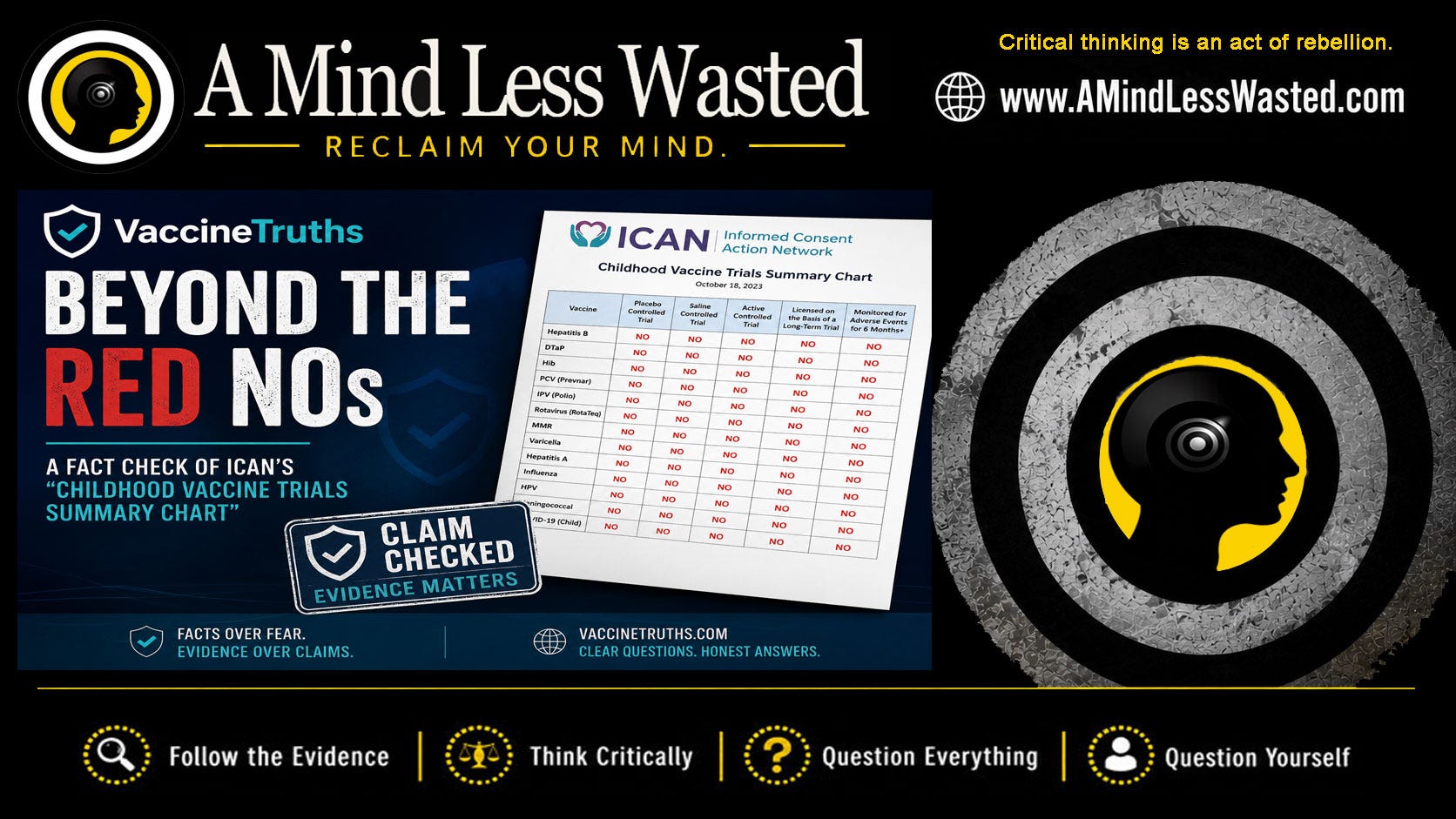
There is a reason this chart keeps circulating. It makes its argument before you have read a single study.
Row after row ends with a bright red NO. Beside those red boxes are safety review periods such as 4 days, 5 days, 30 days, and 42 days.
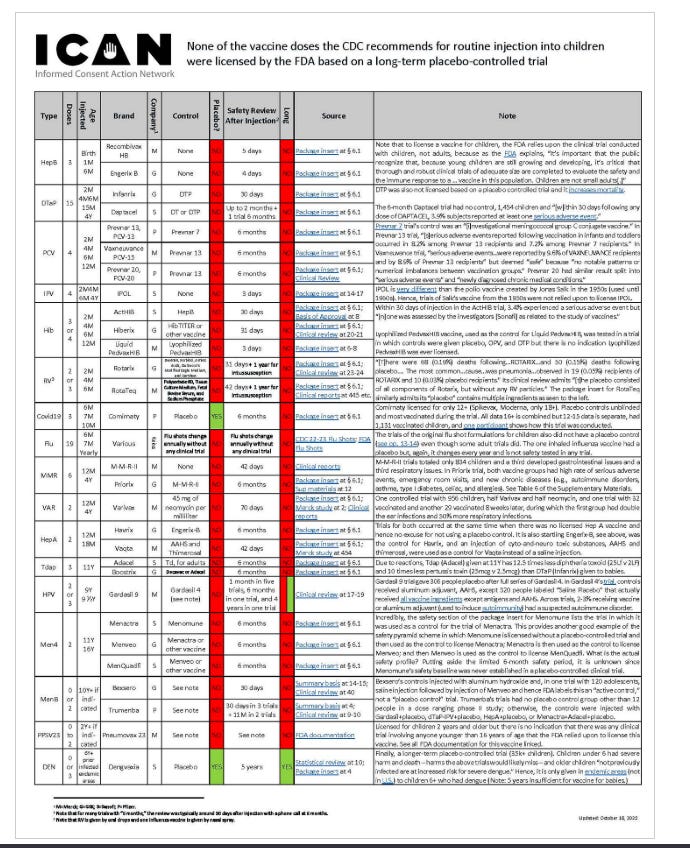
Then comes the claim:
“Not a SINGLE routine injected childhood vaccine was licensed based on a placebo controlled trial.”
Another version adds that most ordinary drugs are licensed after multi-year placebo-controlled trials, while most childhood vaccines receive only days or weeks of safety review.
Put those statements together, and the conclusion seems obvious:
Childhood vaccines were never properly safety tested.
But that is not actually what the chart proves. And this is where the story gets interesting.
The ICAN chart is not simply fabricated. Many of its numbers come from real FDA package inserts and clinical reviews. Some of the limitations it points to are real. Some prelicensure monitoring periods were short. Some currently marketed vaccines were compared with other vaccines rather than an inert saline injection.
That is exactly why this deserves something better than a quick TRUE or FALSE stamp.
The question is not whether the chart contains facts.
It does.
The question is whether those facts support the conclusion people are being encouraged to draw from them.
This article is not arguing that every vaccine trial was ideally designed, that every follow-up period was long enough, or that an inert placebo is never preferable. We are asking a narrower question: Does the evidence in this chart justify the much broader claim that childhood vaccines were never properly safety tested?
Start With the Wording
Read the headline carefully:
“None of the vaccine doses the CDC recommends for routine injection into children were licensed by the FDA based on a long-term placebo-controlled trial.”
There are several important qualifiers packed into that sentence:
routine
injection
licensed based on
long-term
placebo-controlled
Notice that “long-term” is not a self-defining scientific threshold. Does it mean six months? One year? Several years? Before accepting an absolute claim built around that phrase, we should know what duration is being required and why.
Every qualifier narrows the claim.
That matters.
Consider these three statements:
This exact currently marketed vaccine formulation was not licensed based on a long-term trial against an inert saline control.
This vaccine was never tested against a placebo.
Therefore, we do not know whether this vaccine is safe.
They sound related.
They are not equivalent.
The first statement can be true without establishing either of the other two.

A True Fact Can Still Create a False Impression
Critical thinking is not simply determining whether someone quoted a number correctly.
Ask what conclusion the number is being used to support.
A statement can be narrowly true while creating a much broader impression that the evidence does not establish.
That distinction will matter throughout this article.
What Counts as a Placebo?
A lot of this argument revolves around one word.
Placebo.
In online vaccine debates, placebo is frequently treated as another word for saline.
Saline can certainly be used as an inert placebo. But clinical trials are not required to use the same type of control in every situation.
One distinction is important: another vaccine is an active comparator, not a placebo. The point is not that every control should be called a placebo. It is that a randomized controlled trial can use different kinds of control groups, and each design answers a somewhat different question.
FDA regulations recognize several kinds of controlled drug trials, including placebo controls, dose-comparison controls, no-treatment controls, active-treatment controls, and historical controls. The FDA specifically recognizes that different controls may be appropriate in different clinical settings. (U.S. Food and Drug Administration)
FDA’s own description of vaccine development similarly explains that vaccine study control groups may receive an approved vaccine, a placebo or another substance, depending on the trial. Phase 3 trials generally involve thousands of participants and gather both effectiveness and additional safety information. (U.S. Food and Drug Administration)
Why would researchers use an active control instead of saline?
Sometimes the question is whether a new vaccine performs at least as well as an existing vaccine. Sometimes withholding an established preventive intervention would expose participants to avoidable risk.
But there is a limitation here that shouldn’t be brushed aside.
If you want to determine the absolute difference in adverse events between receiving a vaccine and receiving an inert injection, an active comparator cannot answer that question by itself.
That is a legitimate criticism.
What does not follow is that an active-control study provides no useful safety information.
If Vaccine A is compared with Vaccine B, researchers can still determine whether one group experiences substantially more of the measured outcomes than the other.
That is comparative safety information. What it does not establish by itself is the absolute adverse-event rate compared with receiving no vaccine or an inert injection.
Even the word “placebo” does not always mean a solution containing nothing but saline literally. In blinded trials, a placebo may contain inactive formulation ingredients so that it resembles the study product, while an active comparator is a different category altogether because it contains another active intervention.
The better question is not simply:
Was there saline in the other syringe?
It is:
What question was the trial designed to answer, and was the comparator capable of answering it?
We Checked the Red Boxes
Once you leave the graphic and open the underlying records, the picture gets more complicated very quickly.
Hepatitis B: The Short Follow-Up Criticism Is Real
This is one area where critics have a legitimate point.
The Recombivax HB prescribing information says that three clinical studies administered 434 doses to 147 healthy infants and children up to age 10. They were monitored for five days after each dose for the adverse reactions described in that section. (DailyMed)
The Engerix-B label says that 13,495 doses were administered to 5,071 healthy adults and children, including healthy neonates, across 36 studies. Participants were monitored for four days after administration. (DailyMed)
Those really are short monitoring windows. There is no need to pretend otherwise.
Could five days of observation in 147 infants and children, by itself, exclude an adverse event that appears several weeks later?
No.
Could it reliably detect an adverse event occurring once in 50,000 or 100,000 recipients?
Of course not. The sample isn’t remotely large enough. That is a fair limitation of that particular prelicensure safety dataset.
But another mistake occurs when that observation turns into:
“Hepatitis B vaccines were never tested against placebo.”
They were.
A 1984 randomized, double-blind, placebo-controlled trial studied hepatitis B vaccination in high-risk newborns born to mothers who were HBeAg-positive hepatitis B carriers.
Infants were assigned to several vaccine and hepatitis B immunoglobulin regimens or placebo. The first injections were administered within an hour of birth, and comparisons were reported among infants followed during a trial lasting 495 days. (ScienceDirect)
There is an important qualification.
That was an earlier plasma-derived hepatitis B vaccine, not the exact recombinant Recombivax HB or Engerix-B formulations used today.
We shouldn’t erase that distinction. But we shouldn’t erase the trial either. So the accurate version is considerably less dramatic:
The currently used recombinant hepatitis B vaccines were not individually licensed through the type of long-term inert-placebo trial critics argue should have been required. Earlier hepatitis B vaccines were studied in randomized placebo-controlled trials, including in newborns.
Both statements can be true. That is often where critical thinking gets interesting.
“Seven Days of Safety Testing” Can Be Technically True and Deeply Misleading
One of the most persuasive columns in the ICAN chart is labeled Safety Review After Injection.
You see:
4 days
5 days
30 days
42 days
A reasonable reader can come away believing researchers simply stopped looking after that number of days. Sometimes the cited monitoring period really is short, as we just saw with the hepatitis B labels. Other times it represents only one layer of the safety monitoring.
Daptacel
For Daptacel, parents recorded solicited local and systemic adverse events during days 0 through 7.
Stop reading there, and you might reasonably say:
Seven days of safety testing.
Keep reading.
The same prescribing information says investigators made periodic telephone calls to inquire about adverse events and that serious adverse events were monitored through six months after the last dose in the three U.S. studies. (DailyMed)
Seven days was a monitoring period.
It was not the entire safety follow-up.
Prevnar 13
Prevnar 13 makes the problem even clearer.
Parents recorded specified local and systemic reactions for seven days after each vaccination.
Unsolicited adverse events were monitored over longer periods.
Information concerning serious adverse events, newly diagnosed chronic medical conditions, and hospitalizations was collected during later visits and again through a scripted telephone interview six months after the fourth dose. Serious adverse events were collected throughout the study period. (DailyMed)
Reducing all of that to a box that says 7 days changes the impression of what happened.
The number is not necessarily false.
The interpretation is incomplete.
Gardasil 9
FDA’s current Gardasil 9 prescribing information makes the distinction even clearer. Unsolicited systemic adverse reactions were collected during the short post-vaccination window, but serious adverse events were collected throughout the entire study period across seven clinical studies, with follow-up ranging from one month to 48 months after the last dose.
That does not mean every possible adverse event was actively solicited for four years. It does mean that describing Gardasil 9 as having only a few days or weeks of “safety review” leaves out a substantial part of the actual follow-up.

Ask “Days of What?”
Someone tells you:
“This vaccine was safety tested for only seven days.”
Before arguing, ask:
Seven days of what?
Was that seven days of recording fever and injection-site pain?
Seven days for all unsolicited medical events?
Seven days for hospitalizations?
Seven days for serious adverse events?
Seven days of total participant follow-up?
Until you know what the clock was measuring, the number alone doesn’t tell you very much.
Then We Got to Varivax
This is where our audit uncovered something much more interesting.
Look at the Varivax row in the ICAN chart.
The control is described as containing approximately 45 milligrams of neomycin per milliliter.
That number wasn’t invented by ICAN.
It came from the scientific literature. And it sat there for more than forty years.
There was just one problem.
It was wrong.
In December 2025, the New England Journal of Medicine formally corrected its 1984 varicella vaccine study. The original paper said the vaccine contained 45 mg of neomycin per milliliter.
The corrected amount is:
no more than 0.64 micrograms per milliliter.
The journal also corrected the description of the placebo. Rather than containing approximately 45 mg/mL, it consisted of lyophilized stabilizer containing approximately the same trace concentrations of neomycin as the vaccine. (New England Journal of Medicine)
That is not a rounding error.
Forty-five milligrams is roughly 70,000 times 0.64 micrograms.
There is an important fairness point here.
The ICAN chart shown above is dated October 2023.
The NEJM correction was not published until December 2025.
ICAN could not have cited a correction that didn’t exist.
But the graphic continues to circulate today.
And that row is now outdated.
The underlying study is even more interesting.
The 1984 trial was double-blind and placebo-controlled. It enrolled 956 children between ages 1 and 14. Among the 914 confirmed to be susceptible to chickenpox, 468 received vaccine and 446 received placebo.
During nine months of surveillance, 39 clinically diagnosed chickenpox cases occurred.
All 39 were in the placebo group. (New England Journal of Medicine)
The current FDA Varivax insert explicitly says that its protective efficacy was established in part by a placebo-controlled, double-blind clinical trial. (U.S. Food and Drug Administration)
That trial was primarily designed to establish efficacy, not to rule out very rare or long-latency adverse events. Its relevance here is narrower: it shows that a placebo-controlled trial of the varicella vaccine did, in fact, exist.
But here comes another important qualification.
The FDA also says that the placebo trial used an earlier formulation containing 17,000 PFU per dose, rather than the exact current vaccine formulation. (U.S. Food and Drug Administration)
Now compare these two statements:
“The exact current Varivax formulation was not tested in that placebo-controlled trial.”
True.
“There was no placebo-controlled trial of the chickenpox vaccine.”
False.
Same evidence. Very different claim.

Following a Citation Is Not the End of Fact-Checking
A citation can be real and still be outdated. A respected journal can publish an error and correct it decades later. A chart can accurately quote a source and still become wrong when that source changes.
The presence of a citation proves that somebody cited something.
It does not prove the conclusion.
Sometimes #FollowTheEvidence means following the citation one step farther than the person who posted it.
Rotarix Disappears Because of One Word
Consider Rotarix.
The FDA licensing review describes a Phase 3 study that was randomized, double-blind, placebo-controlled, multinational, and involved roughly 60,000 infants.
One of its primary safety objectives specifically evaluated intussusception, a rare but serious bowel complication, during the defined post-vaccination risk period. (U.S. Food and Drug Administration)
That is a very large randomized, placebo-controlled vaccine trial in infants.
But there is an important limitation to what this example proves. It does not settle Siri’s narrower argument about whether a control was completely inert or saline. Its relevance here is simpler: a large randomized, double-blind, placebo-controlled childhood vaccine trial clearly existed.
So why doesn’t it count in the viral claim?
Because you swallow it.
Rotarix is an oral vaccine. It isn’t injected.
That one word, injected, removes a roughly 60,000-infant randomized placebo-controlled trial from the discussion.
This is why qualifiers matter.
The broad social-media claim sounds like:
“Childhood vaccines were never placebo tested.”
The defensible version becomes something closer to:
“The exact currently marketed standalone routine injected childhood vaccines were not licensed based on the particular kind of long-term inert-control trial we are defining as acceptable.”
That is not nearly as memorable.
But it is much closer to the actual argument.
Fluzone Creates Another Problem for the Sweeping Claim
The current Fluzone prescribing information contains another inconvenient example.
A study in children ages 6 through 24 months was randomized, double-blind and placebo-controlled.
There were 786 children in the intent-to-treat population.
525 received Fluzone.
261 received placebo. (DailyMed)
And here the control really was saline.
The label identifies the placebo as 0.4% NaCl. It also reports 12 months of follow-up in the first influenza season and six months in the second. (DailyMed)
That does not mean every annual flu formulation has subsequently undergone a brand-new saline-controlled trial. Influenza strains change, and updated formulations introduce a separate regulatory question.
That does not refute Siri’s narrowly worded claim about what a particular formulation was “licensed based on.” It does refute the much broader claim people routinely take from it: that injected childhood vaccines simply have not been tested against saline controls.
What About “Most Drugs Get Multi-Year Placebo Trials”?
This may be the least examined part of the viral claim.
The post says:
“Most drugs are licensed based on multi year placebo controlled trials.”
That creates a powerful contrast.
Ordinary drugs supposedly face years of placebo testing.
Vaccines supposedly get four days.
Except there is no general FDA rule requiring ordinary drugs to undergo multi-year placebo-controlled trials before approval.
FDA recognizes multiple legitimate study designs, including active-treatment controls. (U.S. Food and Drug Administration)
And it takes very little digging through FDA records to find ordinary drug trials measured in weeks, not years.
Latuda: Its pediatric bipolar depression indication was established in a six-week randomized, double-blind, placebo-controlled study. (FDA Access Data)
Seysara: Its acne program included two 12-week randomized, double-blind, placebo-controlled trials involving about 2,000 participants. (FDA Access Data)
Pristiq: Two pediatric depression trials were randomized, double-blind and placebo-controlled for eight weeks. Longer-term risks were examined separately in six-month open-label extension studies. (FDA Access Data)
Those examples do not prove what “most drugs” receive, and we should not pretend they do. To establish that, we would need a defined sample of drug approvals and a clear rule for what counts as a “multi-year placebo-controlled trial.”
What they do establish is narrower: there is no universal FDA requirement that ordinary drugs undergo multi-year placebo-controlled trials before approval.
So when somebody says:
“Most drugs...”
stop.
Ask for the denominator.
Most of what?
All drugs?
Chronic medications?
Antibiotics?
Cancer treatments?
Psychiatric medications?
Pediatric drugs?
New molecular entities?
Which years?
Which approval pathways?
“Most” sounds statistical.
Without a denominator, it may simply be rhetorical.

Beware of Statistics Without Denominators
“Most.”
“Almost all.”
“None.”
“Not a single one.”
Absolute language should make you more curious, not less.
Ask exactly what was counted and exactly what was excluded.
Now Look at the 1986 vs. 2025 Baby Graphic
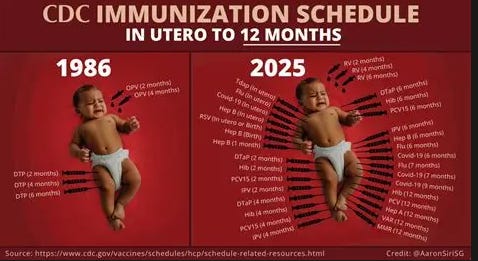
This graphic barely needs words.
On the left, a baby has a handful of arrows. On the right, the baby looks like a dartboard. Its message is emotional and immediate:
Look how much more we’re doing to babies now.
The childhood schedule did expand.
More diseases became vaccine-preventable, and additional products were introduced.
Even the 1986 side was not simply a list of injections. The routine polio vaccine used then was oral poliovirus vaccine (OPV). In September 1986, CDC recommended that MMR, DTP and OPV could be given at the same 15-month visit, with OPV administered by mouth. So an arrow-for-arrow comparison across the two eras is not necessarily an injection-for-injection comparison.
But the graphic isn’t comparing one simple thing.
For starters, the official CDC schedule itself is labeled “Vaccines and Other Immunizing Agents.” (CDC)
That distinction matters.
Rotavirus vaccination is oral.
Nirsevimab, used to prevent severe RSV disease in infants, is a monoclonal antibody, not a vaccine.
Maternal RSV vaccine is administered to the pregnant person, not to the infant.
And maternal RSV vaccination and infant RSV antibody are usually alternatives. CDC says most infants will not need both. (CDC)
Yet a graphic can visually stack them together around one baby.
The arrows make them look equivalent even when they aren’t all vaccines, aren’t all injections into the infant, and aren’t all interventions that the same infant would normally receive.
Then there is the larger question:
What exactly are we trying to measure?
If the claim is about immune-system burden, counting injections is not the same thing as counting antigens.
A review in Pediatrics specifically addressed this question and concluded that children encounter fewer vaccine antigens than children did decades earlier, even while receiving protection against more diseases. (AAP Publications)
That does not prove that every addition to every vaccine schedule is automatically necessary.
It doesn’t need to. It proves something much simpler:
Counting arrows isn’t measuring immune burden. Antigen count is not a complete measure of “immune burden” either. The point is simpler: counting injections alone does not measure it.

Is the Thing Being Counted the Thing That Matters?
You can count: doses, injections, antigens, diseases prevented, hospitalizations, serious adverse events, or deaths.
Those numbers answer different questions.
A dramatic graphic can become persuasive simply by choosing the easiest metric to display.
Before reacting to the number, ask whether it actually measures the concern being raised.
What Placebo Trials Can and Cannot Tell Us
There is nothing irrational about valuing randomized placebo-controlled trials.
They are powerful research tools.
Where scientifically appropriate and ethical, an inert-control trial can help determine whether common outcomes occur more frequently after vaccination than among comparable people who did not receive the vaccine.
But even a perfect saline-controlled trial has a limitation that no amount of saline can solve.
Sample size.
Imagine a serious vaccine reaction really occurs once in every 100,000 doses.
A trial containing 5,000 vaccinated people could easily see zero cases.
A trial containing 20,000 could still see zero.
You cannot reliably detect extremely uncommon events without extremely large populations.
That is why vaccine safety research continues after licensure.
VAERS is one part of that system. CDC explicitly says that a VAERS report alone generally cannot establish that a vaccine caused an event. Its strength is finding unusual patterns or possible safety signals that warrant further investigation. (CDC WONDER)
The Vaccine Safety Datalink serves a different purpose. It uses electronic health records from participating healthcare systems to examine vaccine safety in large populations, including rare and serious adverse events, and can conduct near-real-time comparisons of event rates. (CDC)
Prelicensure trials and post-licensure surveillance do different jobs.
That doesn’t mean post-market monitoring excuses inadequate prelicensure studies.
It also doesn’t mean an RCT with saline eliminates the need for post-market surveillance.
Both ideas can be true at once.
So Is the ICAN Chart False?
I don’t think that is the most useful question. Parts of it are accurate. Some rows identify real limitations.
On Siri’s narrowly worded claim, several of those red NO boxes can be technically correct. What does not follow is the much broader conclusion that the vaccines therefore received no meaningful safety testing or that their risks are unknown.
The hepatitis B labels really do contain short monitoring windows worth questioning. Other rows compress different categories of safety follow-up into one number.
Daptacel, Prevnar 13 and Gardasil 9 show why a short diary period should not automatically be described as the entire duration of safety observation.
Rotarix shows how a massive placebo-controlled infant vaccine trial disappears when the word “injected” is added.
Fluzone shows that saline-controlled pediatric vaccine trials unquestionably exist.
Varivax shows how someone can truthfully say that the current formulation did not undergo the earlier placebo trial while leaving readers with the false impression that no placebo-controlled chickenpox vaccine trial ever occurred.
And Varivax gives us something else.
One of the numbers in the circulating ICAN chart is now outdated because the scientific paper it relied on was formally corrected after the chart was produced.
This is not a story about ICAN inventing everything.
It is more interesting than that.
It is a story about using real information to build a much larger narrative.
And those are not the same thing.
That does not refute Siri's narrowly worded claim about what a particular formulation was “licensed based on.” It does refute the broader claim people routinely take from it: that injected childhood vaccines simply haven't been tested against saline controls.

Separate the Data From the Story
The data says:
“The comparator was another vaccine.”
The story becomes:
“There was no meaningful safety testing.”
The data says:
“Solicited reactions were recorded for seven days.”
The story becomes:
“Researchers only watched the children for seven days.”
The data says:
“The exact current formulation was not licensed using an inert placebo trial.”
The story becomes:
“Vaccines have never been placebo tested.”
Critical thinking lives in the space between those sentences.
How to Read a Chart Like This
Don’t dismiss it because you dislike ICAN.
Don’t accept it because the footnotes link to the FDA.
Take one row and follow it.
Find out what the comparator actually was.
Find out whether the study was randomized.
Find out whether it was blinded.
Find out how many participants were involved.
Find out what the short monitoring period actually measured.
Find out how long serious adverse events were collected.
Find out whether earlier formulations had placebo-controlled evidence.
Find out whether later studies found anything different.
Find out what happened when hundreds of thousands or millions of people received the vaccine.
And when the chart gives you a bright red NO, ask one final question:
Exactly how narrowly did the question have to be written to make “NO” the answer?
The Bottom Line
The strongest defensible version of the vaccine placebo argument is considerably narrower than the version that goes viral.
It is fair to say that many currently marketed routine childhood vaccines were not individually licensed after multi-year trials against completely inert saline controls.
It is fair to question whether some prelicensure safety datasets were large enough or followed subjects long enough.
The hepatitis B labeling provides a legitimate example.
It is fair to ask whether an active comparator is capable of answering the particular safety question you care about.
And it is fair to prefer an inert placebo when one is scientifically appropriate and ethically acceptable.
What the evidence does not support is the much broader leap to:
“Childhood vaccines were never placebo-tested.”
“Vaccines were only tested for four or five days.”
“Therefore nobody knows their risks.”
The evidence base is more complicated than a column of red NO boxes. Placebo-controlled childhood vaccine trials exist, including large infant trials and some saline-controlled studies. Other vaccines were studied against active comparators, and different safety outcomes were often followed for different lengths of time.
None of that proves every trial was ideal. It does show why “not licensed on the basis of a long-term inert-placebo trial” is not the same claim as “never properly safety tested.”
You don’t have to trust ICAN.
You don’t have to blindly trust the FDA.
You have to read past the red box.
If you found this useful, subscribe to A Mind Less Wasted.
No talking points. No team jerseys. Just the evidence, the sources, and the uncomfortable questions that deserve better answers.
And if you know someone who would appreciate that approach, share this article with them.

Resources
The Original Claim
Informed Consent Action Network (ICAN), “Childhood Vaccine Trials Summary Chart,” October 18, 2023. The original chart examined in this article. ICAN Childhood Vaccine Trials Summary Chart
FDA Standards and Vaccine Development
U.S. Food and Drug Administration, “Vaccine Development – 101.” FDA overview of vaccine clinical development, control groups, Phase 1–3 testing, licensing, and post-approval safety surveillance. FDA Vaccine Development – 101
U.S. Food and Drug Administration, 21 CFR §314.126, “Adequate and Well-Controlled Studies.” Describes acceptable controlled-study designs, including placebo, active-treatment, dose-comparison, no-treatment, and historical controls. FDA §314.126
Hepatitis B
RECOMBIVAX HB Prescribing Information. Includes the prelicensure dataset of 434 doses given to 147 infants and children who were monitored for five days after each dose. RECOMBIVAX HB – DailyMed
ENGERIX-B Prescribing Information. Reports 13,495 doses administered to 5,071 adults, children, and neonates, with participants monitored for four days after administration. ENGERIX-B – DailyMed
Wong VC et al., The Lancet, 1984. “Prevention of the HBsAg Carrier State in Newborn Infants…” Double-blind randomized placebo-controlled study in high-risk newborns of HBeAg-carrier mothers. PMID 6143868; DOI 10.1016/S0140-6736(84)92388-2. PubMed record
DTaP and Pneumococcal Vaccines
DAPTACEL Prescribing Information. Solicited reactions were recorded for seven days; serious adverse events were monitored through six months after the final dose in the U.S. studies. DAPTACEL – DailyMed
PREVNAR 13 Prescribing Information. Documents seven-day solicited-reaction monitoring while serious adverse events were collected throughout the infant and toddler study periods, including six-month follow-up after the final dose. PREVNAR 13 – DailyMed
HPV
FDA, GARDASIL 9 Prescribing Information. Serious adverse events were collected throughout seven clinical studies, with follow-up ranging from one to 48 months after the final dose. FDA GARDASIL 9 Prescribing Information
Varicella
Weibel RE et al., New England Journal of Medicine, 1984. “Live Attenuated Varicella Virus Vaccine — Efficacy Trial in Healthy Children.” The original randomized, double-blind, placebo-controlled varicella vaccine trial. DOI 10.1056/NEJM198405313102201. PubMed record
New England Journal of Medicine, 2025 correction to the 1984 varicella trial. Corrects the neomycin concentration from 45 mg/mL to no more than 0.64 µg/mL and corrects the description of the placebo. DOI 10.1056/NEJMx250021. NEJM correction
FDA, VARIVAX Prescribing Information. States that protective efficacy was established in part through a placebo-controlled, double-blind trial while noting that the trial used an earlier 17,000-PFU formulation rather than the current vaccine formulation. FDA VARIVAX Prescribing Information
Rotavirus and Influenza
FDA, Statistical Review and Evaluation — ROTARIX. Describes the Phase 3 randomized, double-blind, placebo-controlled multinational trial involving approximately 60,000 infants, including its primary intussusception safety objective. FDA ROTARIX Statistical Review
Fluzone Quadrivalent Prescribing Information. Includes the randomized, double-blind pediatric placebo trial in children 6–24 months old; the study used a 0.4% NaCl placebo and followed influenza outcomes for 12 months in the first season and six months in the second. Fluzone Quadrivalent – DailyMed
The 1986 vs. 2025 Schedule
CDC, “New Recommended Schedule for Active Immunization of Normal Infants and Children,” September 19, 1986. Contemporary CDC document showing use of oral poliovirus vaccine and recommending simultaneous MMR, DTP, and OPV administration at 15 months. CDC 1986 MMWR
CDC, Recommended Child and Adolescent Immunization Schedule, United States, 2025. Archived 2025 schedule covering vaccines and other immunizing agents. CDC 2025 Childhood Schedule
CDC, RSV Immunization Guidance for Infants and Young Children. Explains that infant RSV monoclonal antibodies are not vaccines and that most infants do not need both maternal RSV vaccination and an infant RSV antibody. CDC RSV Guidance
Offit PA et al., Pediatrics, 2002. “Addressing Parents’ Concerns: Do Multiple Vaccines Overwhelm or Weaken the Infant’s Immune System?” Reviews antigen exposure and notes that children can receive protection against more diseases while encountering fewer vaccine antigens than in earlier eras. Pediatrics article
The “Most Drugs” Comparison
FDA Pediatric Labeling Database — LATUDA. Pediatric bipolar depression was studied in a six-week randomized, double-blind, placebo-controlled trial. FDA LATUDA Pediatric Labeling Record
FDA Pediatric Labeling Database — SEYSARA. Safety and effectiveness were established in two 12-week multicenter randomized, double-blind, placebo-controlled trials involving 2,002 patients. FDA SEYSARA Pediatric Labeling Record
FDA Pediatric Labeling Database — PRISTIQ. Documents two eight-week randomized, double-blind, placebo-controlled pediatric trials and separate six-month open-label extensions for longer-term assessment. FDA PRISTIQ Pediatric Labeling Record
Post-Licensure Safety Surveillance
CDC, Vaccine Adverse Event Reporting System (VAERS). Explains the role and limitations of VAERS, including why a report alone cannot establish that a vaccine caused an adverse event. CDC VAERS
CDC, Vaccine Safety Datalink (VSD). Describes the use of electronic health records to study vaccine safety in large populations and investigate rare and serious adverse events. CDC Vaccine Safety Datalink