


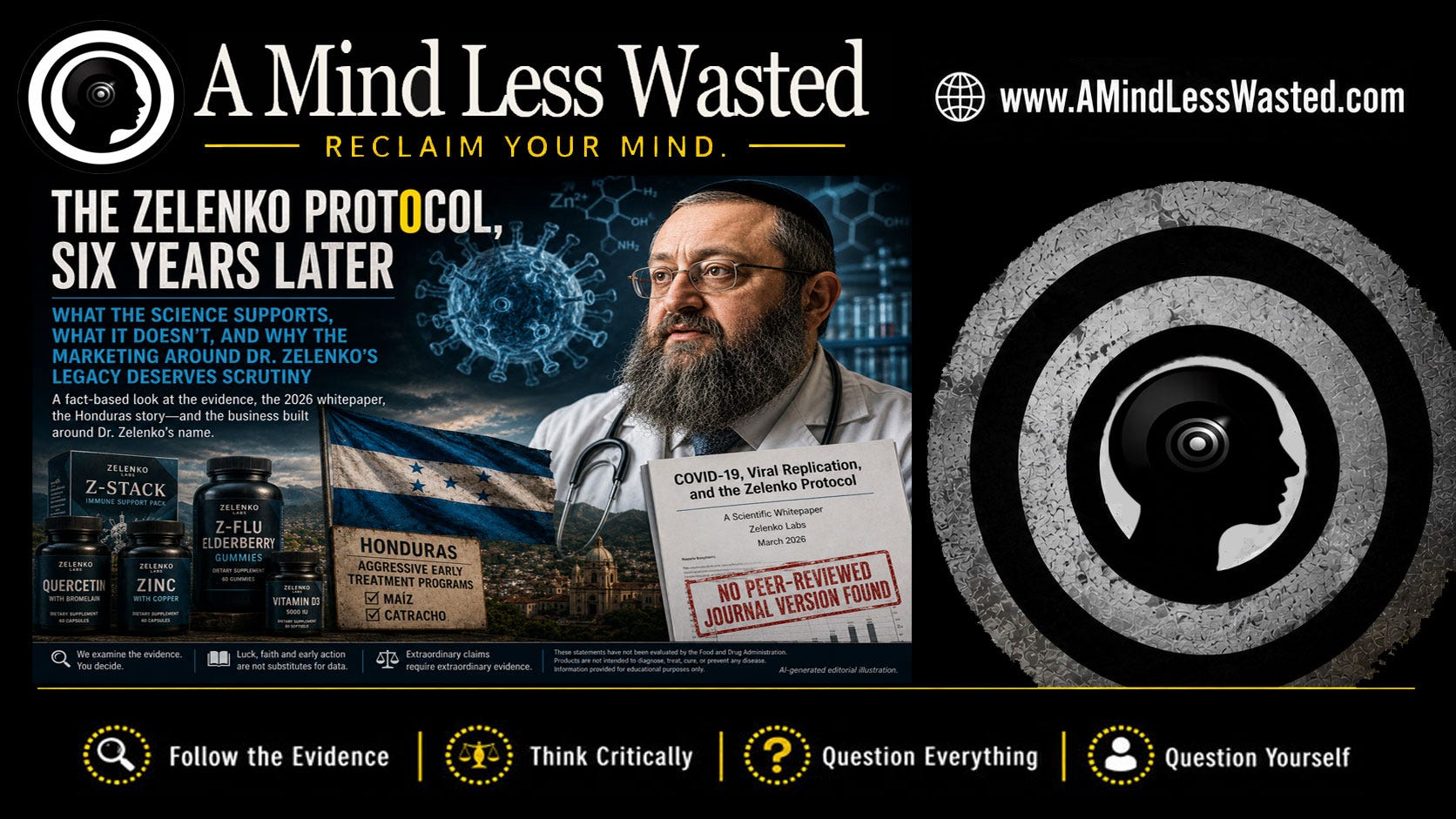
There is an easy way to write about Dr. Vladimir Zelenko.
Pick a side.
Either portray him as the courageous doctor who discovered a cheap COVID treatment that the medical establishment refused to acknowledge, or dismiss him as a physician who became convinced of something the evidence ultimately failed to support.
Neither version tells the whole story.
March 2020 was different from August 2026. COVID was new. Doctors had sick patients in front of them. There were no proven outpatient antivirals. Hospitals were filling, clinical guidance was changing rapidly, and physicians were trying to figure out what might keep people from getting worse.
Zelenko was a family doctor trying to keep his patients out of the hospital.
I have no reason to doubt that he believed deeply in what he was doing.
But sincerity and scientific validity are different questions.
Six years later, we don’t have to judge the Zelenko Protocol only by what was known in March 2020. We now have randomized trials, systematic reviews, additional laboratory research and years of clinical experience.
That later evidence matters.
Which brings us to a new document published by Zelenko Labs in March 2026: COVID-19, Viral Replication, and the Zelenko Protocol.
The paper presents a scientific explanation for the protocol centered largely on zinc, zinc ionophores and viral replication. It describes itself as a Zelenko Labs scientific whitepaper prepared for educational and research purposes.
But there is something immediately striking about its bibliography.
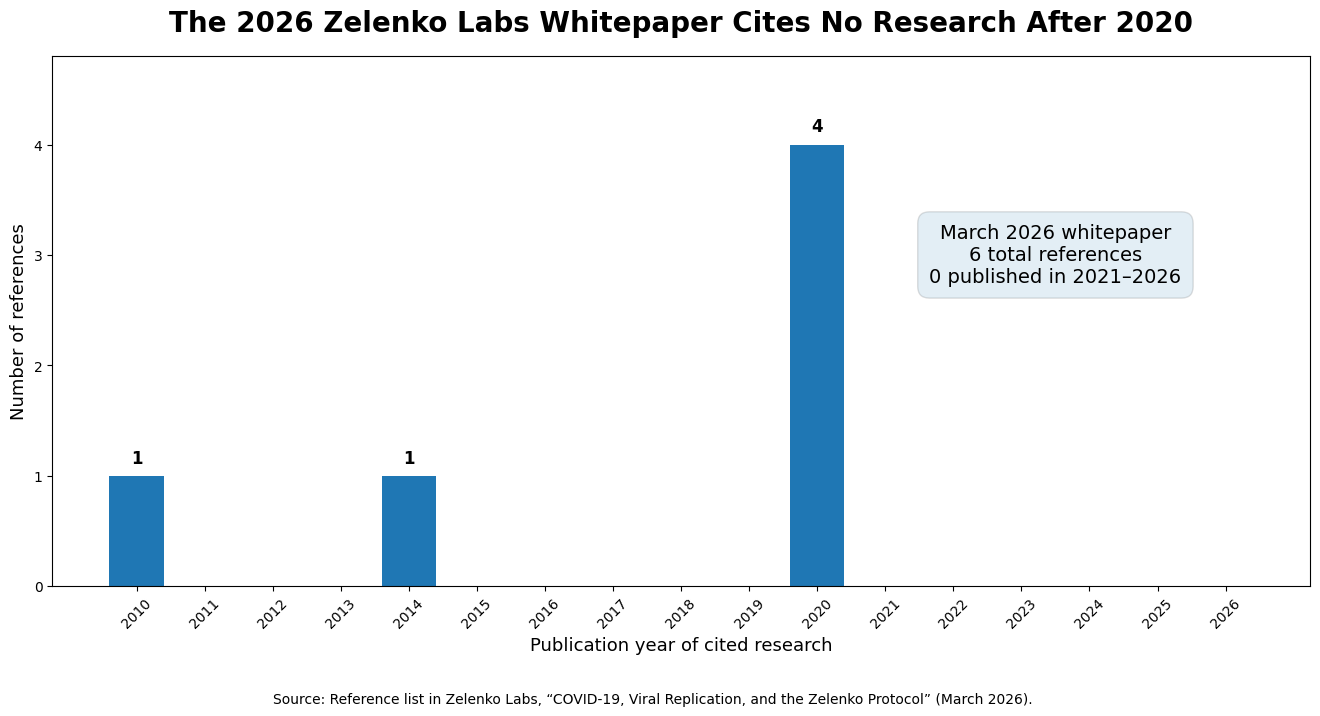
It contains six references.
The newest is from 2020.
A scientific defense of a controversial COVID treatment published in 2026 stops citing evidence at almost exactly the point when the large body of subsequent clinical evidence begins.
That deserves a closer look.
Start with what Zelenko got right
The biological idea behind the original protocol wasn’t invented out of nowhere.
Zelenko focused initially on hydroxychloroquine, zinc and azithromycin. One part of his reasoning was that zinc might interfere with coronavirus replication inside infected cells, while another substance could help increase intracellular zinc.
There was legitimate laboratory science behind the first part of that hypothesis.
In 2010, Aartjan te Velthuis and colleagues reported that zinc ions could inhibit the RNA-dependent RNA polymerase, or RdRp, used by SARS coronavirus. In cell culture, increasing intracellular zinc with an ionophore also interfered with viral replication.
That is a real and interesting finding.
But the details matter.
The virus was SARS-CoV, not SARS-CoV-2.
The ionophore used in the viral cell-culture experiment was pyrithione, not hydroxychloroquine.
And this was laboratory research, not a trial showing that zinc plus an ionophore treated coronavirus disease in human patients.
Yet a 2026 Zelenko Labs essay describing how the protocol was born says Zelenko found a 2010 paper showing that zinc ionophores “like hydroxychloroquine,” taken with zinc, were effective at treating coronavirus.
That goes beyond what the study showed.
The study supplied a good reason to investigate the idea.
It didn’t establish the treatment.
That distinction matters throughout this story.
From a promising idea to certainty
Frank Zelenko’s account of the protocol’s beginnings gives us a revealing picture of how his brother became convinced.
Patients were being treated.
His office followed up with them.
Many were recovering.
Frank describes calling elderly and vulnerable patients who were alive, well and back to their lives.
It is easy to understand why that would have been persuasive in March 2020.
The problem is that recovery after treatment does not tell us whether recovery happened because of treatment.
If 97 out of 100 treated patients recover, the result sounds extraordinary. But if 96 comparable untreated patients would also have recovered, the treatment contributed very little.
Without a comparison group, we don’t know.
That is why controlled trials exist.
Frank’s account says that once Zelenko became convinced he had found the treatment for COVID, he was not going to wait for blinded clinical studies.
Given the emergency confronting doctors in early 2020, trying a treatment on the basis of incomplete evidence is understandable.
But there is a difference between saying:
The evidence isn’t complete, but I believe the potential benefit outweighs the risk.
and saying:
I have established that this treatment works.
The first is a medical judgment made under uncertainty.
The second requires evidence showing that treated patients do better than comparable patients who don’t receive the treatment.
That evidence eventually arrived.
There actually was peer review
This part needs to be stated accurately.
It would be wrong to say that the Zelenko treatment approach was never examined in peer-reviewed literature.
In 2020, Roland Derwand, Martin Scholz, and Vladimir Zelenko published a retrospective outpatient study in the International Journal of Antimicrobial Agents.
The study reported outcomes for 141 patients treated with zinc, low-dose hydroxychloroquine and azithromycin and compared them with 377 untreated patients drawn from public community data.
Hospitalization occurred in 2.8% of the treated patients compared with 15.4% in the comparison population.
Deaths were 0.7% versus 3.4%. That mortality difference was not statistically significant.
Those results were worth investigating.
But the study wasn’t randomized.
The treated patients were selected according to Zelenko’s own risk-stratification criteria, while the comparison group came from public data. That makes it difficult to know how comparable the two groups really were or how much of the apparent difference was caused by treatment.
Peer review means that a journal subjected a paper to outside scientific review before publication.
It does not convert an observational study into a randomized controlled trial.
The appropriate conclusion from the 2020 study was that there was an interesting signal worth testing more rigorously.
And then it was.
The controlled studies eventually arrived
Hydroxychloroquine was studied extensively.
One objection often raised is that the drug failed only because researchers waited until patients were severely ill.
That isn’t the whole story.
A randomized double-blind trial enrolled 491 symptomatic nonhospitalized adults with confirmed or probable early COVID. Of those, 423 contributed primary-endpoint data. Hydroxychloroquine did not substantially reduce symptom severity compared with placebo.
Researchers also tested hydroxychloroquine as prevention.
In a randomized post-exposure prophylaxis trial involving 821 participants after moderate- or high-risk exposure, hydroxychloroquine did not significantly prevent COVID-compatible illness compared with placebo. Side effects were more common in the hydroxychloroquine group.
In Brazil, 667 hospitalized patients with mild-to-moderate disease were randomized to hydroxychloroquine, hydroxychloroquine plus azithromycin, or standard care. The primary modified intention-to-treat analysis included 504 patients with confirmed COVID. Neither hydroxychloroquine regimen improved clinical status at 15 days. QT prolongation and liver-enzyme abnormalities occurred more often in patients receiving hydroxychloroquine.
These were not the only studies.
By April 2025, the World Health Organization said its recommendation against hydroxychloroquine for treatment rested on 30 trials involving more than 10,000 COVID patients. Its prevention recommendation drew on six trials involving more than 6,000 participants.
That doesn’t prove that every possible combination, timing and dose could never produce any effect.
But it makes the claim that hydroxychloroquine is an established treatment for COVID very difficult to defend.
There is also a problem with the zinc-ionophore explanation
A central part of the Zelenko story is that hydroxychloroquine carries zinc across cellular membranes.
Later laboratory work challenged that explanation directly.
In 2022, researchers tested hydroxychloroquine’s interaction with zinc using chemical-binding experiments, artificial membranes and A549 human lung epithelial cells.
They found that hydroxychloroquine did not behave as a direct zinc ionophore.
The researchers did observe changes in intracellular zinc associated with hydroxychloroquine, so this doesn’t mean the drug has no effect whatsoever on zinc handling inside cells.
But the simple “HCQ carries zinc through the membrane” explanation did not hold up under direct testing.
That is especially relevant because the March 2026 Zelenko Labs whitepaper continues to describe hydroxychloroquine as one of the zinc ionophore options.
A review written in 2026 should address the later evidence.
This one doesn’t.
Zinc itself is more interesting
None of this means zinc is biologically irrelevant.
It isn’t.
Zinc is essential for normal immune function, and laboratory research showing that zinc can interfere with viral replication deserves attention.
Quercetin and EGCG have also demonstrated zinc-ionophore activity experimentally. The Zelenko Labs whitepaper cites the 2014 work of Dabbagh-Bazarbachi and colleagues showing this activity in cells and artificial membranes.
But again, the question changes once we leave the laboratory.
Can swallowing zinc and quercetin or EGCG reliably produce enough free intracellular zinc in infected human respiratory cells to inhibit viral replication?
At what dose?
For how long?
With what clinical effect?
And with what risks?
Those questions require human evidence.
Clinical studies of zinc have produced mixed results. Quercetin has produced some encouraging but still limited evidence. Vitamin D has remained an active area of study, particularly in people who are deficient.
That makes these legitimate areas for research.
It doesn’t prove the complete Zelenko Protocol.
The protocol eventually became much broader
The historical protocol currently presented by the Zelenko Protocol Educational Center contains considerably more than zinc and hydroxychloroquine.
For higher-risk patients it lists zinc, vitamin C, high-dose vitamin D, azithromycin or doxycycline, hydroxychloroquine and/or ivermectin.
Additional options include dexamethasone or prednisone, inhaled budesonide, anticoagulants, colchicine, monoclonal antibodies, oxygen and IV fluids.
That leads to an important point:
Some treatments associated with the broader protocol really did turn out to be useful.
Dexamethasone became an important treatment for patients with severe or critical COVID who required oxygen.
But timing matters. Corticosteroids were not beneficial as a blanket early treatment for otherwise stable patients and could be harmful when used at the wrong stage.
Inhaled budesonide produced a more modest signal. In the open-label PRINCIPLE trial, higher-risk community patients who received budesonide reported recovery roughly three days sooner. The hospitalization/death result did not meet the trial’s prespecified threshold for superiority.
Oxygen is obviously appropriate when a patient’s oxygen level is dangerously low.
Anticoagulation has legitimate roles in certain hospitalized patients.
Some monoclonal antibodies were genuinely effective against susceptible SARS-CoV-2 variants until newer variants escaped them.
Other treatments fared considerably worse. Larger and better randomized trials substantially weakened the case for ivermectin as a COVID treatment.
So the record isn’t:
Everything associated with Zelenko failed.
It didn’t.
But neither can we say:
Some components worked, therefore the Zelenko Protocol worked.
A treatment has to be judged according to the patient, dose, timing and outcome for which it was tested.
Then we get to the 2026 whitepaper
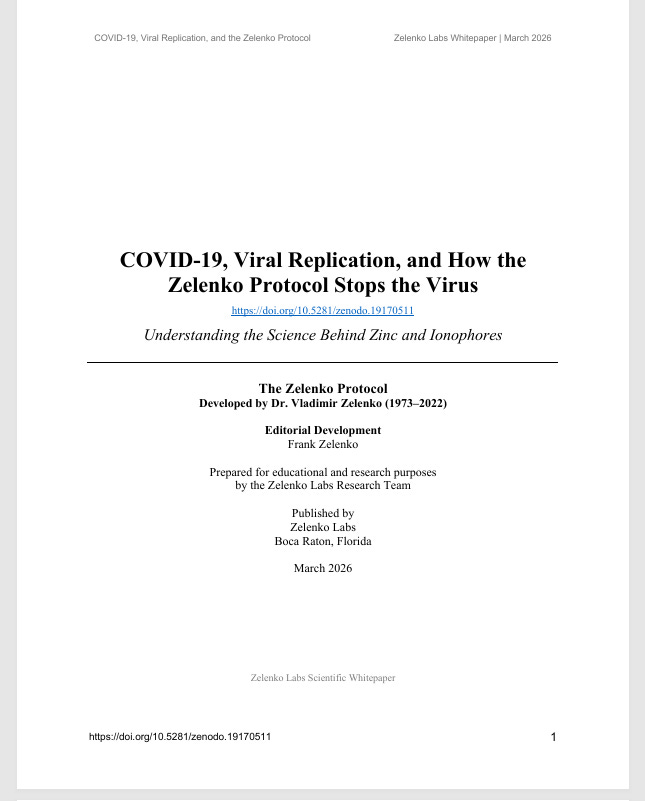
The new paper defines the “Zelenko Protocol” differently from the sprawling historical treatment regimen.
It says that for purposes of the paper, the term refers primarily to the strategy of increasing intracellular zinc through a zinc ionophore rather than to one fixed medication regimen.
That is the authors’ right.
But it also has an effect.
It centers the discussion on one of the most scientifically interesting parts of the story—the zinc mechanism—while much of the later clinical evidence surrounding hydroxychloroquine, ivermectin, azithromycin and other components largely disappears.
Then there is that reference list.
Six papers.
The publication years are:
2010
2020
2020
2020
2020
2014
Nothing from 2021.
Nothing from 2022.
Nothing from 2023.
Nothing from 2024.
Nothing from 2025.
Nothing from 2026.
That isn’t a minor omission.
Those missing years contain precisely the evidence needed to evaluate whether the early hypothesis survived clinical testing.
What about peer review?
The March 2026 PDF displays the identifier 10.5281/zenodo.19170511.
However, I was unable to independently verify a live Zenodo record for that identifier, and the Zelenko Protocol Educational Center currently lists the whitepaper’s DOI as “Pending Registration.”
That discrepancy may have a simple explanation. But until it is clarified, the safest thing is to report exactly what is visible rather than assume the status of the DOI.
More important is the peer-review question.
I can find no evidence that this March 2026 Zelenko Labs whitepaper has been published in a peer-reviewed journal, and I found no peer-reviewed journal version under its title.
That does not mean nobody has ever read or informally reviewed it.
It means I can find no conventional journal peer review of the document.
And that matters because the whitepaper makes strong claims.
For example, it says the protocol “works” for prevention and treatment and describes intracellular zinc as stopping viral replication.
A formal review would almost certainly have to deal with some obvious questions:
Why does a 2026 literature review end in 2020?
Why isn’t the 2022 research challenging hydroxychloroquine’s direct zinc-ionophore mechanism discussed?
Where are the randomized outpatient hydroxychloroquine studies?
Where are the prophylaxis trials?
Where are the later ivermectin trials?
What evidence shows that the proposed oral doses create antiviral concentrations of intracellular zinc in infected human respiratory tissue?
And most importantly:
Where is the controlled clinical evidence showing that this mechanism produces the claimed patient benefit?
Those questions remain unanswered in the whitepaper.
From advising Honduras to “saving” Honduras
Another Zelenko Labs essay is titled:
“When Dr. Zelenko Saved Honduras.”
Frank Zelenko describes how his brother made contact with Honduran officials and says President Juan Orlando Hernández arranged for him to train more than 1,000 Honduran physicians.
There may well be an important historical story there.
Honduras did pursue aggressive early multidrug treatment.
But contemporary Honduran sources describe the country’s national programs, known as MAÍZ and CATRACHO, as protocols developed by Honduran physicians, including Miguel Sierra-Hoffman, Omar Videa and colleagues.
MAÍZ included Microdacyn, azithromycin, ivermectin and zinc.
That was not Zelenko’s original hydroxychloroquine, azithromycin and zinc regimen.
An analysis of Honduras later found that implementation of its multidrug programs was associated with declining case-fatality rates.
But an association across an entire country cannot tell us that the medications caused the decline.
Testing changed. Medical capacity changed. Who was being diagnosed changed. The epidemic changed.
A review in the Revista Médica Hondureña concluded that the MAÍZ regimen lacked sufficient evidence demonstrating effectiveness and called for clinical trials.
That doesn’t mean Zelenko played no role.
He may have influenced Honduran officials or physicians.
But there is a large evidentiary gap between:
Dr. Zelenko advised people involved in Honduras’s early-treatment effort.
and:
Dr. Zelenko saved Honduras.
The second makes a causal claim the available evidence cannot establish.
The marketing angle cannot simply be ignored
Selling supplements doesn’t invalidate someone’s science.
A physician can develop a product.
A researcher can own a company.
A company can fund scientific work.
None of those things automatically means the research is wrong or the people involved are dishonest.
But commercial context matters.
And Zelenko Labs does not keep the medical claims, the stories about Zelenko’s legacy and sales of Zelenko-branded supplements in separate worlds.
Consider the article Five Times Dr Zelenko Was Right.
It opens by telling readers that virtually every conspiracy theory from the pandemic has now become fact.
It presents five Zelenko claims as capital-T “TRUTH.”
Those include claims involving COVID vaccine lots, Bill Gates, vaccine injury, masks and influenza vaccination.
The article then tells readers that these truths helped motivate Zelenko to create an over-the-counter supplement line.
From there, it moves into elderberry, promotes Z-Flu Elderberry Gummies, describes purported health benefits and advertises its extract as having four times greater bioavailability than competing formulas.
The article eventually tells readers to stock up on Z-Stack and Z-Flu, promotes free shipping and offers a discount for new customers.
Then, at the bottom, comes the disclaimer:
The claims have not been evaluated by the FDA, and the products are not intended to diagnose, treat, cure or prevent disease.
That sequence deserves attention.
Not because it proves fraud.
It doesn’t.
But the reader is being asked to move through a very specific story:
Zelenko was right.
The establishment was wrong.
His understanding of viruses was vindicated.
His formulations were based on that understanding.
And here are the products carrying his name.
When medical authority and scientific certainty help sell a product, the evidence supporting those claims deserves especially careful scrutiny.
CHECKPOINT: What do we actually know?
This is where it helps to separate what the evidence supports from what people may believe about it.
The zinc/RdRp hypothesis had a legitimate experimental basis.
Zelenko had reasonable grounds to investigate it in the extraordinary uncertainty of early 2020.
His initial outpatient results were interesting enough to publish and study further.
His 2020 observational study was peer-reviewed. But it wasn’t randomized and couldn’t establish that the treatment caused the better outcomes that were observed.
Subsequent randomized hydroxychloroquine trials, including early outpatient and prophylaxis studies, failed to show the clinical benefit predicted by the original theory.
Later laboratory research also challenged the simple claim that hydroxychloroquine directly carries zinc through cell membranes.
Some treatments that later became part of broader Zelenko-style regimens proved useful for particular patients at particular stages of disease. Others did not.
Zinc and compounds such as quercetin remain scientifically interesting. That is not the same thing as having established the complete protocol.
The March 2026 Zelenko Labs whitepaper has not been shown to have undergone conventional journal peer review, and I can find no peer-reviewed journal version of it.
Its six references end in 2020.
Zelenko Labs also sells branded supplements, and some of its medical and historical articles lead directly into promotion of those products.
None of that tells us what Vladimir Zelenko privately intended.
It does tell us to keep five things separate:
belief, hypothesis, observational evidence, demonstrated clinical effect and marketing.
They aren’t interchangeable.
The question isn’t whether Zelenko was a good man
Criticism of a medical claim does not require criticism of the physician’s character.
Zelenko died in 2022.
The 2026 whitepaper, the current website, the recent Honduras story and today’s supplement marketing are being produced by people carrying his work forward.
That distinction matters.
Maybe Zelenko sincerely believed he had discovered something extraordinary.
The accounts from his brother certainly suggest that he did.
Maybe he would have disputed the interpretation of the later trials.
We can’t ask him.
But we can examine the evidence that exists now.
Science doesn’t freeze at the moment somebody becomes convinced.
A hypothesis becomes stronger when it survives serious attempts to prove it wrong.
A treatment becomes credible when properly designed studies show that patients receiving it do better than comparable patients who don’t.
And when later evidence changes the picture, the conclusion should change with it.
Six years later
My problem isn’t that Zelenko looked for an early treatment. Doctors should look for treatments.
My problem isn’t zinc. Zinc biology is worth studying.
My problem isn’t even that Zelenko became convinced before randomized trials were available. March 2020 forced doctors to make decisions under extraordinary uncertainty.
My problem is what happened after the evidence changed.
There was a plausible idea.
There were encouraging patient stories.
There was an observational study suggesting benefit.
Then came controlled trials.
More laboratory research.
Systematic reviews.
Updated clinical recommendations.
Six years later, Zelenko Labs published a new scientific whitepaper.
And its references stop in 2020.
At the same time, the website preserving and promoting Zelenko’s legacy sells supplements based in part on the health philosophy associated with his name.
While that does not prove a sinister motive, it does leave us with a question worth asking:
Are we being shown the current scientific case for the Zelenko Protocol, or are we being shown the version of the story that best preserves the Zelenko legacy and the products built around it?
Perhaps there is some of both.
Dr. Zelenko deserved to have his hypothesis tested. It was.
People who continue to believe in his work deserve to see the results of those tests too.
If a scientific case for the Zelenko Protocol is going to be made in 2026, then it should use the evidence available in 2026.
Positive evidence. Negative evidence. Evidence that complicates the story.
Anything less isn’t following the evidence.
It’s stopping where you liked what the evidence was saying.
If you found this article useful, please subscribe so you don’t miss the next one.
And if you know someone who would appreciate a careful look at the evidence instead of another round of slogans, share it with them.
The more people who read the sources for themselves, the better.

Selected research and resources
Zelenko Labs. COVID-19, Viral Replication, and the Zelenko Protocol. March 2026. The paper identifies itself as a Zelenko Labs scientific whitepaper, and its bibliography contains six references ranging from 2010 through 2020.
te Velthuis AJW, van den Worm SHE, Sims AC, Baric RS, Snijder EJ, van Hemert MJ. “Zn²⁺ Inhibits Coronavirus and Arterivirus RNA Polymerase Activity In Vitro and Zinc Ionophores Block the Replication of These Viruses in Cell Culture.” PLOS Pathogens. 2010;6(11):e1001176. DOI: 10.1371/journal.ppat.1001176.
Derwand R, Scholz M, Zelenko V. “COVID-19 outpatients: early risk-stratified treatment with zinc plus low-dose hydroxychloroquine and azithromycin: a retrospective case series study.” International Journal of Antimicrobial Agents. 2020;56(6):106214. DOI: 10.1016/j.ijantimicag.2020.106214.
Skipper CP, Pastick KA, Engen NW, et al. “Hydroxychloroquine in Nonhospitalized Adults With Early COVID-19.” Annals of Internal Medicine. 2020.
Boulware DR, Pullen MF, Bangdiwala AS, et al. “A Randomized Trial of Hydroxychloroquine as Postexposure Prophylaxis for Covid-19.” New England Journal of Medicine. 2020.
Cavalcanti AB, Zampieri FG, Rosa RG, et al. “Hydroxychloroquine with or without Azithromycin in Mild-to-Moderate Covid-19.” New England Journal of Medicine. 2020.
Kavanagh O, Marie Healy A, Dayton F, Robinson S, O’Reilly NJ. “Hydroxychloroquine Does Not Function as a Direct Zinc Ionophore.” Pharmaceutics. 2022.
Dabbagh-Bazarbachi H, Clergeaud G, Quesada IM, et al. “Zinc ionophore activity of quercetin and epigallocatechin-gallate: from Hepa 1-6 cells to a liposome model.” Journal of Agricultural and Food Chemistry. 2014;62(32):8085–8093. DOI: 10.1021/jf5014633.
World Health Organization. Hydroxychloroquine evidence and recommendations for COVID-19 treatment and prevention, updated April 2025.
World Health Organization/BMJ living guideline. Therapeutics and COVID-19, including updated recommendations concerning ivermectin and corticosteroids.
PRINCIPLE Collaborative Group. Randomized evaluation of inhaled budesonide for higher-risk community patients with COVID-19. The Lancet. 2021.
Revista Médica Hondureña. Review of the Honduran MAÍZ COVID-19 regimen and the need for clinical evidence.
Zelenko Labs. How The Zelenko Protocol Was Born. Primary source for the account of how Zelenko developed and interpreted his early treatment experience.
Zelenko Labs. When Dr. Zelenko Saved Honduras. Primary source for claims concerning Zelenko’s role in Honduras.
Zelenko Labs. Five Times Dr Zelenko Was Right. Primary source for the current combination of Zelenko legacy claims, health claims and branded supplement promotion.