

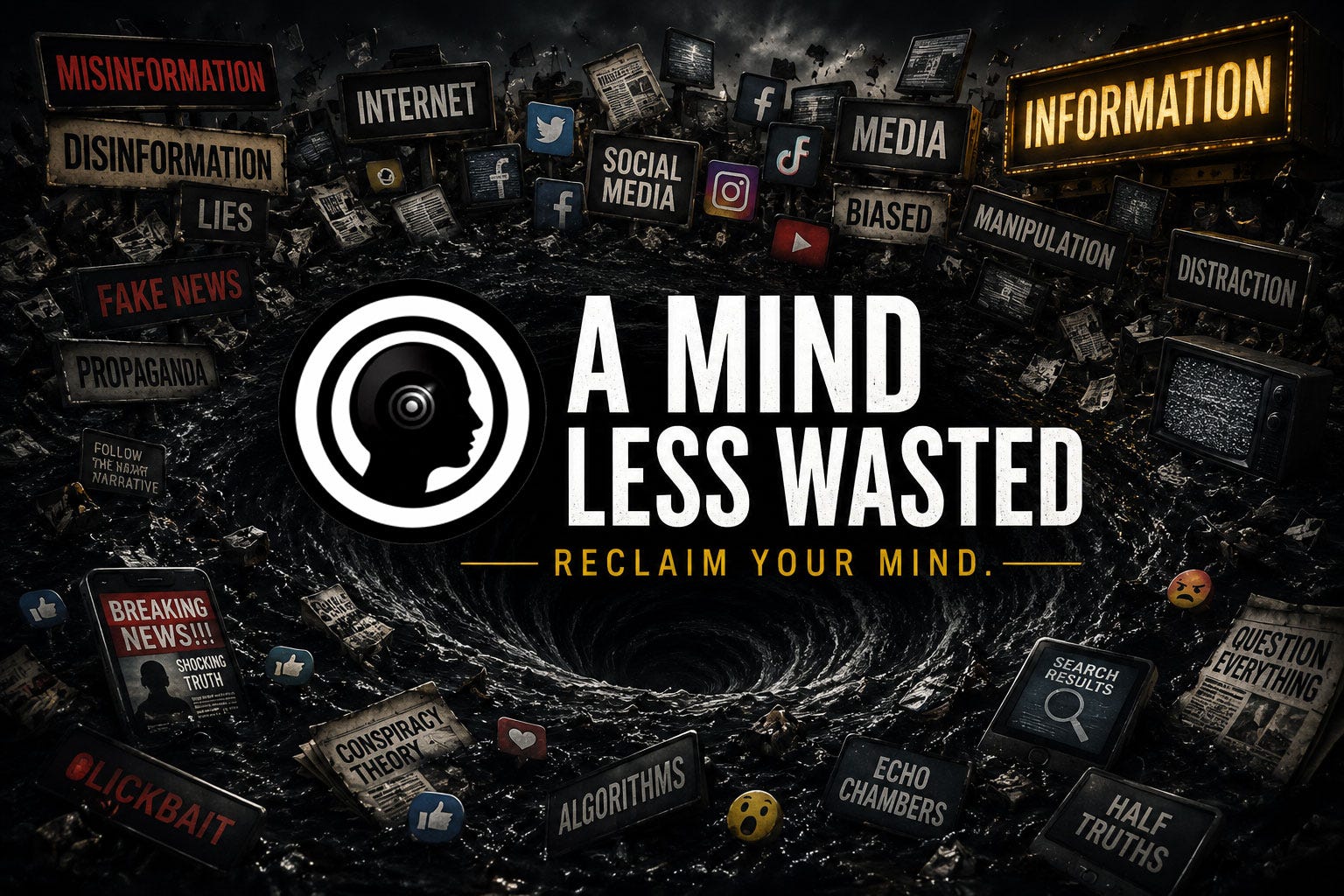
Spend enough time on social media, and it can seem as though critical thinking has become a lost art.
I don’t believe it has. I think most of us are capable of thinking carefully, questioning our assumptions, and changing our minds when the evidence demands it.
We simply don’t always do it.
We become angry. We treat disagreement as hostility. We form conclusions from emotion, tribal loyalty, headlines, and repetition rather than evidence. Opponents become enemies, and curiosity gives way to certainty.
But that can change.
A Mind Less Wasted exists to cut through the noise, examine claims carefully, and encourage evidence-based thinking without surrendering curiosity, skepticism, or civility.

Who am I?
I am Vincent Mercer.
I am not a physician, psychologist, scientist, or epidemiologist. I am not a spokesperson for the pharmaceutical industry, nor am I reflexively opposed to it. I am not interested in defending a political party, institution, movement, or predetermined narrative.
The argument should stand or fall on the quality of its evidence, not on the credentials, popularity, political identity, or social status of the person presenting it.
What you can expect
This publication isn’t about proving one side right and the other wrong.
It’s about asking better questions, reading sources, separating facts from assumptions, and being willing to change our minds when the evidence warrants it.
You’ll find fact-checks, long-form investigations, scientific analysis, media criticism, and discussions about how to think more critically in an age of information overload.
Some articles may confirm popular beliefs. Others may challenge them. My only commitment is to follow the evidence wherever it leads.
What will we explore?
This publication will examine claims circulating through social media, journalism, politics, medicine, science, and popular culture.
Some articles will fact-check specific assertions. Others will explore flawed reasoning, misleading statistics, media narratives, scientific studies, or the psychology behind why intelligent people can reach weak conclusions.
I will not pretend to possess expertise I do not have. I will rely on original documents, credible sources, peer-reviewed research, and qualified specialists whenever possible. I will distinguish facts from interpretation and speculation.
Most importantly, I will remain willing to correct myself.
Following the evidence wherever it leads matters more than defending something I previously wrote.
Free speech and accountability
I strongly support freedom of expression. That includes the freedom to question powerful institutions, challenge prevailing views, and criticize the claims made by governments, corporations, scientists, journalists, activists, and independent commentators.
But freedom of speech does not make every claim accurate or place it beyond criticism.
People are free to speak. Others are equally free to examine the evidence, identify errors, and hold public claims accountable—especially when misinformation may cause harm.
Join the conversation
You will not agree with everything published here.
You are not expected to.
Disagreement is welcome. Questions are encouraged. Corrections supported by evidence are appreciated.
What I ask in return is civility, intellectual honesty, and a willingness to apply the same standards of evidence to the claims you agree with as you apply to the claims you oppose.
The goal is not to win every argument.
The goal is to think more clearly.
Subscribe and join me as we question assumptions, challenge narratives, follow the evidence, and reclaim our minds.
I’ll meet you on the field.