

A baby can stare at a ceiling fan for six uninterrupted minutes, ignore an expensive educational toy, and then laugh so hard at a fake sneeze that the entire family gathers around hoping for an encore.
So what, exactly, is going on in there?
It is tempting to imagine one of two extremes. Either the baby is a tiny philosopher silently contemplating existence, or there is not much happening until words arrive and turn on the lights.
The evidence supports neither.
The honest answer is that we cannot know what a baby’s private experience feels like. Babies cannot describe it, and no brain scan prints out a thought bubble. What researchers can do is observe what infants remember, what surprises them, what they anticipate, where they look, and how their behavior changes with experience.
That evidence points to a busy mind. Before babies can talk, they can learn patterns, remember events, pursue goals, form expectations about objects and people, understand some words, and notice when an adult is behaving in a delightfully ridiculous way.
Their thoughts may not arrive as sentences. That does not mean their minds are empty.
Thinking is older than talking
Adults often confuse thought with inner speech because so much of our own thinking sounds verbal. We rehearse conversations, argue with ourselves in the shower, and come up with the perfect comeback about three hours too late.
But even adult thought is not entirely made of words. We recognize a familiar face before naming the person. We picture a route, feel that something is off, predict where a moving object will land, or reach to catch a falling glass before putting any of it into words.
Babies think in many of these nonverbal ways too. Their experience is likely built from perception, emotion, bodily sensation, memory, recognition, anticipation, and action. A hungry baby does not need the sentence, “I would like to discuss the disappointing pace of today’s milk service.” The discomfort, the expectation of relief, and the effort to summon a caregiver are already meaningful.
We should also be careful with the phrase “before language.” Babies often understand some words long before they can say them. In one study, researchers found that infants between 6 and 9 months old looked toward the correct picture after hearing familiar words for foods and body parts.
They could not say “banana,” but the word was not meaningless to them. Other experiments have found that 8 month olds can track patterns in streams of syllables, one of the abilities that may help them discover where words begin and end.
So the period before speech is not a silent waiting room. Language is already moving in, even if it has not unpacked all its boxes.
How do you interview someone who eats the questionnaire?
Studying infant thought requires some ingenuity. Researchers cannot ask a 6-month-old whether an event violated the laws of physics. The baby is unlikely to answer, and may attempt to digest the consent form.
Instead, scientists use indirect measures. One common method is to show infants an event repeatedly until it becomes familiar, then change something. If babies look longer at the new or seemingly impossible event, researchers infer that it did not match what they expected.
In classic object-permanence experiments, young infants watched objects move behind screens. They looked longer when an object appeared to vanish, pass through a barrier, or emerge where it should not have been. Other studies found that by about 6 months, infants paid attention to the goal of a person’s reach, not merely to the path taken by the hand.
Learning can also be measured through action. In the mobile-conjugate reinforcement task, a ribbon connects an infant’s leg to a crib mobile. The baby kicks, the mobile moves, and before long the baby increases the kicking. Cause and effect has been discovered. The infant is now, briefly, chief executive officer of ceiling decorations.
None of these methods gives researchers a literal transcript of a baby’s thoughts. Longer looking can have more than one explanation, and scientists still debate how much knowledge particular experiments reveal. That limitation matters.
Evidence of an expectation is not proof that the baby holds an adult-like theory about it.
Still, the combined findings are difficult to square with the idea of a passive mind waiting for vocabulary to begin.
A baby’s world is full of predictions
Much of early thought may be less like a narrated story and more like a continuous stream of predictions:
This face usually appears when I hear that voice.
This object should still be behind the blanket.
When I kick, the mobile moves.
When I drop the spoon, someone picks it up.
That last experiment is often repeated at home until the adult researcher withdraws funding.
Predictions give the world structure. A baby learns the rhythm of feeding, bathing, being lifted, hearing footsteps, and seeing a familiar person return. Each repetition creates an expectation. Expectations make surprise possible, and surprise is one of the raw materials of humor.
Why is peekaboo funny?
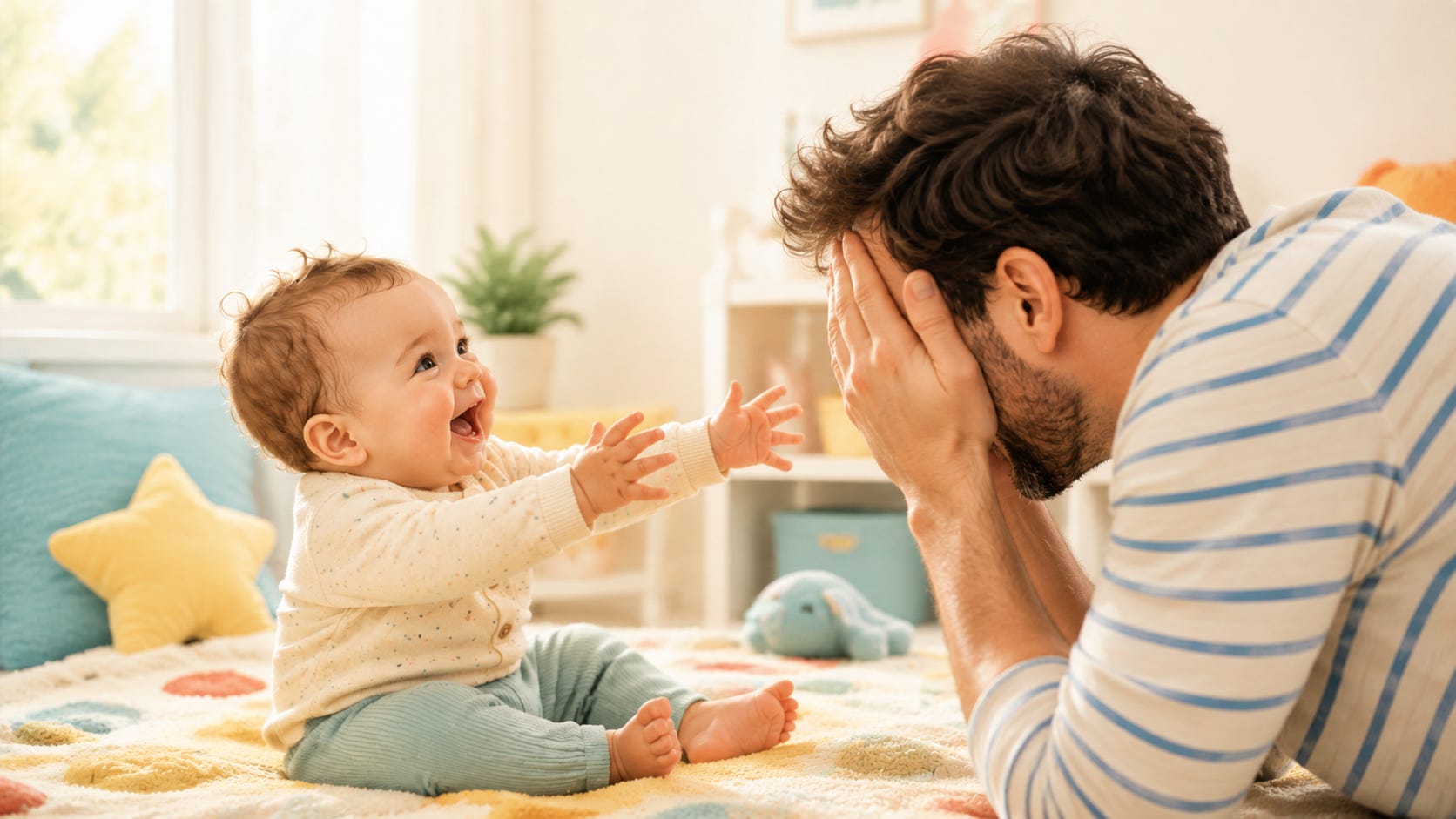
Peekaboo is often explained as a simple lesson in object permanence. The adult disappears, the baby briefly believes the adult no longer exists, and the returning face is astonishing.
That explanation is probably too simple. Research suggests that infants form some expectations about hidden objects quite early. Peekaboo also contains anticipation, timing, repetition, eye contact, a familiar partner, and a surprise that is safely resolved.
After a few rounds, the baby is not merely waiting to see whether you still exist. The baby knows the performance. The covered face is the setup. The pause creates tension. The return is the punch line.
Peekaboo may be the first sitcom. It has a predictable plot, a beloved recurring character, and the same joke can run for twelve seasons without anyone complaining that the writers have run out of ideas.
Funny begins with something being safely wrong
Much humor depends on a broken expectation that does not feel dangerous. A shoe belongs on a foot. A cup is for drinking. A person’s face does not normally make that noise. Once a child knows the ordinary pattern, violating it can become funny.
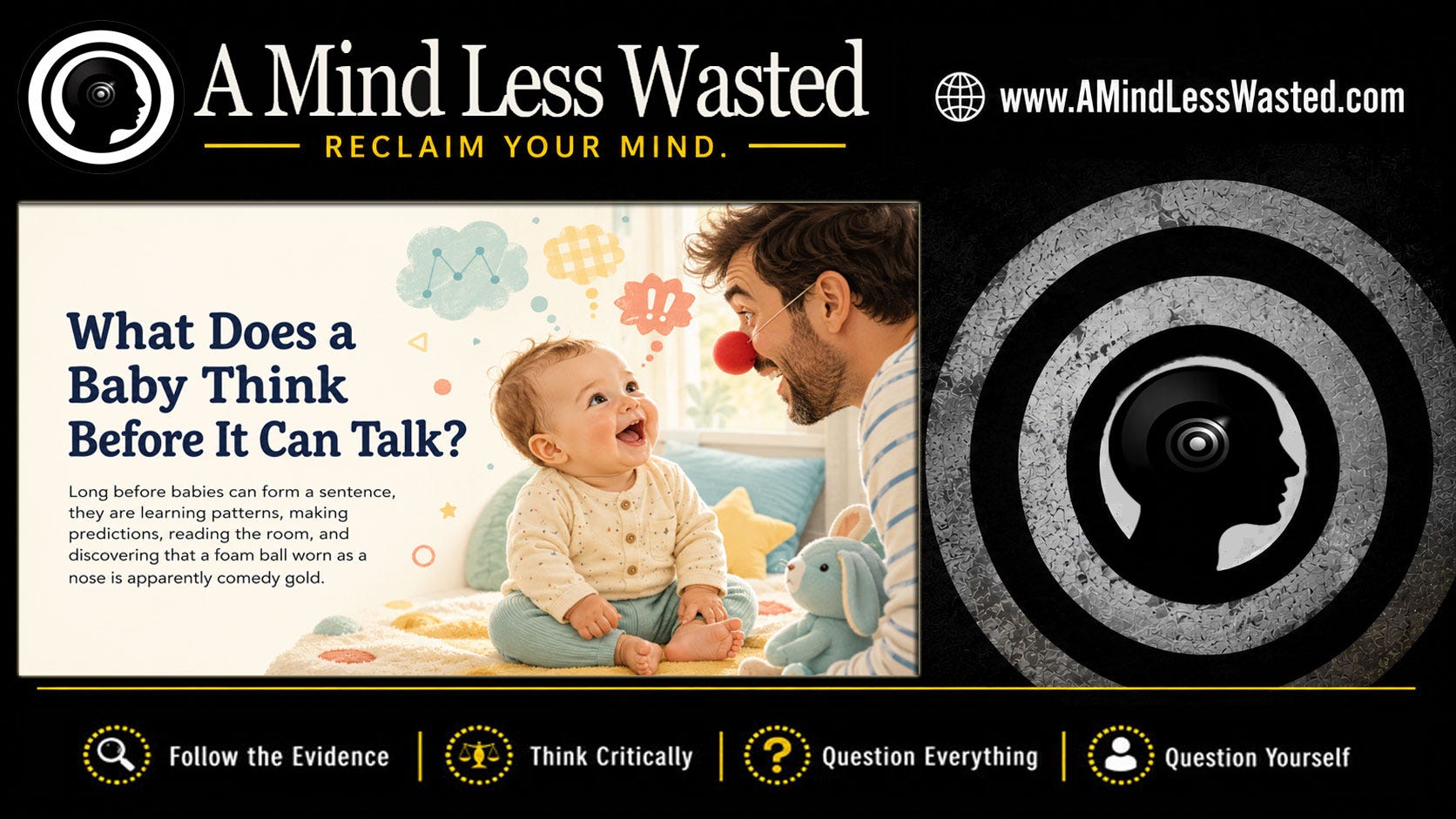
Researchers studying infant humor have used exactly this kind of absurdity. In one series of experiments, an adult first handled a red foam ball normally, then wore it as a nose while making a silly sound. Babies reacted differently to the ordinary and absurd versions.
In a study following infants from 5 to 7 months, parents alternated between laughing at an absurd event and watching it with a neutral expression. The babies sometimes smiled at the absurdity even without parental laughter, which suggests that they were not simply copying the adult. But the parents’ laughter affected how quickly, how often, or how long the babies smiled, with the influence becoming clearer by 7 months.
The adult’s reaction provides useful information: Yes, this is strange. No, the family has not been placed in immediate danger by the foam nose. We are doing this on purpose, and it is safe to enjoy.
That is an early version of “reading the room,” a skill some adults continue developing for several decades.
Laughter is social information
A baby’s laughter does more than announce pleasure. It helps coordinate attention and emotion between people. The baby looks at the parent, the parent laughs, the baby laughs harder, and both know they are sharing the same moment.
Infants also seem sensitive to what other people’s laughter tells them. In two experiments, 5-month-olds distinguished between co-laughter shared by friends and co-laughter shared by strangers. They were not following a clever anecdote. They were picking up clues about affiliation from the sound of people laughing together.
This helps explain why an absurd face produced by a familiar adult may be hilarious while the same face in a frightening setting may not be. Surprise alone is not enough. Context tells the baby whether the unexpected event is playful, confusing, or threatening.
Humor, even at this early stage, is a group project.
Then the baby becomes the comedian
At some point, babies stop being only the audience.
Observational research describes infants in the second half of their first year repeating odd faces, noises, or actions that previously made someone laugh. They may watch the adult’s reaction, repeat the performance, or tease by offering an object and pulling it away just as someone reaches for it.
The baby has discovered audience feedback.
This does not mean a 9-month-old is developing a tight five minutes for the local comedy club. It does suggest an impressive combination of memory, social awareness, timing, and intention. The infant remembers what produced laughter, recognizes another person as an audience, and tries the act again.
In other words, babies may begin doing crowd work before they can say “crowd.”
Do babies think in pictures?
“Pictures instead of words” sounds plausible, but it is probably too neat. A baby’s mind is not necessarily a silent movie playing behind the eyes. Thought can include sound patterns, touch, movement, emotion, spatial relationships, familiarity, and expectations that may not resemble either a picture or a sentence.
We should also be careful not to project a fully formed adult mind onto an infant. A baby who expects a hidden toy to remain in place does not necessarily understand object permanence as an abstract principle. A baby who laughs at a sock on someone’s head has not written a theory of incongruity.
The safest conclusion is narrower and more interesting. Babies build mental representations of the world before they can explain any of them. They learn what usually happens, notice when something changes, and use other people’s reactions to help interpret the change.
That is enough to support memory, expectation, recognition, goal-directed behavior, and the earliest forms of humor.
The thought inside the laugh
We may never know exactly what it feels like to inhabit a mind before speech. The best we can do is design careful experiments and watch where thought leaks out through gaze, movement, anticipation, smiles, and laughter.
When a baby laughs at a spoon balanced on your head, the response may contain more understanding than it appears to. Spoons have a usual place. Heads have a usual lack of spoons.
You broke the pattern, made it clear that everyone was safe, and invited the baby to share the joke.
That little laugh tells us something important: the baby already knows enough about how the world normally works to enjoy watching it go slightly wrong.
And somewhere in the performance, the baby learns one more rule about adults.
If you laugh once, they will do the same ridiculous thing at least fourteen more times.
As if we need even more reasons to love them.
If you enjoyed this lighter visit to the science of how minds work, subscribe to A Mind Less Wasted. We usually spend more time examining dubious claims than explaining why a foam ball on someone’s nose can bring down the house. Both are really questions about the same thing: How do we know what we think we know?

Resources
Elika Bergelson and Daniel Swingley, “At 6–9 months, human infants know the meanings of many common nouns”, Proceedings of the National Academy of Sciences, 2012.
Jenny R. Saffran, Richard N. Aslin, and Elissa L. Newport, “Statistical learning by 8-month-old infants”, Science, 1996.
Renée Baillargeon and Julie DeVos, “Object permanence in young infants: Further evidence”, Child Development, 1991.
Emily C. Merz and colleagues, “The mobile conjugate reinforcement paradigm in a lab setting”, Developmental Psychobiology, 2017.
Gina C. Mireault and colleagues, “Laughing Matters: Infant Humor in the Context of Parental Affect”, Journal of Experimental Child Psychology, 2015.
Athena Vouloumanos and Gregory A. Bryant, “Five-month-old infants detect affiliation in colaughter”, Scientific Reports, 2019.
Vasudevi Reddy and Gina Mireault, “Teasing and clowning in infancy”, Current Biology, 2015.