

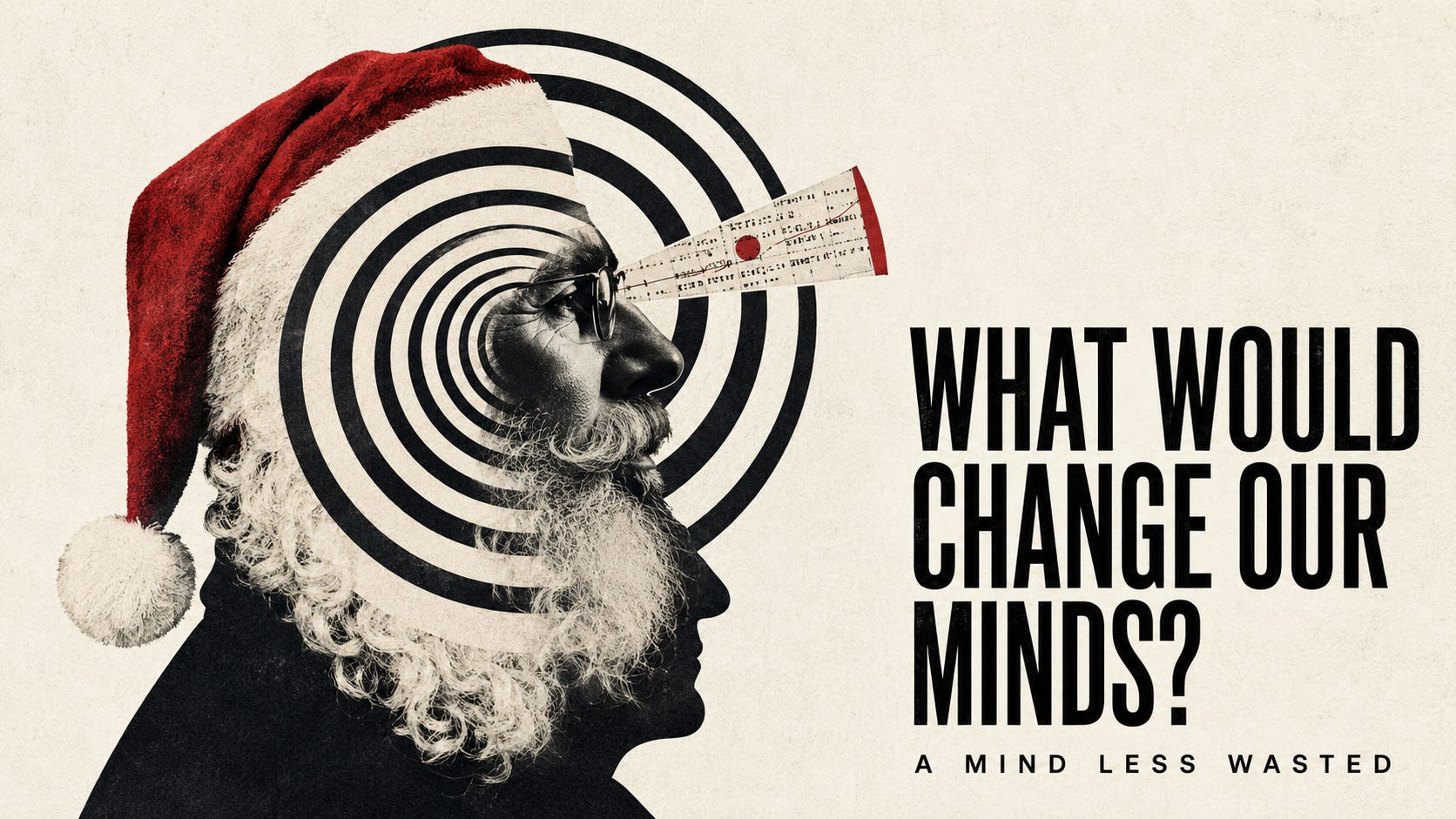
I used to believe in Santa Claus.
Eventually, the evidence became difficult to ignore, although the handwriting on the gift tags should have tipped me off sooner.
Changing my mind was relatively painless. I had not spent years defending Santa on social media. My political identity was not tied to the North Pole. I did not have friends, followers, or a reputation invested in his continued existence.
The beliefs we form as adults can be much harder to reconsider. Not necessarily because the evidence supporting them is stronger, but because changing our minds may cost us something: certainty, pride, belonging, or the uncomfortable admission that we were wrong.
I am no exception.
I have accepted evidence too readily when it supported something I already believed. I have examined contradictory evidence more critically, noticed its weaknesses more quickly, and expected it to clear a higher bar.
I certainly have not caught myself every time. Recognizing our own bias is part of the difficulty.
But I have experienced it, and I have no reason to believe I am less susceptible than anyone else.
We See Bias More Clearly in Others
Most of us want to believe we are open-minded. We also tend to notice closed-mindedness more readily when it belongs to someone else.
Biased reasoning is easy to recognize when another person ignores inconvenient evidence, accepts a weak argument, or moves the goalposts. It is considerably harder to recognize when we are doing it ourselves. From the inside, biased reasoning rarely feels biased. It usually feels like reasoning.
Recognizing biased reasoning does not tell us whether a conclusion is true or false. We can reach a correct conclusion for poor reasons, just as careful reasoning can still lead us into error. Bias concerns how we evaluate the evidence, not a verdict on the conclusion itself.
Psychologists call this the bias blind spot: our tendency to recognize the influence of bias more readily in others than in ourselves.
That does not mean we are dishonest or uniquely irrational. None of us approaches evidence as a perfectly neutral observer. We interpret new information through what we already believe, what we have experienced, whom we trust, and sometimes who we believe ourselves to be.
Researchers have studied these tendencies under several overlapping names: confirmation bias, biased assimilation, selective exposure, and motivated skepticism. The details differ, but the general pattern is familiar. We are often more receptive to information that fits our existing beliefs and more demanding of information that threatens them.
A meta-analysis of selective-exposure research found a moderate preference for information supporting existing views. Other experiments have found that unwelcome conclusions prompt more scrutiny, doubt, counterarguments, and searches for alternative explanations.
No group has a monopoly on this vulnerability.
In one study involving 3,899 participants, people with both favorable and unfavorable views of vaccination were more likely to evaluate a fictional trial incorrectly when its results contradicted their existing beliefs. Researchers did not detect the same asymmetry when comparable data concerned an unrelated subject.
It was one experiment using a fictional trial, not a universal law of human behavior. But its lesson is difficult to miss:
The subject changes. The vulnerability remains.
“Can I Believe This?” and “Must I Believe This?”
In his 1991 book How We Know What Isn’t So, psychologist Thomas Gilovich captured the difference with two questions:
When we favor a conclusion, we ask, “Can I believe this?”
When we dislike it, we ask, “Must I believe this?”
When we want a claim to be true, one credible-looking study, a trusted commentator, or a persuasive example may be enough. We find a path to belief and stop looking.
When a claim threatens something we already believe, our inner skeptic becomes remarkably industrious. Now we notice the sample size. We question the methods. We investigate the funding. We examine the author’s history. We demand replication. We search for another explanation.
None of that is wrong.
Evidence deserves scrutiny. Methods matter. Conflicts of interest matter. Replication is important. Alternative explanations should be considered.
The problem begins when we reserve our strongest scrutiny for conclusions we dislike.
In a series of experiments, psychologists Peter Ditto and David Lopez found that people required less information to reach a preferred conclusion than an unwelcome one. Unfavorable information prompted more doubt and more attempts to explain the result away.
Their findings did not show that we become incapable of reasoning whenever we care about an outcome. They showed how easily the amount of evidence we require can change without our noticing.
That is what makes motivated skepticism so difficult to recognize:
It often is careful thinking, selectively applied.
The objections we raise need not be imaginary. The limitations may be real. The counterargument may be plausible. The source may deserve suspicion.
What we may fail to notice is that we conducted no comparable investigation when the conclusion pleased us.
The Symmetry Test
One of the simplest tests we can apply is also one of the most uncomfortable:
Would we judge this evidence the same way if it supported the opposing conclusion?
Would the study design still seem rigorous?
Would the sample suddenly appear too small?
Would the same conflict of interest matter as much?
Would we describe the expert as highly qualified, or dismiss the argument as an appeal to authority?
Would a personal story remain powerful evidence, or would it become “just an anecdote”?
We can apply the test by imagining that the study produced the opposite result while everything else- the source, methods, sample, and limitations- remained unchanged.
Would our judgment change with it?
The symmetry test does not require us to pretend that every source, study, or claim is equally credible. They are not. Nor must opposing conclusions begin with identical odds. Prior evidence matters. A claim contradicting a large and well-established body of knowledge should face a higher evidentiary burden than one consistent with it.
Rejecting weak evidence is not confirmation bias merely because the evidence challenges what we believe.
The important question is why we judged it weak. Was it genuinely less reliable, or did its conclusion cause us to search harder for reasons to reject it than we searched for reasons to doubt comparable evidence that supported us?
The symmetry test cannot tell us which conclusion is correct. It can reveal whether our evidentiary standards shift to accommodate our preferences.
That distinction is not always easy to recognize. If it were, this article would be much shorter and the internet considerably quieter.
A Brief Coffee Break ☕
This might be a good time for coffee.
Not because caffeine improves open-mindedness. I have already reached my preferred conclusion on that subject and would rather not investigate it too closely.
When a study says coffee is good for us, we may accept it while pouring another cup. When another says it is harmful, we suddenly become experts in sample sizes, confounding, funding, and study design.
Those are legitimate concerns.
The question is whether we raised them when we liked the answer.
That is the symmetry test.
Open-Mindedness Is Not Permanent Uncertainty
Being open-minded does not require us to wander through life refusing to reach conclusions.
We can hold beliefs strongly. We can decide that one explanation is better supported than another. We can reject claims that lack credible evidence. We can recognize that some questions are largely settled while remaining willing to examine genuinely new evidence.
Critical thinking is not the performance of endless doubt.
There is no virtue in pretending every claim has a fifty-fifty chance of being true. Evidence accumulates, and our confidence should rise with it. The stronger and more consistent the evidence behind a conclusion, the stronger the contrary evidence should need to be before we abandon it.
But high confidence and absolute certainty are not the same thing.
A well-supported conclusion should be difficult to overturn—not impossible. Otherwise, we have quietly granted it immunity from every conceivable challenge.
That is why “What would change our minds?” is more useful than “Are we open-minded?” Almost all of us would answer yes to the second question. The first asks us to identify the conditions under which our beliefs are allowed to lose.
If no possible evidence could lower our confidence—if every failed prediction, contradictory result, or missing piece can be reinterpreted as further proof—then we are no longer testing the belief.
We are protecting it.
Why “Just Be Objective” Is Not Enough
Once we recognize that our reasoning may be biased, the solution seems obvious: make a conscious effort to be fair.
Unfortunately, simply telling ourselves to be objective may not accomplish very much.
The problem is not usually that we have decided to distort the evidence. We may sincerely believe we are examining it impartially. Because our reasoning feels reasonable from the inside, trying harder can sometimes mean constructing even stronger arguments for the conclusion we already prefer.
In a 1984 experiment, researchers revisited an earlier capital-punishment exercise in which participants evaluated two studies reaching opposing conclusions. Participants instructed simply to be fair and unbiased still judged the evidence in ways that favored their prior views.
A more specific strategy worked better. Participants were asked to consider whether they would have judged each study differently if it had produced the opposite result. In that experiment, the strategy reduced biased assimilation more effectively than general instructions to be objective.
The distinction matters. “Be objective” expresses a worthy intention, but it gives us no procedure for recognizing when we are failing.
Specific questions interrupt our usual reasoning:
What is the strongest alternative explanation?
What evidence would lower our confidence?
Would we accept this argument if it supported the other side?
Have we examined favorable evidence as critically as unfavorable evidence?
Even these questions cannot make us perfectly objective. No checklist can remove our histories, loyalties, emotions, or prior beliefs from the process. Many interventions have shown benefits on specific tasks, but whether those effects endure and carry into other situations remains less certain.
There is no intellectual antivirus we can install and forget about.
What we can do is make selective reasoning more difficult. We can slow down, generate alternatives, seek disconfirming evidence, and create a record of what we believed before the evidence arrived.
Perfect objectivity may be unreachable. Better procedures can still improve our judgments.
A Few Obstacles for Our Own Certainty
No checklist can guarantee objectivity. But we can place a few obstacles between our first reaction and our conclusion.
1. State the claim clearly
Before gathering evidence, we should write down exactly what we are evaluating. Vague claims are remarkably good at changing shape whenever the evidence becomes inconvenient.
2. Record our current confidence
Not every question can be reduced to true or false. Are we slightly more confident than not? Fairly certain? Nearly certain?
Thinking in degrees makes belief revision easier to recognize. It also reduces the temptation to treat any concession as complete surrender.
3. Decide what would lower that confidence
What finding, document, failed prediction, failed replication, or pattern of evidence would cause us to reconsider?
The answer must be possible in the real world—not a standard carefully designed never to be met.
4. Generate a plausible competing explanation
Saying “I could be wrong” is easy. Explaining how we might be wrong requires considerably more effort.
Research on “consider the opposite” strategies suggests that seriously constructing an alternative explanation can be more effective than simply instructing ourselves to be unbiased.
5. Seek the strongest contrary evidence
The weakest opposing argument is easy to defeat and teaches us very little.
We should look for the evidence that gives our position the most trouble—not merely the version we can dispatch with one sarcastic sentence.
6. Apply the same standards in both directions
If we reject one study because it is observational, we should not treat a comparable observational study as definitive when we prefer its conclusion.
If an anecdote cannot establish causation for one side, it cannot establish causation for ours.
7. Revise our confidence, or explain why we did not
Changing our minds does not always mean reversing our position.
New evidence may move us from near certainty to cautious confidence. It may reveal an important weakness without defeating the central conclusion. It may even strengthen our original view after that view survives serious scrutiny.
The purpose is not to force ourselves to change our minds.
It is to make changing them possible.
A Standard This Publication Must Also Meet
It would be easy to present these habits as instructions for everyone else.
That would also be a remarkably efficient way to miss the point.
A Mind Less Wasted cannot ask readers to examine their reasoning while treating its own conclusions as exempt. If the symmetry test matters, it must be applied here too.
That means resisting the temptation to begin with a verdict and then assemble the evidence around it. It means seeking primary sources, examining serious counterarguments, distinguishing what the evidence establishes from what I infer, and acknowledging limitations that complicate the conclusion.
It also means being willing to say three words that rarely generate an exciting headline:
We don’t know.
This does not require neutrality on every question or the pretense that all positions are equally supported. Some investigations will lead to firm conclusions. Others will leave us with probabilities, unresolved questions, or evidence too weak to justify certainty.
The standard is not whether every article changes my mind. Nor is changing my mind proof that I approached the evidence fairly. The question is whether the conclusion was genuinely open to revision.
I will not always succeed. I may overlook evidence, misunderstand an argument, or judge a source more generously because it supports my expectations. When that happens, the response should not be to defend the article at all costs. It should be to examine the criticism, correct meaningful errors, and revise the conclusion when the evidence requires it.
If a standard applies only when it is convenient, it is not a standard.
It is branding.
The promise of A Mind Less Wasted is not that every conclusion published here will remain correct forever. It is that no conclusion should be protected merely because I wrote it.
Evidence must be allowed to matter here too.
So, What Would Change Our Minds?
The question is not an accusation. It is an invitation, one we should extend to ourselves before demanding an answer from anyone else.
What evidence would lower our confidence?
What result would genuinely surprise us?
Would we judge the same study differently if its conclusion were reversed?
Have we identified conditions that could change our minds, or only conditions that protect us from ever having to?
We may never eliminate confirmation bias, motivated skepticism, or the pull of identity. We will not catch ourselves every time. But we can become less comfortable with one-way skepticism. We can build habits that make our beliefs earn their survival.
Changing our minds is not surrender. It does not prove that our earlier selves were foolish, dishonest, or incapable of reasoning. Sometimes it simply means that we encountered better evidence and did what a functioning mind is supposed to do.
Nor must every honest examination end in reversal. We may weigh the strongest opposing evidence and retain our original conclusion. Open-mindedness does not require movement for its own sake.
It requires movement to remain possible.
I was wrong about Santa.
I have been wrong before, and I will almost certainly be wrong again. I would prefer not to make a schedule.
The goal is not to become someone who is never wrong. That option is unavailable to all of us.
The goal is to remain someone who can still find out.
If you enjoyed this article, please subscribe to A Mind Less Wasted. Together, we’ll continue to ask difficult questions, examine the evidence, and follow the facts wherever they lead.
Resources
Pronin, E., Lin, D. Y., and Ross, L. (2002). “The Bias Blind Spot: Perceptions of Bias in Self Versus Others.” Personality and Social Psychology Bulletin, 28(3), 369–381.
Hart, W., Albarracín, D., Eagly, A. H., Brechan, I., Lindberg, M. J., and Merrill, L. (2009). “Feeling Validated Versus Being Correct: A Meta-Analysis of Selective Exposure to Information.” Psychological Bulletin, 135(4), 555–588.
Malthouse, E. (2023). “Confirmation Bias and Vaccine-Related Beliefs in the Time of COVID-19.” Journal of Public Health, 45(2), 523–528.
Gilovich, T. (1991). How We Know What Isn’t So: The Fallibility of Human Reason in Everyday Life. Free Press.
Ditto, P. H., and Lopez, D. F. (1992). “Motivated Skepticism: Use of Differential Decision Criteria for Preferred and Nonpreferred Conclusions.” Journal of Personality and Social Psychology, 63(4), 568–584.
Lord, C. G., Lepper, M. R., and Preston, E. (1984). “Considering the Opposite: A Corrective Strategy for Social Judgment.” Journal of Personality and Social Psychology, 47(6), 1231–1243.
Dolbier, S. Y., Dieffenbach, M. C., and Lieberman, M. D. (2025). “Open-Mindedness: An Integrative Review of Interventions.” Psychological Review, 132(1), 204–238.