

The reasonable temptation is to answer every post. It is also a trap.
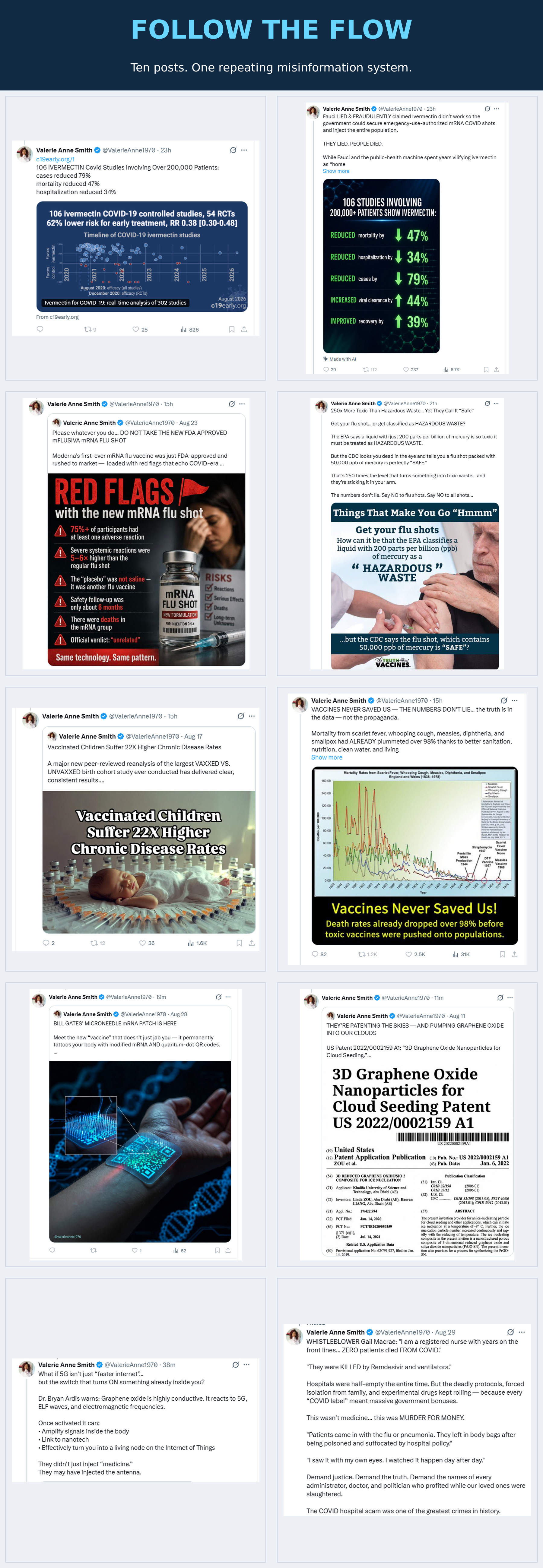
One says ivermectin cut COVID deaths by 47 percent. Another says a new mRNA flu vaccine harmed three-quarters of the people in its trial. Another compares the mercury concentration in a multidose flu-vaccine vial with the threshold for hazardous waste. Then come the vaccinated-versus-unvaccinated study, the graph claiming vaccines never saved anyone, the microneedle “tattoo,” the graphene cloud-seeding patent, the injected 5G antenna and the nurse who says COVID patients were murdered for money.
Each claim could consume an article. By the time the tenth rebuttal is finished, twenty more posts have appeared.
That is why Valerie Anne Smith’s X account, @ValerieAnne1970, is more useful as a study of misinformation flow than as a checklist of false statements. The account does not ask followers to accept one isolated claim. It surrounds them with a continuous story: Smith says she recovered after conventional medicine failed her; official medicine cannot be trusted; every alarming fragment confirms that distrust; and the treatments, services and products she accepts can be found through the next link.
The public evidence does not tell us whether Smith believes every claim she posts, what she earns from any particular link or what ultimately motivates her. It does show what the account publishes, how the claims are constructed and where the audience is sent. That is enough to examine the system without pretending to read her mind.
Ten posts captured on August 31, 2026. Their subjects vary, but the pattern repeats: start with something real, remove the context that limits it, add a catastrophic interpretation, assign a villain and move on before scrutiny can catch up.
The account begins with its strongest evidence: her own life
Smith has publicly described a long struggle with anorexia and mental illness, followed by a dramatic recovery after adopting an animal-based ketogenic diet. Her public materials connect that experience to a 2023 case series of three patients with severe anorexia. All three gained substantial weight and reported sustained improvement after adopting high-fat, animal-based ketogenic diets.
Nothing in this article disputes the reality of Smith’s suffering or the improvement she reports. A person is entitled to tell the story of her own recovery. The criticism begins only when that experience is extended into broad medical claims, or used to supply authority on subjects the experience cannot answer.
That is evidence worth taking seriously. It is also limited evidence, as the paper’s authors acknowledged. The patients selected the diets themselves. The report was retrospective. There was no control group, and the researchers could not determine whether the improvements resulted from ketosis, nutritional replenishment, psychological factors or some combination. They concluded that ketogenic diets might help some patients and deserved further study.
The scientific paper says possible treatment deserving study. Smith’s public bio and interview titles repeatedly say cured, completely healed and fixed. Her Linktree contains titles such as “How She Used Carnivore to COMPLETELY HEAL,” “40 Years of Mental Illness Healed in ONE Year,” and “How the Carnivore Diet FIXES Depression.”
That change in language matters. A three-person case series can generate a hypothesis. It cannot establish that an animal-based ketogenic diet cures eating disorders or psychiatric conditions generally. Nor can participation in that case series confer expertise in vaccine epidemiology, antiviral drugs, toxicology or radio-frequency engineering.
But social media does not assign authority by field. It assigns authority to a person who has earned attention and trust.
Researchers have repeatedly found that anecdotes can exert more influence than their evidentiary value warrants. In four experiments involving more than 4,100 participants, even a single negative anecdote changed medical judgments despite participants also receiving stronger statistical evidence or a decision aid. The story does not have to disprove the data. It can simply become the part people remember.
In the structure of the account, Smith’s recovery story therefore does two jobs. It tells people what she says happened to her, and it creates a transferable sense of credibility: I found what doctors missed, so I can help you see what they are hiding elsewhere.
The first proposition may be true. The second does not follow from it.
Six fact-checks—and the technique behind each one
The point of sampling these posts is not to declare every sentence false. Several contain real facts. The problem is what happens between the fact and the conclusion.
1. Ivermectin: a study count is made to impersonate a scientific consensus
Two screenshots repeat figures from c19early.org: 106 controlled studies, 54 randomized trials and a 62 percent lower risk with early ivermectin treatment. The second turns the same numbers into an AI-made graphic and adds a larger allegation: Anthony Fauci supposedly lied about ivermectin so the government could authorize mRNA vaccines, and “people died.”
The number of studies is not the same thing as the weight of the evidence. The site pools unlike material: randomized and nonrandomized designs, different patient populations, different treatment stages, different doses, different co-treatments and different outcomes. A small observational study of viral clearance and a large placebo-controlled trial of hospitalization or recovery do not become equivalent because both can be plotted as dots. Nor does a pooled association establish a plot to suppress treatment.
When reviewers restricted the evidence according to study reliability, the dramatic benefit disappeared. The 2022 Cochrane review found no evidence supporting ivermectin for COVID-19 treatment or prevention. In the double-blind ACTIV-6 randomized trial, 1,591 participants completed follow-up and ivermectin did not significantly improve recovery; a later trial of a higher dose for a longer period also found no benefit.
The move here is aggregation without commensurability. “There are many studies” becomes “the treatment works,” and “the treatment works” becomes “officials knowingly killed people.” The final accusation is not a finding of any of the studies in the graphic.
2. MFLUSIVA: a side-effect tally is presented as an injury rate
The mRNA flu-vaccine graphic has a stronger factual core. MFLUSIVA was approved by the FDA on August 5, 2026 for adults 50 and older. The approval was traditional for ages 50–64 and accelerated for ages 65 and older, with a confirmatory trial required for the older group. Its pivotal study did report more short-term reactions than the standard-dose flu-vaccine comparator.
But “75%+ of participants had at least one adverse reaction” does not mean three-quarters were seriously harmed. In the FDA’s clinical review, 75.7 percent of a 3,015-person MFLUSIVA solicited-safety subset reported at least one solicited reaction during the first seven days. That category included injection-site pain, redness, fatigue, headache, muscle pain, joint pain, chills, nausea and fever. Most were mild or moderate. Grade 3 systemic reactions were higher—5.5 percent versus 0.9 percent for the standard flu vaccine—which is a legitimate reactogenicity difference to discuss. It is not the same claim as “75 percent injured.”
Calling the comparator a fake placebo is also misleading. This was an active-comparator trial asking how the new product performed against an existing flu vaccine, not whether any flu vaccine beats saline. That comparison produced useful information: in roughly 40,700 participants, laboratory-confirmed influenza-like illness occurred in 2.0 percent of the MFLUSIVA group and 2.8 percent of the standard-vaccine group, a relative vaccine efficacy of 26.6 percent.
The death claim loses its denominator too. There were 40 deaths among 20,350 MFLUSIVA recipients and 34 among 20,353 comparator recipients—0.2 percent in each group—and investigators assessed none as vaccine-related. After reviewing the case narratives, FDA said causation was unlikely. In its pooled safety analysis, however, FDA found more deaths recorded without a specified cause, or as sudden death, in the mRNA-vaccine groups. All-cause mortality remained balanced, but the 29 affected mRNA recipients had no autopsies and there was no systematic cause-of-death adjudication. FDA therefore said residual uncertainty remained. Serious adverse events in the pivotal trial were 2.2 percent and 1.9 percent, respectively. FDA required confirmatory efficacy work for the accelerated approval and accepted a separate postmarketing safety-surveillance commitment. That is a reason for continued monitoring, not evidence that trial deaths were concealed.
The move is denominator removal. A common short-term reaction becomes “an adverse reaction”; six additional deaths among more than 20,000 people become “there were deaths in the mRNA group”; the comparator, the equal rounded death rate and the efficacy result disappear.
3. Mercury: two valid concentrations are used in an invalid comparison
The flu-shot post claims that a vaccine containing 50,000 parts per billion of mercury is 250 times more toxic than material the EPA classifies as hazardous waste at 200 ppb.
The arithmetic can be reconstructed. Some multidose influenza vaccines contain 25 micrograms of mercury from thimerosal in a 0.5 mL dose, which can be expressed as 50,000 micrograms per litre. Federal hazardous-waste rules list mercury at 0.2 milligrams per litre, or 200 micrograms per litre.
What the post hides is that the EPA value is not a human injection-safety limit. It is the threshold in a leaching test used to decide whether discarded solid waste could release contaminants into groundwater. The vaccine figure is the concentration of a measured dose of ethylmercury used as a preservative. Toxicology depends on the chemical species, total dose, route and how the body processes it—not concentration alone. The FDA distinguishes ethylmercury from methylmercury, and the CDC notes that most single-dose flu shots and prefilled syringes contain no thimerosal.
The move is unit laundering. Two numbers share a unit, so the post treats them as if they answer the same safety question. They do not.
4. “22X”: the headline misstates even the paper it is promoting
One supplied post declares: “Vaccinated Children Suffer 22X Higher Chronic Disease Rates.” Its own text then describes a “peer-reviewed reanalysis” of a large vaccinated-versus-unvaccinated birth cohort.
The underlying 2025 paper does not report that the overall chronic-disease rate was 22 times higher. It says all 22 categories in the source table had higher proportions in the vaccinated group. Elsewhere it highlights a 5.49-fold figure for a cluster of neurodevelopmental diagnoses and a roughly threefold difference in the draft’s 10-year chronic-disease-free analysis. Neither is 22-fold. The account has turned the number of categories into a multiplier.
The deeper problem is methodological. The reanalysis relies heavily on proportional comparisons between 16,511 vaccinated children and 1,957 unvaccinated children even though the vaccinated children were followed longer and had far more medical encounters. More observation creates more opportunities for diagnosis. The unpublished Henry Ford draft entered into the Senate hearing record itself reported roughly seven annual encounters in the vaccinated group and two in the unvaccinated group, a major risk of ascertainment bias. Its authors used patient-time rates and survival models in an attempt to address unequal follow-up. The reanalysis argues that the greater number of visits reflects vaccine-caused illness, but that assumption cannot be used to prove the conclusion it is supposed to test. Henry Ford Health says the draft failed internal review because of serious data and methodological problems.
Its publication label deserves context too. One of the paper’s three authors is also one of the journal’s editors in chief. The paper says that another editor temporarily replaced him for its review and obtained two reviewers. That does not settle whether the analysis is right or wrong. It does make “peer reviewed” a poor substitute for examining the data and method.
The move is credential compression. A paper published in a journal becomes “the largest study ever”; a contested secondary analysis becomes a clean conclusion; 22 measured categories become “22X.”
5. “Vaccines never saved us”: mortality is substituted for disease incidence
The historical graph says mortality from scarlet fever, whooping cough, measles, diphtheria and smallpox had already fallen by more than 98 percent before the relevant vaccines, thanks to sanitation, nutrition, clean water and better living conditions.
Part of that history is real. Better nutrition, less crowding, antibiotics and improved supportive care reduced the chance that an infected person would die. But a falling death rate does not show that vaccines failed to prevent infections, outbreaks, hospitalizations, disability or later deaths. It is possible for case fatality to decline while a disease continues circulating widely.
Measles makes the substitution easy to see. Before the vaccine was introduced in England and Wales in 1968, there were 160,000 to 800,000 notifications a year and roughly 100 acute deaths. In the United States, the decade before the vaccine brought an estimated 3 million to 4 million infections, 48,000 hospitalizations, 1,000 cases of encephalitis and 400 to 500 deaths each year. The vaccine-era collapse in incidence cannot be read from a chart designed to show mortality alone. Smallpox is more decisive still: the disease was eradicated through coordinated surveillance and vaccination, with the WHO declaring eradication in 1980.
The move is outcome substitution. The chart answers “Why did infected people become less likely to die?” and is presented as if it answered “Did vaccines prevent disease?”
6. Graphene and 5G: a real paper and a real patent become a secret bodily network
Three posts form a miniature misinformation chain.
The first announces that a Bill Gates microneedle mRNA patch will permanently tattoo people with modified mRNA and “quantum-dot QR codes.” This appears to splice together separate technologies. A real 2019 Science Translational Medicine paper tested near-infrared quantum-dot patterns delivered by dissolvable microneedles as a possible vaccination record. The researchers used a polio vaccine in rats and tested pattern visibility in cadaver skin. It was not an approved product, not an mRNA vaccine, not a QR code connected to a network and not evidence that such a patch “is here.” The Gates Foundation helped fund the research; funding is not ownership of a secret deployed device.
The second post displays US patent 2022/0002159 A1 and says “they’re patenting the skies” and pumping graphene oxide into clouds. The patent is real, and the application later became an active patent. It describes a reduced-graphene-oxide and silica composite intended to promote ice nucleation. A patent establishes a claim to an invention. It does not show where, whether or at what scale the invention has been manufactured or deployed, much less prove a covert program.
The third post assumes the missing steps: graphene oxide is already “inside you,” 5G switches it on, it amplifies signals, links a person to nanotechnology and turns the body into a node on the Internet of Things. No evidence is supplied for any of those transitions. UK regulators have stated that authorized COVID-19 vaccines contain no graphene oxide, and vaccine ingredients and batch specifications are controlled as part of authorization.
The move is narrative chaining. Real research establishes that a technology has been studied. A real patent establishes that somebody sought legal rights to an invention. The next post treats secret deployment as settled. The final post places the material inside the follower’s body and gives it a science-fiction function. Each unsupported step borrows credibility from the true fact before it.
Testimony is repeatedly promoted into proof
The final screenshot quotes a nurse who says she saw no patients die from COVID, only from remdesivir and ventilators, and calls hospital care “murder for money.” Whatever that individual believes she witnessed, one person’s recollection cannot establish the cause of death for a country, the efficacy of a drug or a coordinated murder scheme.
The randomized evidence on remdesivir is more complicated than either “miracle” or “murder.” The placebo-controlled ACTT-1 trial found faster recovery and fewer serious adverse events with remdesivir, without a statistically conclusive mortality reduction. The larger WHO Solidarity trial found no significant overall mortality benefit, though its updated meta-analysis suggested a modest benefit among patients not already ventilated. Mechanical ventilation was used for people in severe respiratory failure; the fact that many ventilated patients died does not show the machine caused the illness that required it.
The post replaces those questions with a witness and a villain. “I saw it” is emotionally potent. It is not a controlled comparison.
This is why Smith’s own recovery story matters beyond diet. The account’s structure encourages followers to treat testimony as a superior way of knowing: the patient knows what doctors missed; the nurse knows what hospitals hid; the whistleblower knows what regulators concealed. Formal evidence is not merely judged inadequate. It is recast as a tool of the suspected conspiracy.
The recurring pattern is more important than the topics
Ivermectin, flu vaccines, mercury regulation, childhood health records, mortality graphs, microneedles, patents, cloud seeding and 5G look like unrelated subjects. They are held together by a small set of moves:
Borrow authority from a true fragment. Start with a personal recovery, a real study, an FDA document, a concentration, a historical graph or a patent number.
Remove the limiting context. Drop the denominator, study quality, active comparator, chemical form, route of exposure, time at risk or distinction between mortality and incidence.
Convert uncertainty into intent. A disputed result is not merely wrong; somebody lied, hid the cure or killed patients for money.
Make disagreement self-incriminating. Doctors, regulators and researchers who reject the conclusion are treated as members of the system under accusation.
Repeat the conclusion in new wrappers. A website chart becomes an AI image, a quote card, a video clip and a fresh all-caps warning.
Move before the claim can settle. The volume makes careful checking feel permanently behind.
The account’s recurring 2,094-percent autism statistic follows the same route. The number can be traced to a non-peer-reviewed 2016 document by Richard Lear called “The Root Cause in the Dramatic Rise of Chronic Disease”, which built a custom “Generation Growth” measure by mixing incidence and prevalence, using data from different countries and extrapolating shorter trends across a 25-year period. The author acknowledged that the results were over-precise. On X, the method disappears and the giant percentage survives.
This is content laundering: paper to chart, chart to screenshot, screenshot to conclusion, conclusion to memory.
Repetition turns alarm into background knowledge
The two ivermectin posts in the collage are not redundant. They show the mechanism in real time. The first presents the graph. The second repeats the same source numbers, adds an AI-generated visual and attaches the moral verdict: officials lied and people died.
Repetition changes how information feels. In a 2024 field experiment with professional content moderators, a single prior exposure made repeated headlines more likely to be judged true, including false ones. Prompting people to consider accuracy when they first encountered a claim eliminated the effect.
Habit matters too. A 2023 study in the Proceedings of the National Academy of Sciences found that the 15 percent most habitual sharers accounted for roughly 30 to 40 percent of the false news shared in the researchers’ experiments. Continuous misinformation does not require every follower to become a committed believer. It needs enough people to become accustomed to reacting and reposting.
Outrage supplies the energy. A large study of Twitter rumor cascades found that false news was 70 percent more likely to be retweeted than true news. Later work in Science found that misinformation evokes moral outrage and that outrage increases sharing, including sharing without opening the linked material.
The language in the screenshots is built for that response: “They lied. People died.” “Murder for money.” “They may have injected the antenna.” The follower is offered a role—protector of children, defender of patients, opponent of corruption—before being offered time to examine the source.
Once the world is divided into victims and villains, a correction from a doctor, regulator or public-health agency arrives pre-discredited. Its disagreement is treated as evidence that the institution belongs to the corrupt side.
That is how the stream protects itself. It does not have to rebut every future correction. It gives followers a ready-made reason that corrections should not count.
The bio completes the flow
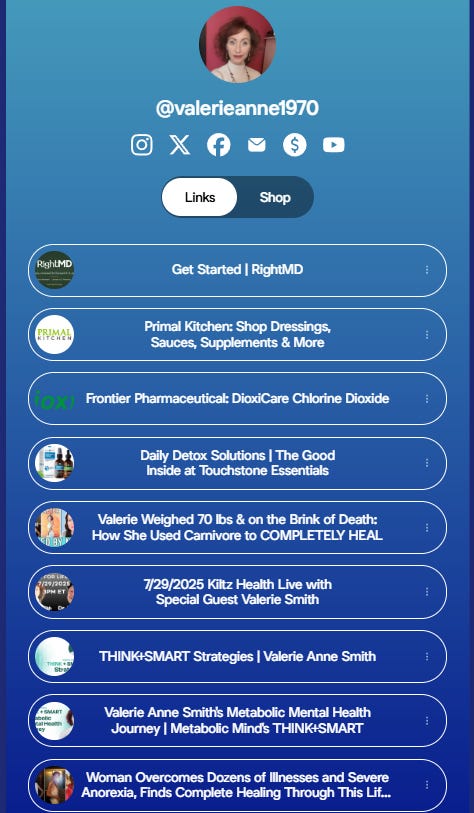
Smith’s Linktree, captured on August 31, 2026, places commercial and health-related destinations at the top: RightMD, Primal Kitchen, Frontier Pharmaceutical’s DioxiCare chlorine-dioxide products and “Daily Detox Solutions.” The page also contains a Shop tab, a payment link, product discount codes and a long list of interviews repeating her recovery story. Her connected platforms include X, Instagram, Facebook and YouTube.
RightMD advertises telehealth services involving cancer, COVID-19, weight loss and other conditions, along with ivermectin and natural supplements. Frontier Pharmaceutical offers chlorine-dioxide products and advertises an affiliate program. Other links promote food, supplements, salt, skin products and sleep products. Some use personalized discount codes.
The destinations complicate the account’s simple opposition between “nature” and the pharmaceutical industry. Its X bio says nature provides cures and vaccines cause harm, while its link page directs followers to a telehealth medication service and a company called Frontier Pharmaceutical. The dividing line is not natural versus pharmaceutical. It is between products and providers accepted by the account and institutions the account has taught followers to distrust.
The commercial pathway becomes especially important when a post makes a safety claim. In an August thread, Smith said the FDA “no longer claims that chlorine dioxide is unsafe” because warning pages had disappeared from its website. The thread described drinking, nebulizing and injecting chlorine dioxide, then linked to DioxiCare products.
Removing or relocating a webpage is not a regulatory finding. FDA enforcement material still describes ingested sodium-chlorite products that generate chlorine dioxide as unapproved and capable of severe harm. Federal authorities described “Miracle Mineral Solution” as producing chlorine dioxide, a powerful bleach used in industrial treatment. Chlorine dioxide has legitimate antimicrobial uses at controlled concentrations, including certain food-processing applications with strict residual limits. That does not make it an approved treatment for cancer, autism or COVID-19.
The product URL in Smith’s thread contains a referral identifier. That does not establish how she is compensated or whether a purchase pays her. It does establish that a broad medical claim, an attack on the regulator and a trackable product link appear in the same path.
The public flow is visible:
Personal recovery → borrowed authority → alarming claim → repeated exposure → outrage → institutional distrust → alternative treatment → product or service link
The product link is not sitting separately from the message. It is where the message has prepared the follower to go.
A 2026 systematic scoping review in JAMA Network Open examined 12 articles about influencer promotion of prescription drugs. It found recurring problems with misinformation, inconsistent disclosure and audiences’ difficulty recognizing promotional intent when marketing was embedded in personal narratives. The authors also described the evidence base as small and fragmented. The finding does not establish Smith’s motives or compensation; it explains why clear disclosure matters when personal health stories and product pathways overlap.

Are we making the opposite mistake?
This is where it helps to pause the argument and question our own reasoning. A critical article can repeat the same error it condemns if it turns fragments into a verdict about a person.
Smith’s recovery may be exactly as she describes it. Early or unconventional research can identify ideas that established medicine has missed. Regulators and researchers can be wrong. An active-comparator trial does not answer every question a saline-controlled trial would answer. A real patent can eventually lead to a real product. A referral code may be used for tracking, a discount or compensation, and the public URL alone does not tell us which.
Grant all of that. The central findings still hold because they do not depend on diagnosing Smith, denying her recovery or proving a hidden motive. They depend on public, checkable acts: a 22-category result is posted as “22X”; a waste-leaching threshold is presented as an injection limit; solicited reactions are framed as mass injury; a research prototype becomes a deployed control system; and a regulator’s missing webpage becomes proof that an unapproved therapy is safe.
Four questions keep the standard consistent:
Would we accept this reasoning if it supported the opposite conclusion? A patent, testimony or raw proportion would still need the missing steps.
Are we claiming more than the evidence can establish? This sample shows a repeated misinformation pattern. It does not establish what Smith privately believes, what every post says or what she earns.
What evidence would change the conclusion? Reliable trials supporting the medical claims, proof of the alleged deployment, corrections that preserve denominators and study limits, or clear disclosures separating testimony from promotion would all matter.
Are we criticizing the claim or the person’s vulnerability? The proper target is the public leap from experience to authority, not the suffering that preceded the experience.
Uncertainty deserves room. It does not make unsupported conclusions and supported findings interchangeable.
Why correcting one post is not enough
A conventional fact-check treats misinformation as a defective statement: identify the claim, present the evidence, render a verdict. That work is necessary. The examples above show why it is insufficient on its own.
When followers have an established relationship with an influencer, a correction arrives from outside that relationship. A 2026 study of Community Notes on X found that community fact-checking reduced reposting but was less effective among people who had previously interacted with the misleading post’s author. It was least effective with health and political misinformation. Trust in the person can blunt the note attached to the post.
The better question is not only, Is this claim wrong? It is, What keeps carrying me to the next one?
Before sharing health content, follow it backward and forward:
What is the original source—not the screenshot, video or person repeating it?
Did that source measure what the post says it measured?
What denominator, comparison group, follow-up period or definition has been left out?
Has a possibility, association, case report, patent or early trial been converted into proof of deployment or a cure?
Is a personal recovery being used to claim authority in an unrelated field?
Can the account’s central belief ever be proved wrong, or is every correction absorbed into the conspiracy?
Where does the bio send the audience, and are commercial relationships clearly disclosed?
The value of examining Smith’s account is not that it contains the worst claim on the internet. It is that the pattern is unusually visible.
The story supplies trust. The real fragment supplies plausibility. Context removal supplies the alarming conclusion. Repetition supplies familiarity. Outrage supplies reach. Institutional suspicion blocks the exits. The bio supplies somewhere to act—and sometimes somewhere to spend.
The individual post is only a frame. The influence is in the flow.
Method note: This article is based on publicly accessible profile material, indexed X posts, Smith’s Linktree, the supplied Linktree capture and ten supplied X screenshots captured on August 31, 2026, together with the linked scientific and regulatory sources. Clinical claims were checked primarily against regulator reviews, trial reports, systematic reviews, and original publications.
Advocacy sites, social posts, and commercial pages are used to document what was claimed or sold, not as proof that the claims are medically correct. The sample was selected to represent recurring claim types, not to quantify every post on the account. The article analyzes public claims and content structure; it does not infer private medical facts, undisclosed income, or intent.
If this made you think, subscribe to A Mind Less Wasted. There are always more questions hiding in plain sight…and we’re going to keep asking them.
Resources
The sources below are grouped by how they were used. Regulatory reviews, original studies and systematic reviews carry the factual analysis. Social, advocacy and commercial pages document what the account claimed, repeated or promoted; they are not treated as proof that the medical claims are correct.
Medical, scientific and regulatory sources
Ketogenic diet treatment of anorexia nervosa: a three-patient case series (2023)
JAMA: ACTIV-6 randomized trial of ivermectin for mild-to-moderate COVID-19
Electronic Code of Federal Regulations: Toxicity-characteristic limits for hazardous waste
IJVTPR: Vaccinated-versus-unvaccinated child-health reanalysis (2025)
U.S. Senate hearing record: Henry Ford vaccinated-versus-unvaccinated draft and testimony
Henry Ford Health: Institutional response to the vaccinated-versus-unvaccinated study
Science Translational Medicine: Near-infrared quantum-dot patterns delivered by microneedles
U.S. patent record: Reduced-graphene-oxide/silica composite for ice nucleation
UK Medicines and Healthcare products Regulatory Agency: COVID-19 vaccines and graphene oxide
New England Journal of Medicine: ACTT-1 final report on remdesivir
WHO Solidarity trial: Final results and updated meta-analysis of remdesivir
FDA enforcement record: Chlorine-dioxide “Miracle Mineral Solution” case
FDA food-contact notification: Controlled chlorine-dioxide use and residual limits
Research on misinformation and influence
Four experiments on the influence of anecdotes in medical decisions
PNAS Nexus: Repetition and belief among professional content moderators
JAMA Network Open: Systematic scoping review of influencer promotion of prescription drugs
Nature Communications: Community Notes, prior interaction and misinformation sharing