


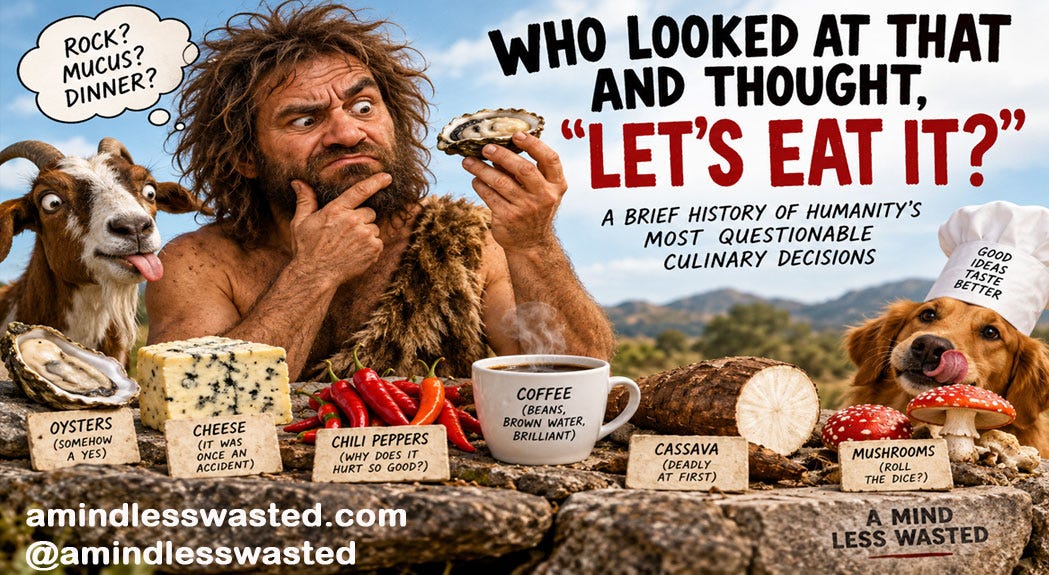
At some point in human history, someone cracked open an oyster, stared directly into what appeared to be a small bag of seawater and phlegm, and thought:
Dinner.
There was no menu.
No Yelp review.
No guy standing nearby saying, “They’re actually really good with lemon.”
Just a wet rock containing something that looked very much as though nature had gone out of its way to tell us not to put it in our mouths.
And yet somebody did.
Then, presumably, somebody else watched him.
And instead of saying, “Frank has finally lost his mind,” he said, “Give me one.”
This may be one of the most underappreciated forces in human history.
Nearly everything we eat required, at some point, a first volunteer.
We talk about human beings as toolmakers, explorers, inventors and problem solvers. All true.
But we are also the species that wandered around the planet pointing at suspicious objects and asking:
Can I eat that?
The answer was occasionally no.
Very, very no.
But every so often the answer was cheese.
And that kept us going.
The Oyster Problem
Oysters are a good place to begin because they require almost no imagination to understand the problem.
Fruit advertises itself.
Fruit develops bright colors, sweetness and aromas specifically because plants benefit when animals eat it and spread the seeds.
An oyster does none of this. An oyster hides inside a rock. You have to find it, pry it open and then make a conscious decision to swallow the contents.
And humans have been doing exactly that for an astonishingly long time.
Archaeological evidence shows Indigenous peoples harvesting oysters for thousands of years. Ancient coastal settlements left behind enormous piles of discarded shells, known as shell middens.
Which means oysters weren’t some desperate experiment attempted once during a particularly bad Tuesday.
People liked them.
Imagine the first sales pitch.
“Okay, hear me out.”
“No.”
“You haven’t even seen what’s inside.”
“I have seen what’s inside.”
“But you haven’t tasted it.”
“That is because I possess survival instincts.”
Somehow Team Oyster won.
Thousands of years later, human beings put them on silver platters, charge $4 apiece for them and argue about which coastal inlet produces the finest flavor.
That is quite a promotion for something that spends its entire life glued to the bottom of the sea.
And Then Someone Let Milk Go Bad
Cheese requires an even stranger leap.
Milk makes sense immediately.
A mammal produces it. Babies drink it. Humans figured out that the milk of domesticated animals was nutritious.
Fine.
But cheese?
Cheese begins with someone looking at milk that is no longer behaving like milk and refusing to throw it away.
It curdled.
It separated.
It smelled different.
Today we call this cheesemaking.
Without several thousand years of cultural context, it would have looked suspiciously similar to a kitchen accident.
Archaeological evidence indicates that humans were making cheese thousands of years ago. Residues found in ancient pottery strainers provide evidence of cheesemaking in prehistoric Europe roughly 7,500 years ago, while broader archaeological evidence places dairy fermentation even earlier in parts of the Near East.
Someone discovered that milk could be transformed into something that lasted longer, traveled better and tasted completely different.
That discovery eventually gave humanity Parmesan, mozzarella, cheddar, brie, provolone and the ability to charge an extra $2.50 to put cheese on a hamburger.
Progress.
But imagine getting there without knowing what bacteria were.
There was no microbiology.
No fermentation science.
No refrigeration.
Just:
“The milk became a lump.”
“Throw it away.”
“Wait.”
“No.”
“I think I can do something with this.”
Human cuisine owes an enormous debt to people who refused to throw things away when any reasonable person would have.
Now Let’s Eat Something That Hurts
At least cheese tastes like food.
Chili peppers present a different question.
Why would you eat something that causes your nervous system to report an emergency?
Capsaicin, the compound responsible for the heat in chili peppers, activates some of the same sensory pathways involved in detecting high temperatures. Your mouth isn’t literally burning, but your nervous system is responding to a chemical signal that resembles one.
The rational response would seem obvious:
Stop eating it.
Humanity’s response was:
Can you make it hotter?
People in the Americas were eating wild chilies thousands of years ago and cultivating them more than 6,000 years ago. After peppers traveled around the world, they became so deeply embedded in Asian cuisines that it is easy to forget that chili peppers did not arrive in places such as India, Thailand, Korea or China until after contact between the Americas and the Old World.
Think about what happened psychologically.
Person One eats pepper.
Person One begins sweating.
Eyes water.
Nose runs.
Mouth feels as though it has been placed against the surface of the sun.
Person Two observes all of this.
Person Two says:
“I want one.”
And here we encounter something distinctly human.
We don’t merely tolerate discomfort.
Under the right circumstances, we enjoy it.
Researchers have proposed several explanations for our attraction to spicy foods, including cultural learning and the pleasure some people get from controlled risk or intense sensation.
A roller coaster frightens you without actually throwing you off a mountain.
A horror movie terrifies you while you remain safely on the couch.
A hot pepper convinces your nervous system that something terrible is happening while you calmly reach for another chicken wing.
Humans apparently discovered recreational suffering long before CrossFit.
Coffee Makes Even Less Sense
Then there is coffee.
Today coffee is so normal that we rarely consider what a bizarre chain of decisions was required to produce it.
Coffee fruit grows on a plant.
Inside that fruit are seeds.
We take those seeds.
Dry them.
Roast them until brown.
Grind them into powder.
Pour hot water through the powder.
Throw the powder away.
Drink the brown water.
And somehow this process became so important to civilization that millions of people refuse to engage in conversation before completing it.
The exact origin of coffee drinking is murky, and the famous story of Kaldi, the Ethiopian goat herder who supposedly noticed his goats becoming energetic after eating coffee berries, is legend rather than established history. Coffee itself has deep roots in Ethiopia, while Yemen became crucial to its early cultivation and development as the beverage we recognize today.
I prefer the goat story anyway.
Partly because it involves goats.
But mostly because it perfectly captures the recurring principle of human culinary discovery.
An animal eats something strange.
The animal behaves differently.
A human watches.
And instead of thinking, “I should keep the goats away from that,” the human thinks:
I wonder what happens if I eat it.
Science, ladies and gentlemen.
Early-stage science, admittedly.
But science.
The Person Who Figured Out Cassava Deserves a Statue
Some foods took more than courage.
They required genuine ingenuity.
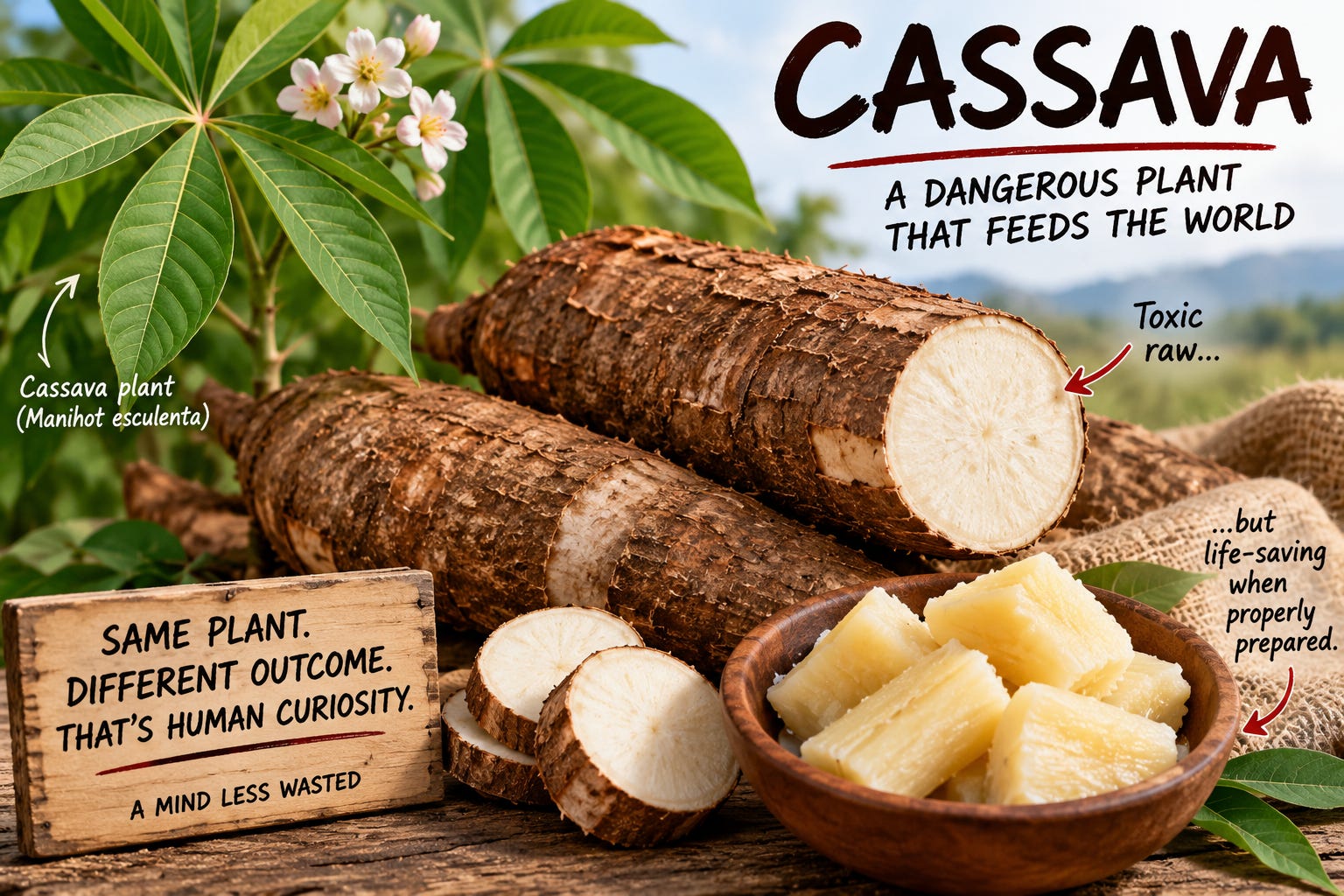
Cassava is one of the world’s important staple crops, but the plant contains naturally occurring cyanogenic compounds that can release cyanide. Improperly processed cassava can cause serious poisoning. Traditional processing methods developed by Indigenous peoples made the food safer to eat.
That is remarkable.
Imagine encountering a plant that isn’t safely edible in its natural state and deciding not simply to abandon it, but to experiment until you discover a way to turn it into food.
This is where the joke about our ancestors eating random things stops being entirely a joke.
They were observant.
They experimented.
They remembered.
Most importantly, they passed knowledge forward.
One person learned something.
Another person improved it.
A community preserved the method.
Eventually something that could harm you became a dependable source of calories.
That process happened again and again throughout human history.
Fermentation.
Cooking.
Soaking.
Drying.
Grinding.
Roasting.
Smoking.
Salting.
Pickling.
We did not simply discover food.
We invented ways of making food out of things that did not initially cooperate.
There Must Have Been a Lot of Bad Days
Of course, we are seeing only the winners.
History remembers bread.
History doesn’t remember whatever Kevin ate in 14,000 BC that caused everybody else in the village to agree never to touch the purple berries again.
That knowledge was just as important.
Human beings learned food partly through success and partly through what must have been an enormous, multigenerational game of:
Don’t eat that.
The accumulated knowledge became culture.
These mushrooms are safe.
Those mushrooms aren’t.
Cook this first.
Don’t eat that part.
Harvest this when it turns this color.
Soak that.
Dry this.
Ferment this one.
If Uncle Grog starts hallucinating after eating those leaves, make a note.
Long before written language, people were building enormous databases of practical information inside traditions, stories, habits, and recipes.
Your grandmother telling you exactly how long something has to cook is the descendant of a very old system.
Except somewhere near the beginning of that chain, the consequences of getting the recipe wrong were considerably worse than dry chicken.
The First Person Is Still With Us
We tend to imagine ancient humans as fundamentally different from us.
They weren’t.
The same impulse still exists.
Walk through any supermarket and look at how many products exist solely because somebody asked:
“What happens if we combine these?”
Hot honey.
Chocolate-covered bacon.
Pickle-flavored potato chips.
Cronuts.
Sushi burritos.
Deep-fried Oreos.
Pizza with cheeseburgers embedded in the crust.
We have laboratories, food scientists, health departments and ingredient labels now, but somewhere deep inside the human brain, the original experiment continues.
Can I eat that?
Sometimes the question becomes:
Should I eat that?
And occasionally:
How much will you pay me to eat that?
TikTok has merely accelerated a research program that began in prehistory.
Curiosity Was Probably the Secret Ingredient
There is a temptation to look backward and imagine that everything humans discovered was inevitable.
Of course people discovered cheese.
Of course somebody roasted coffee.
Of course people learned to ferment grapes.
Of course somebody ate the oyster.
But none of it was inevitable to the person standing there before it had been done.
Every familiar food hides thousands of forgotten experiments.
Someone had to notice that heat changed food.
Someone had to discover that fermentation could preserve it.
Someone had to learn which plants were dangerous.
Someone had to discover that the terrifying red pepper was actually delicious.
Someone had to open the oyster.
And behind all of those discoveries was one of the strangest characteristics of our species.
Curiosity frequently overrides common sense.
That sounds like a defect.
Sometimes it is.
It is also why we crossed oceans, climbed mountains, built telescopes, split atoms, walked on the Moon and created several thousand varieties of cheese.
Human progress has always depended on somebody being willing to ask a question whose answer wasn’t obvious.
Sometimes the question was profound.
What are the stars?
Sometimes it changed civilization.
Can we grow this ourselves?
And sometimes it was simply:
What happens if I put this in my mouth?
Fortunately for the rest of us, somebody was usually willing to find out.
So the next time you’re sitting in a restaurant looking at a plate of oysters, a wheel of cheese, a bowl of painfully hot peppers and a cup of coffee, consider what you’re actually looking at.
It isn’t just lunch.
It’s a record of thousands of years of human curiosity, experimentation, occasional recklessness and the accumulated wisdom of people whose names we will never know.
Raise your coffee to them.
Especially the oyster guy.
That man took one for the team.
Your turn: What’s the most disgusting, bizarre, or strangely fascinating food you’ve ever eaten? And more importantly, what made you say, “Yeah, I’ll try that”? Drop it in the comments.
A Mind Less Wasted
Question everything. Especially the first person who looked at an oyster and said, “Pass me a fork.”
Resources and Further Reading
Smithsonian Institution — “Indigenous Peoples Have Shucked Billions of Oysters Around the World Sustainably.”
Archaeological evidence documenting Indigenous oyster harvesting over hundreds and thousands of years, including extensive shell middens.
Read at Smithsonian
University of Bristol — “Chemical Analysis of Sieve Vessels Reveals First Cheese Making in Northern Europe in the 6th Millennium BC.”
Research published in Nature identifying milk residues in prehistoric pottery strainers and providing direct evidence of cheesemaking more than 7,000 years ago.
Read at the University of Bristol
Smithsonian Magazine — “What’s So Hot About Chili Peppers?”
A look at the archaeology and biology of chili peppers, including evidence that humans were eating wild chilies at least 8,000 years ago and cultivating them more than 6,000 years ago.
Read at Smithsonian Magazine
National Library of Medicine — “A Molecular Perspective on Identifying TRPV1 Thermosensitive Regions and Disentangling Polymodal Activation.”
A scientific review of TRPV1, the sensory receptor activated by both heat and capsaicin that helps explain why chili peppers produce a burning sensation.
Read at PubMed Central
Oxford Research Encyclopedia of Food Studies — “The Ethiopian and Yemeni Roots of Coffee.”
An academic history of coffee’s origins in Ethiopia, its development in Yemen, and the evidence separating coffee history from legends such as the story of Kaldi and his goats.
Read at Oxford Academic
World Health Organization — “Natural Toxins in Food.”
An overview of naturally occurring food toxins, including the cyanogenic glycosides found in cassava and the potential for cyanide poisoning when cyanogenic foods are improperly prepared.
Read at the World Health Organization
Food and Agriculture Organization of the United Nations — “An Overview of Traditional Processing and Utilization of Cassava in Africa.”
A detailed review of traditional cassava processing techniques, including fermentation, drying and other methods used to reduce cyanide content and make cassava suitable for consumption.
Read at the FAO