

Of all the improbable things that have ever happened, the strangest is not simply that I exist.
It is that I exist as me.
There are ordinary answers to how I got here.
Two people met.
One particular sperm fertilized one particular egg.
A body developed, a brain organized itself, and a child entered a world already crowded with language, history, and other people’s hopes.
Change almost any detail in that chain and this person might never have existed.
But that is not quite the question.
I am not asking only why this body exists. I am asking why I am the one looking through its eyes. Why is its pain felt here? Why are its memories mine? Why did this life, rather than any other life, or no life at all, become the place from which the universe is present?
The question sounds circular: Why am I me? Who else could I be?
Yet the word me is doing two different jobs. It names a person whom others can observe, and it points toward the private subject to whom the world appears.
Science has learned a great deal about the person. It is still struggling with the subject.
Two questions hiding inside one
The question contains two mysteries. The first is how a brain and body produce a sense of self: a body that feels like mine, actions that feel like mine, and a story that connects the child I was to the person reading this sentence now.
The second is harder to get hold of: Why is any of that accompanied by experience? Why does activity in a brain feel like something from the inside?
Philosopher David Chalmers famously distinguished between the functional questions of consciousness, how a system pays attention, integrates information, or reports what it sees, and what he called the “hard problem”: why physical processes are accompanied by subjective experience at all. The “easy” problems are not easy in practice. They are called easy because, at least in principle, they can be approached by explaining mechanisms.
We might explain how a hand detects heat and pulls away from a flame. The harder question is why the burn hurts.
That distinction matters. A theory of how the brain models a person is not automatically a theory of consciousness. A brain may build an extraordinarily detailed model of its body, its past, and its surroundings, while leaving us with the question of why there is anything it is like for that model to be running.
How a brain builds a self
The self does not seem to arrive all at once. Philosopher and cognitive scientist Shaun Gallagher distinguishes between a “minimal self” and a “narrative self”. The minimal self is immediate and embodied: the basic sense that experience is happening here, that this is my body, and that I am initiating this movement. The narrative self reaches across time. It is the remembered and continually revised story of who I have been, who I am, and who I might become.
Long before a child can tell an autobiography, the beginnings of an embodied point of view are already in place. Later come names, mirrors, memories, social roles, promises, embarrassments, and plans. Other people help write the story. They tell us what we were like before we could remember, reward some versions of us, resist others, and give us the language with which we learn to describe ourselves.
Even apparently simple self-recognition is not a universal switch that flips at one exact age. In many urban Western studies, children begin passing the mirror-mark test during the second year of life. Results vary across cultural settings, and researchers debate how familiarity with mirrors and the social demands of the test affect performance. A 2026 study of 56 toddlers in rural Vanuatu found that 29 percent passed the face-mark test. Success increased with age, and a majority passed by 36 months—later than commonly reported in urban Western samples. That does not mean the other children lacked a self. The test captures one narrow, visually mediated form of explicit self-recognition.
Adults are not as fixed as we feel, either. In the classic rubber-hand experiment, synchronized touches to a hidden real hand and a visible fake hand can create the uncanny feeling that the rubber hand belongs to the participant. Virtual-reality experiments have similarly shifted people’s experienced location toward an artificial body seen from a distance.
These illusions suggest that bodily ownership and self-location are not read from an infallible inner label. The brain appears to assemble them by combining vision, touch, movement, and signals from within the body.
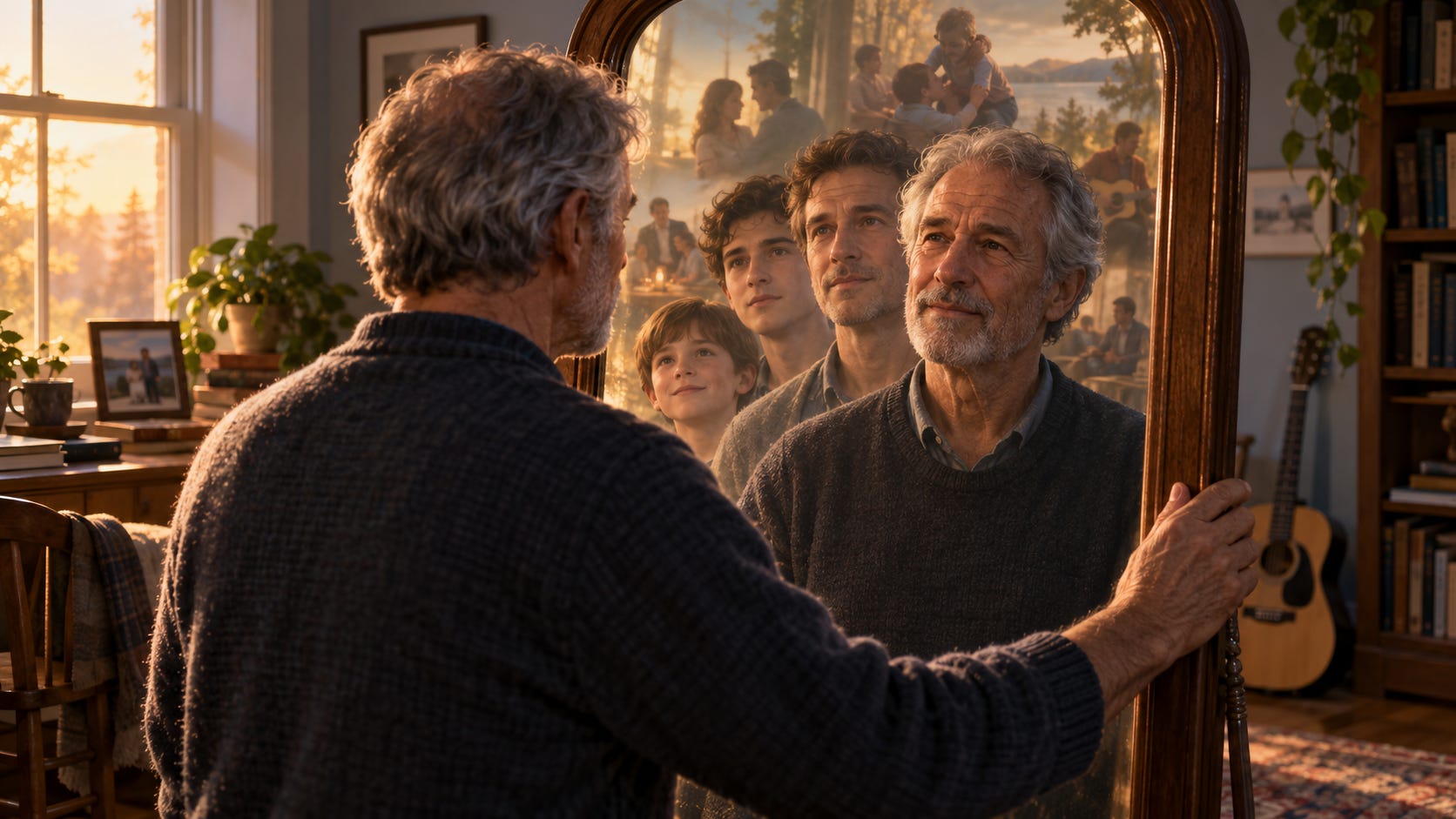
Calling the self “constructed” does not mean it is imaginary. A melody is constructed from notes; that does not make the music unreal. It means the self may be less like a hidden object lodged somewhere in the skull and more like an activity the living brain and body must keep performing.
That activity is remarkably stable. Most mornings, we wake without having to determine whose life has resumed. But it is not perfectly stable. Memory can fail. The sense of ownership can be manipulated. Injury and illness can alter personality, agency, or the boundary between self and world. The continuity we take for granted is an achievement, not a given.
And yet: who experiences the construction?
Neuroscience is not empty-handed. Researchers can study which patterns of activity accompany seeing a face, feeling pain, recognizing a body, or becoming aware of a stimulus. Competing theories offer different accounts of what makes information conscious. There is, however, no settled theory.
A review of 412 experiments found that which theory a study appeared to support could be predicted from its methodological choices, regardless of the findings. In 2025, a large preregistered collaboration tested predictions from two leading accounts—global neuronal workspace theory and integrated information theory—using fMRI, MEG, and intracranial EEG across 256 participants. The results supported some predictions from each theory while substantially challenging key claims of both. There was no decisive winner.
This does not show that consciousness is beyond science. It shows that declarations of victory are premature.
Some philosophers reject the hard problem itself. Daniel Dennett argued that once we explain attention, memory, discrimination, report, and the brain’s beliefs about its own inner life, no additional mystery may remain. On this view, asking what turns brain activity into an extra ingredient called “experience” may be a mistake. There is no extra ingredient; there are only the complex things a conscious organism does.
Others think that leaves out the very fact needing explanation. Thomas Nagel put the point simply: an organism is conscious if there is something it is like to be that organism. A complete description of a bat’s sonar, behavior, and nervous system might still fail to tell a human what echolocation is like for the bat.
The disagreement is not merely about missing data. It is about what an explanation of experience would have to explain.
The question that makes you dizzy
Then there is the most intimate part of the puzzle: not only Why is there experience? but Why is this experience mine?
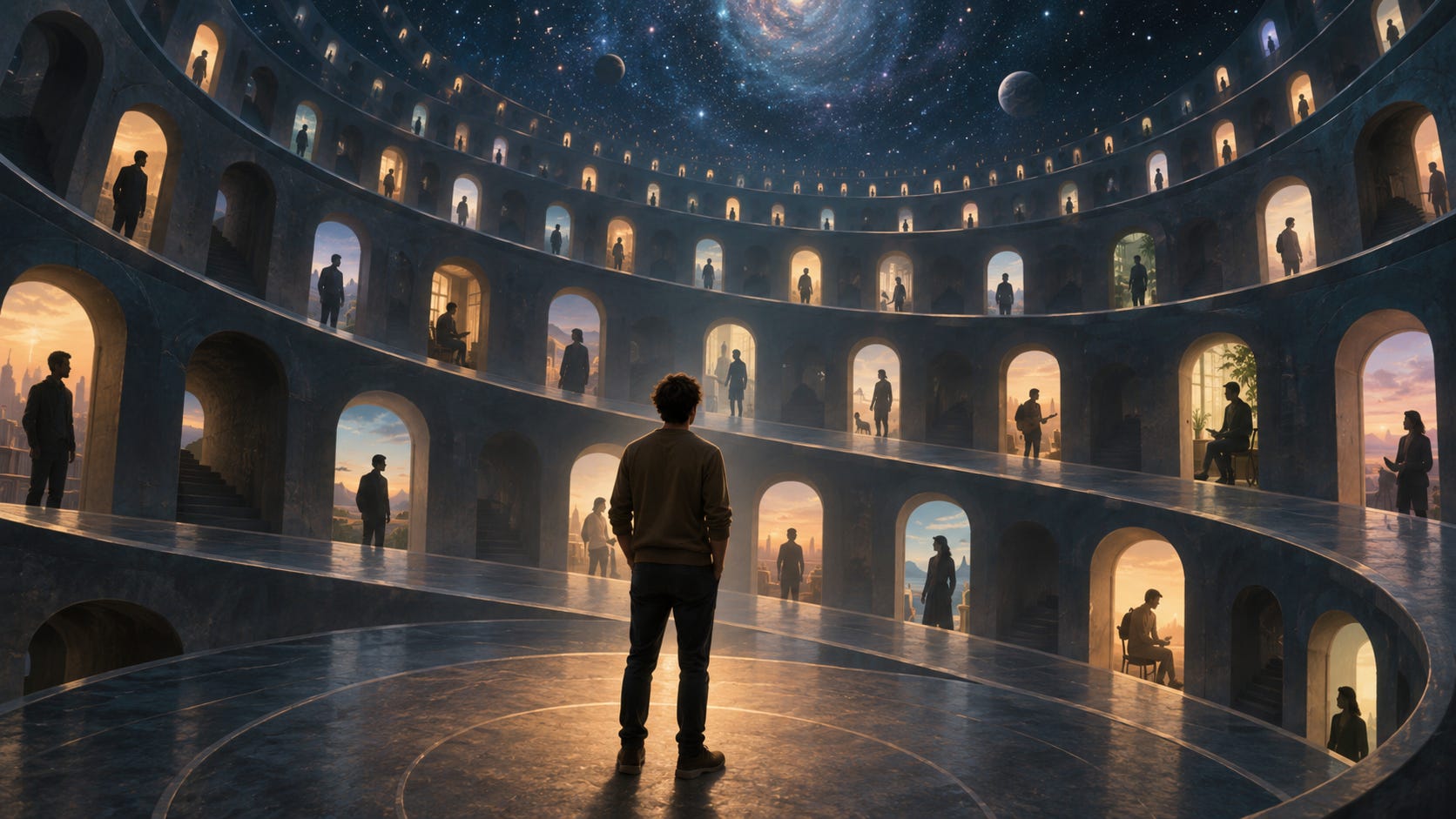
Philosopher Benj Hellie calls this the “vertiginous question”. Imagine possessing a perfect, objective inventory of the universe. It describes every person, every brain, every thought, and every point of view. The inventory may still seem to omit one fact: Why is this particular stream of experience the one that is live for me?
The most economical naturalistic answer is that nothing was omitted. There was no bare observer waiting outside the universe to be assigned a body. This organism came to exist, and as it developed a conscious point of view, that point of view was the organism’s. I could not have awakened as someone else because there was no detachable “I” available for reassignment.
On this account, asking why I am this person resembles asking why here is this place. Every location can be described from the outside, but here refers to the place from which the word is spoken. In the same way, every conscious subject refers to itself as I. The word does not select one privileged observer from a cosmic list. It marks the perspective doing the speaking.
That answer dissolves part of the puzzle. It explains why no soul lottery is required. But for many of us, it does not touch the deepest source of the dizziness: Why is there a first-person presence anywhere? Why is the universe not merely unfolding, but unfolding for someone at countless local points within it?
Religious and metaphysical traditions offer other answers. The subject may be an immortal soul, a fragment of a universal mind, or a stream that extends beyond one biological life. These ideas can carry profound meaning, but they are not conclusions current evidence allows science to establish. A gap in one explanation is not positive evidence for whichever alternative we prefer.
A mystery is not a blank check.
The honest position is narrower and less satisfying. The natural sciences can increasingly describe the conditions under which human selves and conscious reports arise. They do not yet provide an agreed explanation for why those conditions are accompanied by felt experience—or why reality is present from any particular point of view.
Why joy and heartache come together
Whatever consciousness ultimately is, ours is not detached observation. Human experience is organized around what matters to us.
Love provides a clear example. In a small 2005 brain-imaging study, 17 people who described themselves as intensely in love viewed photographs of their partners. The images engaged parts of the brain associated with reward and motivation, including the ventral tegmental area and caudate. The study did not discover love inside a handful of brain regions. It showed that romantic attachment recruits systems involved in wanting, learning, and directed pursuit.
Separation reaches into some of the same architecture of significance. In the well-known Cyberball experiment, being excluded from a virtual ball-tossing game increased activity in the anterior cingulate cortex, a region also implicated in the distressing component of physical pain. That activity tracked participants’ reported distress. Rejection is not identical to physical injury, but social loss is not merely an abstract opinion, either. The body treats belonging as consequential.
Grief makes the connection clearer. In one fMRI study of 23 women who had lost a mother or sister to breast cancer, reminders of the deceased engaged regions previously associated with emotional pain in both groups. Only the 11 women with complicated grief also showed greater activity in the nucleus accumbens, a reward-related region, and that activity correlated with yearning. The study was small and narrowly sampled; it cannot explain grief as a whole. But it fits an experience many bereaved people recognize: someone can be painfully absent while the mind and body continue to reach for them.
These findings do not reduce joy, love, or sorrow to colored patches on a brain scan. They reveal something more modest. The systems that allow another person to become rewarding, expected, and woven into our future are also the systems that make separation consequential.
Love teaches a nervous system that someone matters. Loss can change the world faster than that learning can change.
This is why joy and heartache are not unrelated accidents that happen to share a life. Both become possible when a conscious creature can care—when another person, place, hope, or purpose becomes part of how the future is imagined. The capacity that opens us to delight also exposes us to grief.
That does not make suffering good. It does not mean every loss was “worth it,” or that pain must be romanticized into a lesson. It means vulnerability is built into attachment. A life protected from every possible heartache would also have to be protected from much of what makes anything matter.
Did I receive this life?
To say I received a life suggests that an “I” existed before the life arrived. The naturalistic account reverses the order: A life did not happen to a preexisting self; a living process gradually became capable of saying I. The receiver was made by what it received.
That answer may describe the sequence without exhausting its meaning. Gift is not always a scientific claim about a giver. Sometimes it is a way of acknowledging that none of us authored the conditions of our arrival. We did not choose our century, body, first language, early caregivers, or the accidents that placed certain people in our path. By the time we became able to choose, much of the chooser had already been formed.
We inherit a life before we can evaluate it. Then, within limits we did not select, we participate in making it.

How can I cease to be me?
Before going further, I should be clear about the scope of this essay. It is not meant to promote a religious, atheistic, agnostic, or strictly secular interpretation of death. I will not be discussing heaven or hell, nor trying to prove or disprove an afterlife. Those questions matter deeply to many people, but they are not the question I am asking here. I am interested in a narrower and stranger puzzle: why it is so difficult for a conscious mind to imagine its own absence, and why love makes that imagined absence feel like missing the people who remain.
There is one point at which the question stops being an intellectual puzzle.
I can understand the sentence One day I will die. I know what the words mean. What I cannot genuinely picture is this point of view—the only one from which I have known anything—simply ending. I have never experienced a moment in which I was not present. Every darkness I imagine is still a darkness I see. Every silence still has me listening to it.
When I try to imagine my family after my death, I can see them continuing their lives. I imagine conversations I will not join, birthdays I will not attend, troubles I will not be there to help with. Then comes the thought that feels completely natural: I will miss them.
But who, exactly, would be doing the missing?
The imagination has played a quiet trick. To picture my own absence, it has placed me back inside the scene as an invisible observer. My body is gone, but my point of view remains, watching everyone else go on without me. Perhaps that is as close as a conscious mind can come to picturing nonexistence. Every mental picture still has someone looking.
This is not abstract for me. My mother passed away recently, and I apply this question to her every day. Does she miss us? Can someone who was so completely herself simply cease to be? I know my mind may be placing her back inside the world as an unseen observer, still loving us and still aware that we are here. Perhaps those questions tell me more about my grief than about what comes after death. But knowing that does not make them disappear.
On a naturalistic account, if consciousness ends when the brain can no longer sustain it, I will not experience an endless absence. There will be no future me waiting somewhere in the dark, longing for the people I love. Darkness is still an experience. Missing someone is still something a conscious person does.
Epicurus argued more than two thousand years ago that when we exist, death is not present, and when death is present, we no longer exist. That addresses the imagined experience of being dead. It does not make every fear surrounding death irrational. Dying can involve suffering. Our absence can wound the people who remain. And death may still harm us by depriving us of a future we otherwise could have lived, even if we never experience that deprivation.
On that account, I will miss them is logically misplaced but emotionally exact. The missing is happening now. It is love in the present trying to imagine a future from which I have been removed. I am not really picturing myself dead. I am picturing myself alive but unable to reach the people who made life matter.
If some form of personal consciousness survives death, as many religions hold, then the question takes a different shape. Science has not established that it does, so honesty requires leaving the possibility unresolved. The feeling itself cannot settle that question. It reveals something certain about this life: I am deeply attached to it.
That need not be morose. The thought of death does not tell me what comes next. It tells me what I do not want to leave: these people, these voices, these ordinary days, and this particular place in their lives. The ache is not evidence about an afterlife. It is evidence of how much there is here to love.
The most honest answer
So why am I me? If the standard naturalistic picture is right, there was no separate “me” who might have been placed somewhere else. This organism’s embodied, remembered, socially shaped point of view is not a container I occupy. It is what I am.
Why did this organism exist? Because of an immense chain of causes, much of it accidental.
How did it become a self? Through a developing brain and body that learned to locate experience here, distinguish action from event, remember a past, anticipate a future, and build a story with other people.
Why is any of that felt from within? We do not know. We do not even agree on whether the question identifies a missing mechanism, a conceptual confusion, or a fundamental feature of reality.
And how did I come to experience a life with joy and heartache? Because this conscious human life became capable of attachment. People and possibilities ceased to be neutral facts. They mattered. Joy was the felt presence of what mattered; heartache was what happened when reality tore away from it.
That answer does not reveal why existence produced you. But it explains something about why existence could matter once you were here.
I do not know why I am me. I know only that, for a brief interval, this life is not merely an item in the universe’s inventory. It is present. It is felt. It can love, lose, remember, create something that did not exist before, and ask what any of it means.
The mystery is not proof of a hidden answer. But neither is it nothing.
The universe is happening, and from here, for a while, it feels like me.
If you value writing that follows a question as far as the evidence allows—without pretending every mystery has been solved—subscribe to A Mind Less Wasted.
Follow the Evidence. Think Critically.
Question Everything. Question Yourself.
Resources
David J. Chalmers, “Facing Up to the Problem of Consciousness” (1995) — The influential distinction between functional questions about cognition and the “hard problem” of subjective experience.
Thomas Nagel, “What Is It Like to Be a Bat?” (1974) — A foundational argument about the subjective character of consciousness.
Daniel C. Dennett, “Facing up to the hard question of consciousness” (2018) — A prominent challenge to the idea that consciousness presents a separate hard problem.
Benj Hellie, “Against Egalitarianism” (2013) — Introduces the “vertiginous question” of why one subject’s perspective is the one that is live for that subject.
Shaun Gallagher, “Philosophical conceptions of the self: implications for cognitive science” (2000) — Develops the distinction between minimal and narrative forms of selfhood.
Petrović et al., “Mirror self-recognition in ni-Vanuatu toddlers: developmental trajectory and cultural validity” (2026) — Examines the timing and cultural validity of the mirror-mark test in a rural ni-Vanuatu community.
Botvinick and Cohen, “Rubber hands ‘feel’ touch that eyes see” (1998) — The classic demonstration that multisensory cues can alter experienced body ownership.
Lenggenhager et al., “Video ergo sum: manipulating bodily self-consciousness” (2007) — Shows that conflicting visual and tactile signals can alter self-location and identification with a body.
Yaron et al., “The ConTraSt database for analysing and comparing empirical studies of consciousness theories” (2022) — Examines how experimental methods relate to reported support for competing theories of consciousness.
Cogitate Consortium et al., “Adversarial testing of global neuronal workspace and integrated information theories of consciousness” (2025) — A preregistered theory-comparison study that challenged important predictions of both accounts.
Aron et al., “Reward, motivation, and emotion systems associated with early-stage intense romantic love” (2005) — An early fMRI study of the motivational and reward systems recruited by romantic love.
Eisenberger, Lieberman, and Williams, “Does rejection hurt? An fMRI study of social exclusion” (2003) — Evidence that social exclusion engages some neural systems associated with distress and pain.
O’Connor et al., “Craving love? Enduring grief activates brain’s reward center” (2008) — A small imaging study examining pain, reward, and yearning in bereavement.
Steven Luper, “Death,” The Stanford Encyclopedia of Philosophy (Winter 2024) — Reviews Epicurus’s argument that being dead is not an experience and the competing view that death can still harm us by depriving us of a future we otherwise would have had.