


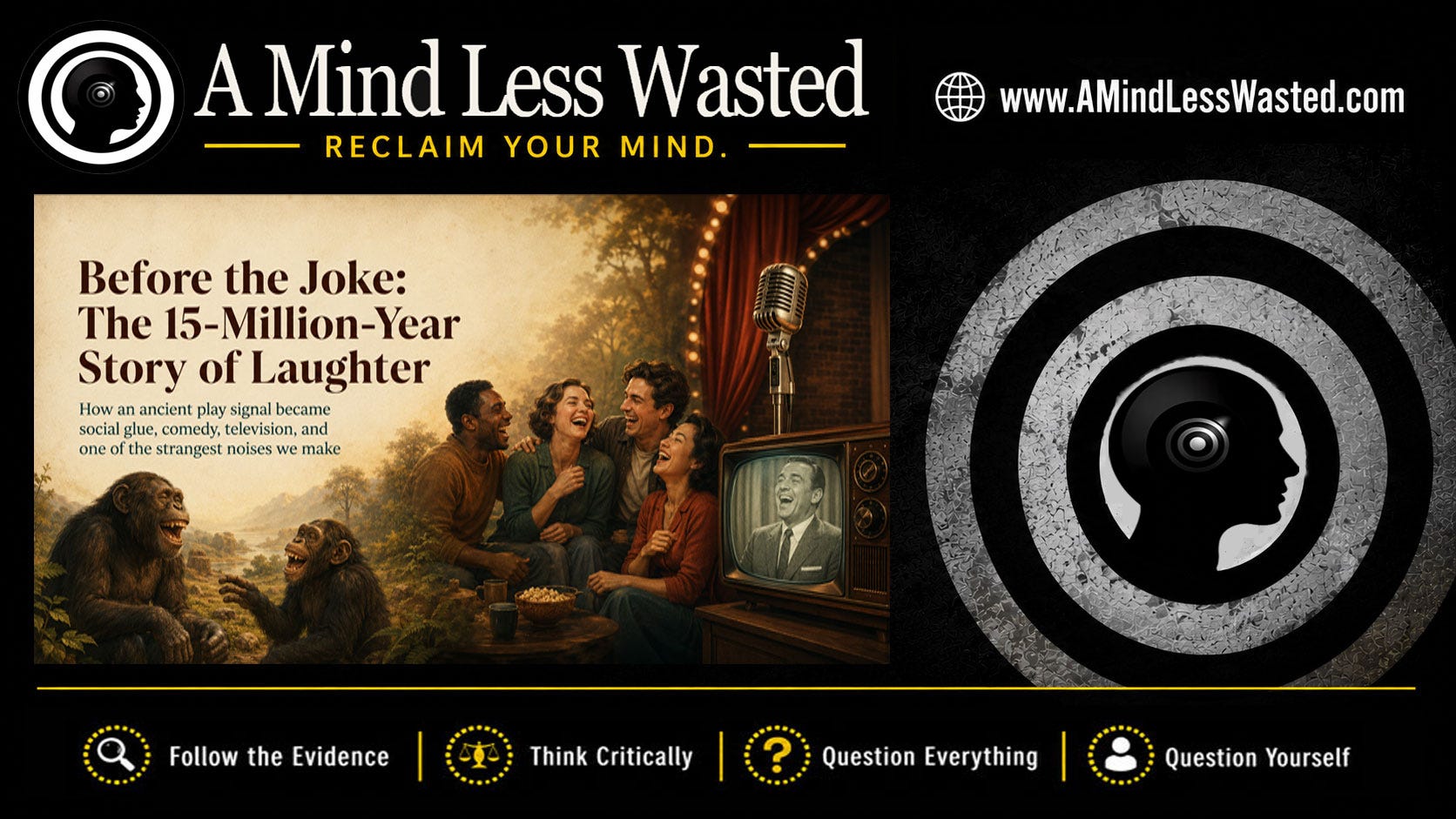
If researchers are right, the basic rhythm of laughter may be around 15 million years old.
Which raises an obvious problem.
There were no comedians 15 million years ago.
No sitcoms. No knock-knock jokes. No drunk uncle working his way through the same story at Thanksgiving. Not even a dad available to ask someone to pull his finger.
Yet something resembling laughter was already there.
A study published in Communications Biology in June 2026 compared laughter in humans, chimpanzees, bonobos, gorillas, and orangutans. Researchers found a shared rhythmic organization across all five great-ape groups. Their analysis suggests that the common ancestor of today’s great apes already produced regularly timed laughter-like vocalizations, with human laughter later becoming faster, more variable, and more sensitive to social context.
There is an important caution here. Sound doesn’t fossilize. Nobody dug up a 15-million-year-old laugh.
The researchers are reconstructing evolutionary history by comparing living species, and the study itself was small, involving 17 individuals. So “15 million years” is an evolutionary inference, not a date we can circle on a prehistoric calendar. Still, it fits earlier work showing strong similarities between the laughter humans produce and the vocalizations great apes make during play and tickling.
And that may tell us something important.
Laughter probably came before humor.
Long before anything had to be funny, laughter may have had a job.
Before the joke
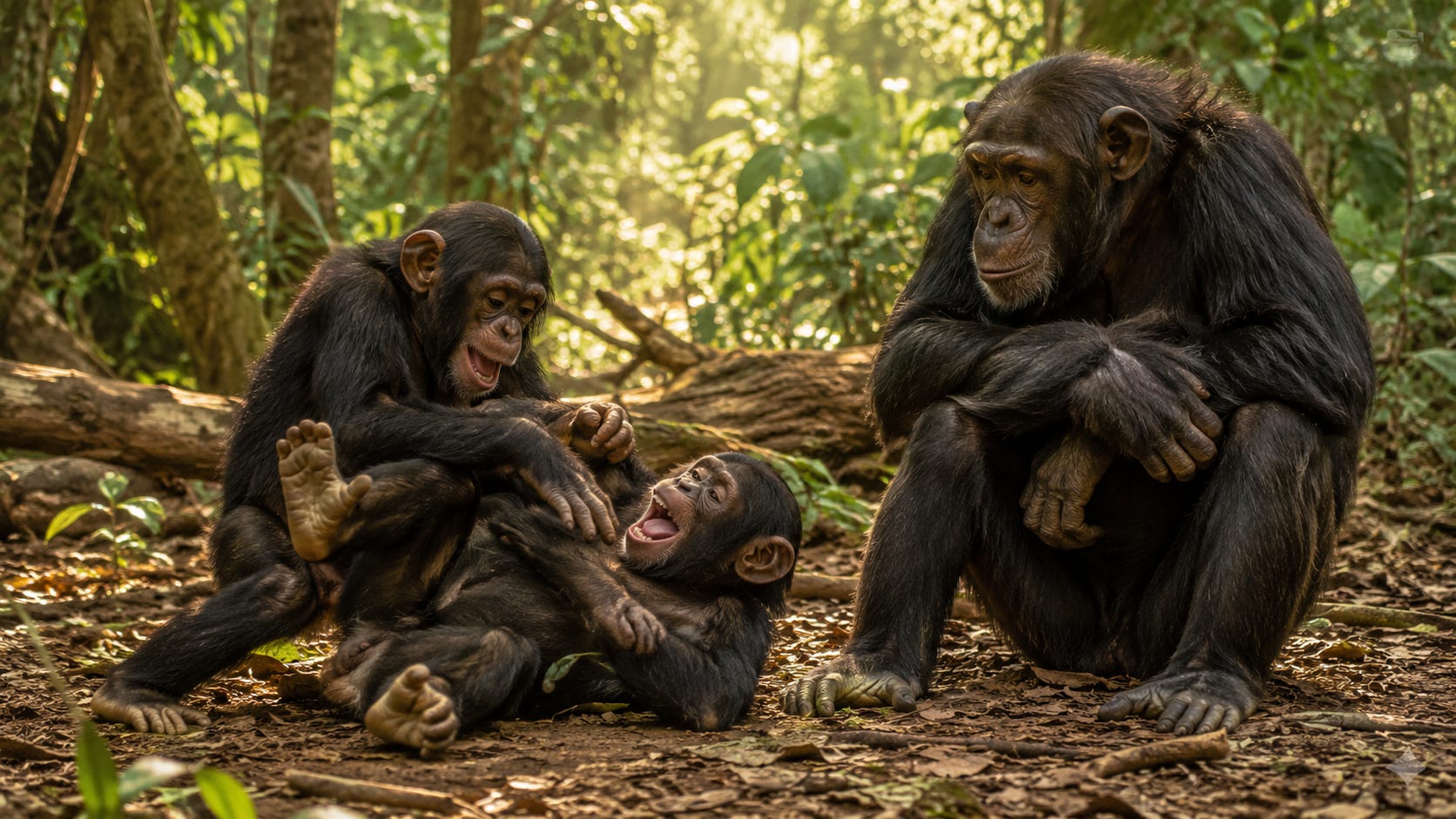
Watch young chimpanzees wrestle and chase one another and you’ll see something recognizable. Their mouths open. They make breathy vocalizations. They respond to one another’s play faces and sounds.
The prevailing evolutionary picture is that laughter began as part of play.
Rough-and-tumble play has a problem. Many of the movements look suspiciously similar to fighting. Biting, chasing, grabbing, knocking somebody over. If you’re going to do that for fun, you need some way to communicate that nobody is trying to start a war.
A play face or laugh-like vocalization can help say, in effect:
We’re good. Keep going.
Great-ape laughter today occurs especially during social play and tickling, where it appears to help communicate benign intent and coordinate the interaction. Recent research has even found rapid matching of particular “laugh faces” between chimpanzees and orangutans, suggesting that this kind of social signaling has deep evolutionary roots.
Humans eventually did something much more elaborate with the equipment.
We made it funny.
That suggests an intriguing possibility. We tend to assume humor evolved and laughter followed.
It may have happened largely the other way around.
Evolution gave us the laugh. Human cognition found more and more ways to trigger it.
We’re not the only animals making funny noises
Great apes aren’t the end of the story.
Rats produce ultrasonic vocalizations around 50 kilohertz during play, anticipation of play, and when researchers tickle them. Jaak Panksepp and Jeffrey Burgdorf famously proposed that these chirps might represent a rat equivalent of laughter. Tickled rats will even approach the experimenter’s hand for more.
Calling it “laughter” requires some restraint. Rats and primates are separated by an enormous evolutionary distance, and researchers have warned that similar play vocalizations do not necessarily mean they share the same evolutionary origin. What we can say with much more confidence is that rats make distinctive vocalizations during positive, playful experiences.
So the next time someone tells you science has no sense of humor, remember that there are researchers professionally employed to tickle rats.
Somebody had to get that grant approved.

The First Laugh
Long before babies understand jokes—or even words—they begin to laugh. The first real laughs usually appear at around three or four months, often in response to tickling, bouncing, funny sounds, exaggerated faces, or a parent suddenly reappearing during peekaboo.
So what are they laughing at?
A baby doesn’t need language to recognize that something unexpected has happened. From the earliest months, babies are constantly learning patterns: faces behave a certain way, objects move in predictable directions, and familiar people usually make familiar sounds. When one of those patterns is broken harmlessly, Dad puts a spoon on his head, Mom makes an absurd noise, or a face disappears and suddenly returns, the surprise can become funny.
But the broken pattern alone isn’t enough. Babies also watch the adults around them for clues. A strange event paired with a frightened expression may feel threatening. The same event accompanied by a smile, playful voice, and eye contact signals that the surprise is safe. Laughter grows out of that combination: expectation, harmless violation, and shared emotion.
Repetition matters too. Adults often tire of the same joke, but babies may laugh harder each time it is repeated. They begin anticipating the funny moment. The pleasure comes partly from knowing what is about to happen—and then watching it happen again.
As babies grow, they move from appreciating humor to creating it. They make deliberately wrong sounds, misuse familiar objects, pull exaggerated faces, and repeat actions that previously made someone laugh. Their sense of humor develops through observation and experimentation: What normally happens? What happens if I change it? Will you laugh with me?
Their earliest laughter supports the larger story of laughter itself. Humor did not begin with clever language or polished punchlines. It began with play, surprise, safety, and two minds enjoying the same unexpected moment.
This also tells us something deeper about infant thought. Babies may not have words yet, but they are already forming expectations, recognizing patterns, reading emotions, and testing the reactions of other people. I explore that hidden mental world more fully in What Does a Baby Think Before It Can Talk?.
Research support: infant laughter commonly emerges around three to four months, while humor appreciation and production develop progressively through early childhood. Laughing Matters and The Early Humor Survey.

Most laughter isn’t about jokes
Here’s where laughter becomes much stranger.
We associate laughing with something being funny, but much of everyday laughter isn’t a response to comedy at all.
Psychologist Robert Provine spent years studying laughter in ordinary conversation rather than bringing people into a laboratory and telling them when to laugh. In one study, he observed 1,200 naturally occurring episodes. Laughter appeared in orderly places in conversation, overwhelmingly at the ends of phrases and sentences, and frequently followed remarks that would never survive an open-mic night.
People laugh while greeting friends.
They laugh while flirting.
They laugh because somebody else laughed.
They laugh when embarrassed.
They laugh when a tense moment has passed.
They laugh while saying perfectly ordinary things.
And we laugh far more readily when other people are around. Earlier diary research found laughter was dramatically more common in social situations than when people were alone. Experimental work also supports the idea that shared laughter can increase feelings of social bonding.
That makes laughter less like a comedy alarm and more like a piece of social equipment.
Sometimes it means, that’s funny.
Sometimes it means, I like you.
Sometimes it means, I understand.
Sometimes it means, please don’t make this awkward.
And sometimes it means I nearly died on that roller coaster and for some reason I want to go again.
Why do we laugh after being scared half to death?
You’ve probably done it.
The roller coaster creeps up the first hill. Your heart is pounding. The car tips over the edge and your body reacts as though you have made a catastrophic transportation decision.
You scream.
Thirty seconds later, you’re laughing.
The same thing happens after a jump scare. Someone jumps out from behind a door, you nearly leave your body, and then, once you realize who it is, you laugh.
Nothing about the first half of that experience was funny.
So what changed?
The threat became safe.
Research on fear shows that when a threat ends, the nervous system can rapidly reduce its defensive state. Other experimental work has found that successful avoidance of an expected threat produces a distinctly pleasurable feeling of relief.
Researchers studying the relationship between fear and humor argue that playful fear works partly because we can experience something as threatening and then reinterpret it as benign. Haunted houses, scary movies, practical jokes and roller coasters put us close enough to danger to activate the machinery, while allowing another part of the brain to recognize that we are probably going to survive the experience.
Probably is doing important work on some roller coasters.
This doesn’t mean scientists have discovered a single “relief laugh” switch. The relationship between fear, relief, amusement and laughter is more complicated than that. But it helps explain something the simple “we laugh because things are funny” theory cannot.
Sometimes laughter seems to help mark the transition from:
Something is wrong.
to
Never mind. We’re okay.
And if other people are laughing with you, that message becomes even stronger.
What actually happens in your brain?
There isn’t a single laughter center waiting for a punchline.
Brain imaging research points instead to a network involving motor systems, emotional and reward circuits, auditory areas, and regions involved in interpreting meaning and social information. Emotional laughter has been associated with activity in areas including the anterior cingulate cortex, amygdala, nucleus accumbens, motor regions, basal ganglia, thalamus and cerebellum.
Humor itself adds another layer.
A meta-analysis of 57 neuroimaging studies involving 1,248 participants found that humor engages regions associated with emotion as well as language, semantic knowledge and understanding other people’s mental states. Different kinds of humor recruit somewhat different networks because understanding a cartoon, a verbal joke and a sarcastic comment are not exactly the same cognitive job.
There is also evidence that spontaneous laughter and deliberate social laughter aren’t identical.
The laugh that erupts when something genuinely gets you appears to rely partly on different neural pathways from the laugh you produce when your boss tells a joke, and you remember who signs the checks.
Both are real human behaviors.
Only one is likely to get you promoted.
So what makes something funny?
People have been arguing about this for a very long time.
One idea says we laugh because we feel superior to somebody else. Slapstick certainly gives that theory plenty of material.
Another says laughter releases tension.
Another focuses on incongruity. Your brain expects one thing and gets another.
Modern research hasn’t produced one grand theory that explains every joke, pun, pratfall, sarcastic remark and absurd situation. A major review found more than 20 psychological theories of humor. The strongest recurring ingredients included a perceived violation paired with some way of interpreting it as benign or acceptable.
That fits an enormous range of comedy.
A person slips on a banana peel.
If they get up embarrassed, it can be funny.
If they crack their skull open, the comedy portion of the evening is over.
Context matters.So does timing. So does expectation.
Which comedians figured out long before neuroscientists arrived with an MRI machine.
Then somebody finally wrote a joke down
Laughter is ancient.
Written jokes are considerably younger.
One of the oldest surviving examples of recorded humor dates to ancient Mesopotamia around 1900 BCE. It is a Sumerian proverb concerning something supposedly unheard of since the beginning of time:
A young wife who did not fart in her husband’s lap.
Yes.
Nearly four thousand years of recorded comedy, and toilet humor was apparently in the pilot episode.
The identification comes from a historical humor project led by Paul McDonald at the University of Wolverhampton. Calling it the “oldest joke” requires the same caution we should use with other archaeological firsts. It is one of the oldest jokes we have found. People were obviously joking long before they started preserving the material on clay tablets.
Still, something is reassuring about it.
Empires rise. Languages disappear. Technologies transform civilization.
Farts remain funny.
When laughter became an art
By the sixth century BCE, the Greeks had institutionalized comedy as theatrical entertainment. Philosophers then began doing what philosophers do best.
They worried about it.
Plato was suspicious of uncontrolled laughter and frequently associated it with ridicule and loss of self-control. Aristotle was more accommodating, treating wit as part of civilized social interaction while also thinking carefully about what made comic situations work. Later thinkers would spend centuries developing superiority, relief and incongruity theories of humor.
The important development wasn’t merely that humans laughed.
We had begun deliberately constructing things for the purpose of making other people laugh.
A biological response had become an art form.
And art eventually became a business.
The day we learned to manufacture laughter
For most of human history, comedy had a serious distribution problem.
If you wanted to hear the funny person, you generally had to be in the same place as the funny person.
Mass entertainment changed that.
In the United States, vaudeville became one of the first large-scale systems for packaging and distributing comedy. From the early 1880s through the end of the 1920s, it was the country’s dominant form of live entertainment. Successful acts toured established circuits, performing routines over and over in theaters around the nation.
The Library of Congress describes vaudeville as a precursor to mass media. A successful act could essentially be reproduced from city to city, carrying the same jokes, monologues, sketches and comic characters to audiences who had never met one another.
Comedy had become scalable.
Then radio arrived and changed the mathematics completely.
A comedian who once needed months of touring to reach thousands of people could now speak into a microphone and reach millions at once. Performers such as Jack Benny, Fred Allen, Ed Wynn and Bob Hope carried traditions developed on the vaudeville stage into broadcasting. Hope eventually employed teams of writers because radio burned through material at a rate live touring never had.
Movies added editing, close-ups, reaction shots, music, and visual timing.
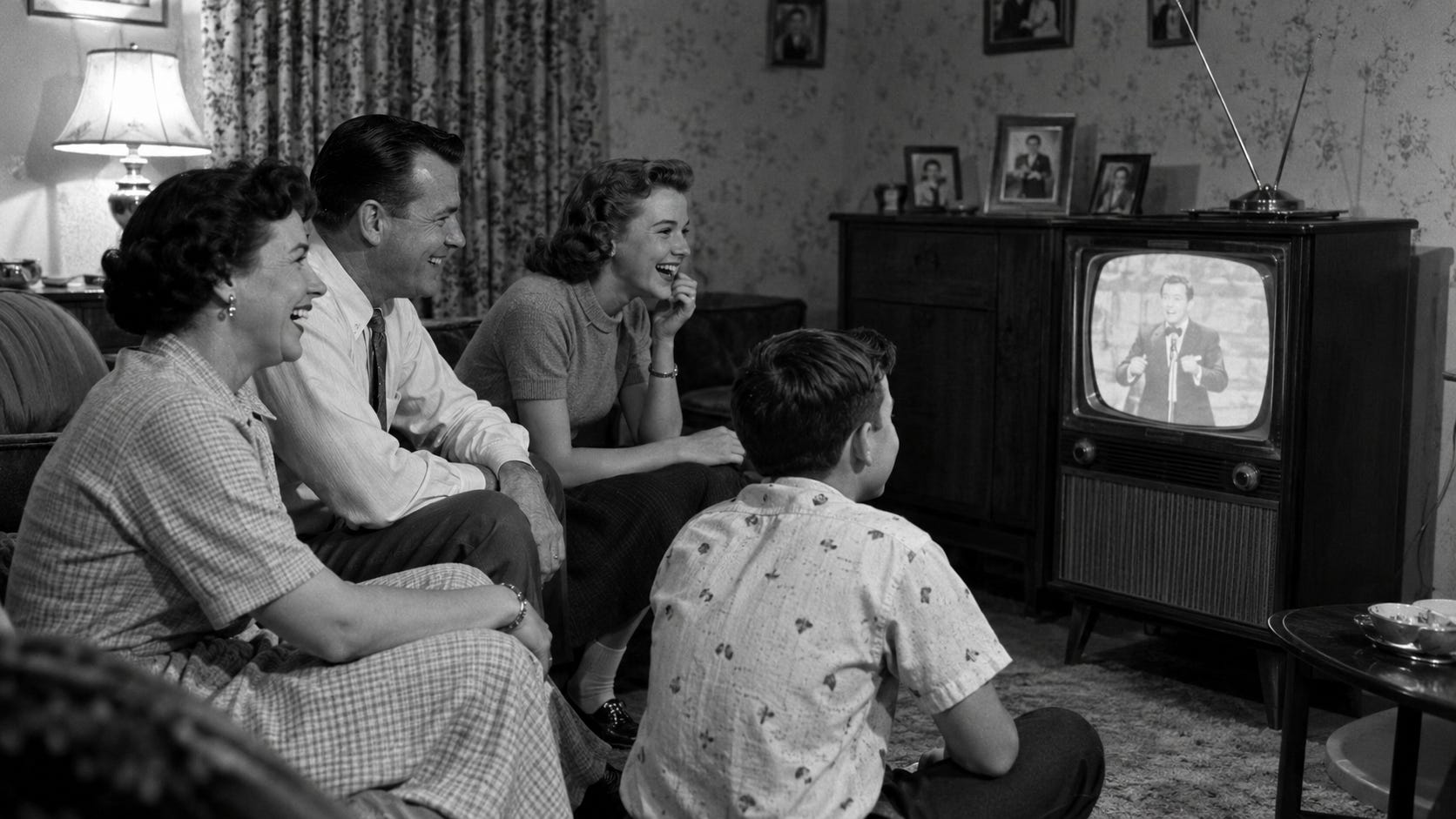
Television put the comedian in the living room.
Sitcoms turned humor into a weekly production schedule. Writers’ rooms, rehearsals, retakes, and editing allowed laughter to be engineered with increasing precision.
We went from laughing during play to employing people whose job description was essentially:
Make strangers exhale uncontrollably at 8:30 on Thursday night.
And then we invented fake people to laugh with you
The laugh track may be one of the strangest inventions in the history of entertainment.
Early radio comedians often performed in front of live audiences because laughter affected both the performer and the people listening at home. Television inherited that tradition, but production became more complicated as programs were filmed, edited and reshot.
In 1950, The Hank McCune Show became the first network television series known to use a recorded laugh track. Engineer Charles Douglass later developed his famous “Laff Box,” which allowed recorded audience reactions to be inserted, extended, shortened or strengthened.
Think about what television had done.
Millions of years earlier, laughter had evolved as a social signal between animals physically together.
Television separated us.
So engineers recorded the social signal and put the group back into the room electronically.
And there was a reason it worked.
Laughter is contagious.
Recent experimental research has found that simply hearing another person’s laughter can increase how funny people rate something and make their own laughter harder to suppress. Brain studies likewise show that hearing laughter engages systems involved in preparing facial responses and social behavior.
The television industry didn’t invent contagious laughter.
It put it on tape.
Everybody laughs. Not everybody laughs at the same thing.
If laughter has such ancient biological roots, why can a joke destroy a room in London and die painfully in New York?
Because the ability to laugh may be widespread, but the triggers are partly learned.
Language, taboos, social rules, expectations, status, and shared history all provide material for humor. A joke often works because the audience knows what is normally supposed to happen. The comic violates that expectation in just the right way.
Change the expectations, and you can change the joke.
This is where familiar descriptions of “British humor,” “American humor,” “Japanese humor,” or any other national style need some care. Countries contain millions of people and multiple comedy traditions. There is no British humor gene hiding next to the gene for tea.
But cultural patterns are real.
One study showed clips of British television comedies to British and American English speakers. The British participants rated them as funnier and were more likely to pick up the irony and sarcasm that some of the American viewers missed. The language was technically English in both cases. The cultural cues weren’t identical.
That helps explain why British comedy has developed a reputation for deadpan delivery, understatement, irony and awkwardness, while many American comedy traditions favor a more explicit setup, punchline, larger comic persona or direct observational style.
Those are traditions, not rules.
A broader review of cross-cultural humor research found differences in how humor is valued and used across societies. North American participants have generally reported more positive attitudes toward humor and greater use of humor than East Asian participants in the studies examined. Just as importantly, the authors warned that the existing research is limited and disproportionately focused on a relatively small number of cultural comparisons.
Translation makes matters even more interesting.
A pratfall can travel reasonably well.
A pun may die at customs.
Sarcasm can be even worse because the listener has to understand not only the words, but that the speaker doesn’t actually mean them.
So the human capacity for laughter may be ancient and broadly shared.
What we laugh at carries our culture with it.
Comedy becomes an industry
By the twentieth century, laughter wasn’t simply something that happened between people. It supported theaters, studios, radio networks, television networks, movie companies, comedy clubs, writers, actors, directors, producers and advertisers.
Vaudeville fed radio.
Vaudeville and radio fed movies.
Radio and theater fed television.
Television produced sitcoms, sketch shows and late-night comedy.
Stand-up developed its own clubs, touring circuits, records and specials.
Cable expanded the market.
Streaming removed the schedule.
The internet removed most of the remaining gatekeepers.
Today a comedian can spend months writing and touring a one-hour special. Or somebody can fall off a folding chair in a twelve-second video and make half the planet laugh before breakfast.
The technology changes. The underlying transaction doesn’t.
One human tries to trigger an ancient response in another human.
Sometimes advertisers pay for the privilege.
Is laughter really the best medicine?
No. Penicillin is going to be offended.
But the cliché isn’t completely empty either.
Laughter has measurable physiological effects. A 2023 systematic review and meta-analysis examined eight intervention studies involving 315 adults and found that laughter interventions were associated with lower cortisol levels compared with control conditions. The pooled reduction was substantial, although the evidence base was small.
Research has also linked laughter with autonomic recovery after stress, increased pain tolerance and changes consistent with activation of the body’s endogenous opioid system.
More recent reviews of laughter-based interventions have found promising effects on stress and anxiety. But they have also reported high variability among studies, inconsistent methods, and methodological limitations. A 2026 meta-analysis of randomized trials, for example, found a large average reduction in reported stress but extremely high statistical heterogeneity, meaning the size of the effect varied greatly from study to study.
That’s an important distinction.
There is decent evidence that laughter can affect stress, mood and some physiological measures.
That is not the same as proving that laughter prevents disease, “boosts the immune system” in some sweeping clinical sense, treats cancer or replaces medicine.
Laughter may be good for you.
It is not chemotherapy.
Science gets considerably less funny when we forget the difference.
A very old piece of social technology
The more we study laughter, the harder it becomes to describe it simply.
It is a vocalization.
An emotional expression.
A social signal.
A response to play.
A response to humor.
A response to embarrassment.
Sometimes a response to fear.
A tool for bonding.
A way of showing agreement.
Something we can produce voluntarily.
Something that can completely escape voluntary control.
Something babies do before they can tell jokes, and something our evolutionary relatives do without ever having watched a sitcom.
Then humans took this ancient behavior and built culture around it.
We wrote jokes.
We put comedy on stages.
We charged admission.
We recorded it.
Broadcast it.
Filmed it.
Created professional joke writers.
Invented sitcoms.
Invented comedy clubs.
Invented laugh tracks.
And eventually built phones capable of delivering a practically unlimited supply of people getting hit in sensitive areas by objects they should have seen coming.
Progress is difficult to measure.
The last laugh
After 15 million years of evolution, thousands of years of comedy, centuries of philosophy, and decades of neuroscience, scientists still haven’t completely figured out why we laugh.
Which is probably for the best.
Because nothing kills a joke faster than explaining it.
If you enjoy following ordinary questions farther than they usually go, subscribe to A Mind Less Wasted. Sometimes following the evidence takes us into medicine, psychology, or misinformation.
And sometimes it leads to scientists tickling rats.

Selected research and sources
De Gregorio, C., Davila-Ross, M., & Lameira, A. R. “Rhythm and timing in laughter reveal that human vocal plasticity falls on a hominid continuum.” Communications Biology, 9, 824 (2026).
Provine, R. R. “Laughter Punctuates Speech: Linguistic, Social and Gender Contexts of Laughter.” Ethology, 95, 291–298 (1993).
Dunbar, R. I. M., Frangou, A., Grainger, F., & Pearce, E. “Laughter influences social bonding but not prosocial generosity to friends and strangers.” PLOS ONE, 16(8), e0256229 (2021).
Caruana, F., Palagi, E., & de Waal, F. B. M. “Cracking the laugh code: laughter through the lens of biology, psychology and neuroscience.” Philosophical Transactions of the Royal Society B, 377, 20220159 (2022).
Hye-Knudsen, M., Kjeldgaard-Christiansen, J., Boutwell, B. B., & Clasen, M. “First They Scream, Then They Laugh: The Cognitive Intersections of Humor and Fear.” Evolutionary Psychology, 22(2) (2024).
Chen, X., & Dewaele, J.-M. “‘We are not amused’: The appreciation of British humour by British and American English L1 users.” Language & Communication, 79, 147–162 (2021).
Lu, J. G. “Cultural differences in humor: A systematic review and critique.” Current Opinion in Psychology, 53, 101690 (2023).
Kramer, C. K., & Leitão, C. B. “Laughter as medicine: A systematic review and meta-analysis of interventional studies evaluating the impact of spontaneous laughter on cortisol levels.” PLOS ONE, 18(5), e0286260 (2023).
Library of Congress. “Bob Hope and American Variety,” including its collections on vaudeville, radio, and television.